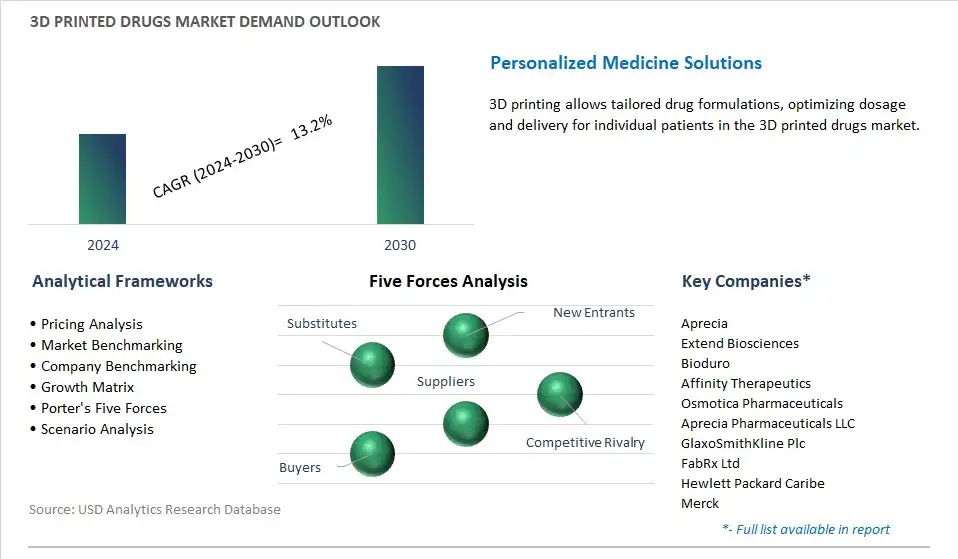
3D Printed Drugs Market is estimated to increase at a growth rate of 13.2% CAGR over the forecast period from 2024 to 2030.
The 3D Printed Drugs Market study analyzes and forecasts the market size across 6 regions and 24 countries for diverse segments including By Technology (Inkjet Printing, Fused Deposition Modeling, Stereolithography, ZipDose Technology), By Application (Orthopedic, Neurology, Dental, Others), By End-user (Hospitals & Clinics, Research Laboratories, Others).
An Introduction to 3D Printed Drugs Market in 2024
The 3D Printed Drugs market in 2024 represents a groundbreaking approach to pharmaceutical manufacturing, leveraging additive manufacturing technology to produce personalized dosage forms with precise drug dosing, release kinetics, and patient-specific formulations. 3D printing, also known as pharmaceutical 3D printing or additive pharmaceutical manufacturing, offers unparalleled flexibility and customization in drug development and delivery, enabling on-demand production of complex dosage forms tailored to individual patient needs. The market is witnessing increasing adoption of 3D printing technology by pharmaceutical companies and research institutions for drug discovery, formulation optimization, and personalized medicine initiatives. Moreover, regulatory agencies are actively engaged in establishing quality standards and regulatory frameworks governing 3D printed drugs, ensuring product safety, efficacy, and compliance with good manufacturing practices (GMP). Furthermore, collaborative efforts between academia, industry stakeholders, and regulatory authorities are driving innovation in 3D printing technology, material science, and pharmacokinetics, paving the way for personalized therapeutics and precision medicine in the pharmaceutical industry.
3D Printed Drugs Market Trend: Customized Dosage Forms and Personalized Medicine
A prominent trend in the 3D Printed Drugs market is the shift towards customized dosage forms and personalized medicine, driven by advancements in 3D printing technology. Traditional manufacturing methods often limit the design and formulation of pharmaceuticals, resulting in standardized dosage forms that may not suit individual patient needs. However, 3D printing enables the precise control of drug composition, dose, and release profile, allowing pharmaceutical companies to create bespoke medications tailored to specific patient requirements. This trend towards personalized medicine fosters greater patient adherence, therapeutic efficacy, and treatment outcomes, paving the way for the development of patient-centric pharmaceuticals across various therapeutic areas.
3D Printed Drugs Market Driver: Enhanced Drug Formulation Flexibility and Manufacturing Efficiency
A key driver propelling the growth of the 3D Printed Drugs market is the enhanced drug formulation flexibility and manufacturing efficiency offered by 3D printing technology. Traditional pharmaceutical manufacturing processes are often complex, time-consuming, and resource-intensive, involving multiple steps such as drug synthesis, formulation, and packaging. In contrast, 3D printing streamlines the drug development process by allowing for the direct fabrication of dosage forms layer by layer from digital blueprints. This on-demand production capability enables rapid prototyping, iterative design optimization, and flexible scaling of production volumes, reducing time-to-market and manufacturing costs. Additionally, 3D printing facilitates the incorporation of multiple active pharmaceutical ingredients (APIs) into a single dosage form, enabling the development of combination therapies and complex drug formulations with enhanced therapeutic efficacy and safety profiles.
3D Printed Drugs Market Opportunity: Customized Pediatric and Geriatric Medications
An opportunity in the 3D Printed Drugs market lies in the development of customized pediatric and geriatric medications to address the unique healthcare needs of vulnerable patient populations. Pediatric and geriatric patients often require individualized dosage forms and formulations due to differences in physiology, metabolism, and medication tolerance. However, conventional drug formulations may pose challenges in achieving accurate dosing and patient compliance, particularly in these demographic groups. By leveraging 3D printing technology, pharmaceutical companies can design and manufacture age-appropriate dosage forms with precise dosing accuracy and palatable formulations tailored to the preferences of pediatric and geriatric patients. This opportunity not only improves medication adherence and therapeutic outcomes but also addresses the unmet medical needs of vulnerable populations, driving market expansion and fostering innovation in pediatric and geriatric healthcare.
3D Printed Drugs Market Segmentation
By Technology
Inkjet Printing
Fused Deposition Modeling
Stereolithography
ZipDose Technology
By Application Type
Orthopedic
Neurology
Dental
Others
By End-use
Hospitals & Clinics
Research Laboratories
Others
Geographical Analysis
North America (United States, Canada, Mexico)
Europe (Germany, France, United Kingdom, Spain, Italy, Rest of Europe)
Asia Pacific (China, India, Japan, South Korea, Rest of Asia Pacific)
South America (Brazil, Argentina, Rest of South America)
Middle East and Africa (Saudi Arabia, UAE, Rest of Middle East, South Africa, Egypt, Rest of Africa)
3D Printed Drugs Market Companies
Aprecia
Extend Biosciences
Bioduro
Affinity Therapeutics
Osmotica Pharmaceuticals
Aprecia Pharmaceuticals LLC
GlaxoSmithKline Plc
FabRx Ltd
Hewlett Packard Caribe
Merck
Cycle Pharmaceuticals
AstraZeneca
*- List Not Exhaustive
Reasons to Buy the 3D Printed Drugs Market Study
• Deepen your industry insights and navigate uncertainties for strategy formulation, CAPEX, and Operational decisions
• Gain access to detailed insights on the 3D Printed Drugs Market, encompassing current market size, growth trends, and forecasts till 2030.
• Access detailed competitor analysis, enabling competitive advantage through a thorough understanding of market players, strategies, and potential differentiation opportunities
• Stay ahead of the curve with insights on technological advancements, innovations, and upcoming trends
• Identify lucrative investment avenues and expansion opportunities within the 3D Printed Drugs Market industry, guided by robust, data-backed analysis.
• Understand regional and global markets through country-wise analysis, regional market potential, regulatory nuances, and dynamics
• Execute strategies with confidence and speed through information, analytics, and insights on the industry value chain
• Corporate leaders, strategists, financial experts, shareholders, asset managers, and governmental representatives can make long-term planning scenarios and build an integrated and timely understanding of market dynamics
• Benefit from tailored solutions and expert consultation based on report insights, providing personalized strategies aligned with specific business needs.
TABLE OF CONTENTS
1 Introduction to 2024 3D Printed Drugs Market
1.1 Market Overview
1.2 Quick Facts
1.3 Scope/Objective of the Study
1.4 Market Definition
1.5 Countries and Regions Analyzed
1.6 Units, Currency, and Conversions
1.7 Industry Value Chain
2 Research Methodology
2.1 Market Size Estimation
2.2 Sources and Research Methodology
2.3 Data Triangulation
2.4 Assumptions and Limitations
3 Executive Summary
3.1 Global 3D Printed Drugs Market Size Outlook, $ Million, 2021 to 2030
3.2 3D Printed Drugs Market Outlook by Type, $ Million, 2021 to 2030
3.3 3D Printed Drugs Market Outlook by Product, $ Million, 2021 to 2030
3.4 3D Printed Drugs Market Outlook by Application, $ Million, 2021 to 2030
3.5 3D Printed Drugs Market Outlook by Key Countries, $ Million, 2021 to 2030
4 Market Dynamics
4.1 Key Driving Forces of 3D Printed Drugs Market Industry
4.2 Key Market Trends in 3D Printed Drugs Market Industry
4.3 Potential Opportunities in 3D Printed Drugs Market Industry
4.4 Key Challenges in 3D Printed Drugs Market Industry
5 Market Factor Analysis
5.1 Competitive Landscape
5.1.1 Global 3D Printed Drugs Market Share by Company (%), 2023
5.1.2 Product Offerings by Company
5.2 Porter’s Five Forces Analysis
6 Growth Outlook Across Scenarios
6.1 Growth Analysis-Case Scenario Definitions
6.2 Low Growth Scenario Forecasts
6.3 Reference Growth Scenario Forecasts
6.4 High Growth Scenario Forecasts
7 Global 3D Printed Drugs Market Outlook By Segments
7.1 3D Printed Drugs Market Outlook by Segments
By Technology
Inkjet Printing
Fused Deposition Modeling
Stereolithography
ZipDose Technology
By Application Type
Orthopedic
Neurology
Dental
Others
By End-use
Hospitals & Clinics
Research Laboratories
Others
8 North America 3D Printed Drugs Market Analysis And Outlook To 2030
8.1 Introduction to North America 3D Printed Drugs Markets in 2024
8.2 North America 3D Printed Drugs Market Size Outlook by Country, 2021-2030
8.2.1 United States
8.2.2 Canada
8.2.3 Mexico
8.3 North America 3D Printed Drugs Market size Outlook by Segments, 2021-2030
By Technology
Inkjet Printing
Fused Deposition Modeling
Stereolithography
ZipDose Technology
By Application Type
Orthopedic
Neurology
Dental
Others
By End-use
Hospitals & Clinics
Research Laboratories
Others
9 Europe 3D Printed Drugs Market Analysis And Outlook To 2030
9.1 Introduction to Europe 3D Printed Drugs Markets in 2024
9.2 Europe 3D Printed Drugs Market Size Outlook by Country, 2021-2030
9.2.1 Germany
9.2.2 France
9.2.3 Spain
9.2.4 United Kingdom
9.2.4 Italy
9.2.5 Russia
9.2.6 Norway
9.2.7 Rest of Europe
9.3 Europe 3D Printed Drugs Market Size Outlook By Segments, 2021-2030
By Technology
Inkjet Printing
Fused Deposition Modeling
Stereolithography
ZipDose Technology
By Application Type
Orthopedic
Neurology
Dental
Others
By End-use
Hospitals & Clinics
Research Laboratories
Others
10 Asia Pacific 3D Printed Drugs Market Analysis And Outlook To 2030
10.1 Introduction to Asia Pacific 3D Printed Drugs Markets in 2024
10.2 Asia Pacific 3D Printed Drugs Market Size Outlook by Country, 2021-2030
10.2.1 China
10.2.2 India
10.2.3 Japan
10.2.4 South Korea
10.2.5 Indonesia
10.2.6 Malaysia
10.2.7 Australia
10.2.8 Rest of Asia Pacific
10.3 Asia Pacific 3D Printed Drugs Market size Outlook by Segments, 2021-2030
By Technology
Inkjet Printing
Fused Deposition Modeling
Stereolithography
ZipDose Technology
By Application Type
Orthopedic
Neurology
Dental
Others
By End-use
Hospitals & Clinics
Research Laboratories
Others
11 South America 3D Printed Drugs Market Analysis And Outlook To 2030
11.1 Introduction to South America 3D Printed Drugs Markets in 2024
11.2 South America 3D Printed Drugs Market Size Outlook by Country, 2021-2030
11.2.1 Brazil
11.2.2 Argentina
11.2.3 Rest of South America
11.3 South America 3D Printed Drugs Market size Outlook by Segments, 2021-2030
By Technology
Inkjet Printing
Fused Deposition Modeling
Stereolithography
ZipDose Technology
By Application Type
Orthopedic
Neurology
Dental
Others
By End-use
Hospitals & Clinics
Research Laboratories
Others
12 Middle East And Africa 3D Printed Drugs Market Analysis And Outlook To 2030
12.1 Introduction to Middle East and Africa 3D Printed Drugs Markets in 2024
12.2 Middle East and Africa 3D Printed Drugs Market Size Outlook by Country, 2021-2030
12.2.1 Saudi Arabia
12.2.2 UAE
12.2.3 Oman
12.2.4 Rest of Middle East
12.2.5 Egypt
12.2.6 Nigeria
12.2.7 South Africa
12.2.8 Rest of Africa
12.3 Middle East and Africa 3D Printed Drugs Market size Outlook by Segments, 2021-2030
By Technology
Inkjet Printing
Fused Deposition Modeling
Stereolithography
ZipDose Technology
By Application Type
Orthopedic
Neurology
Dental
Others
By End-use
Hospitals & Clinics
Research Laboratories
Others
13 Company Profiles
13.1 Company Snapshot
13.2 SWOT Profiles
13.3 Products and Services
13.4 Recent Developments
13.5 Financial Profile
List of Companies
Aprecia
Extend Biosciences
Bioduro
Affinity Therapeutics
Osmotica Pharmaceuticals
Aprecia Pharmaceuticals LLC
GlaxoSmithKline Plc
FabRx Ltd
Hewlett Packard Caribe
Merck
Cycle Pharmaceuticals
AstraZeneca
14 Appendix
14.1 Customization Offerings
14.2 Subscription Services
14.3 Related Reports
14.4 Publisher Expertise
3D Printed Drugs Market Segmentation
By Technology
Inkjet Printing
Fused Deposition Modeling
Stereolithography
ZipDose Technology
By Application Type
Orthopedic
Neurology
Dental
Others
By End-use
Hospitals & Clinics
Research Laboratories
Others
Geographical Analysis
North America (United States, Canada, Mexico)
Europe (Germany, France, United Kingdom, Spain, Italy, Rest of Europe)
Asia Pacific (China, India, Japan, South Korea, Rest of Asia Pacific)
South America (Brazil, Argentina, Rest of South America)
Middle East and Africa (Saudi Arabia, UAE, Rest of Middle East, South Africa, Egypt, Rest of Africa)
