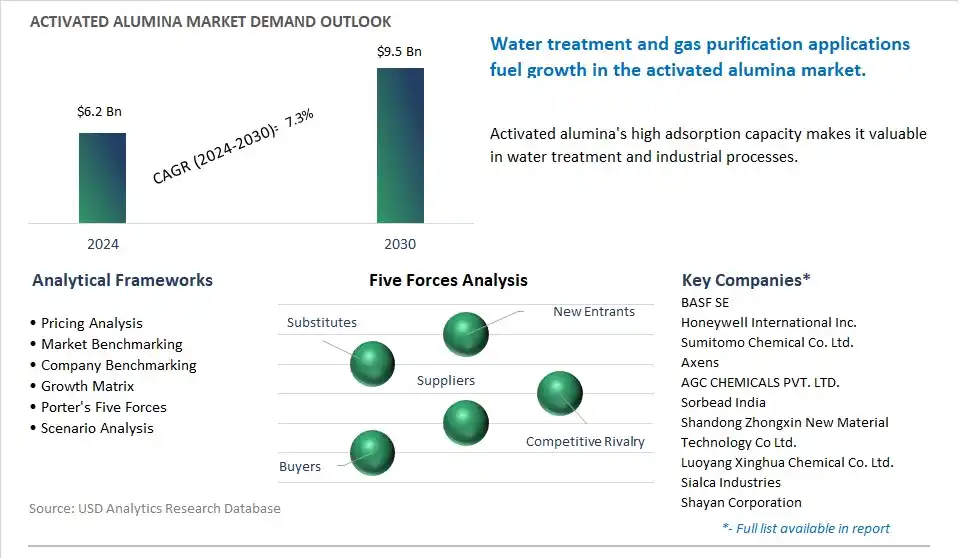
The global Activated Alumina Market is poised to register a 7.3% CAGR from $6.2 Billion in 2024 to $9.5 Billion in 2030.
The global Activated Alumina Market Study analyzes and forecasts the market size across 6 regions and 24 countries for diverse segments -By End-User (Water Treatment, Oil & gas, Plastics, Healthcare, Others), By Application (Catalyst, Desiccant, Fluoride Adsorbent, Bio Ceramics, Others).
An Introduction to Global Activated Alumina Market in 2024
The activated alumina market is experiencing notable growth driven by its widespread applications in adsorption, catalysts, and water treatment. Key trends shaping the future of the industry include the increasing demand for activated alumina as a desiccant for drying air and gases, as well as its use in fluoride removal from drinking water and as a catalyst support in petrochemical and hydrogen purification processes. Moreover, there's a rising emphasis on technological advancements and product innovation to enhance the surface area, pore structure, and adsorption capacity of activated alumina for improved performance and cost-effectiveness. Additionally, advancements in manufacturing processes, such as spray drying and fluidized bed technology, are driving innovation and market expansion, enabling manufacturers to offer a wide range of activated alumina products tailored to meet diverse industrial and environmental applications in the global activated alumina market.
Activated Alumina Market Competitive Landscape
The market report analyses the leading companies in the industry including BASF SE, Honeywell International Inc., Sumitomo Chemical Co. Ltd., Axens, AGC CHEMICALS PVT. LTD., Sorbead India, Shandong Zhongxin New Material Technology Co Ltd., Luoyang Xinghua Chemical Co. Ltd., Sialca Industries, Shayan Corporation, BeeChems, Hengye Inc., Huber Engineered Materials.
Activated Alumina Market Dynamics
Activated Alumina Market Trend: Growing Demand for Water Treatment Solutions
Activated alumina is witnessing a surge in demand due to the increasing need for efficient water treatment solutions across various industries. With concerns over water pollution and the depletion of freshwater sources intensifying, governments and industries are investing in advanced water treatment technologies. Activated alumina, known for its high surface area and adsorption capabilities, is being increasingly utilized in processes like fluoride and arsenic removal from drinking water, wastewater treatment, and desiccant applications. This trend is expected to continue as regulations become stricter and industries prioritize sustainable water management practices.
Activated Alumina Market Driver: Environmental Regulations and Water Quality Standards
Stringent environmental regulations and stringent water quality standards are significant drivers of the activated alumina market. Governments worldwide are enforcing regulations to control water pollution and ensure safe drinking water for their populations. Activated alumina, with its ability to effectively remove contaminants like fluoride, arsenic, and heavy metals from water, is becoming indispensable for industries and municipalities striving to meet these standards. The growing awareness about the health risks associated with contaminated water further amplifies the demand for activated alumina-based water treatment solutions, driving market growth.
Activated Alumina Market Opportunity: Technological Advancements and Product Innovation
The activated alumina market presents a significant opportunity for technological advancements and product innovation. As industries seek more efficient and cost-effective water treatment solutions, there's a growing demand for advancements in activated alumina manufacturing processes and product design. Innovations focusing on enhancing the adsorption capacity, regeneration efficiency, and lifespan of activated alumina can unlock new opportunities in diverse applications, including water purification, gas drying, and catalyst support. Additionally, expanding research and development efforts to explore novel uses of activated alumina, such as in pharmaceuticals and air purification, can further broaden its market potential. Embracing innovation and investing in research and development initiatives can position companies for sustained growth and competitiveness in the dynamic activated alumina market.
Activated Alumina Market Share Analysis: Water Treatment end-user segment generated the highest revenue in the industry
The largest segment in the Activated Alumina Market is the Water Treatment end-user segment. This dominance can be attributed to diverse factors. The activated alumina is widely recognized for its exceptional adsorption capacity and effectiveness in removing various contaminants from water, making it a preferred choice for water treatment applications. Activated alumina is commonly used for the removal of fluoride, arsenic, lead, and other harmful substances from drinking water, wastewater, and industrial process water. Additionally, activated alumina is highly porous with a large surface area, providing ample active sites for adsorbing impurities and pollutants, thereby improving water quality and safety. In addition, the increasing concerns over water scarcity, pollution, and the need for clean drinking water drive the demand for effective water treatment solutions, spurring the growth of the activated alumina market in the water treatment sector. Further, advancements in water treatment technologies and regulations mandating the removal of specific contaminants from drinking water further bolster the demand for activated alumina as a reliable and cost-effective solution. With its widespread use, superior adsorption properties, and critical role in addressing water quality challenges, the Water Treatment segment remains the largest in the Activated Alumina Market.
Activated Alumina Market Share Analysis: Fluoride Adsorbent application Segment is poised to register the fastest growth rate (CAGR) over the forecast period to 2030
The fastest-growing segment in the Activated Alumina Market is the Fluoride Adsorbent application segment. The rapid growth is driven by fluoride contamination in water sources has become a significant concern globally due to its adverse health effects, including dental fluorosis and skeletal fluorosis. Activated alumina exhibits exceptional adsorption capacity for fluoride ions, making it an effective solution for removing fluoride from drinking water and industrial wastewater. Additionally, activated alumina-based fluoride adsorbents offer diverse advantages, including high adsorption efficiency, long service life, and ease of regeneration, making them a preferred choice for water treatment applications. In addition, regulatory standards and guidelines for fluoride levels in drinking water drive the demand for fluoride removal technologies such as activated alumina adsorbents. Further, increasing awareness of the health risks associated with fluoride exposure and the growing demand for safe and clean drinking water contribute to the rapid growth of the fluoride adsorbent segment in the Activated Alumina Market. With its critical role in addressing fluoride contamination and ensuring water safety, the Fluoride Adsorbent application segment is the fastest-growing segment in the Activated Alumina Market.
Activated Alumina Market Report Segmentation
By End-User
Water Treatment
Oil & gas
Plastics
Healthcare
Others
By Application
Catalyst
Desiccant
Fluoride Adsorbent
Bio Ceramics
Others
Regions Included
North America (US, Canada, Mexico)
Europe (Germany, UK, France, Spain, Italy, Russia, Rest of Europe)
Asia Pacific (China, India, Japan, South Korea, Australia, South East Asia, Rest of Asia)
South America (Brazil, Argentina, Rest of South America)
Middle East and Africa (Saudi Arabia, UAE, Rest of Middle East, South Africa, Egypt, Rest of Africa)
Activated Alumina Companies Profiled in the Market Study
BASF SE
Honeywell International Inc.
Sumitomo Chemical Co. Ltd.
Axens
AGC CHEMICALS PVT. LTD.
Sorbead India
Shandong Zhongxin New Material Technology Co Ltd.
Luoyang Xinghua Chemical Co. Ltd.
Sialca Industries
Shayan Corporation
BeeChems
Hengye Inc.
Huber Engineered Materials
*- List Not Exhaustive
TABLE OF CONTENTS
1 Introduction to 2024 Activated Alumina Market
1.1 Market Overview
1.2 Quick Facts
1.3 Scope/Objective of the Study
1.4 Market Definition
1.5 Countries and Regions Covered
1.6 Units, Currency, and Conversions
1.7 Industry Value Chain
2 Research Methodology
2.1 Market Size Estimation
2.2 Sources and Research Methodology
2.3 Data Triangulation
2.4 Assumptions and Limitations
3 Executive Summary
3.1 Global Activated Alumina Market Size Outlook, $ Million, 2021 to 2030
3.2 Activated Alumina Market Outlook by Type, $ Million, 2021 to 2030
3.3 Activated Alumina Market Outlook by Product, $ Million, 2021 to 2030
3.4 Activated Alumina Market Outlook by Application, $ Million, 2021 to 2030
3.5 Activated Alumina Market Outlook by Key Countries, $ Million, 2021 to 2030
4 Market Dynamics
4.1 Key Driving Forces of Activated Alumina Industry
4.2 Key Market Trends in Activated Alumina Industry
4.3 Potential Opportunities in Activated Alumina Industry
4.4 Key Challenges in Activated Alumina Industry
5 Market Factor Analysis
5.1 Value Chain Analysis
5.2 Competitive Landscape
5.2.1 Global Activated Alumina Market Share by Company (%), 2023
5.2.2 Product Offerings by Company
5.3 Porter’s Five Forces Analysis
5.4 Pricing Analysis and Outlook
6 Growth Outlook Across Scenarios
6.1 Growth Analysis-Case Scenario Definitions
6.2 Low Growth Scenario Forecasts
6.3 Reference Growth Scenario Forecasts
6.4 High Growth Scenario Forecasts
7 Global Activated Alumina Market Outlook by Segments
7.1 Activated Alumina Market Outlook by Segments, $ Million, 2021- 2030
By End-User
Water Treatment
Oil & gas
Plastics
Healthcare
Others
By Application
Catalyst
Desiccant
Fluoride Adsorbent
Bio Ceramics
Others
8 North America Activated Alumina Market Analysis and Outlook To 2030
8.1 Introduction to North America Activated Alumina Markets in 2024
8.2 North America Activated Alumina Market Size Outlook by Country, 2021-2030
8.2.1 United States
8.2.2 Canada
8.2.3 Mexico
8.3 North America Activated Alumina Market size Outlook by Segments, 2021-2030
By End-User
Water Treatment
Oil & gas
Plastics
Healthcare
Others
By Application
Catalyst
Desiccant
Fluoride Adsorbent
Bio Ceramics
Others
9 Europe Activated Alumina Market Analysis and Outlook To 2030
9.1 Introduction to Europe Activated Alumina Markets in 2024
9.2 Europe Activated Alumina Market Size Outlook by Country, 2021-2030
9.2.1 Germany
9.2.2 France
9.2.3 Spain
9.2.4 United Kingdom
9.2.4 Italy
9.2.5 Russia
9.2.6 Norway
9.2.7 Rest of Europe
9.3 Europe Activated Alumina Market Size Outlook by Segments, 2021-2030
By End-User
Water Treatment
Oil & gas
Plastics
Healthcare
Others
By Application
Catalyst
Desiccant
Fluoride Adsorbent
Bio Ceramics
Others
10 Asia Pacific Activated Alumina Market Analysis and Outlook To 2030
10.1 Introduction to Asia Pacific Activated Alumina Markets in 2024
10.2 Asia Pacific Activated Alumina Market Size Outlook by Country, 2021-2030
10.2.1 China
10.2.2 India
10.2.3 Japan
10.2.4 South Korea
10.2.5 Indonesia
10.2.6 Malaysia
10.2.7 Australia
10.2.8 Rest of Asia Pacific
10.3 Asia Pacific Activated Alumina Market size Outlook by Segments, 2021-2030
By End-User
Water Treatment
Oil & gas
Plastics
Healthcare
Others
By Application
Catalyst
Desiccant
Fluoride Adsorbent
Bio Ceramics
Others
11 South America Activated Alumina Market Analysis and Outlook To 2030
11.1 Introduction to South America Activated Alumina Markets in 2024
11.2 South America Activated Alumina Market Size Outlook by Country, 2021-2030
11.2.1 Brazil
11.2.2 Argentina
11.2.3 Rest of South America
11.3 South America Activated Alumina Market size Outlook by Segments, 2021-2030
By End-User
Water Treatment
Oil & gas
Plastics
Healthcare
Others
By Application
Catalyst
Desiccant
Fluoride Adsorbent
Bio Ceramics
Others
12 Middle East and Africa Activated Alumina Market Analysis and Outlook To 2030
12.1 Introduction to Middle East and Africa Activated Alumina Markets in 2024
12.2 Middle East and Africa Activated Alumina Market Size Outlook by Country, 2021-2030
12.2.1 Saudi Arabia
12.2.2 UAE
12.2.3 Oman
12.2.4 Rest of Middle East
12.2.5 Egypt
12.2.6 Nigeria
12.2.7 South Africa
12.2.8 Rest of Africa
12.3 Middle East and Africa Activated Alumina Market size Outlook by Segments, 2021-2030
By End-User
Water Treatment
Oil & gas
Plastics
Healthcare
Others
By Application
Catalyst
Desiccant
Fluoride Adsorbent
Bio Ceramics
Others
13 Company Profiles
13.1 Company Snapshot
13.2 SWOT Profiles
13.3 Products and Services
13.4 Recent Developments
13.5 Financial Profile
BASF SE
Honeywell International Inc.
Sumitomo Chemical Co. Ltd.
Axens
AGC CHEMICALS PVT. LTD.
Sorbead India
Shandong Zhongxin New Material Technology Co Ltd.
Luoyang Xinghua Chemical Co. Ltd.
Sialca Industries
Shayan Corporation
BeeChems
Hengye Inc.
Huber Engineered Materials
14 Appendix
14.1 Customization Offerings
14.2 Subscription Services
14.3 Related Reports
14.4 Publisher Expertise
By End-User
Water Treatment
Oil & gas
Plastics
Healthcare
Others
By Application
Catalyst
Desiccant
Fluoride Adsorbent
Bio Ceramics
Others
Countries Analyzed
North America (US, Canada, Mexico)
Europe (Germany, UK, France, Spain, Italy, Russia, Rest of Europe)
Asia Pacific (China, India, Japan, South Korea, Australia, South East Asia, Rest of Asia)
South America (Brazil, Argentina, Rest of South America)
Middle East and Africa (Saudi Arabia, UAE, Rest of Middle East, South Africa, Egypt, Rest of Africa)
