
The global Active Insulation Market Study analyzes and forecasts the market size across 6 regions and 24 countries for diverse segments -By Product (Textile Insulation Products, Building & Construction Insulation Products), By Application (Textile, Building & Construction).
The active insulation market is experiencing notable growth driven by increasing demand for energy-efficient building materials and advancements in construction technologies. Key trends shaping the future of the industry include the growing adoption of active insulation systems, such as phase change materials (PCMs) and aerogels, to improve thermal performance and indoor comfort in residential, commercial, and industrial buildings. Moreover, there's a rising emphasis on sustainability and green building standards, leading to innovations in active insulation materials derived from recycled content and renewable resources. Additionally, advancements in insulation technology, such as smart sensors and adaptive control systems, are driving innovation and market expansion, enabling building owners and developers to optimize energy consumption, reduce heating and cooling costs, and achieve environmental certifications in the global active insulation market.
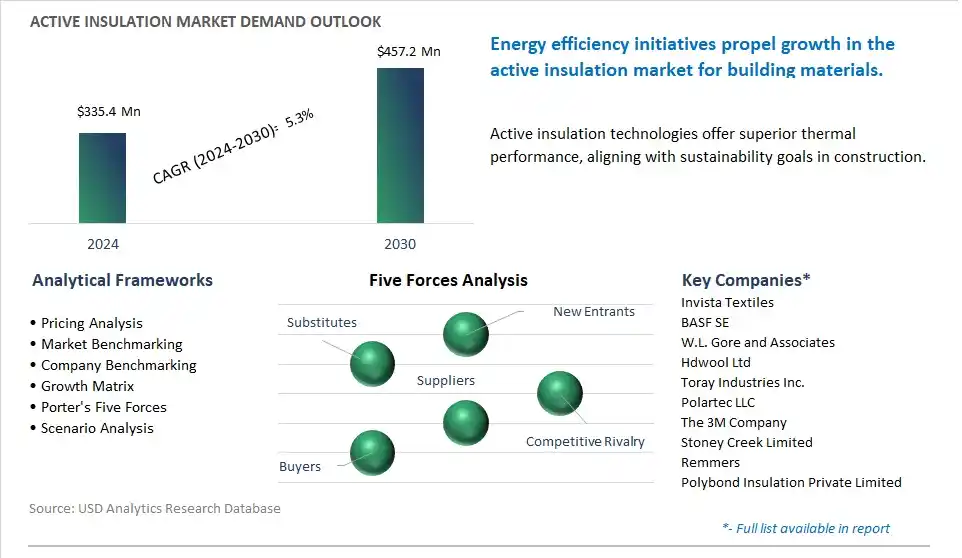
The market report analyses the leading companies in the industry including Invista Textiles, BASF SE, W.L. Gore and Associates, Hdwool Ltd, Toray Industries Inc., Polartec LLC, The 3M Company, Stoney Creek Limited, Remmers, Polybond Insulation Private Limited.
Active insulation is witnessing a significant market trend driven by the growing emphasis on energy efficiency and sustainability in the construction industry. As awareness of environmental concerns and energy consumption escalates, builders and homeowners are increasingly prioritizing insulation materials that offer superior thermal performance and contribute to reducing energy consumption. Active insulation, known for its ability to regulate indoor temperature, minimize heat loss or gain, and reduce reliance on heating and cooling systems, is becoming increasingly popular. This trend is expected to continue as energy codes become more stringent and green building practices gain traction globally.
Government incentives and regulations promoting energy-efficient buildings serve as a significant driver for the active insulation market. Governments worldwide are introducing policies, incentives, and building codes aimed at reducing energy consumption and carbon emissions in the built environment. Incentives such as tax credits, grants, and rebates encourage builders and homeowners to invest in energy-efficient insulation solutions like active insulation. Additionally, stringent building codes mandate higher insulation standards, further driving the adoption of advanced insulation materials. As governments continue to prioritize sustainability and energy conservation, the demand for active insulation is expected to rise.
The active insulation market presents a promising opportunity for the integration of smart technologies and innovative materials. With the rise of the Internet of Things (IoT) and smart building systems, there's an opportunity to develop active insulation solutions that incorporate sensors, actuators, and control systems to optimize energy usage and indoor comfort. Furthermore, ongoing research and development efforts in material science can lead to the creation of advanced insulation materials with enhanced thermal performance, durability, and sustainability. By leveraging smart technologies and innovative materials, manufacturers can differentiate their products in the market, cater to evolving customer needs, and capitalize on the growing demand for energy-efficient building solutions.
The largest segment in the Active Insulation Market is the Building & Construction Insulation Products segment. This dominance can be attributed to diverse factors. The building and construction activities represent a significant portion of the global insulation market, with a constant demand for high-performance insulation materials to enhance energy efficiency, thermal comfort, and environmental sustainability in buildings and infrastructure projects. Active insulation products designed for the building and construction sector are specifically engineered to meet the stringent requirements of modern construction practices, including thermal insulation, moisture management, fire resistance, and acoustic performance. Additionally, building codes, standards, and regulations mandating energy-efficient building designs and sustainable construction practices drive the adoption of active insulation solutions in residential, commercial, and institutional buildings. In addition, active insulation products for building and construction applications offer a wide range of options, including insulation boards, panels, foams, and spray foam insulation, providing versatility and flexibility to architects, builders, and contractors in addressing diverse insulation needs. Further, the growing trend towards green building certification programs such as LEED (Leadership in Energy and Environmental Design) and BREEAM (Building Research Establishment Environmental Assessment Method) further accelerates the demand for active insulation solutions that contribute to energy savings, indoor air quality, and Over the forecast period building performance. With its significant market share and essential role in improving building efficiency and sustainability, the Building & Construction Insulation Products segment remains the largest in the Active Insulation Market.
The fastest-growing segment in the Active Insulation Market is the Textile application segment. The rapid growth is driven by there is an increasing demand for innovative and high-performance textile materials with enhanced insulation properties across various industries, including apparel, outdoor gear, automotive, and aerospace. Active insulation technologies in textiles offer advanced thermal regulation, moisture management, and breathability, making them ideal for use in a wide range of applications where comfort, performance, and versatility are essential. Additionally, the rise of athleisure and outdoor recreation trends has led to a surge in demand for activewear, outerwear, and performance apparel that provide insulation without compromising on mobility or comfort. Active insulation textiles offer lightweight, flexible, and durable solutions for active lifestyles, enabling users to stay comfortable and protected in various weather conditions and physical activities. In addition, advancements in textile engineering and manufacturing processes have facilitated the development of active insulation fabrics with innovative features such as phase change materials (PCMs), aerogels, and conductive fibers, further driving their adoption in diverse applications. Further, the increasing awareness of environmental sustainability and eco-friendly textiles fuels the demand for active insulation materials derived from renewable sources or recycled fibers, aligning with consumer preferences for sustainable and responsible products. With its innovative solutions, performance benefits, and growing applications across multiple industries, the Textile application segment is the fastest-growing segment in the Active Insulation Market.
By Product
Textile Insulation Products
-Polyester
-Cotton
-Wool
-Nylon
Building & Construction Insulation Products
-Glass wool
-Mineral wool
-EPS
-Others
By Application
Textile
-Activewear
-Sportswear
-Others
Building & Construction
-Residential
-Commercial
Regions Included
North America (US, Canada, Mexico)
Europe (Germany, UK, France, Spain, Italy, Russia, Rest of Europe)
Asia Pacific (China, India, Japan, South Korea, Australia, South East Asia, Rest of Asia)
South America (Brazil, Argentina, Rest of South America)
Middle East and Africa (Saudi Arabia, UAE, Rest of Middle East, South Africa, Egypt, Rest of Africa)
Invista Textiles
BASF SE
W.L. Gore and Associates
Hdwool Ltd
Toray Industries Inc.
Polartec LLC
The 3M Company
Stoney Creek Limited
Remmers
Polybond Insulation Private Limited
*- List Not Exhaustive
TABLE OF CONTENTS
1 Introduction to 2024 Active Insulation Market
1.1 Market Overview
1.2 Quick Facts
1.3 Scope/Objective of the Study
1.4 Market Definition
1.5 Countries and Regions Covered
1.6 Units, Currency, and Conversions
1.7 Industry Value Chain
2 Research Methodology
2.1 Market Size Estimation
2.2 Sources and Research Methodology
2.3 Data Triangulation
2.4 Assumptions and Limitations
3 Executive Summary
3.1 Global Active Insulation Market Size Outlook, $ Million, 2021 to 2030
3.2 Active Insulation Market Outlook by Type, $ Million, 2021 to 2030
3.3 Active Insulation Market Outlook by Product, $ Million, 2021 to 2030
3.4 Active Insulation Market Outlook by Application, $ Million, 2021 to 2030
3.5 Active Insulation Market Outlook by Key Countries, $ Million, 2021 to 2030
4 Market Dynamics
4.1 Key Driving Forces of Active Insulation Industry
4.2 Key Market Trends in Active Insulation Industry
4.3 Potential Opportunities in Active Insulation Industry
4.4 Key Challenges in Active Insulation Industry
5 Market Factor Analysis
5.1 Value Chain Analysis
5.2 Competitive Landscape
5.2.1 Global Active Insulation Market Share by Company (%), 2023
5.2.2 Product Offerings by Company
5.3 Porter’s Five Forces Analysis
5.4 Pricing Analysis and Outlook
6 Growth Outlook Across Scenarios
6.1 Growth Analysis-Case Scenario Definitions
6.2 Low Growth Scenario Forecasts
6.3 Reference Growth Scenario Forecasts
6.4 High Growth Scenario Forecasts
7 Global Active Insulation Market Outlook by Segments
7.1 Active Insulation Market Outlook by Segments, $ Million, 2021- 2030
By Product
Textile Insulation Products
-Polyester
-Cotton
-Wool
-Nylon
Building & Construction Insulation Products
-Glass wool
-Mineral wool
-EPS
-Others
By Application
Textile
-Activewear
-Sportswear
-Others
Building & Construction
-Residential
-Commercial
8 North America Active Insulation Market Analysis and Outlook To 2030
8.1 Introduction to North America Active Insulation Markets in 2024
8.2 North America Active Insulation Market Size Outlook by Country, 2021-2030
8.2.1 United States
8.2.2 Canada
8.2.3 Mexico
8.3 North America Active Insulation Market size Outlook by Segments, 2021-2030
By Product
Textile Insulation Products
-Polyester
-Cotton
-Wool
-Nylon
Building & Construction Insulation Products
-Glass wool
-Mineral wool
-EPS
-Others
By Application
Textile
-Activewear
-Sportswear
-Others
Building & Construction
-Residential
-Commercial
9 Europe Active Insulation Market Analysis and Outlook To 2030
9.1 Introduction to Europe Active Insulation Markets in 2024
9.2 Europe Active Insulation Market Size Outlook by Country, 2021-2030
9.2.1 Germany
9.2.2 France
9.2.3 Spain
9.2.4 United Kingdom
9.2.4 Italy
9.2.5 Russia
9.2.6 Norway
9.2.7 Rest of Europe
9.3 Europe Active Insulation Market Size Outlook by Segments, 2021-2030
By Product
Textile Insulation Products
-Polyester
-Cotton
-Wool
-Nylon
Building & Construction Insulation Products
-Glass wool
-Mineral wool
-EPS
-Others
By Application
Textile
-Activewear
-Sportswear
-Others
Building & Construction
-Residential
-Commercial
10 Asia Pacific Active Insulation Market Analysis and Outlook To 2030
10.1 Introduction to Asia Pacific Active Insulation Markets in 2024
10.2 Asia Pacific Active Insulation Market Size Outlook by Country, 2021-2030
10.2.1 China
10.2.2 India
10.2.3 Japan
10.2.4 South Korea
10.2.5 Indonesia
10.2.6 Malaysia
10.2.7 Australia
10.2.8 Rest of Asia Pacific
10.3 Asia Pacific Active Insulation Market size Outlook by Segments, 2021-2030
By Product
Textile Insulation Products
-Polyester
-Cotton
-Wool
-Nylon
Building & Construction Insulation Products
-Glass wool
-Mineral wool
-EPS
-Others
By Application
Textile
-Activewear
-Sportswear
-Others
Building & Construction
-Residential
-Commercial
11 South America Active Insulation Market Analysis and Outlook To 2030
11.1 Introduction to South America Active Insulation Markets in 2024
11.2 South America Active Insulation Market Size Outlook by Country, 2021-2030
11.2.1 Brazil
11.2.2 Argentina
11.2.3 Rest of South America
11.3 South America Active Insulation Market size Outlook by Segments, 2021-2030
By Product
Textile Insulation Products
-Polyester
-Cotton
-Wool
-Nylon
Building & Construction Insulation Products
-Glass wool
-Mineral wool
-EPS
-Others
By Application
Textile
-Activewear
-Sportswear
-Others
Building & Construction
-Residential
-Commercial
12 Middle East and Africa Active Insulation Market Analysis and Outlook To 2030
12.1 Introduction to Middle East and Africa Active Insulation Markets in 2024
12.2 Middle East and Africa Active Insulation Market Size Outlook by Country, 2021-2030
12.2.1 Saudi Arabia
12.2.2 UAE
12.2.3 Oman
12.2.4 Rest of Middle East
12.2.5 Egypt
12.2.6 Nigeria
12.2.7 South Africa
12.2.8 Rest of Africa
12.3 Middle East and Africa Active Insulation Market size Outlook by Segments, 2021-2030
By Product
Textile Insulation Products
-Polyester
-Cotton
-Wool
-Nylon
Building & Construction Insulation Products
-Glass wool
-Mineral wool
-EPS
-Others
By Application
Textile
-Activewear
-Sportswear
-Others
Building & Construction
-Residential
-Commercial
13 Company Profiles
13.1 Company Snapshot
13.2 SWOT Profiles
13.3 Products and Services
13.4 Recent Developments
13.5 Financial Profile
Invista Textiles
BASF SE
W.L. Gore and Associates
Hdwool Ltd
Toray Industries Inc.
Polartec LLC
The 3M Company
Stoney Creek Limited
Remmers
Polybond Insulation Private Limited
14 Appendix
14.1 Customization Offerings
14.2 Subscription Services
14.3 Related Reports
14.4 Publisher Expertise
By Product
Textile Insulation Products
-Polyester
-Cotton
-Wool
-Nylon
Building & Construction Insulation Products
-Glass wool
-Mineral wool
-EPS
-Others
By Application
Textile
-Activewear
-Sportswear
-Others
Building & Construction
-Residential
-Commercial
Countries Analyzed
North America (US, Canada, Mexico)
Europe (Germany, UK, France, Spain, Italy, Russia, Rest of Europe)
Asia Pacific (China, India, Japan, South Korea, Australia, South East Asia, Rest of Asia)
South America (Brazil, Argentina, Rest of South America)
Middle East and Africa (Saudi Arabia, UAE, Rest of Middle East, South Africa, Egypt, Rest of Africa)
Global Active Insulation is forecast to reach $457.2 Million in 2030 from $335.4 Million in 2024, registering a CAGR of 5.3%
Emerging Markets across Asia Pacific, Europe, and Americas present robust growth prospects.
Invista Textiles, BASF SE, W.L. Gore and Associates, Hdwool Ltd, Toray Industries Inc., Polartec LLC, The 3M Company, Stoney Creek Limited, Remmers, Polybond Insulation Private Limited
Base Year- 2023; Estimated Year- 2024; Historic Period- 2018-2023; Forecast period- 2024 to 2030; Currency: Revenue (USD); Volume