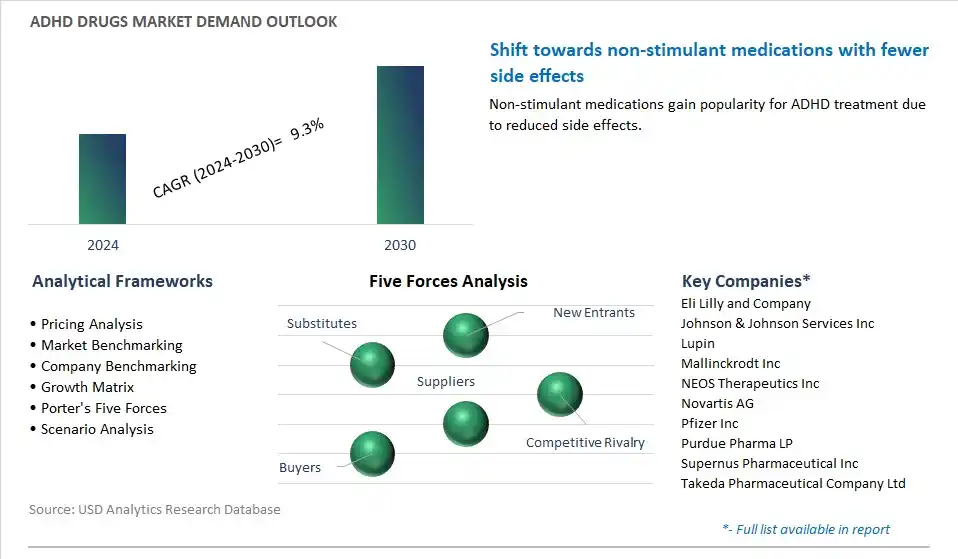
ADHD Drugs Market is estimated to increase at a growth rate of 9.3% CAGR over the forecast period from 2024 to 2030.
The global ADHD Drugs Market Study analyzes and forecasts the market size across 6 regions and 24 countries for diverse segments including By Drug (Stimulants (Amphetamine, Methylphenidate, Lisdexamfetamine, Dexmethylphenidate), Non-stimulants (Atomoxetine, Guanfacine, Clonidine)), By Demographics (Children, Adults), By Distribution Channel (Retail Pharmacy, Hospital Pharmacy).
An Introduction to ADHD Drugs Market in 2024
The ADHD Drugs Market in 2024 is witnessing steady growth driven by the increasing prevalence of attention-deficit hyperactivity disorder (ADHD) globally and the continuous development of novel therapeutics to address the diverse needs of patients. ADHD, a neurodevelopmental disorder, presents challenges in attention, hyperactivity, and impulsivity. Pharmaceutical companies are innovating with stimulant medications, non-stimulant alternatives, and combination therapies to provide effective symptom management and improved quality of life for individuals with ADHD.
ADHD Drugs Market Competitive Landscape
The global ADHD Drugs Industry is highly competitive with a large number of companies focusing on niche market segments. Amidst intense competitive conditions, ADHD Drugs Companies are investing in new product launches and strengthening distribution channels. Key companies operating in the ADHD Drugs Industry include- Eli Lilly and Company, Johnson & Johnson Services Inc, Lupin, Mallinckrodt Inc, NEOS Therapeutics Inc, Novartis AG, Pfizer Inc, Purdue Pharma LP, Supernus Pharmaceutical Inc, Takeda Pharmaceutical Company Ltd.
ADHD Drugs Market Trend: Expanding Treatment Options and Therapeutic Classes
A significant trend in the ADHD Drugs market is the expansion of treatment options and therapeutic classes for attention deficit hyperactivity disorder (ADHD). With a growing understanding of ADHD as a neurodevelopmental disorder with multifactorial etiology, there is a shift towards personalized treatment approaches that target specific symptoms and functional impairments. This trend is driven by the need for tailored interventions to address the diverse needs of individuals with ADHD across the lifespan, leading to the development of novel medications, non-pharmacological therapies, and digital health solutions aimed at improving symptom management, executive function, and overall quality of life.
ADHD Drugs Market Driver: Increasing ADHD Diagnosis Rates and Awareness
A key driver propelling the ADHD Drugs market is the increasing diagnosis rates and awareness of ADHD among healthcare providers, educators, and the general population. As awareness grows regarding the prevalence, impact, and genetic basis of ADHD, there is a corresponding rise in the number of individuals seeking evaluation and treatment for ADHD-related symptoms. This driver is fueled by efforts to improve public education, reduce stigma, and enhance access to ADHD assessment and support services, leading to earlier detection, diagnosis, and intervention for individuals with ADHD and driving the demand for pharmacological and non-pharmacological treatment options.
ADHD Drugs Market Opportunity: Integration of Digital Health Technologies and Behavior Modification Tools
An opportunity within the ADHD Drugs market lies in the integration of digital health technologies and behavior modification tools for enhancing ADHD management and treatment outcomes. With advances in mobile health applications, wearable devices, and telehealth platforms, there is an opportunity to complement pharmacotherapy with personalized interventions aimed at improving executive function, organization skills, and behavioral self-regulation in individuals with ADHD. By leveraging digital health solutions for remote monitoring, symptom tracking, and behavior modification, healthcare providers can empower patients and caregivers, optimize treatment adherence, and improve long-term functional outcomes for individuals with ADHD.
Market Share Analysis: Non-stimulants is the fastest growing segment in the ADHD Drugs industry
Non-stimulants emerge as the fastest-growing segment within ADHD Drugs. Traditionally, stimulants like amphetamine and methylphenidate have been the primary pharmacological treatment for ADHD. However, non-stimulant medications such as atomoxetine, guanfacine, and clonidine have gained traction due to their distinct mechanisms of action and lower risk of abuse and dependence. Non-stimulants are particularly favored for individuals who do not respond well to or experience intolerable side effects from stimulant medications. Additionally, as awareness about ADHD increases and diagnosis rates rise among adults, there's a growing need for alternative treatment options that cater to different age groups and demographics. The expanding role of non-stimulant drugs in managing ADHD symptoms, coupled with their availability through various distribution channels including retail and hospital pharmacies, drives their rapid growth within the ADHD Drugs market, offering patients more personalized and effective therapeutic choices.
ADHD Drugs Market Segmentation
By Drug
Stimulants
-Amphetamine
-Methylphenidate
-Lisdexamfetamine
-Dexmethylphenidate
Non-stimulants
-Atomoxetine
-Guanfacine
-Clonidine
-Others
By Demographics
Children (2 to 17 years of age)
Adults
By Distribution Channel
Retail Pharmacy
Hospital Pharmacy
Geographical Analysis
North America (United States, Canada, Mexico)
Europe (Germany, France, United Kingdom, Spain, Italy, Rest of Europe)
Asia Pacific (China, India, Japan, South Korea, Rest of Asia Pacific)
South America (Brazil, Argentina, Rest of South America)
Middle East and Africa (Saudi Arabia, UAE, Rest of Middle East, South Africa, Egypt, Rest of Africa)
ADHD Drugs Companies
Eli Lilly and Company
Johnson & Johnson Services Inc
Lupin
Mallinckrodt Inc
NEOS Therapeutics Inc
Novartis AG
Pfizer Inc
Purdue Pharma LP
Supernus Pharmaceutical Inc
Takeda Pharmaceutical Company Ltd
* List not Exhaustive
Reasons to Buy the ADHD Drugs Market Study
• Deepen your industry insights and navigate uncertainties for strategy formulation, CAPEX, and Operational decisions
• Gain access to detailed insights on the ADHD Drugs Market, encompassing current market size, growth trends, and forecasts till 2030.
• Access detailed competitor analysis, enabling competitive advantage through a thorough understanding of market players, strategies, and potential differentiation opportunities
• Stay ahead of the curve with insights on technological advancements, innovations, and upcoming trends
• Identify lucrative investment avenues and expansion opportunities within the ADHD Drugs Industry, guided by robust, data-backed analysis.
• Understand regional and global markets through country-wise analysis, regional market potential, regulatory nuances, and dynamics
• Execute strategies with confidence and speed through information, analytics, and insights on the industry value chain
• Corporate leaders, strategists, financial experts, shareholders, asset managers, and governmental representatives can make long-term planning scenarios and build an integrated and timely understanding of market dynamics
• Benefit from tailored solutions and expert consultation based on report insights, providing personalized strategies aligned with specific business needs.
TABLE OF CONTENTS
1 Introduction to 2024 ADHD Drugs Market
1.1 Market Overview
1.2 Quick Facts
1.3 Scope/Objective of the Study
1.4 Market Definition
1.5 Countries and Regions Analyzed
1.6 Units, Currency, and Conversions
1.7 Industry Value Chain
2 Research Methodology
2.1 Market Size Estimation
2.2 Sources and Research Methodology
2.3 Data Triangulation
2.4 Assumptions and Limitations
3 Executive Summary
3.1 Global ADHD Drugs Market Size Outlook, $ Million, 2021 to 2030
3.2 ADHD Drugs Market Outlook by Type, $ Million, 2021 to 2030
3.3 ADHD Drugs Market Outlook by Product, $ Million, 2021 to 2030
3.4 ADHD Drugs Market Outlook by Application, $ Million, 2021 to 2030
3.5 ADHD Drugs Market Outlook by Key Countries, $ Million, 2021 to 2030
4 Market Dynamics
4.1 Key Driving Forces of ADHD Drugs Industry
4.2 Key Market Trends in ADHD Drugs Industry
4.3 Potential Opportunities in ADHD Drugs Industry
4.4 Key Challenges in ADHD Drugs Industry
5 Market Factor Analysis
5.1 Value Chain Analysis
5.2 Competitive Landscape
5.2.1 Global ADHD Drugs Market Share by Company (%), 2023
5.2.2 Product Offerings by Company
5.3 Porter’s Five Forces Analysis
5.4 Pricing Analysis and Outlook
6 Growth Outlook Across Scenarios
6.1 Growth Analysis-Case Scenario Definitions
6.2 Low Growth Scenario Forecasts
6.3 Reference Growth Scenario Forecasts
6.4 High Growth Scenario Forecasts
7 Global ADHD Drugs Market Outlook by Segments
7.1 ADHD Drugs Market Outlook by Segments, $ Million, 2021- 2030
By Drug
Stimulants
-Amphetamine
-Methylphenidate
-Lisdexamfetamine
-Dexmethylphenidate
Non-stimulants
-Atomoxetine
-Guanfacine
-Clonidine
-Others
By Demographics
Children (2 to 17 years of age)
Adults
By Distribution Channel
Retail Pharmacy
Hospital Pharmacy
8 North America ADHD Drugs Market Analysis and Outlook To 2030
8.1 Introduction to North America ADHD Drugs Markets in 2024
8.2 North America ADHD Drugs Market Size Outlook by Country, 2021-2030
8.2.1 United States
8.2.2 Canada
8.2.3 Mexico
8.3 North America ADHD Drugs Market size Outlook by Segments, 2021-2030
By Drug
Stimulants
-Amphetamine
-Methylphenidate
-Lisdexamfetamine
-Dexmethylphenidate
Non-stimulants
-Atomoxetine
-Guanfacine
-Clonidine
-Others
By Demographics
Children (2 to 17 years of age)
Adults
By Distribution Channel
Retail Pharmacy
Hospital Pharmacy
9 Europe ADHD Drugs Market Analysis and Outlook To 2030
9.1 Introduction to Europe ADHD Drugs Markets in 2024
9.2 Europe ADHD Drugs Market Size Outlook by Country, 2021-2030
9.2.1 Germany
9.2.2 France
9.2.3 Spain
9.2.4 United Kingdom
9.2.4 Italy
9.2.5 Russia
9.2.6 Norway
9.2.7 Rest of Europe
9.3 Europe ADHD Drugs Market Size Outlook by Segments, 2021-2030
By Drug
Stimulants
-Amphetamine
-Methylphenidate
-Lisdexamfetamine
-Dexmethylphenidate
Non-stimulants
-Atomoxetine
-Guanfacine
-Clonidine
-Others
By Demographics
Children (2 to 17 years of age)
Adults
By Distribution Channel
Retail Pharmacy
Hospital Pharmacy
10 Asia Pacific ADHD Drugs Market Analysis and Outlook To 2030
10.1 Introduction to Asia Pacific ADHD Drugs Markets in 2024
10.2 Asia Pacific ADHD Drugs Market Size Outlook by Country, 2021-2030
10.2.1 China
10.2.2 India
10.2.3 Japan
10.2.4 South Korea
10.2.5 Indonesia
10.2.6 Malaysia
10.2.7 Australia
10.2.8 Rest of Asia Pacific
10.3 Asia Pacific ADHD Drugs Market size Outlook by Segments, 2021-2030
By Drug
Stimulants
-Amphetamine
-Methylphenidate
-Lisdexamfetamine
-Dexmethylphenidate
Non-stimulants
-Atomoxetine
-Guanfacine
-Clonidine
-Others
By Demographics
Children (2 to 17 years of age)
Adults
By Distribution Channel
Retail Pharmacy
Hospital Pharmacy
11 South America ADHD Drugs Market Analysis and Outlook To 2030
11.1 Introduction to South America ADHD Drugs Markets in 2024
11.2 South America ADHD Drugs Market Size Outlook by Country, 2021-2030
11.2.1 Brazil
11.2.2 Argentina
11.2.3 Rest of South America
11.3 South America ADHD Drugs Market size Outlook by Segments, 2021-2030
By Drug
Stimulants
-Amphetamine
-Methylphenidate
-Lisdexamfetamine
-Dexmethylphenidate
Non-stimulants
-Atomoxetine
-Guanfacine
-Clonidine
-Others
By Demographics
Children (2 to 17 years of age)
Adults
By Distribution Channel
Retail Pharmacy
Hospital Pharmacy
12 Middle East and Africa ADHD Drugs Market Analysis and Outlook To 2030
12.1 Introduction to Middle East and Africa ADHD Drugs Markets in 2024
12.2 Middle East and Africa ADHD Drugs Market Size Outlook by Country, 2021-2030
12.2.1 Saudi Arabia
12.2.2 UAE
12.2.3 Oman
12.2.4 Rest of Middle East
12.2.5 Egypt
12.2.6 Nigeria
12.2.7 South Africa
12.2.8 Rest of Africa
12.3 Middle East and Africa ADHD Drugs Market size Outlook by Segments, 2021-2030
By Drug
Stimulants
-Amphetamine
-Methylphenidate
-Lisdexamfetamine
-Dexmethylphenidate
Non-stimulants
-Atomoxetine
-Guanfacine
-Clonidine
-Others
By Demographics
Children (2 to 17 years of age)
Adults
By Distribution Channel
Retail Pharmacy
Hospital Pharmacy
13 Company Profiles
13.1 Company Snapshot
13.2 SWOT Profiles
13.3 Products and Services
13.4 Recent Developments
13.5 Financial Profile
List of Companies
Eli Lilly and Company
Johnson & Johnson Services Inc
Lupin
Mallinckrodt Inc
NEOS Therapeutics Inc
Novartis AG
Pfizer Inc
Purdue Pharma LP
Supernus Pharmaceutical Inc
Takeda Pharmaceutical Company Ltd
14 Appendix
14.1 Customization Offerings
14.2 Subscription Services
14.3 Related Reports
14.4 Publisher Expertise
