Market Analysis: AI and Data-Driven Tools Propel the Advertising Effectiveness & ROI Measurement Market
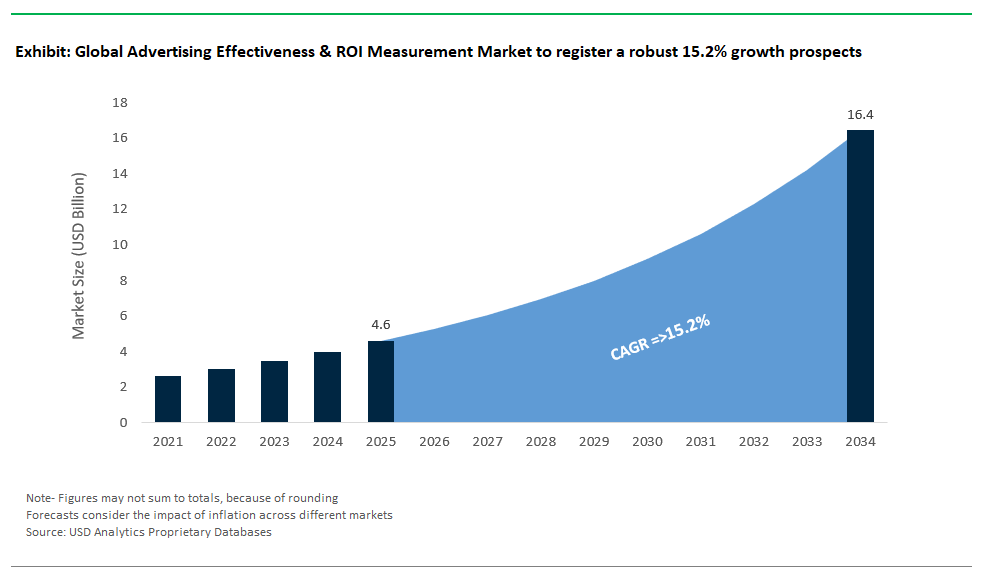
The Global Advertising Effectiveness & ROI Measurement Market Size is estimated at $4.6 Billion in 2025 and is forecast to register an annual growth rate (CAGR) of 15.2% to reach $16.4 Billion by 2034.
The advertising effectiveness and ROI measurement market is experiencing transformative growth, as global tech leaders and analytics providers unveil powerful new tools to help brands maximize the impact of their ad spend. At Google Marketing Live (GML) in July 2025, Google introduced a suite of AI-powered marketing measurement solutions designed to deliver actionable insights and improved ROI. These innovations include the Projections Report for campaign pacing, Scenario Planner for data-driven budget optimization, and the Data Manager API for privacy-safe signal integration enabling agencies and advertisers to measure and refine performance with unprecedented accuracy. Additionally, the new Google Tag Gateway brings server-side tagging as a default, yielding stronger bidding and up to 11% uplift in signal performance, while the Confidential Matching Expansion ensures privacy-first, secure data matching across key Google platforms.
Salesforce continues to lead with its ongoing emphasis on AI-driven CRM tools and its robust Marketing Cloud suite, empowering marketers to unify data, personalize campaigns, and clearly demonstrate marketing ROI. The company’s latest Sixth State of Marketing report (2024–2025) reinforces that optimizing marketing ROI and accurate attribution remain top priorities worldwide driving Salesforce’s product roadmap and strategic partnerships in the measurement market. Across the industry, marketers are leveraging these AI-enhanced CRM and analytics platforms to achieve greater efficiency and transparency in tracking advertising performance.
This momentum is validated by independent research: the January 2025 WARC ROI Benchmark report, which analyzed over 1,500 successful advertising campaigns, found that the median profit ROI for top-performing advertisers rose from 1.9:1 in 2017 to 2.5:1 in 2024. This improvement underscores how advanced measurement tools and smarter strategies are driving real-world advertising efficiency. As privacy regulations evolve and advertisers demand more granular, real-time insights, the advertising effectiveness and ROI measurement market is set to remain a cornerstone of digital marketing innovation empowering brands to achieve stronger results and more measurable business outcomes.
Innovations Driving the Advertising Effectiveness & ROI Measurement Market
Trend: Integration of Biometric Response Tracking with AI Attribution
The advertising effectiveness and ROI measurement market is undergoing a paradigm shift with the integration of biometric response tracking into AI-driven attribution models. Traditional attribution systems have long relied on digital behavioral signals like click-through rates and conversion data, but these fail to capture the underlying emotional and cognitive responses driving consumer actions. By incorporating physiological indicators such as EEG-based emotional arousal or galvanic skin response, brands gain a far deeper understanding of engagement quality and purchase intent. This fusion of neuro-analytics and AI-powered modeling is significantly improving predictive accuracy for sales conversions, enabling advertisers to optimize media spend with unprecedented precision.
However, the surge in biometric data utilization is coinciding with stricter privacy regulations, compelling brands to rethink compliance strategies. Regulatory bodies worldwide are mandating explicit consumer consent for biometric data collection, introducing operational complexities for advertisers and analytics firms. This compliance challenge is creating a new sub-market for biometric data governance tools and consent management platforms, projected to grow into a multi-million-dollar sector. As brands navigate this evolving landscape, solutions that ensure ethical data collection and regulatory adherence will become critical differentiators in a competitive advertising ecosystem.
Opportunity: Dark Social Measurement for Regulated Industries
The rise of "dark social" channels content sharing through private messaging apps and encrypted platforms represents one of the largest blind spots in advertising measurement today, particularly for brands operating in regulated sectors like pharmaceuticals and financial services. These industries frequently experience significant, untracked ROI from peer-to-peer content sharing, often related to educational campaigns or drug adherence programs, but lack visibility due to the private nature of these interactions. This presents a massive opportunity for analytics providers to develop secure, privacy-compliant solutions capable of capturing engagement data without compromising user confidentiality.
Emerging regulatory clarity is fueling this opportunity. Agencies such as the FDA are introducing guidelines that outline permissible digital engagement practices, enabling brands to leverage private digital ecosystems more confidently. By deploying technologies like encrypted engagement tags, blockchain-based tracking, or consent-driven monitoring, marketers can unlock actionable insights from previously inaccessible consumer touchpoints. With pharmaceutical brands alone investing billions annually in patient engagement, the ability to measure and attribute dark social interactions ethically and accurately is poised to become a multi-billion-dollar market. Providers who innovate in this space will play a pivotal role in transforming opaque engagement channels into measurable, ROI-positive assets.
Competitive Landscape: Advertising Effectiveness & ROI Measurement Market
Nielsen: Setting the Global Standard in Cross-Media Advertising ROI Measurement
Nielsen stands at the forefront of the advertising effectiveness and ROI measurement market, consistently innovating to keep pace with the complex, fragmented digital and cross-media landscape. The company’s flagship platform, Nielsen ONE, offers a unified view of audience engagement, seamlessly integrating linear TV, streaming, and digital measurement. This comprehensive solution is trusted by media companies and top advertisers worldwide for its de-duplicated reach, campaign planning, and outcome tracking crucial for optimizing cross-channel media spend and maximizing advertising ROI. In 2024-2025, Nielsen accelerated the rollout of Nielsen ONE, expanding its Outcomes measurement suite with new creative evaluation capabilities, thanks to partnerships with AI innovators like Realeyes. By blending traditional person-level panel data with big data analytics, Nielsen empowers marketers with granular, actionable insights into campaign performance, creative impact, and business outcomes such as sales and brand lift. The company’s annual Marketing Report continues to shape industry benchmarks, offering marketers best-in-class guidance for maximizing ROI across linear, CTV, and digital environments. As brands face increasing pressure to demonstrate holistic marketing impact, Nielsen’s integrated solutions for audience measurement, media planning, creative evaluation, and marketing mix modeling solidify its leadership position in advertising ROI analytics.
Kantar: Comprehensive Marketing ROI and Creative Effectiveness for a Holistic Approach
Kantar, backed by Bain Capital, is renowned for its end-to-end marketing analytics and ROI measurement services, addressing both the short-term and long-term impact of advertising investments. With its proprietary Athena platform, Kantar delivers “always-on” global marketing ROI outputs and campaign effectiveness insights for some of the world’s biggest advertisers. The company’s Total Marketing ROI solution uses sophisticated econometric modeling to quantify the incremental sales and brand impact of every marketing activity, supporting dynamic budget optimization and scenario planning. In recent years, Kantar has deepened its integration of AI to decode creative effectiveness, emotional response, and attention metrics enabling clients to fine-tune creative assets before, during, and after launch. Its campaign intelligence spans media planning, audience targeting, and competitive spend analysis, helping brands target the right audiences with precision. Kantar’s masterclasses and industry thought leadership emphasize holistic measurement, considering all touchpoints including paid, owned, and earned media, creative content, and influencer marketing. With its robust international reach and scalable platforms, Kantar continues to deliver high-impact insights that drive smarter marketing decisions and maximize advertising ROI across global brands.
Integral Ad Science (IAS): Leading Digital Ad Verification and Quality Attention Metrics
Integral Ad Science (IAS) has established itself as a leader in digital ad verification, brand safety, and advanced attention measurement, ensuring media quality and maximizing the effectiveness of every digital ad dollar. IAS’s Total Media Quality (TMQ) platform provides end-to-end verification across multiple digital environments including programmatic, social, video, and mobile measuring key elements such as viewability, invalid traffic (IVT), brand safety, and contextual suitability. In 2025, IAS launched innovative AI-driven solutions, including social attention measurement for Snapchat (with Lumen Research), contextual reporting for Meta, and partnerships with Lyft Media and Nextdoor, further expanding its footprint across premium and emerging media channels. IAS’s expertise in AI and machine learning powers granular content analysis and real-time optimization, while its new sustainability measurement tools, such as integration with Impact Plus, allow advertisers to track the carbon footprint of digital campaigns. By providing actionable, third-party verified insights into campaign quality, attention, and suitability, IAS is an essential partner for advertisers, agencies, and publishers seeking to protect brand reputation, optimize performance, and demonstrate advertising ROI.
DoubleVerify: Full-Spectrum Digital Ad Measurement and Optimization
DoubleVerify (DV) delivers a unified, AI-powered platform for verifying, optimizing, and proving the effectiveness of digital advertising campaigns. DV’s proprietary DV Authentic Ad™ metric ensuring that ads are viewable, fraud-free, and brand-safe/suitable sets the gold standard for digital ad quality. The DV Media AdVantage Platform (DV MAP) integrates verification, dynamic AI optimization (via Scibids), and comprehensive outcome measurement (via Rockerbox), making it a full-spectrum solution for digital advertisers. In 2025, DV introduced DV Authentic AdVantage for walled gardens like Meta, TikTok, and Netflix, unifying verification and performance optimization. The company continues to expand measurement across social and video platforms, with new capabilities for Instagram Reels, TikTok, and Google’s Search Partner Network. Advanced features like multi-touch attribution, incrementality testing, and marketing mix modeling help brands not only measure but also enhance campaign outcomes. With a focus on AI and machine learning to detect sophisticated fraud, contextualize ad placements, and maximize attention, DoubleVerify empowers global brands to improve media quality, protect budgets, and optimize advertising ROI in a fast-evolving ecosystem.
Experian Marketing Impact: Data-Driven Attribution and Omnichannel ROI Insights
Experian Marketing Impact leverages one of the world’s richest sets of consumer data and analytics to connect advertising exposure with real business outcomes. The platform is designed for omnichannel campaign attribution, helping brands understand the incremental impact of ads on key performance indicators such as sales, auto purchases, foot traffic, and web engagement across digital, TV, and offline channels. Experian’s sophisticated consumer profiling and audience segmentation tools allow advertisers to identify, target, and measure high-value customers, providing deep insight into campaign lift and effectiveness. Recent innovations include AI integration for real-time brand tracking and behavioral insights, as well as new partnerships to expand measurement across video and social channels (Netflix, Roku, TikTok, Meta). Experian’s first-party data strategies are increasingly vital in a privacy-first world, enabling advertisers to build robust, compliant measurement frameworks. The company’s global reach, digital analytics integration, and focus on measurable, actionable ROI make Experian Marketing Impact a crucial resource for brands looking to optimize campaigns, allocate budgets, and drive tangible marketing results.
Market Share and Segmentation Insights: Advertising Effectiveness & ROI Measurement Market
By Measurement Type: Attribution Modeling Dominates, Sentiment Analysis Surges
In the advertising effectiveness and ROI measurement market, Attribution Modeling commands the largest market share at 23.9% in 2025. This dominance is fueled by brands’ growing need for multi-touchpoint tracking, which allows marketers to accurately assess digital campaign performance across channels and optimize media spend in real time. As digital campaigns become increasingly complex, attribution modeling is central to understanding true ROI.
Sentiment Analysis & Social Listening is the fastest-growing segment, expanding at a CAGR of 16.1%. Brands are rapidly adopting these tools to gain real-time insights into consumer perception, campaign impact, and brand health via social media channels. Media Measurement & Verification also grows rapidly, as concerns over ad fraud and the rise of connected TV (CTV) and over-the-top (OTT) streaming require robust, transparent verification solutions. Other important segments include Marketing Mix Modeling (MMM), which remains essential for large-scale, multi-channel campaigns, and Customer Lifetime Value (CLTV) Analysis, increasingly valued for long-term ROI optimization. Brand lift and incrementality testing round out the segment, supporting campaign validation and message resonance tracking.
.png)
By End-User Industry: Retail & E-commerce Leads, Media & Entertainment Expands Fastest
From an end-user perspective, Retail & E-commerce accounts for the largest share at 30% in 2025, propelled by performance-driven advertising and a relentless focus on measurable results. Digital retailers (e.g., Amazon Ads, Shopify) and D2C brands rely heavily on granular ROI measurement to fine-tune their campaigns and maximize sales conversion.
Media & Entertainment is the fastest-growing end-user, with a CAGR of 16.8%, as fierce competition among streaming platforms, content creators, and digital media outlets fuels the demand for sophisticated advertising measurement. The FMCG sector also plays a significant role, leveraging marketing mix modeling for mass-market brand campaigns. BFSI, Automotive, Telecom, Healthcare, and Travel & Hospitality industries are steadily investing in advanced measurement solutions to optimize marketing budgets and improve campaign impact.
United States: AI-Driven Optimization and the Rise of First-Party Data
The United States is at the global forefront of advertising effectiveness and ROI measurement, thanks to rapid adoption of AI-powered optimization tools across all major digital channels. U.S. advertisers leveraging AI in their campaigns report an average 76% increase in ROI over traditional methods, with these intelligent platforms enabling real-time budget allocation and precise targeting of high-value audience segments. One standout result: customer acquisition costs are dropping by an average of 30% when AI is used to predict conversion likelihood, ensuring ad spend is directed toward prospects with the highest intent. Advanced attribution models are now the standard, using machine learning to credit each touchpoint across clicks, video views, and devices rather than relying on outdated last-click approaches. This holistic view is critical as U.S. digital video ad spending climbs toward $53.9 billion in 2025, with short-form and interactive video formats demanding granular, cross-platform ROI insights.
Concurrently, the United States is transitioning to a privacy-first measurement ecosystem as third-party cookies are deprecated. Brands are investing heavily in first-party data strategies and privacy-enhancing technologies (PETs) to maintain effective targeting and measurement without compromising compliance. HubSpot’s 2025 State of Marketing Report highlights the dominance of short-form video (TikTok, YouTube Shorts, Instagram Reels) as the highest ROI format, with 21% of U.S. marketers naming it most effective. Meanwhile, Facebook stands out as the top channel for influencer marketing ROI, according to 28% of surveyed brands. This is underpinned by a surge in AI-powered creative and audience analytics, which are now essential for optimizing campaign performance in a highly competitive and increasingly regulated advertising market.
India: Unified Measurement in a Rapidly Growing Digital Ad Market
India’s advertising effectiveness and ROI measurement market is undergoing a dramatic transformation, spurred by booming digital ad spend and the integration of advanced AI tools. Indian advertisers are using AI to analyze consumer trends, automate real-time bid adjustments, and fine-tune audience targeting for improved ROI. This digital acceleration is necessitating robust measurement solutions that can track campaign effectiveness across a fragmented media landscape spanning social media, search, vernacular video, and traditional TV. Unified measurement platforms are in demand, enabling marketers to bridge the gap between offline and online channels, and to attribute conversions with greater accuracy. Automation platforms with integrated analytics are growing in popularity, empowering businesses to streamline repetitive tasks while extracting actionable insights that drive campaign performance and bottom-line impact.
Regulatory scrutiny is also shaping India’s advertising measurement landscape. In May 2024, the Supreme Court declared celebrities and influencers equally accountable for misleading ads, raising the bar for transparency and authenticity in endorsement campaigns. As a result, brands are investing more in tools that can not only measure ad impact but also ensure compliance and protect reputation. Marketers are increasingly focusing on the ROI of localized content, recognizing that effectiveness can differ greatly across India’s linguistically and culturally diverse regions. This is prompting brands to fine-tune measurement models for regional campaigns and vernacular platforms, optimizing creative and spend for maximum engagement and conversion at the hyperlocal level.
Germany: GDPR-Driven Measurement and Privacy-First Attribution
Germany’s advertising effectiveness market is characterized by a strong emphasis on GDPR compliance and first-party data strategies. German advertisers are investing heavily in privacy-enhancing measurement technologies, ensuring user consent and compliance with stringent data privacy laws. The shift toward first-party data has prompted widespread adoption of contextual advertising and cookieless measurement frameworks. As a result, brands are increasingly using hybrid models combining traditional market research, such as surveys and focus groups, with digital analytics to gain a holistic view of campaign effectiveness. This allows for accurate brand lift analysis while respecting data privacy regulations, and provides more meaningful insights than digital metrics alone.
As Connected TV (CTV) adoption rises, German advertisers are prioritizing advanced measurement solutions that offer cross-device attribution and audience insights for streaming campaigns. Brand safety and contextual suitability are equally prioritized, with measurement platforms required to verify placement and assess content for positive brand associations. The growth of CTV and the increasing fragmentation of digital channels make it crucial for German brands to rely on unified measurement frameworks that connect performance across traditional and digital media, ensuring reliable ROI attribution even as the regulatory and technological landscape evolves.
United Kingdom: Video Ad Measurement and First-Party Data Leadership
The United Kingdom is rapidly advancing in the measurement of advertising effectiveness, driven by the surge in digital video ad spend and the dominance of online video (OLV) formats. For the first time in 2024, OLV overtook OTT in growth rate, compelling UK marketers to demand more sophisticated video effectiveness metrics especially on social platforms like YouTube, TikTok, and Instagram. This shift is paired with aggressive investment in first-party data strategies and identity resolution, as brands prepare for a cookieless future by building customer data platforms (CDPs) and leveraging data clean rooms for privacy-compliant measurement. Unified measurement frameworks are in high demand, with brands seeking to integrate performance insights across all media channels and touchpoints for a “single source of truth” on advertising ROI.
AI-driven creative optimization is also transforming UK advertising. Marketers are deploying machine learning for multivariate and A/B testing, enabling real-time refinement of ad messaging and creative, which has shown to boost conversion rates and overall ROI measurability. Regulatory oversight remains strong, with the Advertising Standards Authority (ASA) enforcing strict rules on transparency, reporting, and consumer data protection. This environment encourages the adoption of holistic, privacy-centric measurement approaches, positioning the UK as a benchmark market for innovation and compliance in advertising effectiveness.
Canada: Cross-Platform Attribution and Privacy-Centric Analytics
Canada’s advertising effectiveness and ROI measurement market is being reshaped by a surge in AI adoption for campaign management and a growing demand for privacy-compliant analytics. Canadian marketers are integrating AI tools to automate trend analysis, campaign optimization, and outcome prediction boosting efficiency and ensuring advertising dollars are spent more effectively. Mobile video ad spend is on the rise, especially across platforms like TikTok and Instagram Reels, increasing the need for granular short-form video measurement and robust cross-platform attribution tools that capture the full consumer journey across digital, social, and legacy media.
With evolving privacy regulations, Canadian advertisers are prioritizing measurement solutions that aggregate data, rely on modeled outcomes, and maximize insights from first-party sources eschewing individual tracking in favor of compliant, audience-focused reporting. There is a notable shift toward AI-driven customer lifetime value (CLV) models, where brands focus not only on immediate conversions but on optimizing for sustainable growth. These strategies are helping advertisers assign long-term value to customer acquisition channels and refine campaigns for better ROI, ensuring Canada’s measurement market keeps pace with the highest global standards.
Australia: Performance Marketing, Predictive AI, and Content ROI
In Australia, the advertising effectiveness landscape is being transformed by a strong emphasis on performance marketing and the rapid adoption of predictive analytics. Australian businesses are investing in paid search, paid social, and other performance channels where ROI is measurable and directly linked to outcomes. AI is being used for campaign forecasting and pre-launch optimization, allowing brands to allocate budgets with unprecedented precision. This proactive approach, which replaces reactive measurement, is helping Australian advertisers maximize their returns in increasingly competitive digital markets.
Content marketing is also seeing a spike in both investment and measurable ROI. According to HubSpot’s 2025 marketing report, content marketing has become a leading driver of brand engagement and sales for B2C brands in Australia, prompting marketers to develop more robust frameworks for evaluating content’s direct impact on web traffic and revenue. Investment in advanced ad-tech attribution tools is rising, giving companies the ability to track customer journeys and assign credit across touchpoints accurately. As consumer privacy concerns grow, advertisers are also embracing transparency and privacy-centric analytics, building trust while still measuring campaign effectiveness.
France: Regulatory Shifts, CTV Measurement, and Sustainability
France’s advertising effectiveness and ROI measurement market is adjusting to major regulatory and technological changes, led by the EU’s Digital Services Act (DSA), which enforces strict transparency for online advertising and platform reporting from 2024. French advertisers and platforms are adapting by investing in measurement technologies that meet these requirements, including enhanced transparency on data use, ad placement, and consumer targeting. With the rise of streaming and connected TV (CTV), French brands are investing in advanced measurement solutions to assess campaign reach, frequency, and ROI in a fragmented, cross-screen landscape.
There is a growing movement toward unified media planning integrating performance data from traditional, digital, and new media channels into a holistic measurement strategy. French marketers are also at the forefront of sustainability in advertising, with early efforts underway to quantify the carbon footprint of campaigns and factor environmental impact into ROI calculations. AI-driven hyper-personalization is on the rise, enabling real-time content customization and measurement of engagement at the individual user level, moving beyond basic CTRs. These developments signal a market that’s not only adapting to compliance and digital disruption but also innovating in how advertising effectiveness is defined and measured.
Brazil: Digital Ad Growth, Influencer ROI, and E-commerce Measurement
Brazil is a standout in Latin America for its high rate of digital ad spend growth, making robust effectiveness and ROI measurement more crucial than ever. Brands are prioritizing tools that can accurately track and optimize campaign performance in a landscape dominated by mobile, video, and influencer marketing. Brazil is a global leader in influencer ROI measurement, with brands leveraging analytics platforms to assess engagement, conversion rates, and sentiment across millions of sponsored posts. As influencer collaborations proliferate, the demand for real-time reporting and granular performance metrics continues to rise, ensuring brands allocate budgets to the highest-performing partnerships.
E-commerce is another powerhouse for Brazil’s advertising market, where advertisers are focused on measuring conversion rates, cost-per-acquisition (CPA), and return on ad spend (ROAS) to ensure their digital investments drive real sales. Mobile-first measurement is increasingly prioritized, reflecting the country’s high mobile penetration and the growing prevalence of in-app, mobile video, and social campaigns. Marketers are using advanced analytics to uncover trends, optimize campaigns on the fly, and drive maximum ROI in a market that is both competitive and innovation-driven.
Advertising Effectiveness & ROI Measurement Market Report Scope
Advertising Effectiveness & ROI Measurement Market
|
Parameter
|
Details
|
|
Market Size (2025)
|
$4.6 Billion
|
|
Market Size (2034)
|
$16.4 Billion
|
|
Market Growth Rate
|
15.2%
|
|
Segments
|
By Component (Software/Platform, Services), By Measurement Type (Attribution Modeling, Marketing Mix Modeling (MMM), Incrementality Testing/Lift Studies, Brand Lift Studies, Media Measurement & Verification, Customer Lifetime Value (CLTV) Analysis, Sentiment Analysis & Social Listening), By Platform (Digital Advertising, Traditional Advertising, Direct Mail, Experiential Marketing), By End-User (FMCG (Fast-Moving Consumer Goods), Retail & E-commerce, Automotive, BFSI (Banking, Financial Services, and Insurance), Telecommunications & IT, Healthcare, Media & Entertainment, Travel & Hospitality, Others)
|
|
Study Period
|
2019- 2024 and 2025-2034
|
|
Units
|
Revenue (USD)
|
|
Qualitative Analysis
|
Porter’s Five Forces, SWOT Profile, Market Share, Scenario Forecasts, Market Ecosystem, Company Ranking, Market Dynamics, Industry Benchmarking
|
|
Companies
|
Nielsen Holdings plc, Comscore, Inc., IRI (now SymphonyAI Retail CPG), Kantar Group, Adjust GmbH, AppsFlyer Ltd., Kochava Inc., Branch Metrics, Inc., Optimizely (Episerver), Google LLC, Meta Platforms, Inc., Adobe Inc., Oracle Corporation, SAP SE, SAS Institute Inc., IBM Corporation, HubSpot, Inc., Salesforce.com Inc.
|
|
Countries
|
US, Canada, Mexico, Germany, France, Spain, Italy, UK, Russia, China, India, Japan, South Korea, Australia, South East Asia, Brazil, Argentina, Middle East, Africa
|
Advertising Effectiveness & ROI Measurement Market Segmentation
By Component
- Software/Platform
- Services
By Measurement Type
- Attribution Modeling
- Marketing Mix Modeling (MMM)
- Incrementality Testing/Lift Studies
- Brand Lift Studies
- Media Measurement & Verification
- Customer Lifetime Value (CLTV) Analysis
- Sentiment Analysis & Social Listening
By Platform
- Digital Advertising
- Traditional Advertising
- Direct Mail
- Experiential Marketing
By End-User Industry
- FMCG (Fast-Moving Consumer Goods)
- Retail & E-commerce
- Automotive
- BFSI (Banking, Financial Services, and Insurance)
- Telecommunications & IT
- Healthcare
- Media & Entertainment
- Travel & Hospitality
- Others
Countries Analyzed
- North America (US, Canada, Mexico)
- Europe (Germany, UK, France, Spain, Italy, Russia, Rest of Europe)
- Asia Pacific (China, India, Japan, South Korea, Australia, South East Asia, Rest of Asia)
- South America (Brazil, Argentina, Rest of South America)
- Middle East and Africa (Saudi Arabia, UAE, Rest of Middle East, South Africa, Egypt, Rest of Africa)
Top Companies in Advertising Effectiveness & ROI Measurement Market
- Nielsen Holdings plc
- Comscore, Inc.
- IRI (now SymphonyAI Retail CPG)
- Kantar Group
- Adjust GmbH
- AppsFlyer Ltd.
- Kochava Inc.
- Branch Metrics, Inc.
- Optimizely (Episerver)
- Google LLC
- Meta Platforms, Inc.
- Adobe Inc.
- Oracle Corporation
- SAP SE
- SAS Institute Inc.
- IBM Corporation
- HubSpot, Inc.
- Salesforce.com Inc.
* List Not Exhaustive
Research Coverage
This USDAnalytics report provides in-depth analysis of market sizing, CAGR, and value projections, placing recent developments such as AI-based attribution, privacy-first analytics, and biometric response measurement at the center of its industry review. The study delivers comprehensive segmentation by component (software/platform, services), measurement type (attribution modeling, MMM, incrementality testing, CLTV, sentiment analysis), platform (digital, traditional, experiential), and end-user industry (retail & e-commerce, FMCG, automotive, BFSI, telecom, healthcare, media & entertainment, travel, and more).
Profiles and competitive strategies of top global companies Nielsen, Kantar, Google, Meta, Salesforce, Oracle, DoubleVerify, Adjust, AppsFlyer, HubSpot, and others are covered. Geographic analysis spans North America, Europe, Asia Pacific, South America, and Middle East & Africa. The report covers historic data (2021–2024) and forecasts (2025–2034), offering insights into market dynamics, regulatory trends, measurement technologies, and actionable best practices for maximizing advertising ROI in a privacy-centric and digital-first era. The scope is structured for industry professionals seeking data-driven tools, recent innovations, and comprehensive global coverage.
Deliverables:
- Full Market Research Report (PDF, Excel): Complete data tables, market charts, and visual insights.
- Country-Level Forecasts & Analysis.
- Segment-wise Revenue Projections (2025–2034)
- Competitive Benchmarking & SWOT Analysis.
- Recent Developments & News Tracker
- Executive Summary & Analyst Insights.
- Post-Purchase Analyst Support for Client-Specific Questions and Custom Data Requirements.
