
The global Aerospace and Defense Materials Market Study analyzes and forecasts the market size across 6 regions and 24 countries for diverse segments -By Product (Aluminum, Titanium, Composites, Superalloys, Steel, Plastic, Others), By Application (Aerostructure, Components, Cabin Interiors, Propulsion System, Equipment, System, & Support, Satellites, Construction & Insulation Components), By Aircraft Type (Commercial, Business & General Aviation, Military, Others).
The aerospace and defense materials market is witnessing robust growth driven by increasing demand for lightweight, high-performance materials in aircraft, spacecraft, and defense applications. Key trends shaping the future of the industry include the growing adoption of advanced materials such as carbon fiber composites, titanium alloys, and ceramic matrix composites for their superior strength-to-weight ratio, corrosion resistance, and thermal stability. Moreover, there's a rising emphasis on technological innovation and material science research to develop next-generation materials with enhanced properties, including self-healing capabilities, electromagnetic shielding, and multi-functionality. Additionally, advancements in manufacturing processes, additive manufacturing, and nanotechnology are driving innovation and market expansion, enabling material suppliers and aerospace manufacturers to offer innovative solutions for aircraft structures, engine components, armor systems, and electronic devices in the global aerospace and defense materials market.
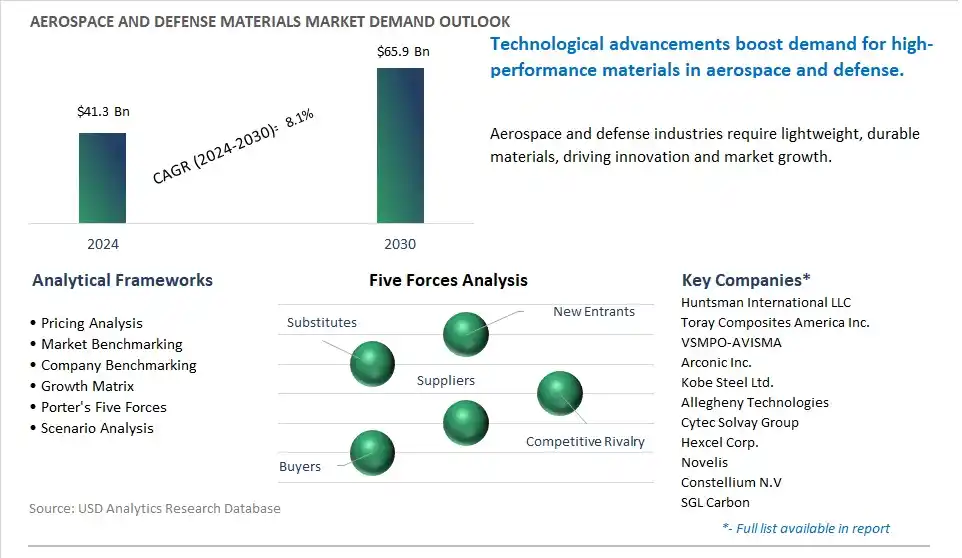
The market report analyses the leading companies in the industry including Huntsman International LLC, Toray Composites America Inc., VSMPO-AVISMA, Arconic Inc., Kobe Steel Ltd., Allegheny Technologies, Cytec Solvay Group, Hexcel Corp., Novelis, Constellium N.V, SGL Carbon, thyssenkrupp Aerospace, Formosa Plastics Corp., Strata Manufacturing PJSC, Teijin Ltd..
A prominent market trend for aerospace and defense materials is the increasing demand for lightweight and high-performance materials. With advancements in aircraft and defense system technologies, there's a growing emphasis on materials that offer superior strength-to-weight ratios, durability, and resistance to extreme conditions. Manufacturers in the aerospace and defense sectors are increasingly turning to advanced composite materials, such as carbon fiber reinforced polymers (CFRP), titanium alloys, and ceramic matrix composites (CMC), to achieve weight savings, fuel efficiency, and enhanced performance capabilities. This trend is driven by the need to improve aircraft fuel efficiency, increase payload capacity, and enhance the maneuverability and survivability of military equipment.
A significant driver for the aerospace and defense materials market is technological advancements and innovation in aerospace and defense applications. As aerospace and defense technologies evolve to meet changing mission requirements and emerging threats, there's a continuous demand for materials that can withstand high temperatures, corrosive environments, and ballistic impacts. Advanced materials play a critical role in enabling next-generation aircraft, spacecraft, missiles, and armored vehicles to achieve higher performance levels, improved safety margins, and mission success. The pursuit of technological superiority and military modernization programs worldwide further accelerates the demand for innovative materials that offer enhanced capabilities and operational effectiveness.
An opportunity for the aerospace and defense materials market lies in the development of sustainable and environmentally friendly materials. With growing concerns about environmental sustainability and carbon emissions, there's increasing pressure on aerospace and defense industries to adopt greener manufacturing practices and reduce their environmental footprint. Manufacturers have the opportunity to innovate and develop materials that offer comparable performance to traditional materials but with lower environmental impact. This includes exploring bio-based composites, recyclable alloys, and eco-friendly surface treatments that minimize waste, energy consumption, and greenhouse gas emissions throughout the product lifecycle. By embracing sustainability and environmental stewardship, aerospace and defense material suppliers can differentiate themselves in the market, meet regulatory requirements, and contribute to a more sustainable future for the industry.
The largest segment in the Aerospace and Defense Materials Market is the Composites product segment. This dominance can be attributed to diverse factors. The composites offer significant advantages over traditional materials such as aluminum, titanium, and steel in aerospace and defense applications. Composites are lightweight yet strong, providing high strength-to-weight ratios and excellent fatigue resistance, which are critical for reducing fuel consumption and enhancing performance in aircraft and defense systems. Additionally, composites offer design flexibility, allowing for complex shapes, integrated structures, and tailored properties to meet specific performance requirements. In addition, composites exhibit superior corrosion resistance, thermal stability, and electromagnetic properties compared to metallic materials, making them suitable for a wide range of aerospace and defense applications, including aircraft structures, interiors, radomes, missiles, and unmanned aerial vehicles (UAVs). Further, advancements in composite manufacturing technologies, such as resin infusion, automated layup, and additive manufacturing, have improved production efficiency, quality control, and cost-effectiveness, further driving the adoption of composites in the aerospace and defense industries. With their superior performance characteristics, versatility, and widespread applications, the Composites product segment remains the largest in the Aerospace and Defense Materials Market.
The fastest-growing segment in the Aerospace and Defense Materials Market is the Satellites application segment. The rapid growth is driven by there is a growing demand for satellites worldwide, driven by increased investments in space exploration, satellite communications, Earth observation, navigation, and remote sensing applications. Satellites play a crucial role in various sectors, including telecommunications, broadcasting, weather forecasting, environmental monitoring, national security, and scientific research. Additionally, the development of small satellites, including nano-satellites and micro-satellites, has expanded the satellite market, enabling cost-effective solutions for a wide range of commercial and government applications. In addition, advancements in satellite technology, including miniaturization, increased payload capacity, and improved performance, have led to the development of sophisticated satellite systems with enhanced capabilities and functionalities. Further, the space industry's shift towards reusable launch vehicles, space tourism, and lunar exploration initiatives drives the demand for innovative materials and technologies to meet the rigorous requirements of space missions. Aerospace and defense materials play a critical role in satellite design and construction, providing lightweight, durable, and reliable solutions for structural components, thermal protection, radiation shielding, and electronics packaging. With the increasing demand for satellites and the continuous advancements in satellite technology, the Satellites application segment is the fastest-growing segment in the Aerospace and Defense Materials Market.
The fastest-growing segment in the Aerospace and Defense Materials Market is the Commercial aircraft type segment. The rapid growth is driven by there is a significant increase in air travel demand worldwide, driven by factors such as economic growth, rising disposable incomes, expanding middle-class populations, and increasing urbanization. As a result, airlines are expanding their fleets and placing orders for new commercial aircraft to meet growing passenger and cargo transportation needs. Additionally, the aviation industry is witnessing a shift towards more fuel-efficient and environmentally friendly aircraft models, such as next-generation narrow-body and wide-body aircraft equipped with advanced composite materials, lightweight structures, and efficient propulsion systems. These modern aircraft designs offer improved fuel efficiency, reduced emissions, and lower operating costs, making them attractive options for airlines seeking to optimize their fleets and comply with stringent environmental regulations. In addition, advancements in aerospace materials technology, including carbon fiber composites, titanium alloys, and advanced aluminum alloys, enable the development of lighter, stronger, and more durable aircraft structures, components, and systems. These materials offer superior performance characteristics, such as high strength-to-weight ratios, corrosion resistance, and fatigue resistance, contributing to the Over the forecast period efficiency, safety, and reliability of commercial aircraft. Further, the growing emphasis on passenger comfort, cabin amenities, and in-flight entertainment drives the demand for innovative materials and interior solutions in commercial aircraft cabin interiors, seating, and entertainment systems. With the continuous growth in air travel demand and the increasing adoption of advanced materials and technologies in commercial aviation, the Commercial aircraft type segment is the fastest-growing segment in the Aerospace and Defense Materials Market.
By Product
Aluminum
Titanium
Composites
Superalloys
Steel
Plastic
Others
By Application
Aerostructure
Components
Cabin Interiors
Propulsion System
Equipment, System, & Support
Satellites
Construction & Insulation Components
By Aircraft Type
Commercial
Business & General Aviation
Military
Others
Regions Included
North America (US, Canada, Mexico)
Europe (Germany, UK, France, Spain, Italy, Russia, Rest of Europe)
Asia Pacific (China, India, Japan, South Korea, Australia, South East Asia, Rest of Asia)
South America (Brazil, Argentina, Rest of South America)
Middle East and Africa (Saudi Arabia, UAE, Rest of Middle East, South Africa, Egypt, Rest of Africa)
Huntsman International LLC
Toray Composites America Inc.
VSMPO-AVISMA
Arconic Inc.
Kobe Steel Ltd.
Allegheny Technologies
Cytec Solvay Group
Hexcel Corp.
Novelis
Constellium N.V
SGL Carbon
thyssenkrupp Aerospace
Formosa Plastics Corp.
Strata Manufacturing PJSC
Teijin Ltd.
*- List Not Exhaustive
TABLE OF CONTENTS
1 Introduction to 2024 Aerospace and Defense Materials Market
1.1 Market Overview
1.2 Quick Facts
1.3 Scope/Objective of the Study
1.4 Market Definition
1.5 Countries and Regions Covered
1.6 Units, Currency, and Conversions
1.7 Industry Value Chain
2 Research Methodology
2.1 Market Size Estimation
2.2 Sources and Research Methodology
2.3 Data Triangulation
2.4 Assumptions and Limitations
3 Executive Summary
3.1 Global Aerospace and Defense Materials Market Size Outlook, $ Million, 2021 to 2030
3.2 Aerospace and Defense Materials Market Outlook by Type, $ Million, 2021 to 2030
3.3 Aerospace and Defense Materials Market Outlook by Product, $ Million, 2021 to 2030
3.4 Aerospace and Defense Materials Market Outlook by Application, $ Million, 2021 to 2030
3.5 Aerospace and Defense Materials Market Outlook by Key Countries, $ Million, 2021 to 2030
4 Market Dynamics
4.1 Key Driving Forces of Aerospace and Defense Materials Industry
4.2 Key Market Trends in Aerospace and Defense Materials Industry
4.3 Potential Opportunities in Aerospace and Defense Materials Industry
4.4 Key Challenges in Aerospace and Defense Materials Industry
5 Market Factor Analysis
5.1 Value Chain Analysis
5.2 Competitive Landscape
5.2.1 Global Aerospace and Defense Materials Market Share by Company (%), 2023
5.2.2 Product Offerings by Company
5.3 Porter’s Five Forces Analysis
5.4 Pricing Analysis and Outlook
6 Growth Outlook Across Scenarios
6.1 Growth Analysis-Case Scenario Definitions
6.2 Low Growth Scenario Forecasts
6.3 Reference Growth Scenario Forecasts
6.4 High Growth Scenario Forecasts
7 Global Aerospace and Defense Materials Market Outlook by Segments
7.1 Aerospace and Defense Materials Market Outlook by Segments, $ Million, 2021- 2030
By Product
Aluminum
Titanium
Composites
Superalloys
Steel
Plastic
Others
By Application
Aerostructure
Components
Cabin Interiors
Propulsion System
Equipment, System, & Support
Satellites
Construction & Insulation Components
By Aircraft Type
Commercial
Business & General Aviation
Military
Others
8 North America Aerospace and Defense Materials Market Analysis and Outlook To 2030
8.1 Introduction to North America Aerospace and Defense Materials Markets in 2024
8.2 North America Aerospace and Defense Materials Market Size Outlook by Country, 2021-2030
8.2.1 United States
8.2.2 Canada
8.2.3 Mexico
8.3 North America Aerospace and Defense Materials Market size Outlook by Segments, 2021-2030
By Product
Aluminum
Titanium
Composites
Superalloys
Steel
Plastic
Others
By Application
Aerostructure
Components
Cabin Interiors
Propulsion System
Equipment, System, & Support
Satellites
Construction & Insulation Components
By Aircraft Type
Commercial
Business & General Aviation
Military
Others
9 Europe Aerospace and Defense Materials Market Analysis and Outlook To 2030
9.1 Introduction to Europe Aerospace and Defense Materials Markets in 2024
9.2 Europe Aerospace and Defense Materials Market Size Outlook by Country, 2021-2030
9.2.1 Germany
9.2.2 France
9.2.3 Spain
9.2.4 United Kingdom
9.2.4 Italy
9.2.5 Russia
9.2.6 Norway
9.2.7 Rest of Europe
9.3 Europe Aerospace and Defense Materials Market Size Outlook by Segments, 2021-2030
By Product
Aluminum
Titanium
Composites
Superalloys
Steel
Plastic
Others
By Application
Aerostructure
Components
Cabin Interiors
Propulsion System
Equipment, System, & Support
Satellites
Construction & Insulation Components
By Aircraft Type
Commercial
Business & General Aviation
Military
Others
10 Asia Pacific Aerospace and Defense Materials Market Analysis and Outlook To 2030
10.1 Introduction to Asia Pacific Aerospace and Defense Materials Markets in 2024
10.2 Asia Pacific Aerospace and Defense Materials Market Size Outlook by Country, 2021-2030
10.2.1 China
10.2.2 India
10.2.3 Japan
10.2.4 South Korea
10.2.5 Indonesia
10.2.6 Malaysia
10.2.7 Australia
10.2.8 Rest of Asia Pacific
10.3 Asia Pacific Aerospace and Defense Materials Market size Outlook by Segments, 2021-2030
By Product
Aluminum
Titanium
Composites
Superalloys
Steel
Plastic
Others
By Application
Aerostructure
Components
Cabin Interiors
Propulsion System
Equipment, System, & Support
Satellites
Construction & Insulation Components
By Aircraft Type
Commercial
Business & General Aviation
Military
Others
11 South America Aerospace and Defense Materials Market Analysis and Outlook To 2030
11.1 Introduction to South America Aerospace and Defense Materials Markets in 2024
11.2 South America Aerospace and Defense Materials Market Size Outlook by Country, 2021-2030
11.2.1 Brazil
11.2.2 Argentina
11.2.3 Rest of South America
11.3 South America Aerospace and Defense Materials Market size Outlook by Segments, 2021-2030
By Product
Aluminum
Titanium
Composites
Superalloys
Steel
Plastic
Others
By Application
Aerostructure
Components
Cabin Interiors
Propulsion System
Equipment, System, & Support
Satellites
Construction & Insulation Components
By Aircraft Type
Commercial
Business & General Aviation
Military
Others
12 Middle East and Africa Aerospace and Defense Materials Market Analysis and Outlook To 2030
12.1 Introduction to Middle East and Africa Aerospace and Defense Materials Markets in 2024
12.2 Middle East and Africa Aerospace and Defense Materials Market Size Outlook by Country, 2021-2030
12.2.1 Saudi Arabia
12.2.2 UAE
12.2.3 Oman
12.2.4 Rest of Middle East
12.2.5 Egypt
12.2.6 Nigeria
12.2.7 South Africa
12.2.8 Rest of Africa
12.3 Middle East and Africa Aerospace and Defense Materials Market size Outlook by Segments, 2021-2030
By Product
Aluminum
Titanium
Composites
Superalloys
Steel
Plastic
Others
By Application
Aerostructure
Components
Cabin Interiors
Propulsion System
Equipment, System, & Support
Satellites
Construction & Insulation Components
By Aircraft Type
Commercial
Business & General Aviation
Military
Others
13 Company Profiles
13.1 Company Snapshot
13.2 SWOT Profiles
13.3 Products and Services
13.4 Recent Developments
13.5 Financial Profile
Huntsman International LLC
Toray Composites America Inc.
VSMPO-AVISMA
Arconic Inc.
Kobe Steel Ltd.
Allegheny Technologies
Cytec Solvay Group
Hexcel Corp.
Novelis
Constellium N.V
SGL Carbon
thyssenkrupp Aerospace
Formosa Plastics Corp.
Strata Manufacturing PJSC
Teijin Ltd.
14 Appendix
14.1 Customization Offerings
14.2 Subscription Services
14.3 Related Reports
14.4 Publisher Expertise
By Product
Aluminum
Titanium
Composites
Superalloys
Steel
Plastic
Others
By Application
Aerostructure
Components
Cabin Interiors
Propulsion System
Equipment, System, & Support
Satellites
Construction & Insulation Components
By Aircraft Type
Commercial
Business & General Aviation
Military
Others
Countries Analyzed
North America (US, Canada, Mexico)
Europe (Germany, UK, France, Spain, Italy, Russia, Rest of Europe)
Asia Pacific (China, India, Japan, South Korea, Australia, South East Asia, Rest of Asia)
South America (Brazil, Argentina, Rest of South America)
Middle East and Africa (Saudi Arabia, UAE, Rest of Middle East, South Africa, Egypt, Rest of Africa)
Global Aerospace and Defense Materials is forecast to reach $65.9 Billion in 2030 from $41.3 Billion in 2024, registering a CAGR of 8.1%
Emerging Markets across Asia Pacific, Europe, and Americas present robust growth prospects.
Huntsman International LLC, Toray Composites America Inc., VSMPO-AVISMA, Arconic Inc., Kobe Steel Ltd., Allegheny Technologies, Cytec Solvay Group, Hexcel Corp., Novelis, Constellium N.V, SGL Carbon, thyssenkrupp Aerospace, Formosa Plastics Corp., Strata Manufacturing PJSC, Teijin Ltd.
Base Year- 2023; Estimated Year- 2024; Historic Period- 2018-2023; Forecast period- 2024 to 2030; Currency: Revenue (USD); Volume