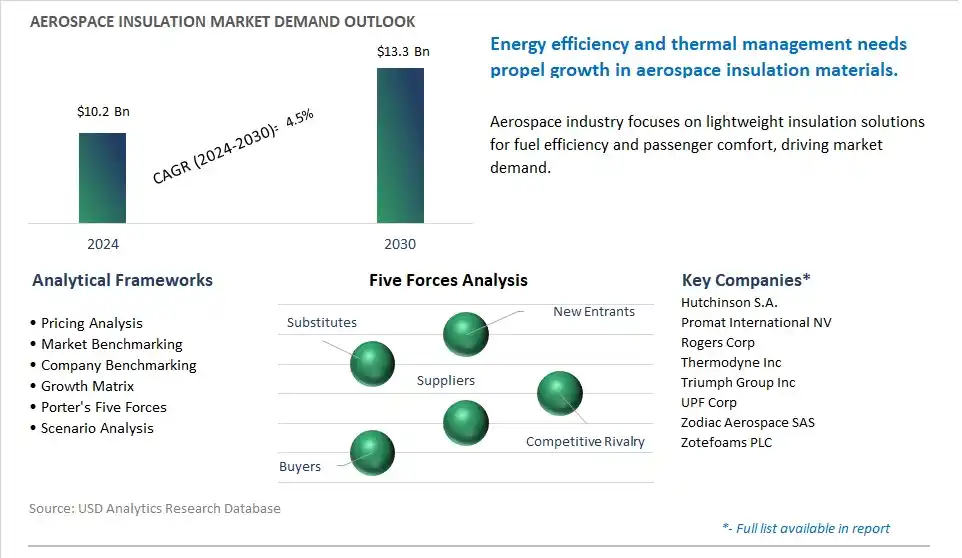
The global Aerospace Insulation Market is poised to register a 4.5% CAGR from $10.2 Billion in 2024 to $13.3 Billion in 2030.
The global Aerospace Insulation Market Study analyzes and forecasts the market size across 6 regions and 24 countries for diverse segments -By Material (Ceramic Materials, Mineral Wool, Foamed Plastic, Fiberglass, Others), By Product (Thermal Insulation, Acoustic Insulation, Electric Insulation), By Application (Engine, Aerostructure), By End-User (Commercial, Military, Business & General Aviation, Others).
An Introduction to Global Aerospace Insulation Market in 2024
The aerospace insulation market is experiencing notable growth driven by increasing demand for thermal and acoustic insulation solutions in aircraft cabins, engines, and cargo compartments. Key trends shaping the future of the industry include the growing adoption of lightweight insulation materials such as aerogels, ceramic fibers, and composite blankets to meet stringent weight restrictions while providing excellent thermal performance and noise reduction. Moreover, there's a rising emphasis on fire safety and environmental sustainability, leading to innovations in insulation coatings, intumescent materials, and low-smoke additives to enhance fire resistance and reduce toxic emissions. Additionally, advancements in insulation installation techniques, sealants, and vapor barriers are driving innovation and market expansion, enabling aerospace manufacturers and suppliers to offer efficient, cost-effective, and compliant insulation solutions for new aircraft designs and retrofit projects in the global aerospace insulation market.
Aerospace Insulation Market Competitive Landscape
The market report analyses the leading companies in the industry including Hutchinson S.A., Promat International NV, Rogers Corp, Thermodyne Inc, Triumph Group Inc, UPF Corp, Zodiac Aerospace SAS, Zotefoams PLC.
Aerospace Insulation Market Dynamics
Aerospace Insulation Market Trend: Demand for Lightweight and Thermal Insulation Materials
A prominent market trend for aerospace insulation is the increasing demand for lightweight and thermal insulation materials. With aircraft manufacturers continuously seeking to reduce weight and improve fuel efficiency, there's a growing need for insulation materials that offer effective thermal protection while being lightweight. Advanced insulation materials such as aerogels, ceramic fiber blankets, and thermal barrier coatings are gaining popularity due to their low density, high thermal resistance, and compatibility with aerospace applications. The trend towards lightweight insulation solutions reflects the industry's ongoing efforts to optimize aircraft performance, enhance passenger comfort, and meet stringent regulatory requirements.
Aerospace Insulation Market Driver: Stringent Safety and Regulatory Standards
A significant driver for the aerospace insulation market is the presence of stringent safety and regulatory standards. Aerospace regulations mandate the use of insulation materials that meet specific performance criteria, including fire resistance, smoke toxicity, and thermal stability, to ensure the safety and integrity of aircraft structures and systems. As safety remains a top priority for aircraft operators, manufacturers, and regulatory authorities, there's a continuous demand for insulation materials that comply with industry standards such as Federal Aviation Administration (FAA) regulations and European Aviation Safety Agency (EASA) guidelines. Compliance with safety and regulatory requirements drives market demand for aerospace insulation products and services, supporting the growth of the industry and driving innovation in insulation technology.
Aerospace Insulation Market Opportunity: Development of Advanced Multi-Functional Insulation Solutions
An opportunity for the aerospace insulation market lies in the development of advanced multi-functional insulation solutions. As aircraft design and operations become increasingly complex, there's a growing demand for insulation materials that offer additional functionalities beyond thermal protection. Manufacturers have the opportunity to innovate and develop insulation materials with integrated features such as acoustic damping, electromagnetic shielding, and vibration dampening properties. Multi-functional insulation solutions can enhance cabin comfort, reduce noise levels, and improve electromagnetic compatibility (EMC) in aircraft systems, addressing multiple performance requirements in a single material. By investing in research and development initiatives and collaborating with industry partners, aerospace insulation manufacturers can capitalize on the demand for advanced multi-functional solutions, differentiate their products in the market, and expand their customer base in the aerospace industry.
Aerospace Insulation Market Share Analysis: Foamed Plastic material segment generated the highest revenue in the industry
The largest segment in the Aerospace Insulation Market is the Foamed Plastic material category. This dominance can be attributed to diverse factors. The foamed plastic insulation materials offer a unique combination of lightweight properties, thermal insulation capabilities, and ease of installation, making them highly suitable for aerospace applications where weight reduction and space-saving are critical considerations. Aircraft manufacturers and operators prioritize materials that provide effective thermal insulation while minimizing Over the forecast period weight to enhance fuel efficiency and performance. Foamed plastic insulation meets these requirements by offering excellent thermal resistance properties while being significantly lighter than traditional insulation materials such as ceramic materials and mineral wool. Additionally, foamed plastic insulation can be easily molded and fabricated to fit complex shapes and contours within aircraft structures, including fuselage, wings, and interior compartments, ensuring efficient use of available space and optimal thermal performance. In addition, foamed plastic insulation materials exhibit good fire resistance properties, meeting stringent aviation safety regulations and standards. Further, advancements in foamed plastic insulation technology, including improved formulations, manufacturing processes, and sustainability initiatives, have further bolstered their adoption in the aerospace industry. With their lightweight, thermal insulation properties, versatility, and compliance with aviation safety standards, foamed plastic insulation materials remain the largest segment in the Aerospace Insulation Market.
Aerospace Insulation Market Share Analysis: Thermal Insulation product Segment is poised to register the fastest growth rate (CAGR) over the forecast period to 2030
The fastest-growing segment in the Aerospace Insulation Market is thermal Insulation product category. Diverse factors contribute to this growth. The thermal insulation is essential for regulating temperature within aircraft structures and components, ensuring the comfort of passengers and crew, as well as protecting sensitive equipment and systems from temperature extremes. With the increasing demand for fuel-efficient aircraft designs, there is a growing emphasis on lightweight thermal insulation materials that can effectively manage heat transfer while minimizing added weight to the aircraft. Thermal insulation materials are used in various areas of aircraft construction, including the fuselage, wings, engines, and cargo compartments, to maintain desired temperature levels and prevent heat loss or gain. Additionally, advancements in aerospace technology and materials science have led to the development of innovative thermal insulation solutions that offer improved thermal performance, durability, and fire resistance properties. These advanced thermal insulation materials, such as aerogels, ceramic fibers, and composite laminates, meet the stringent requirements of modern aircraft designs and contribute to enhanced energy efficiency and operational performance. In addition, the aerospace industry's focus on passenger comfort, cabin insulation, and noise reduction drives the demand for thermal insulation materials that offer additional benefits such as acoustic insulation properties. Further, the increasing adoption of electric propulsion systems and avionics in next-generation aircraft designs necessitates the use of electric insulation materials to protect wiring, cables, and electrical components from heat and electromagnetic interference. With the continuous advancements in aerospace technology and the growing demand for lightweight, high-performance thermal insulation solutions, thermal Insulation product segment is the fastest-growing segment in the Aerospace Insulation Market.
Aerospace Insulation Market Share Analysis: Aerostructure application Segment is poised to register the fastest growth rate (CAGR) over the forecast period to 2030
The fastest-growing segment in the Aerospace Insulation Market is the Aerostructure application category. The rapid growth is driven by aerostructures, which include aircraft fuselages, wings, and other structural components, require insulation materials to provide thermal protection, maintain internal temperature stability, and enhance Over the forecast period structural integrity. With the increasing demand for lightweight aircraft designs to improve fuel efficiency and reduce emissions, there is a growing need for innovative insulation solutions that offer effective thermal management while minimizing added weight to the aircraft structure. Aerostructure insulation materials play a crucial role in optimizing aircraft performance, ensuring passenger comfort, and protecting critical systems and components from temperature extremes. Additionally, advancements in aerospace materials and manufacturing technologies have led to the development of lightweight, high-performance insulation materials specifically designed for aerostructure applications. These advanced insulation materials offer superior thermal resistance, fire resistance, and durability properties, meeting the stringent requirements of modern aircraft designs and regulatory standards. In addition, the growing emphasis on aircraft sustainability, environmental compliance, and operational efficiency drives the adoption of insulation materials that offer additional benefits such as acoustic insulation and vibration damping properties. Further, the ongoing modernization and replacement cycles in the global aviation industry fuel the demand for insulation materials for new aircraft production, as well as retrofit and upgrade projects. With the increasing focus on lightweight, high-performance insulation solutions for aerostructure applications, the Aerostructure segment is the fastest-growing segment in the Aerospace Insulation Market.
Aerospace Insulation Market Report Segmentation
By Material
Ceramic Materials
Mineral Wool
Foamed Plastic
Fiberglass
Others
By Product
Thermal Insulation
Acoustic Insulation
Electric Insulation
By Application
Engine
Aerostructure
By End-User
Commercial
Military
Business & General Aviation
Others
Regions Included
North America (US, Canada, Mexico)
Europe (Germany, UK, France, Spain, Italy, Russia, Rest of Europe)
Asia Pacific (China, India, Japan, South Korea, Australia, South East Asia, Rest of Asia)
South America (Brazil, Argentina, Rest of South America)
Middle East and Africa (Saudi Arabia, UAE, Rest of Middle East, South Africa, Egypt, Rest of Africa)
Aerospace Insulation Companies Profiled in the Market Study
Hutchinson S.A.
Promat International NV
Rogers Corp
Thermodyne Inc
Triumph Group Inc
UPF Corp
Zodiac Aerospace SAS
Zotefoams PLC
*- List Not Exhaustive
TABLE OF CONTENTS
1 Introduction to 2024 Aerospace Insulation Market
1.1 Market Overview
1.2 Quick Facts
1.3 Scope/Objective of the Study
1.4 Market Definition
1.5 Countries and Regions Covered
1.6 Units, Currency, and Conversions
1.7 Industry Value Chain
2 Research Methodology
2.1 Market Size Estimation
2.2 Sources and Research Methodology
2.3 Data Triangulation
2.4 Assumptions and Limitations
3 Executive Summary
3.1 Global Aerospace Insulation Market Size Outlook, $ Million, 2021 to 2030
3.2 Aerospace Insulation Market Outlook by Type, $ Million, 2021 to 2030
3.3 Aerospace Insulation Market Outlook by Product, $ Million, 2021 to 2030
3.4 Aerospace Insulation Market Outlook by Application, $ Million, 2021 to 2030
3.5 Aerospace Insulation Market Outlook by Key Countries, $ Million, 2021 to 2030
4 Market Dynamics
4.1 Key Driving Forces of Aerospace Insulation Industry
4.2 Key Market Trends in Aerospace Insulation Industry
4.3 Potential Opportunities in Aerospace Insulation Industry
4.4 Key Challenges in Aerospace Insulation Industry
5 Market Factor Analysis
5.1 Value Chain Analysis
5.2 Competitive Landscape
5.2.1 Global Aerospace Insulation Market Share by Company (%), 2023
5.2.2 Product Offerings by Company
5.3 Porter’s Five Forces Analysis
5.4 Pricing Analysis and Outlook
6 Growth Outlook Across Scenarios
6.1 Growth Analysis-Case Scenario Definitions
6.2 Low Growth Scenario Forecasts
6.3 Reference Growth Scenario Forecasts
6.4 High Growth Scenario Forecasts
7 Global Aerospace Insulation Market Outlook by Segments
7.1 Aerospace Insulation Market Outlook by Segments, $ Million, 2021- 2030
By Material
Ceramic Materials
Mineral Wool
Foamed Plastic
Fiberglass
Others
By Product
Thermal Insulation
Acoustic Insulation
Electric Insulation
By Application
Engine
Aerostructure
By End-User
Commercial
Military
Business & General Aviation
Others
8 North America Aerospace Insulation Market Analysis and Outlook To 2030
8.1 Introduction to North America Aerospace Insulation Markets in 2024
8.2 North America Aerospace Insulation Market Size Outlook by Country, 2021-2030
8.2.1 United States
8.2.2 Canada
8.2.3 Mexico
8.3 North America Aerospace Insulation Market size Outlook by Segments, 2021-2030
By Material
Ceramic Materials
Mineral Wool
Foamed Plastic
Fiberglass
Others
By Product
Thermal Insulation
Acoustic Insulation
Electric Insulation
By Application
Engine
Aerostructure
By End-User
Commercial
Military
Business & General Aviation
Others
9 Europe Aerospace Insulation Market Analysis and Outlook To 2030
9.1 Introduction to Europe Aerospace Insulation Markets in 2024
9.2 Europe Aerospace Insulation Market Size Outlook by Country, 2021-2030
9.2.1 Germany
9.2.2 France
9.2.3 Spain
9.2.4 United Kingdom
9.2.4 Italy
9.2.5 Russia
9.2.6 Norway
9.2.7 Rest of Europe
9.3 Europe Aerospace Insulation Market Size Outlook by Segments, 2021-2030
By Material
Ceramic Materials
Mineral Wool
Foamed Plastic
Fiberglass
Others
By Product
Thermal Insulation
Acoustic Insulation
Electric Insulation
By Application
Engine
Aerostructure
By End-User
Commercial
Military
Business & General Aviation
Others
10 Asia Pacific Aerospace Insulation Market Analysis and Outlook To 2030
10.1 Introduction to Asia Pacific Aerospace Insulation Markets in 2024
10.2 Asia Pacific Aerospace Insulation Market Size Outlook by Country, 2021-2030
10.2.1 China
10.2.2 India
10.2.3 Japan
10.2.4 South Korea
10.2.5 Indonesia
10.2.6 Malaysia
10.2.7 Australia
10.2.8 Rest of Asia Pacific
10.3 Asia Pacific Aerospace Insulation Market size Outlook by Segments, 2021-2030
By Material
Ceramic Materials
Mineral Wool
Foamed Plastic
Fiberglass
Others
By Product
Thermal Insulation
Acoustic Insulation
Electric Insulation
By Application
Engine
Aerostructure
By End-User
Commercial
Military
Business & General Aviation
Others
11 South America Aerospace Insulation Market Analysis and Outlook To 2030
11.1 Introduction to South America Aerospace Insulation Markets in 2024
11.2 South America Aerospace Insulation Market Size Outlook by Country, 2021-2030
11.2.1 Brazil
11.2.2 Argentina
11.2.3 Rest of South America
11.3 South America Aerospace Insulation Market size Outlook by Segments, 2021-2030
By Material
Ceramic Materials
Mineral Wool
Foamed Plastic
Fiberglass
Others
By Product
Thermal Insulation
Acoustic Insulation
Electric Insulation
By Application
Engine
Aerostructure
By End-User
Commercial
Military
Business & General Aviation
Others
12 Middle East and Africa Aerospace Insulation Market Analysis and Outlook To 2030
12.1 Introduction to Middle East and Africa Aerospace Insulation Markets in 2024
12.2 Middle East and Africa Aerospace Insulation Market Size Outlook by Country, 2021-2030
12.2.1 Saudi Arabia
12.2.2 UAE
12.2.3 Oman
12.2.4 Rest of Middle East
12.2.5 Egypt
12.2.6 Nigeria
12.2.7 South Africa
12.2.8 Rest of Africa
12.3 Middle East and Africa Aerospace Insulation Market size Outlook by Segments, 2021-2030
By Material
Ceramic Materials
Mineral Wool
Foamed Plastic
Fiberglass
Others
By Product
Thermal Insulation
Acoustic Insulation
Electric Insulation
By Application
Engine
Aerostructure
By End-User
Commercial
Military
Business & General Aviation
Others
13 Company Profiles
13.1 Company Snapshot
13.2 SWOT Profiles
13.3 Products and Services
13.4 Recent Developments
13.5 Financial Profile
Hutchinson S.A.
Promat International NV
Rogers Corp
Thermodyne Inc
Triumph Group Inc
UPF Corp
Zodiac Aerospace SAS
Zotefoams PLC
14 Appendix
14.1 Customization Offerings
14.2 Subscription Services
14.3 Related Reports
14.4 Publisher Expertise
By Material
Ceramic Materials
Mineral Wool
Foamed Plastic
Fiberglass
Others
By Product
Thermal Insulation
Acoustic Insulation
Electric Insulation
By Application
Engine
Aerostructure
By End-User
Commercial
Military
Business & General Aviation
Others
Countries Analyzed
North America (US, Canada, Mexico)
Europe (Germany, UK, France, Spain, Italy, Russia, Rest of Europe)
Asia Pacific (China, India, Japan, South Korea, Australia, South East Asia, Rest of Asia)
South America (Brazil, Argentina, Rest of South America)
Middle East and Africa (Saudi Arabia, UAE, Rest of Middle East, South Africa, Egypt, Rest of Africa)
