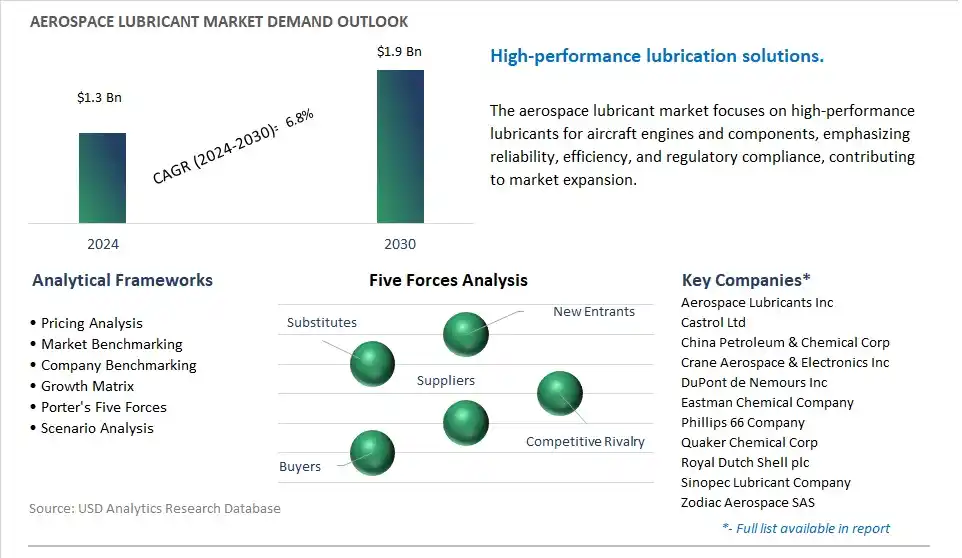
The global Aerospace Lubricant Market is poised to register a 6.8% CAGR from $1.3 Billion in 2024 to $1.9 Billion in 2030.
The global Aerospace Lubricant Market Study analyzes and forecasts the market size across 6 regions and 24 countries for diverse segments -By Type (Gas Turbine Oil, Grease, Piston Engine Oil, Others), By Application (Civil Aviation, Defense, Space, Others), By End-User (Chemical & Petrochemical, Oil & Gas, Energy & Power, Automotive, Food & Beverages, Healthcare, Others).
An Introduction to Global Aerospace Lubricant Market in 2024
The market for aerospace lubricants plays a critical role in ensuring the performance, efficiency, and reliability of aircraft engines, landing gear, and other critical components operating in extreme environments. Key trends shaping the future of this industry include the development of advanced lubricant formulations with improved thermal stability, oxidation resistance, and wear protection, capable of withstanding high temperatures, pressures, and speeds encountered during flight. Additionally, the adoption of synthetic and biodegradable lubricants reduces environmental impact and extends maintenance intervals, reducing operational costs and enhancing sustainability. Moreover, the integration of condition monitoring sensors and predictive maintenance algorithms enables real-time monitoring of lubricant performance and component health, optimizing maintenance schedules and minimizing unplanned downtime. As aerospace manufacturers strive to improve fuel efficiency, reduce emissions, and enhance aircraft reliability, the demand for high-performance lubricants tailored to the unique requirements of aviation applications is expected to continue growing, driving innovation and market expansion in this sector.
Aerospace Lubricant Market Competitive Landscape
The market report analyses the leading companies in the industry including Aerospace Lubricants Inc, Castrol Ltd, China Petroleum & Chemical Corp, Crane Aerospace & Electronics Inc, DuPont de Nemours Inc, Eastman Chemical Company, Phillips 66 Company, Quaker Chemical Corp, Royal Dutch Shell plc, Sinopec Lubricant Company, Zodiac Aerospace SAS.
Aerospace Lubricant Market Dynamics
Aerospace Lubricant Market Trend: Shift Towards Environmentally Friendly Lubricants
Increasing emphasis on environmentally friendly formulations driven by regulatory requirements and sustainability initiatives within the aerospace industry support the market. With growing concerns over the environmental impact of traditional lubricants, aerospace companies are seeking lubricant solutions that offer reduced toxicity, biodegradability, and minimal environmental footprint. Manufacturers are developing lubricants that meet stringent regulatory standards while providing superior performance and protection for aerospace components and systems.
Aerospace Lubricant Market Driver: Aircraft Fleet Expansion and Modernization
As airlines and aircraft operators expand their fleets to meet growing demand for air travel, and as existing aircraft undergo modernization and upgrades, there is a corresponding increase in demand for high-performance lubricants to support maintenance, repair, and overhaul (MRO) activities. Aerospace lubricants play a critical role in ensuring the smooth operation, reliability, and longevity of aircraft engines, landing gear, hydraulic systems, and other critical components. The growth of the aerospace industry and the need for lubricants that meet the performance requirements of modern aircraft drive market demand for aerospace lubricants.
Aerospace Lubricant Market Opportunity: Development of Specialty Lubricant Formulations
With the advancement of aircraft technology and the introduction of new materials and components, there is a growing demand for lubricants that can withstand higher temperatures, pressures, and operating conditions. Manufacturers aim to capitalize on this opportunity by developing specialty lubricants for applications such as high-speed bearings, composite materials, and extreme temperature environments. Additionally, there is potential for the development of lubricants with advanced properties such as self-healing, anti-wear, and corrosion resistance to enhance the performance and reliability of aerospace systems. By focusing on innovation and addressing the evolving needs of the aerospace industry, lubricant manufacturers aim to capture new opportunities for growth in the aerospace lubricant sector.
Aerospace Lubricant Market Ecosystem
The Aerospace Lubricant industry involves diverse key stages, including base stock production, where companies including Exxon Mobil Corporation and Shell plc refine crude oil into high-purity mineral base oils or produce synthetic base stocks. Specialty chemical companies including The Dow Chemical Company and BASF SE manufacture additives to enhance lubricant properties, including extreme pressure performance and corrosion resistance. Independent lubricant blenders, including ExxonMobil and Shell Aviation, blend base stocks with formulated additives to create the final lubricant formulations.
The lubricants are then distributed and sold through channels including industrial distributors including WESCO International, Inc., and dedicated aviation supply divisions of companies including Grainger.
End users including aircraft manufacturers Boeing and airlines including American Airlines Group Inc., utilize aerospace lubricants for various applications in aircraft and aerospace equipment, emphasizing the importance of performance, safety, regulatory compliance, and sustainability throughout the Market Ecosystem.
Aerospace Lubricant Market Share Analysis: Gas Turbine Oil held the dominant revenue share in 2024
The Gas Turbine Oil segment is the largest segment in the Aerospace Lubricant Market due to the critical role of gas turbine engines in various aerospace applications, including commercial aviation, military aviation, and aerospace manufacturing. Gas turbine engines power a wide range of aircraft, from small business jets to large commercial airliners and military fighter jets. These engines operate under extreme conditions of high temperatures, pressures, and rotational speeds, requiring specialized lubricants to ensure smooth and efficient performance while mitigating wear, corrosion, and oxidation. Gas turbine oils are formulated with advanced additives and base oils to withstand the demanding operating environments of gas turbine engines, providing excellent lubrication, cooling, and protection against wear and corrosion. Additionally, stringent regulatory standards and OEM specifications mandate the use of high-quality lubricants in gas turbine engines to maintain safety and reliability. As the aerospace industry continues to grow and modernize, with the introduction of new-generation aircraft featuring more efficient and powerful gas turbine engines, the demand for gas turbine oils is expected to remain robust, solidifying its position as the largest segment in the Aerospace Lubricant Market.
Aerospace Lubricant Market Share Analysis: Space is the fastest growing market segment over the forecast period to 2030
The Space segment is the fastest-growing segment in the Aerospace Lubricant Market due to the increasing activities in space exploration, satellite deployment, and commercial space travel. Lubricants play a crucial role in the aerospace industry, ensuring the smooth operation and longevity of critical components in spacecraft, launch vehicles, and satellite systems. In the space environment, where extreme temperatures, vacuum conditions, and high mechanical loads prevail, specialized lubricants are essential to withstand harsh conditions and maintain optimal performance of propulsion systems, mechanisms, and moving parts. With the growing interest and investment in space exploration by government space agencies and private aerospace companies, there is a rising demand for advanced lubricants capable of meeting the unique requirements of space missions. In addition, the proliferation of satellite constellations and the development of reusable launch vehicles necessitate lubricants that can withstand multiple launch and re-entry cycles without compromising performance. As space exploration and commercial space activities continue to expand, the demand for specialized lubricants tailored to the rigors of space environments is expected to experience rapid growth, making the Space segment the fastest-growing segment in the Aerospace Lubricant Market.
Aerospace Lubricant Market Share Analysis: Oil and Gas is the fastest growing market segment over the forecast period to 2030
The Oil and Gas segment is the fastest-growing segment in the Aerospace Lubricant Market due to the increasing demand for lubricants in the exploration, production, refining, and transportation activities within the oil and gas industry. Lubricants play a critical role in maintaining the efficiency, reliability, and longevity of equipment such as pumps, compressors, turbines, and drilling machinery used in upstream, midstream, and downstream operations. With the ongoing expansion of oil and gas exploration and production activities, particularly in offshore and remote locations, there is a heightened need for high-performance lubricants capable of withstanding extreme operating conditions, including high temperatures, pressures, and corrosive environments. Additionally, as oil and gas companies invest in advanced technologies such as hydraulic fracturing (fracking) and deep-water drilling, the demand for specialized lubricants tailored to these applications is expected to surge. In addition, stringent regulatory requirements and environmental concerns drive the adoption of environmentally friendly lubricants in the oil and gas sector, further contributing to the growth of this segment in the Aerospace Lubricant Market.
Aerospace Lubricant Market Report Scope-
By Type
Gas Turbine Oil
Grease
Piston Engine Oil
Others
By Application
Civil Aviation
Defense
Space
Others
By End-User
Chemical & Petrochemical
Oil & Gas
Energy & Power
Automotive
Food & Beverages
Healthcare
Others
Aerospace Lubricant Market Companies Profiled
Aerospace Lubricants Inc
Castrol Ltd
China Petroleum & Chemical Corp
Crane Aerospace & Electronics Inc
DuPont de Nemours Inc
Eastman Chemical Company
Phillips 66 Company
Quaker Chemical Corp
Royal Dutch Shell plc
Sinopec Lubricant Company
Zodiac Aerospace SAS
*- List Not Exhaustive
TABLE OF CONTENTS
1 Introduction to 2024 Aerospace Lubricant Market
1.1 Market Overview
1.2 Quick Facts
1.3 Scope/Objective of the Study
1.4 Market Definition
1.5 Countries and Regions Covered
1.6 Units, Currency, and Conversions
1.7 Industry Value Chain
2 Research Methodology
2.1 Market Size Estimation
2.2 Sources and Research Methodology
2.3 Data Triangulation
2.4 Assumptions and Limitations
3 Executive Summary
3.1 Global Aerospace Lubricant Market Size Outlook, $ Million, 2021 to 2030
3.2 Aerospace Lubricant Market Outlook by Type, $ Million, 2021 to 2030
3.3 Aerospace Lubricant Market Outlook by Product, $ Million, 2021 to 2030
3.4 Aerospace Lubricant Market Outlook by Application, $ Million, 2021 to 2030
3.5 Aerospace Lubricant Market Outlook by Key Countries, $ Million, 2021 to 2030
4 Market Dynamics
4.1 Key Driving Forces of Aerospace Lubricant Industry
4.2 Key Market Trends in Aerospace Lubricant Industry
4.3 Potential Opportunities in Aerospace Lubricant Industry
4.4 Key Challenges in Aerospace Lubricant Industry
5 Market Factor Analysis
5.1 Value Chain Analysis
5.2 Competitive Landscape
5.2.1 Global Aerospace Lubricant Market Share by Company (%), 2023
5.2.2 Product Offerings by Company
5.3 Porter’s Five Forces Analysis
5.4 Pricing Analysis and Outlook
6 Growth Outlook Across Scenarios
6.1 Growth Analysis-Case Scenario Definitions
6.2 Low Growth Scenario Forecasts
6.3 Reference Growth Scenario Forecasts
6.4 High Growth Scenario Forecasts
7 Global Aerospace Lubricant Market Outlook by Segments
7.1 Aerospace Lubricant Market Outlook by Segments, $ Million, 2021- 2030
By Type
Gas Turbine Oil
Grease
Piston Engine Oil
Others
By Application
Civil Aviation
Defense
Space
Others
By End-User
Chemical & Petrochemical
Oil & Gas
Energy & Power
Automotive
Food & Beverages
Healthcare
Others
8 North America Aerospace Lubricant Market Analysis and Outlook To 2030
8.1 Introduction to North America Aerospace Lubricant Markets in 2024
8.2 North America Aerospace Lubricant Market Size Outlook by Country, 2021-2030
8.2.1 United States
8.2.2 Canada
8.2.3 Mexico
8.3 North America Aerospace Lubricant Market size Outlook by Segments, 2021-2030
By Type
Gas Turbine Oil
Grease
Piston Engine Oil
Others
By Application
Civil Aviation
Defense
Space
Others
By End-User
Chemical & Petrochemical
Oil & Gas
Energy & Power
Automotive
Food & Beverages
Healthcare
Others
9 Europe Aerospace Lubricant Market Analysis and Outlook To 2030
9.1 Introduction to Europe Aerospace Lubricant Markets in 2024
9.2 Europe Aerospace Lubricant Market Size Outlook by Country, 2021-2030
9.2.1 Germany
9.2.2 France
9.2.3 Spain
9.2.4 United Kingdom
9.2.4 Italy
9.2.5 Russia
9.2.6 Norway
9.2.7 Rest of Europe
9.3 Europe Aerospace Lubricant Market Size Outlook by Segments, 2021-2030
By Type
Gas Turbine Oil
Grease
Piston Engine Oil
Others
By Application
Civil Aviation
Defense
Space
Others
By End-User
Chemical & Petrochemical
Oil & Gas
Energy & Power
Automotive
Food & Beverages
Healthcare
Others
10 Asia Pacific Aerospace Lubricant Market Analysis and Outlook To 2030
10.1 Introduction to Asia Pacific Aerospace Lubricant Markets in 2024
10.2 Asia Pacific Aerospace Lubricant Market Size Outlook by Country, 2021-2030
10.2.1 China
10.2.2 India
10.2.3 Japan
10.2.4 South Korea
10.2.5 Indonesia
10.2.6 Malaysia
10.2.7 Australia
10.2.8 Rest of Asia Pacific
10.3 Asia Pacific Aerospace Lubricant Market size Outlook by Segments, 2021-2030
By Type
Gas Turbine Oil
Grease
Piston Engine Oil
Others
By Application
Civil Aviation
Defense
Space
Others
By End-User
Chemical & Petrochemical
Oil & Gas
Energy & Power
Automotive
Food & Beverages
Healthcare
Others
11 South America Aerospace Lubricant Market Analysis and Outlook To 2030
11.1 Introduction to South America Aerospace Lubricant Markets in 2024
11.2 South America Aerospace Lubricant Market Size Outlook by Country, 2021-2030
11.2.1 Brazil
11.2.2 Argentina
11.2.3 Rest of South America
11.3 South America Aerospace Lubricant Market size Outlook by Segments, 2021-2030
By Type
Gas Turbine Oil
Grease
Piston Engine Oil
Others
By Application
Civil Aviation
Defense
Space
Others
By End-User
Chemical & Petrochemical
Oil & Gas
Energy & Power
Automotive
Food & Beverages
Healthcare
Others
12 Middle East and Africa Aerospace Lubricant Market Analysis and Outlook To 2030
12.1 Introduction to Middle East and Africa Aerospace Lubricant Markets in 2024
12.2 Middle East and Africa Aerospace Lubricant Market Size Outlook by Country, 2021-2030
12.2.1 Saudi Arabia
12.2.2 UAE
12.2.3 Oman
12.2.4 Rest of Middle East
12.2.5 Egypt
12.2.6 Nigeria
12.2.7 South Africa
12.2.8 Rest of Africa
12.3 Middle East and Africa Aerospace Lubricant Market size Outlook by Segments, 2021-2030
By Type
Gas Turbine Oil
Grease
Piston Engine Oil
Others
By Application
Civil Aviation
Defense
Space
Others
By End-User
Chemical & Petrochemical
Oil & Gas
Energy & Power
Automotive
Food & Beverages
Healthcare
Others
13 Company Profiles
13.1 Company Snapshot
13.2 SWOT Profiles
13.3 Products and Services
13.4 Recent Developments
13.5 Financial Profile
Aerospace Lubricants Inc
Castrol Ltd
China Petroleum & Chemical Corp
Crane Aerospace & Electronics Inc
DuPont de Nemours Inc
Eastman Chemical Company
Phillips 66 Company
Quaker Chemical Corp
Royal Dutch Shell plc
Sinopec Lubricant Company
Zodiac Aerospace SAS
14 Appendix
14.1 Customization Offerings
14.2 Subscription Services
14.3 Related Reports
14.4 Publisher Expertise
By Type
Gas Turbine Oil
Grease
Piston Engine Oil
Others
By Application
Civil Aviation
Defense
Space
Others
By End-User
Chemical & Petrochemical
Oil & Gas
Energy & Power
Automotive
Food & Beverages
Healthcare
Others
Countries Analyzed
North America (US, Canada, Mexico)
Europe (Germany, UK, France, Spain, Italy, Russia, Rest of Europe)
Asia Pacific (China, India, Japan, South Korea, Australia, South East Asia, Rest of Asia)
South America (Brazil, Argentina, Rest of South America)
Middle East and Africa (Saudi Arabia, UAE, Rest of Middle East, South Africa, Egypt, Rest of Africa)
