The global Algae Biofuel Market is poised to register a 7.8% CAGR from $9.3 Billion in 2024 to $14.6 Billion in 2030.
The global Algae Biofuel Market Study analyzes and forecasts the market size across 6 regions and 24 countries for diverse segments -By Type (Biodiesel, Bioethanol, Methane, Jet Fuel, Biobutanol, Green Diesel, Bio Gasoline, Others), By Application (Aerospace, Transportation, Others).
An Introduction to Global Algae Biofuel Market in 2024
The algae biofuel market is witnessing significant growth driven by the increasing focus on renewable energy sources and sustainable alternatives to fossil fuels. Key trends shaping the future of the industry include the growing adoption of algae-based biofuel production due to its high lipid content, rapid growth rates, and ability to grow in diverse environments, including wastewater and saline water bodies. Moreover, there's a rising emphasis on technological advancements in algae cultivation, harvesting, and conversion processes to improve efficiency, scalability, and cost-effectiveness of biofuel production. Additionally, advancements in biorefinery concepts, genetic engineering, and algae strain selection are driving innovation and market expansion, enabling biofuel companies to develop viable solutions for transportation fuel, electricity generation, and industrial applications in the global algae biofuel market.
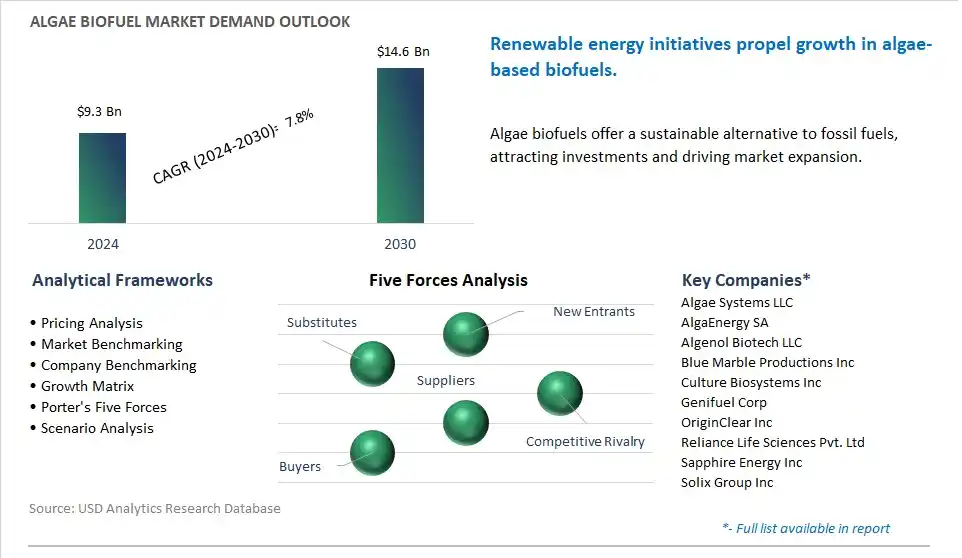
Algae Biofuel Market Competitive Landscape
The market report analyses the leading companies in the industry including Algae Systems LLC, AlgaEnergy SA, Algenol Biotech LLC, Blue Marble Productions Inc, Culture Biosystems Inc, Genifuel Corp, OriginClear Inc, Reliance Life Sciences Pvt. Ltd, Sapphire Energy Inc, Solix Group Inc.
Algae Biofuel Market Dynamics
Algae Biofuel Market Trend: Shift Towards Renewable and Sustainable Energy Sources
A prominent market trend for algae biofuel is the shift towards renewable and sustainable energy sources. With increasing concerns about climate change, carbon emissions, and fossil fuel depletion, there's a growing global focus on transitioning to alternative energy sources that are environmentally friendly and renewable. Algae biofuel, derived from algae biomass through photosynthesis, offers a promising solution to reduce greenhouse gas emissions, mitigate reliance on fossil fuels, and promote energy independence. The trend towards renewable energy adoption drives market interest and investment in algae biofuel technology and production, positioning it as a key contributor to the transition towards a more sustainable energy future.
Algae Biofuel Market Driver: Rising Demand for Low-Carbon Transportation Fuels
A significant driver for the algae biofuel market is the rising demand for low-carbon transportation fuels. With increasing regulatory mandates and consumer preferences for cleaner and greener transportation options, there's a growing market demand for biofuels that can reduce carbon emissions and improve air quality. Algae biofuels, characterized by their high energy content and low carbon intensity, offer an attractive alternative to conventional petroleum-based fuels such as gasoline and diesel. As governments implement policies to incentivize the use of renewable fuels and reduce greenhouse gas emissions from the transportation sector, the demand for algae biofuels as a sustainable transportation fuel solution continues to grow, driving market expansion and investment in algae cultivation and biofuel production technologies.
Algae Biofuel Market Opportunity: Innovation in Algae Cultivation and Production Processes
An opportunity for the algae biofuel market lies in innovation in algae cultivation and production processes. While algae biofuels hold great promise as a renewable energy source, there are challenges related to scalability, cost-effectiveness, and efficiency in algae cultivation and biomass conversion. Manufacturers and researchers have the opportunity to invest in research and development initiatives to improve algae strain selection, cultivation techniques, and harvesting methods to increase biomass productivity and reduce production costs. Additionally, there's potential to explore advanced conversion technologies such as hydrothermal liquefaction, pyrolysis, and fermentation to optimize biofuel yields and quality from algae biomass. By innovating in algae cultivation and production processes, stakeholders in the algae biofuel market can overcome existing barriers, enhance production efficiency, and unlock the full potential of algae as a sustainable energy source for the future.
Algae Biofuel Market Share Analysis: Biodiesel segment generated the highest revenue in the industry
The largest segment in the Algae Biofuel Market is Biodiesel, and this dominance is driven by biodiesel is one of the most widely produced and utilized types of algae biofuel due to its compatibility with existing diesel engines and infrastructure. Biodiesel can be used as a direct substitute for petroleum diesel or blended with conventional diesel fuel in various proportions, making it a versatile and readily adoptable alternative fuel option. Additionally, biodiesel derived from algae offers diverse advantages over traditional biodiesel feedstocks such as soybean oil or palm oil. Algae can be grown in a wide range of environments, including non-arable land and wastewater, and can achieve high oil yields per acre compared to conventional oil crops. In addition, algae biofuel production is highly scalable and can be tailored to meet fluctuating demand, making it suitable for both large-scale commercial production and small-scale decentralized applications. Further, algae biofuels are considered more sustainable and environmentally friendly than fossil fuels, as they can help reduce greenhouse gas emissions, dependence on finite fossil fuel resources, and negative environmental impacts associated with conventional agriculture. Over the forecast period, the dominance of Biodiesel in the Algae Biofuel Market is driven by its compatibility, versatility, scalability, sustainability, and potential to contribute to the transition towards a more renewable and sustainable energy future.
Algae Biofuel Market Share Analysis: Transportation application Segment is poised to register the fastest growth rate (CAGR) over the forecast period to 2030
The fastest-growing segment in the Algae Biofuel Market is the Transportation application, and the rapid growth is driven by there is increasing global concern about climate change and the environmental impact of traditional fossil fuels used in transportation, including cars, trucks, ships, and airplanes. Algae biofuels offer a promising alternative to conventional petroleum-based fuels, as they can be produced sustainably from renewable algae biomass and have the potential to significantly reduce greenhouse gas emissions and dependence on fossil fuels. Additionally, algae biofuels can be used as drop-in replacements or blended with conventional fuels in existing transportation infrastructure without requiring significant modifications to engines or fueling systems. This compatibility makes algae biofuels an attractive option for reducing the carbon footprint of transportation fleets and meeting increasingly stringent emission regulations. In addition, advancements in algae cultivation, harvesting, and conversion technologies have led to improvements in the efficiency and economics of algae biofuel production, making them more competitive with conventional fuels. Further, government incentives, mandates, and subsidies aimed at promoting renewable energy and reducing carbon emissions are driving investment and growth in the algae biofuel industry, particularly in the transportation sector. Over the forecast period, the rapid growth of the Transportation application segment in the Algae Biofuel Market is driven by the increasing demand for sustainable, low-carbon transportation fuels and the expanding infrastructure and policy support for renewable energy adoption in the transportation sector.
Algae Biofuel Market Report Segmentation
By Type
Biodiesel
Bioethanol
Methane
Jet Fuel
Biobutanol
Green Diesel
Bio Gasoline
Others
By Application
Aerospace
Transportation
Others
Regions Included
North America (US, Canada, Mexico)
Europe (Germany, UK, France, Spain, Italy, Russia, Rest of Europe)
Asia Pacific (China, India, Japan, South Korea, Australia, South East Asia, Rest of Asia)
South America (Brazil, Argentina, Rest of South America)
Middle East and Africa (Saudi Arabia, UAE, Rest of Middle East, South Africa, Egypt, Rest of Africa)
Algae Biofuel Companies Profiled in the Market Study
Algae Systems LLC
AlgaEnergy SA
Algenol Biotech LLC
Blue Marble Productions Inc
Culture Biosystems Inc
Genifuel Corp
OriginClear Inc
Reliance Life Sciences Pvt. Ltd
Sapphire Energy Inc
Solix Group Inc
*- List Not Exhaustive
TABLE OF CONTENTS
1 Introduction to 2024 Algae Biofuel Market
1.1 Market Overview
1.2 Quick Facts
1.3 Scope/Objective of the Study
1.4 Market Definition
1.5 Countries and Regions Covered
1.6 Units, Currency, and Conversions
1.7 Industry Value Chain
2 Research Methodology
2.1 Market Size Estimation
2.2 Sources and Research Methodology
2.3 Data Triangulation
2.4 Assumptions and Limitations
3 Executive Summary
3.1 Global Algae Biofuel Market Size Outlook, $ Million, 2021 to 2030
3.2 Algae Biofuel Market Outlook by Type, $ Million, 2021 to 2030
3.3 Algae Biofuel Market Outlook by Product, $ Million, 2021 to 2030
3.4 Algae Biofuel Market Outlook by Application, $ Million, 2021 to 2030
3.5 Algae Biofuel Market Outlook by Key Countries, $ Million, 2021 to 2030
4 Market Dynamics
4.1 Key Driving Forces of Algae Biofuel Industry
4.2 Key Market Trends in Algae Biofuel Industry
4.3 Potential Opportunities in Algae Biofuel Industry
4.4 Key Challenges in Algae Biofuel Industry
5 Market Factor Analysis
5.1 Value Chain Analysis
5.2 Competitive Landscape
5.2.1 Global Algae Biofuel Market Share by Company (%), 2023
5.2.2 Product Offerings by Company
5.3 Porter’s Five Forces Analysis
5.4 Pricing Analysis and Outlook
6 Growth Outlook Across Scenarios
6.1 Growth Analysis-Case Scenario Definitions
6.2 Low Growth Scenario Forecasts
6.3 Reference Growth Scenario Forecasts
6.4 High Growth Scenario Forecasts
7 Global Algae Biofuel Market Outlook by Segments
7.1 Algae Biofuel Market Outlook by Segments, $ Million, 2021- 2030
By Type
Biodiesel
Bioethanol
Methane
Jet Fuel
Biobutanol
Green Diesel
Bio Gasoline
Others
By Application
Aerospace
Transportation
Others
8 North America Algae Biofuel Market Analysis and Outlook To 2030
8.1 Introduction to North America Algae Biofuel Markets in 2024
8.2 North America Algae Biofuel Market Size Outlook by Country, 2021-2030
8.2.1 United States
8.2.2 Canada
8.2.3 Mexico
8.3 North America Algae Biofuel Market size Outlook by Segments, 2021-2030
By Type
Biodiesel
Bioethanol
Methane
Jet Fuel
Biobutanol
Green Diesel
Bio Gasoline
Others
By Application
Aerospace
Transportation
Others
9 Europe Algae Biofuel Market Analysis and Outlook To 2030
9.1 Introduction to Europe Algae Biofuel Markets in 2024
9.2 Europe Algae Biofuel Market Size Outlook by Country, 2021-2030
9.2.1 Germany
9.2.2 France
9.2.3 Spain
9.2.4 United Kingdom
9.2.4 Italy
9.2.5 Russia
9.2.6 Norway
9.2.7 Rest of Europe
9.3 Europe Algae Biofuel Market Size Outlook by Segments, 2021-2030
By Type
Biodiesel
Bioethanol
Methane
Jet Fuel
Biobutanol
Green Diesel
Bio Gasoline
Others
By Application
Aerospace
Transportation
Others
10 Asia Pacific Algae Biofuel Market Analysis and Outlook To 2030
10.1 Introduction to Asia Pacific Algae Biofuel Markets in 2024
10.2 Asia Pacific Algae Biofuel Market Size Outlook by Country, 2021-2030
10.2.1 China
10.2.2 India
10.2.3 Japan
10.2.4 South Korea
10.2.5 Indonesia
10.2.6 Malaysia
10.2.7 Australia
10.2.8 Rest of Asia Pacific
10.3 Asia Pacific Algae Biofuel Market size Outlook by Segments, 2021-2030
By Type
Biodiesel
Bioethanol
Methane
Jet Fuel
Biobutanol
Green Diesel
Bio Gasoline
Others
By Application
Aerospace
Transportation
Others
11 South America Algae Biofuel Market Analysis and Outlook To 2030
11.1 Introduction to South America Algae Biofuel Markets in 2024
11.2 South America Algae Biofuel Market Size Outlook by Country, 2021-2030
11.2.1 Brazil
11.2.2 Argentina
11.2.3 Rest of South America
11.3 South America Algae Biofuel Market size Outlook by Segments, 2021-2030
By Type
Biodiesel
Bioethanol
Methane
Jet Fuel
Biobutanol
Green Diesel
Bio Gasoline
Others
By Application
Aerospace
Transportation
Others
12 Middle East and Africa Algae Biofuel Market Analysis and Outlook To 2030
12.1 Introduction to Middle East and Africa Algae Biofuel Markets in 2024
12.2 Middle East and Africa Algae Biofuel Market Size Outlook by Country, 2021-2030
12.2.1 Saudi Arabia
12.2.2 UAE
12.2.3 Oman
12.2.4 Rest of Middle East
12.2.5 Egypt
12.2.6 Nigeria
12.2.7 South Africa
12.2.8 Rest of Africa
12.3 Middle East and Africa Algae Biofuel Market size Outlook by Segments, 2021-2030
By Type
Biodiesel
Bioethanol
Methane
Jet Fuel
Biobutanol
Green Diesel
Bio Gasoline
Others
By Application
Aerospace
Transportation
Others
13 Company Profiles
13.1 Company Snapshot
13.2 SWOT Profiles
13.3 Products and Services
13.4 Recent Developments
13.5 Financial Profile
Algae Systems LLC
AlgaEnergy SA
Algenol Biotech LLC
Blue Marble Productions Inc
Culture Biosystems Inc
Genifuel Corp
OriginClear Inc
Reliance Life Sciences Pvt. Ltd
Sapphire Energy Inc
Solix Group Inc
14 Appendix
14.1 Customization Offerings
14.2 Subscription Services
14.3 Related Reports
14.4 Publisher Expertise
By Type
Biodiesel
Bioethanol
Methane
Jet Fuel
Biobutanol
Green Diesel
Bio Gasoline
Others
By Application
Aerospace
Transportation
Others
Countries Analyzed
North America (US, Canada, Mexico)
Europe (Germany, UK, France, Spain, Italy, Russia, Rest of Europe)
Asia Pacific (China, India, Japan, South Korea, Australia, South East Asia, Rest of Asia)
South America (Brazil, Argentina, Rest of South America)
Middle East and Africa (Saudi Arabia, UAE, Rest of Middle East, South Africa, Egypt, Rest of Africa)
