The global Alumina Trihydrate Market is poised to register a 5.4% CAGR from $3.92 Billion in 2024 to $5.4 Billion in 2030.
The global Alumina Trihydrate Market Study analyzes and forecasts the market size across 6 regions and 24 countries for diverse segments -By Form (Dry, Wet), By End-User (Chemical Manufacturing, Plastics, Automotive, Construction, Others).
An Introduction to Global Alumina Trihydrate Market in 2024
The alumina trihydrate market is experiencing steady growth driven by its wide-ranging applications in flame retardants, fillers, and coatings across various industries. Key trends shaping the future of the industry include the growing demand for alumina trihydrate as a non-toxic and halogen-free flame retardant additive in plastics, rubber, and construction materials to enhance fire safety and meet stringent regulatory standards. Moreover, there's a rising emphasis on sustainable and eco-friendly materials, leading to innovations in alumina trihydrate production processes that minimize environmental impact and energy consumption. Additionally, advancements in particle size control, surface treatment, and dispersion technology are driving innovation and market expansion, enabling manufacturers to offer high-purity, low-smoke, and cost-effective alumina trihydrate products for diverse industrial applications in the global alumina trihydrate market.
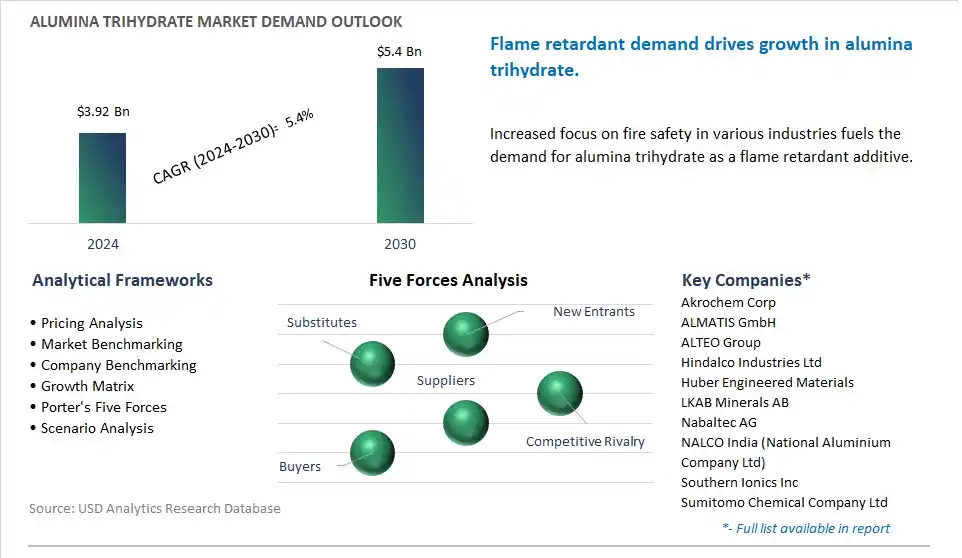
Alumina Trihydrate Market Competitive Landscape
The market report analyses the leading companies in the industry including Akrochem Corp, ALMATIS GmbH, ALTEO Group, Hindalco Industries Ltd, Huber Engineered Materials, LKAB Minerals AB, Nabaltec AG, NALCO India (National Aluminium Company Ltd), Southern Ionics Inc, Sumitomo Chemical Company Ltd, The R.J. Marshall Company, TOR Minerals International Inc.
Alumina Trihydrate Market Dynamics
Alumina Trihydrate Market Trend: Increasing Demand for Flame Retardant Materials
A prominent market trend for alumina trihydrate is the increasing demand for flame retardant materials. With growing concerns about fire safety and regulatory requirements for flame retardancy in various industries such as construction, automotive, and electronics, there's a rising demand for materials that can effectively suppress flames and reduce the spread of fire. Alumina trihydrate, with its high water content and endothermic decomposition properties, is widely used as a flame retardant additive in polymers, coatings, and building materials. The trend towards stricter fire safety regulations and the need to enhance fire resistance in consumer products drive market demand for alumina trihydrate as a key component in flame retardant formulations.
Alumina Trihydrate Market Driver: Growth in Construction and Infrastructure Development
A significant driver for the alumina trihydrate market is the growth in construction and infrastructure development projects worldwide. As urbanization rates rise and populations expand, there's an increasing demand for residential, commercial, and public infrastructure such as buildings, roads, bridges, and tunnels. Alumina trihydrate finds extensive use in construction materials such as paints, coatings, adhesives, sealants, and composite panels, where it acts as a flame retardant and smoke suppressant to improve fire safety and compliance with building codes. The growth in construction activities, particularly in emerging economies and developing regions, fuels market demand for alumina trihydrate as a critical component in fire-resistant construction materials and infrastructure applications.
Alumina Trihydrate Market Opportunity: Expansion into Non-Halogenated Flame Retardant Formulations
An opportunity for the alumina trihydrate market lies in the expansion into non-halogenated flame retardant formulations. With increasing awareness of the environmental and health concerns associated with halogenated flame retardants such as brominated and chlorinated compounds, there's a growing preference for safer and more sustainable flame retardant alternatives. Alumina trihydrate offers a non-halogenated and environmentally friendly option for formulating flame retardant materials that meet stringent regulatory requirements and consumer preferences for greener products. Manufacturers have the opportunity to innovate and develop alumina trihydrate-based formulations with enhanced fire protection properties, compatibility with different polymer matrices, and improved processing characteristics. By expanding into non-halogenated flame retardant formulations, alumina trihydrate suppliers can capitalize on the growing market demand for environmentally sustainable fire safety solutions and differentiate their products in the flame retardant market.
Alumina Trihydrate Market Share Analysis: Wet form segment generated the highest revenue in the industry
The largest segment in the Alumina Trihydrate Market is the Wet form, and this dominance is driven by alumina trihydrate in the wet form is commonly used as a flame retardant and smoke suppressant in various industries, including plastics, rubber, textiles, and construction materials. The wet form of alumina trihydrate is produced by hydrating aluminum oxide, resulting in a slurry or paste-like consistency. This wet form is preferred in many applications because it offers diverse advantages over the dry form. Wet alumina trihydrate has higher dispersibility and easier handling properties compared to the dry form, making it easier to incorporate into formulations and mix with other ingredients. Additionally, the wet form of alumina trihydrate can be directly blended into liquid formulations without the need for additional processing steps, saving time and reducing production costs. In addition, wet alumina trihydrate exhibits superior flame retardant properties and smoke suppression capabilities compared to the dry form, making it highly effective in improving the fire safety performance of materials and products. Further, the wet form of alumina trihydrate can be more easily customized to meet specific performance requirements and application needs, such as particle size distribution, viscosity, and rheological properties. Over the forecast period, the dominance of the Wet form segment in the Alumina Trihydrate Market is driven by its superior performance characteristics, ease of handling, versatility, and widespread use as a flame retardant and smoke suppressant in various industries.
Alumina Trihydrate Market Share Analysis: Plastics end-user Segment is poised to register the fastest growth rate (CAGR) over the forecast period to 2030
The fastest-growing segment in the Alumina Trihydrate Market is the Plastics end-user segment, and the rapid growth is driven by alumina trihydrate is widely used as a flame retardant and smoke suppressant in the plastics industry, where it is incorporated into polymer formulations to improve the fire safety performance of plastic products. With increasing awareness of fire safety regulations and standards across industries, there is a growing demand for flame retardant additives such as alumina trihydrate to enhance the fire resistance of plastics used in various applications, including building and construction, automotive, electrical and electronics, and consumer goods. Additionally, the plastics industry is experiencing significant growth driven by factors such as population growth, urbanization, and increasing consumer demand for lightweight, durable, and aesthetically appealing plastic products. As a result, there is a corresponding increase in the demand for flame retardant additives like alumina trihydrate to meet the fire safety requirements of plastic products used in diverse end-use applications. In addition, advancements in polymer technology and processing techniques have led to the development of innovative plastic formulations that incorporate alumina trihydrate to achieve superior fire safety performance without compromising on mechanical properties or processing characteristics. Further, as sustainability concerns continue to grow, there is a shift towards eco-friendly flame retardant solutions in the plastics industry, driving the adoption of alumina trihydrate derived from natural sources and recycled materials. Over the forecast period, the rapid growth of the Plastics end-user segment in the Alumina Trihydrate Market is driven by increasing fire safety regulations, the expanding plastics industry, technological advancements in polymer formulations, and the demand for sustainable flame retardant solutions.
Alumina Trihydrate Market Report Segmentation
By Form
Dry
Wet
By End-User
Chemical Manufacturing
Plastics
Automotive
Construction
Others
Regions Included
North America (US, Canada, Mexico)
Europe (Germany, UK, France, Spain, Italy, Russia, Rest of Europe)
Asia Pacific (China, India, Japan, South Korea, Australia, South East Asia, Rest of Asia)
South America (Brazil, Argentina, Rest of South America)
Middle East and Africa (Saudi Arabia, UAE, Rest of Middle East, South Africa, Egypt, Rest of Africa)
Alumina Trihydrate Companies Profiled in the Market Study
Akrochem Corp
ALMATIS GmbH
ALTEO Group
Hindalco Industries Ltd
Huber Engineered Materials
LKAB Minerals AB
Nabaltec AG
NALCO India (National Aluminium Company Ltd)
Southern Ionics Inc
Sumitomo Chemical Company Ltd
The R.J. Marshall Company
TOR Minerals International Inc
*- List Not Exhaustive
TABLE OF CONTENTS
1 Introduction to 2024 Alumina Trihydrate Market
1.1 Market Overview
1.2 Quick Facts
1.3 Scope/Objective of the Study
1.4 Market Definition
1.5 Countries and Regions Covered
1.6 Units, Currency, and Conversions
1.7 Industry Value Chain
2 Research Methodology
2.1 Market Size Estimation
2.2 Sources and Research Methodology
2.3 Data Triangulation
2.4 Assumptions and Limitations
3 Executive Summary
3.1 Global Alumina Trihydrate Market Size Outlook, $ Million, 2021 to 2030
3.2 Alumina Trihydrate Market Outlook by Type, $ Million, 2021 to 2030
3.3 Alumina Trihydrate Market Outlook by Product, $ Million, 2021 to 2030
3.4 Alumina Trihydrate Market Outlook by Application, $ Million, 2021 to 2030
3.5 Alumina Trihydrate Market Outlook by Key Countries, $ Million, 2021 to 2030
4 Market Dynamics
4.1 Key Driving Forces of Alumina Trihydrate Industry
4.2 Key Market Trends in Alumina Trihydrate Industry
4.3 Potential Opportunities in Alumina Trihydrate Industry
4.4 Key Challenges in Alumina Trihydrate Industry
5 Market Factor Analysis
5.1 Value Chain Analysis
5.2 Competitive Landscape
5.2.1 Global Alumina Trihydrate Market Share by Company (%), 2023
5.2.2 Product Offerings by Company
5.3 Porter’s Five Forces Analysis
5.4 Pricing Analysis and Outlook
6 Growth Outlook Across Scenarios
6.1 Growth Analysis-Case Scenario Definitions
6.2 Low Growth Scenario Forecasts
6.3 Reference Growth Scenario Forecasts
6.4 High Growth Scenario Forecasts
7 Global Alumina Trihydrate Market Outlook by Segments
7.1 Alumina Trihydrate Market Outlook by Segments, $ Million, 2021- 2030
By Form
Dry
Wet
By End-User
Chemical Manufacturing
Plastics
Automotive
Construction
Others
8 North America Alumina Trihydrate Market Analysis and Outlook To 2030
8.1 Introduction to North America Alumina Trihydrate Markets in 2024
8.2 North America Alumina Trihydrate Market Size Outlook by Country, 2021-2030
8.2.1 United States
8.2.2 Canada
8.2.3 Mexico
8.3 North America Alumina Trihydrate Market size Outlook by Segments, 2021-2030
By Form
Dry
Wet
By End-User
Chemical Manufacturing
Plastics
Automotive
Construction
Others
9 Europe Alumina Trihydrate Market Analysis and Outlook To 2030
9.1 Introduction to Europe Alumina Trihydrate Markets in 2024
9.2 Europe Alumina Trihydrate Market Size Outlook by Country, 2021-2030
9.2.1 Germany
9.2.2 France
9.2.3 Spain
9.2.4 United Kingdom
9.2.4 Italy
9.2.5 Russia
9.2.6 Norway
9.2.7 Rest of Europe
9.3 Europe Alumina Trihydrate Market Size Outlook by Segments, 2021-2030
By Form
Dry
Wet
By End-User
Chemical Manufacturing
Plastics
Automotive
Construction
Others
10 Asia Pacific Alumina Trihydrate Market Analysis and Outlook To 2030
10.1 Introduction to Asia Pacific Alumina Trihydrate Markets in 2024
10.2 Asia Pacific Alumina Trihydrate Market Size Outlook by Country, 2021-2030
10.2.1 China
10.2.2 India
10.2.3 Japan
10.2.4 South Korea
10.2.5 Indonesia
10.2.6 Malaysia
10.2.7 Australia
10.2.8 Rest of Asia Pacific
10.3 Asia Pacific Alumina Trihydrate Market size Outlook by Segments, 2021-2030
By Form
Dry
Wet
By End-User
Chemical Manufacturing
Plastics
Automotive
Construction
Others
11 South America Alumina Trihydrate Market Analysis and Outlook To 2030
11.1 Introduction to South America Alumina Trihydrate Markets in 2024
11.2 South America Alumina Trihydrate Market Size Outlook by Country, 2021-2030
11.2.1 Brazil
11.2.2 Argentina
11.2.3 Rest of South America
11.3 South America Alumina Trihydrate Market size Outlook by Segments, 2021-2030
By Form
Dry
Wet
By End-User
Chemical Manufacturing
Plastics
Automotive
Construction
Others
12 Middle East and Africa Alumina Trihydrate Market Analysis and Outlook To 2030
12.1 Introduction to Middle East and Africa Alumina Trihydrate Markets in 2024
12.2 Middle East and Africa Alumina Trihydrate Market Size Outlook by Country, 2021-2030
12.2.1 Saudi Arabia
12.2.2 UAE
12.2.3 Oman
12.2.4 Rest of Middle East
12.2.5 Egypt
12.2.6 Nigeria
12.2.7 South Africa
12.2.8 Rest of Africa
12.3 Middle East and Africa Alumina Trihydrate Market size Outlook by Segments, 2021-2030
By Form
Dry
Wet
By End-User
Chemical Manufacturing
Plastics
Automotive
Construction
Others
13 Company Profiles
13.1 Company Snapshot
13.2 SWOT Profiles
13.3 Products and Services
13.4 Recent Developments
13.5 Financial Profile
Akrochem Corp
ALMATIS GmbH
ALTEO Group
Hindalco Industries Ltd
Huber Engineered Materials
LKAB Minerals AB
Nabaltec AG
NALCO India (National Aluminium Company Ltd)
Southern Ionics Inc
Sumitomo Chemical Company Ltd
The R.J. Marshall Company
TOR Minerals International Inc
14 Appendix
14.1 Customization Offerings
14.2 Subscription Services
14.3 Related Reports
14.4 Publisher Expertise
By Form
Dry
Wet
By End-User
Chemical Manufacturing
Plastics
Automotive
Construction
Others
Countries Analyzed
North America (US, Canada, Mexico)
Europe (Germany, UK, France, Spain, Italy, Russia, Rest of Europe)
Asia Pacific (China, India, Japan, South Korea, Australia, South East Asia, Rest of Asia)
South America (Brazil, Argentina, Rest of South America)
Middle East and Africa (Saudi Arabia, UAE, Rest of Middle East, South Africa, Egypt, Rest of Africa)
