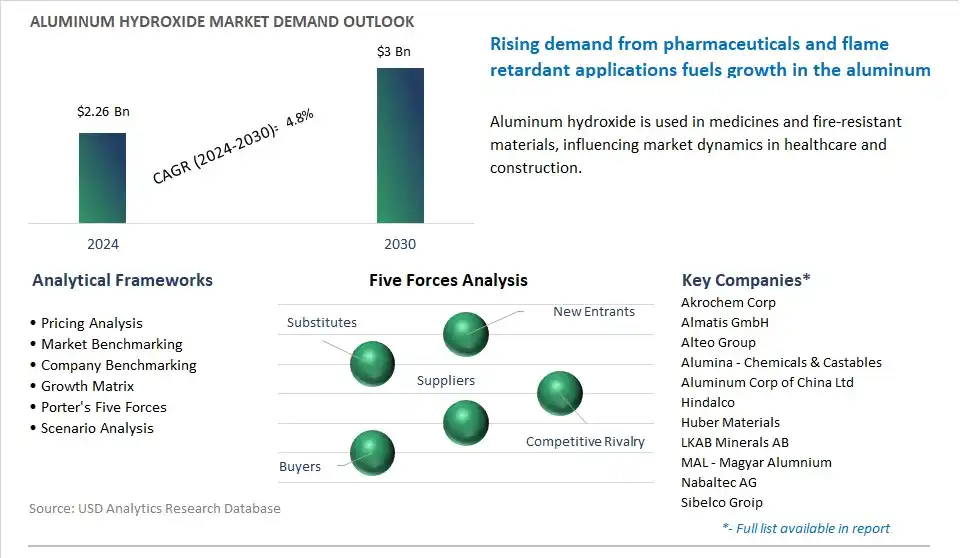
The global Aluminum Hydroxide Market is poised to register a 4.8% CAGR from $2.26 Billion in 2024 to $3 Billion in 2030.
The global Aluminum Hydroxide Market Study analyzes and forecasts the market size across 6 regions and 24 countries for diverse segments -By Product (Industrial Grade, Pharmaceutical Grade, Others), By End-User (Plastics, Pharmaceuticals, Coatings, Adhesives, Sealants & Elastomers, Others).
An Introduction to Global Aluminum Hydroxide Market in 2024
The aluminum hydroxide market is experiencing growth driven by its wide-ranging applications in industries such as pharmaceuticals, chemicals, plastics, and construction. Key trends shaping the future of the industry include innovations in aluminum hydroxide production methods, particle size control, and surface modification techniques to enhance product purity, dispersion, and performance. Advanced aluminum hydroxide products offer superior flame retardant properties, smoke suppression, and thermal stability, making them essential additives in polymer formulations, cable insulation, and building materials. Moreover, the growing demand for aluminum hydroxide as an antacid and gastric acid neutralizer in pharmaceuticals and healthcare products drives market expansion, as it provides relief from symptoms of heartburn, indigestion, and acid reflux. Additionally, the integration of aluminum hydroxide into water treatment processes, ceramics, and catalysts offers opportunities for diverse industrial applications, including wastewater purification, ceramic filler reinforcement, and catalytic conversion reactions. As manufacturers invest in research and development to innovate and optimize aluminum hydroxide products for emerging applications and market needs, the market is poised for sustained growth and diversification as a versatile and indispensable material in various industries.
Aluminum Hydroxide Market Competitive Landscape
The market report analyses the leading companies in the industry including Akrochem Corp, Almatis GmbH, Alteo Group, Alumina - Chemicals & Castables, Aluminum Corp of China Ltd, Hindalco, Huber Materials, LKAB Minerals AB, MAL - Magyar Alumnium, Nabaltec AG, Sibelco Groip, Sumitomo Chemical Co. Ltd, TOR Minerals International Inc.
Aluminum Hydroxide Market Dynamics
Aluminum Hydroxide Market Trend: Increasing Demand for Flame Retardant Materials
A prominent trend in the aluminum hydroxide market is the increasing demand for flame retardant materials. Aluminum hydroxide is widely used as a flame retardant additive in various industries, including construction, automotive, electronics, and textiles, due to its excellent fire-resistant properties and ability to suppress combustion. With growing concerns over fire safety and stringent regulations mandating the use of flame retardant materials in consumer products and building materials, there is a rising demand for aluminum hydroxide as a key ingredient in flame retardant formulations. This trend reflects a broader shift towards enhancing fire safety standards and incorporating flame retardant technologies into the design and manufacturing of products to mitigate the risk of fire-related accidents and property damage.
Aluminum Hydroxide Market Driver: Expansion of the Construction and Building Materials Industry
A key driver for the aluminum hydroxide market is the expansion of the construction and building materials industry. Aluminum hydroxide is utilized as a flame retardant filler in a wide range of building materials, including insulation materials, cables, coatings, and sealants, to enhance fire resistance and meet building code requirements for fire safety. With rapid urbanization, infrastructure development, and increasing construction activities worldwide, there is a growing demand for flame retardant building materials to ensure the safety and durability of structures in residential, commercial, and industrial settings. The expansion of the construction industry, driven by population growth, urbanization, and investments in infrastructure projects, fuels the demand for aluminum hydroxide as a key additive in flame retardant formulations for building materials.
Aluminum Hydroxide Market Opportunity: Development of Specialty Aluminum Hydroxide Grades for Niche Applications
An opportunity within the aluminum hydroxide market lies in the development of specialty grades tailored for niche applications. While aluminum hydroxide is primarily used as a flame retardant, there is potential to expand its application scope by developing specialty grades with customized properties and functionalities. For example, nano-sized aluminum hydroxide particles can be engineered to enhance flame retardancy while minimizing the impact on mechanical properties and material aesthetics, making them suitable for use in high-performance plastics, composites, and electronic devices. Additionally, surface-modified aluminum hydroxide particles can be designed to improve dispersion, compatibility, and adhesion in polymer matrices, enabling their use in advanced coatings, adhesives, and encapsulants. By developing specialty grades for niche applications, manufacturers can diversify their product offerings, capture new market segments, and create value-added solutions that address specific customer needs and market requirements.
Aluminum Hydroxide Market Share Analysis: Industrial Grade segment generated the highest revenue in the industry
The industrial grade segment is the largest in the aluminum hydroxide market for diverse compelling reasons. The industrial-grade aluminum hydroxide finds extensive use in various industrial applications, including flame retardants, catalysts, fillers, and water treatment chemicals. Flame retardant applications represent a significant portion of the industrial-grade aluminum hydroxide market, where it is employed to enhance the fire resistance of plastics, rubber, textiles, and other materials. The construction industry also contributes to the demand for industrial-grade aluminum hydroxide as a filler in composite materials and as a raw material for the production of aluminum-based chemicals. Secondly, industrial-grade aluminum hydroxide is produced in larger quantities and at lower costs compared to pharmaceutical-grade aluminum hydroxide. The industrial manufacturing processes prioritize efficiency, scalability, and cost-effectiveness to meet the high-volume demands of industrial applications. Thirdly, the industrial-grade aluminum hydroxide segment benefits from a wide range of end-use industries and applications, including automotive, electronics, construction, and water treatment. Its versatility and affordability make it a preferred choice for manufacturers seeking cost-effective solutions to meet their specific application requirements. In addition, ongoing advancements in industrial processes, product formulations, and quality control measures further enhance the performance and reliability of industrial-grade aluminum hydroxide, consolidating its position as the largest segment in the aluminum hydroxide market. Over the forecast period, the widespread industrial applications, cost advantages, and technological advancements associated with industrial-grade aluminum hydroxide contribute to its dominance in the market.
Aluminum Hydroxide Market Share Analysis: Pharmaceuticals Segment is poised to register the fastest growth rate (CAGR) over the forecast period to 2030
The pharmaceuticals segment is experiencing the fastest growth in the aluminum hydroxide market for diverse key reasons. The aluminum hydroxide is widely used as an active pharmaceutical ingredient (API) in various medications, particularly antacids and antiperspirants. Antacids containing aluminum hydroxide are commonly used to relieve symptoms of acid reflux, heartburn, and indigestion by neutralizing excess stomach acid. Additionally, aluminum hydroxide is utilized in antiperspirant formulations to control sweat production and reduce body odor. The increasing prevalence of gastrointestinal disorders, such as acid reflux disease and peptic ulcers, drives demand for aluminum hydroxide-based antacids, contributing to market growth. Secondly, aluminum hydroxide nanoparticles have gained attention in pharmaceutical research for their potential applications in drug delivery systems, vaccine adjuvants, and diagnostic imaging agents. Aluminum hydroxide nanoparticles offer advantages such as biocompatibility, controlled release properties, and immune-stimulating effects, making them promising candidates for novel pharmaceutical formulations. Thirdly, the growing emphasis on preventive healthcare and the development of innovative treatments for chronic diseases create opportunities for aluminum hydroxide-based pharmaceuticals. The pharmaceutical industry's focus on personalized medicine and targeted therapies drives demand for specialized formulations containing aluminum hydroxide as a key ingredient. In addition, regulatory approvals, clinical trials, and product innovations further stimulate growth in the pharmaceuticals segment of the aluminum hydroxide market. Over the forecast period, the combination of increasing demand for antacids, research advancements in nanoparticle technology, and expanding applications in drug delivery systems positions the pharmaceuticals segment as the fastest-growing segment in the aluminum hydroxide market.
Aluminum Hydroxide Market Report Segmentation
By Product
Industrial Grade
Pharmaceutical Grade
Others
By End-User
Plastics
Pharmaceuticals
Coatings
Adhesives
Sealants & Elastomers
Others
Regions Included
North America (US, Canada, Mexico)
Europe (Germany, UK, France, Spain, Italy, Russia, Rest of Europe)
Asia Pacific (China, India, Japan, South Korea, Australia, South East Asia, Rest of Asia)
South America (Brazil, Argentina, Rest of South America)
Middle East and Africa (Saudi Arabia, UAE, Rest of Middle East, South Africa, Egypt, Rest of Africa)
Aluminum Hydroxide Companies Profiled in the Market Study
Akrochem Corp
Almatis GmbH
Alteo Group
Alumina - Chemicals & Castables
Aluminum Corp of China Ltd
Hindalco
Huber Materials
LKAB Minerals AB
MAL - Magyar Alumnium
Nabaltec AG
Sibelco Groip
Sumitomo Chemical Co. Ltd
TOR Minerals International Inc
*- List Not Exhaustive
TABLE OF CONTENTS
1 Introduction to 2024 Aluminum Hydroxide Market
1.1 Market Overview
1.2 Quick Facts
1.3 Scope/Objective of the Study
1.4 Market Definition
1.5 Countries and Regions Covered
1.6 Units, Currency, and Conversions
1.7 Industry Value Chain
2 Research Methodology
2.1 Market Size Estimation
2.2 Sources and Research Methodology
2.3 Data Triangulation
2.4 Assumptions and Limitations
3 Executive Summary
3.1 Global Aluminum Hydroxide Market Size Outlook, $ Million, 2021 to 2030
3.2 Aluminum Hydroxide Market Outlook by Type, $ Million, 2021 to 2030
3.3 Aluminum Hydroxide Market Outlook by Product, $ Million, 2021 to 2030
3.4 Aluminum Hydroxide Market Outlook by Application, $ Million, 2021 to 2030
3.5 Aluminum Hydroxide Market Outlook by Key Countries, $ Million, 2021 to 2030
4 Market Dynamics
4.1 Key Driving Forces of Aluminum Hydroxide Industry
4.2 Key Market Trends in Aluminum Hydroxide Industry
4.3 Potential Opportunities in Aluminum Hydroxide Industry
4.4 Key Challenges in Aluminum Hydroxide Industry
5 Market Factor Analysis
5.1 Value Chain Analysis
5.2 Competitive Landscape
5.2.1 Global Aluminum Hydroxide Market Share by Company (%), 2023
5.2.2 Product Offerings by Company
5.3 Porter’s Five Forces Analysis
5.4 Pricing Analysis and Outlook
6 Growth Outlook Across Scenarios
6.1 Growth Analysis-Case Scenario Definitions
6.2 Low Growth Scenario Forecasts
6.3 Reference Growth Scenario Forecasts
6.4 High Growth Scenario Forecasts
7 Global Aluminum Hydroxide Market Outlook by Segments
7.1 Aluminum Hydroxide Market Outlook by Segments, $ Million, 2021- 2030
By Product
Industrial Grade
Pharmaceutical Grade
Others
By End-User
Plastics
Pharmaceuticals
Coatings
Adhesives
Sealants & Elastomers
Others
8 North America Aluminum Hydroxide Market Analysis and Outlook To 2030
8.1 Introduction to North America Aluminum Hydroxide Markets in 2024
8.2 North America Aluminum Hydroxide Market Size Outlook by Country, 2021-2030
8.2.1 United States
8.2.2 Canada
8.2.3 Mexico
8.3 North America Aluminum Hydroxide Market size Outlook by Segments, 2021-2030
By Product
Industrial Grade
Pharmaceutical Grade
Others
By End-User
Plastics
Pharmaceuticals
Coatings
Adhesives
Sealants & Elastomers
Others
9 Europe Aluminum Hydroxide Market Analysis and Outlook To 2030
9.1 Introduction to Europe Aluminum Hydroxide Markets in 2024
9.2 Europe Aluminum Hydroxide Market Size Outlook by Country, 2021-2030
9.2.1 Germany
9.2.2 France
9.2.3 Spain
9.2.4 United Kingdom
9.2.4 Italy
9.2.5 Russia
9.2.6 Norway
9.2.7 Rest of Europe
9.3 Europe Aluminum Hydroxide Market Size Outlook by Segments, 2021-2030
By Product
Industrial Grade
Pharmaceutical Grade
Others
By End-User
Plastics
Pharmaceuticals
Coatings
Adhesives
Sealants & Elastomers
Others
10 Asia Pacific Aluminum Hydroxide Market Analysis and Outlook To 2030
10.1 Introduction to Asia Pacific Aluminum Hydroxide Markets in 2024
10.2 Asia Pacific Aluminum Hydroxide Market Size Outlook by Country, 2021-2030
10.2.1 China
10.2.2 India
10.2.3 Japan
10.2.4 South Korea
10.2.5 Indonesia
10.2.6 Malaysia
10.2.7 Australia
10.2.8 Rest of Asia Pacific
10.3 Asia Pacific Aluminum Hydroxide Market size Outlook by Segments, 2021-2030
By Product
Industrial Grade
Pharmaceutical Grade
Others
By End-User
Plastics
Pharmaceuticals
Coatings
Adhesives
Sealants & Elastomers
Others
11 South America Aluminum Hydroxide Market Analysis and Outlook To 2030
11.1 Introduction to South America Aluminum Hydroxide Markets in 2024
11.2 South America Aluminum Hydroxide Market Size Outlook by Country, 2021-2030
11.2.1 Brazil
11.2.2 Argentina
11.2.3 Rest of South America
11.3 South America Aluminum Hydroxide Market size Outlook by Segments, 2021-2030
By Product
Industrial Grade
Pharmaceutical Grade
Others
By End-User
Plastics
Pharmaceuticals
Coatings
Adhesives
Sealants & Elastomers
Others
12 Middle East and Africa Aluminum Hydroxide Market Analysis and Outlook To 2030
12.1 Introduction to Middle East and Africa Aluminum Hydroxide Markets in 2024
12.2 Middle East and Africa Aluminum Hydroxide Market Size Outlook by Country, 2021-2030
12.2.1 Saudi Arabia
12.2.2 UAE
12.2.3 Oman
12.2.4 Rest of Middle East
12.2.5 Egypt
12.2.6 Nigeria
12.2.7 South Africa
12.2.8 Rest of Africa
12.3 Middle East and Africa Aluminum Hydroxide Market size Outlook by Segments, 2021-2030
By Product
Industrial Grade
Pharmaceutical Grade
Others
By End-User
Plastics
Pharmaceuticals
Coatings
Adhesives
Sealants & Elastomers
Others
13 Company Profiles
13.1 Company Snapshot
13.2 SWOT Profiles
13.3 Products and Services
13.4 Recent Developments
13.5 Financial Profile
Akrochem Corp
Almatis GmbH
Alteo Group
Alumina - Chemicals & Castables
Aluminum Corp of China Ltd
Hindalco
Huber Materials
LKAB Minerals AB
MAL - Magyar Alumnium
Nabaltec AG
Sibelco Groip
Sumitomo Chemical Co. Ltd
TOR Minerals International Inc
14 Appendix
14.1 Customization Offerings
14.2 Subscription Services
14.3 Related Reports
14.4 Publisher Expertise
By Product
Industrial Grade
Pharmaceutical Grade
Others
By End-User
Plastics
Pharmaceuticals
Coatings
Adhesives
Sealants & Elastomers
Others
Countries Analyzed
North America (US, Canada, Mexico)
Europe (Germany, UK, France, Spain, Italy, Russia, Rest of Europe)
Asia Pacific (China, India, Japan, South Korea, Australia, South East Asia, Rest of Asia)
South America (Brazil, Argentina, Rest of South America)
Middle East and Africa (Saudi Arabia, UAE, Rest of Middle East, South Africa, Egypt, Rest of Africa)
