The global Aluminum Smelting Market is poised to register a 4.3% CAGR from $82.1 Billion in 2024 to $105.7 Billion in 2030.
The global Aluminum Smelting Market Study analyzes and forecasts the market size across 6 regions and 24 countries for diverse segments -By Type (Ingots, Billets, Wire Rods), By End-User (Transportation, Heavy Machinery, Construction, Others).
An Introduction to Global Aluminum Smelting Market in 2024
The aluminum smelting industry is witnessing significant growth driven by the increasing demand for lightweight, durable, and sustainable materials in industries such as automotive, aerospace, packaging, and construction. Aluminum smelting involves the extraction of aluminum from bauxite ore through electrolytic reduction in smelting furnaces, resulting in the production of primary aluminum ingots and alloys. Key trends shaping the future of the aluminum smelting industry include the development of advanced smelting technologies such as pre-baked anode cells, inert anode cells, and electrolytic cells with improved energy efficiency, productivity, and environmental performance. Moreover, with advancements in carbon capture and utilization (CCU) technologies, there is a trend towards the reduction of greenhouse gas emissions and carbon footprint in aluminum smelting operations through the capture and utilization of CO2 emissions for industrial processes and product applications. Additionally, innovations in raw material sourcing, process optimization, and waste valorization are driving market adoption of sustainable and circular economy practices in aluminum smelting, enabling the recovery and recycling of by-products such as alumina residue, spent pot lining, and dross for value-added applications in construction materials, cement production, and secondary aluminum alloys. Furthermore, collaborations between aluminum producers, technology providers, and research institutions are driving innovation and market expansion in aluminum smelting, fostering the development of new processes, products, and applications to meet evolving customer needs and regulatory requirements for sustainable and responsible aluminum production.
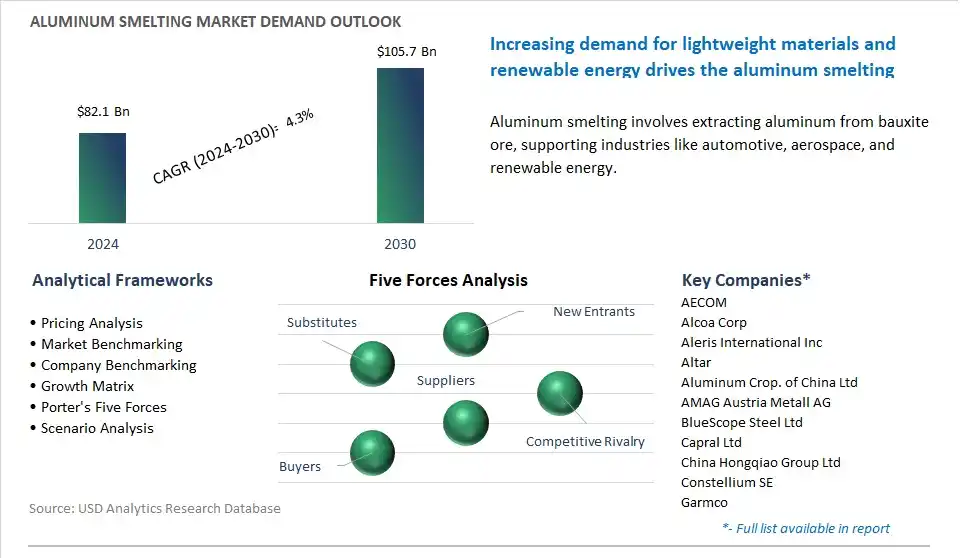
Aluminum Smelting Market Competitive Landscape
The market report analyses the leading companies in the industry including AECOM, Alcoa Corp, Aleris International Inc, Altar, Aluminum Crop. of China Ltd, AMAG Austria Metall AG, BlueScope Steel Ltd, Capral Ltd, China Hongqiao Group Ltd, Constellium SE, Garmco, Golden Aluminum, Kaiser Aluminum Corp, Kobe Steel Ltd, Nanshan Group Singapore Co. Pte. Ltd, Norsk Hydro ASA, Novelis Inc, Rio Tinto Ltd, SHOWA DENKO K.K., United Company RUSAL.
Aluminum Smelting Market Dynamics
Aluminum Smelting Market Trend: Shift Towards Sustainable Aluminum Production
A prominent trend in the aluminum smelting market is the shift towards sustainable aluminum production. As environmental concerns and regulatory pressures mount, aluminum smelters are increasingly adopting cleaner and more sustainable technologies to reduce carbon emissions and energy consumption in the smelting process. This trend is driving the development and adoption of innovative smelting technologies such as inert anode technology, electrolysis using renewable energy sources, and carbon capture and storage (CCS) initiatives. As consumers and businesses alike prioritize sustainability and environmental responsibility, demand for aluminum produced through sustainable smelting practices is expected to grow, influencing market dynamics.
Aluminum Smelting Market Driver: Growing Demand for Aluminum in Automotive and Aerospace Industries
The primary driver for the aluminum smelting market is the growing demand for aluminum in the automotive and aerospace industries. Aluminum's unique combination of lightweight, strength, and corrosion resistance makes it a preferred material for various applications in automotive manufacturing, including vehicle bodies, chassis, engine components, and structural parts. Similarly, in the aerospace industry, aluminum is widely used in aircraft construction for its high strength-to-weight ratio and durability. With the automotive and aerospace sectors witnessing continued growth and increasing demand for aluminum-intensive vehicles and aircraft, the demand for aluminum smelting is expected to remain strong.
Aluminum Smelting Market Opportunity: Expansion into Emerging Markets and Applications
An opportunity for market advancement in the aluminum smelting segment lies in expansion into emerging markets and applications. While traditional sectors like automotive and aerospace continue to drive demand for aluminum, emerging markets such as renewable energy, electric vehicles (EVs), and packaging present new opportunities for aluminum smelters. For instance, the transition towards electric mobility and the increasing adoption of renewable energy sources are driving demand for lightweight aluminum components in EVs, batteries, and solar panels. Additionally, aluminum's recyclability and sustainability make it an attractive choice for eco-friendly packaging solutions. By leveraging their smelting capabilities to meet the evolving needs of these emerging markets and applications, aluminum smelters can capitalize on new growth opportunities and diversify their revenue streams.
Aluminum Smelting Market Share Analysis: Ingots generated the highest revenue in 2024
The largest segment in the Aluminum Smelting Market is ingots, primarily due to their versatility and widespread use as raw material in various downstream industries. Aluminum ingots are the primary form in which aluminum is produced during the smelting process, making them readily available for further processing and fabrication into a wide range of products. Ingots serve as the foundation for manufacturing aluminum products such as sheets, plates, extrusions, castings, and foils across industries like automotive, aerospace, construction, packaging, and electronics. Further, ingots can be easily melted, cast, and formed into different shapes and sizes to meet the specific requirements of end-users, offering flexibility in manufacturing processes. Additionally, ingots are preferred by manufacturers due to their uniform composition, purity, and quality, ensuring consistent performance in downstream applications. Furthermore, the cost-effectiveness and recyclability of aluminum ingots make them a sustainable choice for industries looking to reduce their environmental footprint. As the demand for aluminum continues to grow across various sectors, ingots maintain their dominance as the largest segment in the Aluminum Smelting Market.
Aluminum Smelting Market Share Analysis: Transportation segment is poised to register the fastest growth rate (CAGR) over the forecast period to 2030
The fastest-growing segment in the Aluminum Smelting Market is transportation, propelled by the increasing adoption of lightweight materials to improve fuel efficiency and reduce emissions in the automotive and aerospace industries. Aluminum's unique combination of strength and lightness makes it an ideal material for vehicle and aircraft manufacturing, enabling significant weight reduction without compromising structural integrity or safety standards. In the automotive sector, automakers are increasingly incorporating aluminum components such as body panels, chassis parts, and engine components to produce lighter and more fuel-efficient vehicles. Similarly, in the aerospace industry, aircraft manufacturers are using aluminum alloys for structural components, interior fittings, and engine parts to enhance aircraft performance and fuel economy. Additionally, advancements in aluminum smelting technologies have led to the production of high-quality aluminum alloys with improved mechanical properties and cost-effectiveness, further driving their adoption in transportation applications. Furthermore, stringent regulatory standards and consumer demand for eco-friendly and energy-efficient transportation solutions are accelerating the demand for aluminum in the transportation sector. As industries continue to prioritize lightweighting initiatives to meet sustainability goals and regulatory requirements, the demand for aluminum in transportation applications is expected to experience rapid growth, making it the fastest-growing segment in the Aluminum Smelting Market.
Aluminum Smelting Market Report Segmentation
By Type
Ingots
Billets
Wire Rods
By End-User
Transportation
Heavy Machinery
Construction
Others
Regions Included
North America (US, Canada, Mexico)
Europe (Germany, UK, France, Spain, Italy, Russia, Rest of Europe)
Asia Pacific (China, India, Japan, South Korea, Australia, South East Asia, Rest of Asia)
South America (Brazil, Argentina, Rest of South America)
Middle East and Africa (Saudi Arabia, UAE, Rest of Middle East, South Africa, Egypt, Rest of Africa)
Aluminum Smelting Companies Profiled in the Market Study
AECOM
Alcoa Corp
Aleris International Inc
Altar
Aluminum Crop. of China Ltd
AMAG Austria Metall AG
BlueScope Steel Ltd
Capral Ltd
China Hongqiao Group Ltd
Constellium SE
Garmco
Golden Aluminum
Kaiser Aluminum Corp
Kobe Steel Ltd
Nanshan Group Singapore Co. Pte. Ltd
Norsk Hydro ASA
Novelis Inc
Rio Tinto Ltd
SHOWA DENKO K.K.
United Company RUSAL
*- List Not Exhaustive
TABLE OF CONTENTS
1 Introduction to 2024 Aluminum Smelting Market
1.1 Market Overview
1.2 Quick Facts
1.3 Scope/Objective of the Study
1.4 Market Definition
1.5 Countries and Regions Covered
1.6 Units, Currency, and Conversions
1.7 Industry Value Chain
2 Research Methodology
2.1 Market Size Estimation
2.2 Sources and Research Methodology
2.3 Data Triangulation
2.4 Assumptions and Limitations
3 Executive Summary
3.1 Global Aluminum Smelting Market Size Outlook, $ Million, 2021 to 2030
3.2 Aluminum Smelting Market Outlook by Type, $ Million, 2021 to 2030
3.3 Aluminum Smelting Market Outlook by Product, $ Million, 2021 to 2030
3.4 Aluminum Smelting Market Outlook by Application, $ Million, 2021 to 2030
3.5 Aluminum Smelting Market Outlook by Key Countries, $ Million, 2021 to 2030
4 Market Dynamics
4.1 Key Driving Forces of Aluminum Smelting Industry
4.2 Key Market Trends in Aluminum Smelting Industry
4.3 Potential Opportunities in Aluminum Smelting Industry
4.4 Key Challenges in Aluminum Smelting Industry
5 Market Factor Analysis
5.1 Value Chain Analysis
5.2 Competitive Landscape
5.2.1 Global Aluminum Smelting Market Share by Company (%), 2023
5.2.2 Product Offerings by Company
5.3 Porter’s Five Forces Analysis
5.4 Pricing Analysis and Outlook
6 Growth Outlook Across Scenarios
6.1 Growth Analysis-Case Scenario Definitions
6.2 Low Growth Scenario Forecasts
6.3 Reference Growth Scenario Forecasts
6.4 High Growth Scenario Forecasts
7 Global Aluminum Smelting Market Outlook by Segments
7.1 Aluminum Smelting Market Outlook by Segments, $ Million, 2021- 2030
By Type
Ingots
Billets
Wire Rods
By End-User
Transportation
Heavy Machinery
Construction
Others
8 North America Aluminum Smelting Market Analysis and Outlook To 2030
8.1 Introduction to North America Aluminum Smelting Markets in 2024
8.2 North America Aluminum Smelting Market Size Outlook by Country, 2021-2030
8.2.1 United States
8.2.2 Canada
8.2.3 Mexico
8.3 North America Aluminum Smelting Market size Outlook by Segments, 2021-2030
By Type
Ingots
Billets
Wire Rods
By End-User
Transportation
Heavy Machinery
Construction
Others
9 Europe Aluminum Smelting Market Analysis and Outlook To 2030
9.1 Introduction to Europe Aluminum Smelting Markets in 2024
9.2 Europe Aluminum Smelting Market Size Outlook by Country, 2021-2030
9.2.1 Germany
9.2.2 France
9.2.3 Spain
9.2.4 United Kingdom
9.2.4 Italy
9.2.5 Russia
9.2.6 Norway
9.2.7 Rest of Europe
9.3 Europe Aluminum Smelting Market Size Outlook by Segments, 2021-2030
By Type
Ingots
Billets
Wire Rods
By End-User
Transportation
Heavy Machinery
Construction
Others
10 Asia Pacific Aluminum Smelting Market Analysis and Outlook To 2030
10.1 Introduction to Asia Pacific Aluminum Smelting Markets in 2024
10.2 Asia Pacific Aluminum Smelting Market Size Outlook by Country, 2021-2030
10.2.1 China
10.2.2 India
10.2.3 Japan
10.2.4 South Korea
10.2.5 Indonesia
10.2.6 Malaysia
10.2.7 Australia
10.2.8 Rest of Asia Pacific
10.3 Asia Pacific Aluminum Smelting Market size Outlook by Segments, 2021-2030
By Type
Ingots
Billets
Wire Rods
By End-User
Transportation
Heavy Machinery
Construction
Others
11 South America Aluminum Smelting Market Analysis and Outlook To 2030
11.1 Introduction to South America Aluminum Smelting Markets in 2024
11.2 South America Aluminum Smelting Market Size Outlook by Country, 2021-2030
11.2.1 Brazil
11.2.2 Argentina
11.2.3 Rest of South America
11.3 South America Aluminum Smelting Market size Outlook by Segments, 2021-2030
By Type
Ingots
Billets
Wire Rods
By End-User
Transportation
Heavy Machinery
Construction
Others
12 Middle East and Africa Aluminum Smelting Market Analysis and Outlook To 2030
12.1 Introduction to Middle East and Africa Aluminum Smelting Markets in 2024
12.2 Middle East and Africa Aluminum Smelting Market Size Outlook by Country, 2021-2030
12.2.1 Saudi Arabia
12.2.2 UAE
12.2.3 Oman
12.2.4 Rest of Middle East
12.2.5 Egypt
12.2.6 Nigeria
12.2.7 South Africa
12.2.8 Rest of Africa
12.3 Middle East and Africa Aluminum Smelting Market size Outlook by Segments, 2021-2030
By Type
Ingots
Billets
Wire Rods
By End-User
Transportation
Heavy Machinery
Construction
Others
13 Company Profiles
13.1 Company Snapshot
13.2 SWOT Profiles
13.3 Products and Services
13.4 Recent Developments
13.5 Financial Profile
AECOM
Alcoa Corp
Aleris International Inc
Altar
Aluminum Crop. of China Ltd
AMAG Austria Metall AG
BlueScope Steel Ltd
Capral Ltd
China Hongqiao Group Ltd
Constellium SE
Garmco
Golden Aluminum
Kaiser Aluminum Corp
Kobe Steel Ltd
Nanshan Group Singapore Co. Pte. Ltd
Norsk Hydro ASA
Novelis Inc
Rio Tinto Ltd
SHOWA DENKO K.K.
United Company RUSAL
14 Appendix
14.1 Customization Offerings
14.2 Subscription Services
14.3 Related Reports
14.4 Publisher Expertise
By Type
Ingots
Billets
Wire Rods
By End-User
Transportation
Heavy Machinery
Construction
Others
Countries Analyzed
North America (US, Canada, Mexico)
Europe (Germany, UK, France, Spain, Italy, Russia, Rest of Europe)
Asia Pacific (China, India, Japan, South Korea, Australia, South East Asia, Rest of Asia)
South America (Brazil, Argentina, Rest of South America)
Middle East and Africa (Saudi Arabia, UAE, Rest of Middle East, South Africa, Egypt, Rest of Africa)
