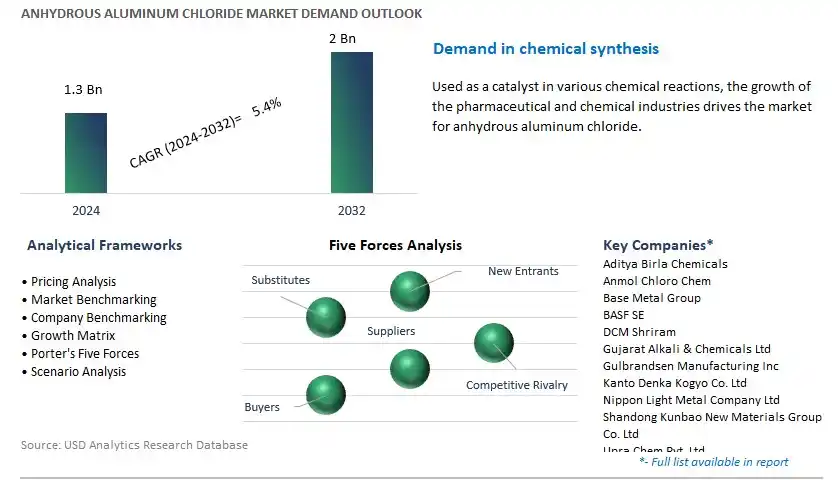
Global Anhydrous Aluminum Chloride Market Size is valued at $1.3 Billion in 2024 and is forecast to register a growth rate (CAGR) of 5.4% to reach $2 Billion by 2032.
The global Anhydrous Aluminum Chloride Market Study analyzes and forecasts the market size across 6 regions and 24 countries for diverse segments -By Form (Powder, Granules), By Application (Pharmaceuticals, Pesticides, Chemical Manufacturing, Pigments, Others).
An Introduction to Anhydrous Aluminum Chloride Market in 2024
Anhydrous aluminum chloride (AlCl3) is a chemical compound composed of aluminum and chlorine, primarily used as a catalyst in organic synthesis reactions. It is a white or pale yellow solid that can exist in anhydrous or hydrated forms, depending on the conditions of storage and handling. The market for anhydrous aluminum chloride is driven by its importance as a Lewis acid catalyst in various chemical processes, including Friedel-Crafts alkylation and acylation reactions, polymerization reactions, and isomerization reactions. Anhydrous aluminum chloride is valued for its high catalytic activity, selectivity, and ease of use in promoting numerous organic transformations. Additionally, anhydrous aluminum chloride finds applications in the production of pharmaceuticals, fragrances, dyes, and other specialty chemicals. Further, advancements in catalyst design, recycling methods, and green chemistry approaches are enhancing the efficiency and sustainability of anhydrous aluminum chloride-based processes, driving innovation and growth within the market. As industries to demand efficient and environmentally friendly catalysts for organic synthesis, anhydrous aluminum chloride remains a key component in enabling the development of high-value chemical products.
Anhydrous Aluminum Chloride Market Competitive Landscape
The market report analyses the leading companies in the industry including Aditya Birla Chemicals, Anmol Chloro Chem, Base Metal Group, BASF SE, DCM Shriram, Gujarat Alkali & Chemicals Ltd, Gulbrandsen Manufacturing Inc, Kanto Denka Kogyo Co. Ltd, Nippon Light Metal Company Ltd, Shandong Kunbao New Materials Group Co. Ltd, Upra Chem Pvt. Ltd, and others.
Anhydrous Aluminum Chloride Market Dynamics
Market Trend: Increasing Demand in Chemical Synthesis and Petrochemical Industries
A significant market trend for Anhydrous Aluminum Chloride is the increasing demand in chemical synthesis and petrochemical industries, driven by its versatile applications as a catalyst and raw material. Anhydrous aluminum chloride serves as a catalyst in various chemical reactions, including Friedel-Crafts alkylation and acylation, polymerization, and isomerization processes, essential for the production of pharmaceuticals, fragrances, dyes, and specialty chemicals. Additionally, it finds application as a catalyst in the production of ethylbenzene, which is a key intermediate in the manufacturing of styrene, an important monomer used in plastics production. The growing demand for chemical intermediates and petrochemicals, driven by industrialization, urbanization, and technological advancements, stimulates the demand for anhydrous aluminum chloride and supports market growth in the chemical sector.
Market Driver: Expansion of Pharmaceutical and Specialty Chemical Industries
A significant market driver for Anhydrous Aluminum Chloride is the expansion of pharmaceutical and specialty chemical industries, where it serves as a critical catalyst in the synthesis of various active pharmaceutical ingredients (APIs) and specialty chemicals. With increasing healthcare expenditures, aging populations, and the prevalence of chronic diseases, there is a growing demand for pharmaceutical products and specialty chemicals for medical treatments, diagnostics, and industrial applications. Anhydrous aluminum chloride's role as a Lewis acid catalyst in organic synthesis, particularly in complex molecule construction and functional group transformations, is instrumental in the development of pharmaceuticals and specialty chemicals with diverse therapeutic and industrial applications. The expansion of pharmaceutical and specialty chemical sectors worldwide, driven by research and development, regulatory approvals, and market demand, fuels the demand for anhydrous aluminum chloride and drives market growth in these industries.
Market Opportunity: Innovation in Green Catalysis and Sustainable Processes
An attractive opportunity in the Anhydrous Aluminum Chloride market lies in innovation in green catalysis and sustainable processes to address environmental concerns and regulatory requirements. As industries strive to minimize waste, reduce energy consumption, and mitigate environmental impact, there is a growing interest in developing greener alternatives to traditional catalytic processes using anhydrous aluminum chloride. Opportunities exist for the development of catalytic systems that utilize safer and more environmentally benign solvents, reduce the generation of hazardous by-products, and improve process efficiency and selectivity. By investing in research and development, collaborating with academia and research institutions, and adopting green chemistry principles, manufacturers can develop sustainable catalytic solutions based on anhydrous aluminum chloride, aligning with market trends towards eco-friendly and socially responsible practices.
Anhydrous Aluminum Chloride Market Share Analysis: Powder generated the highest revenue in 2024
Within the Anhydrous Aluminum Chloride Market, the Powder segment is the largest segment, primarily due to its versatility and widespread applications across various industries. Powdered anhydrous aluminum chloride offers potential advantages over granules, including ease of handling, storage, and transportation. Industries such as pharmaceuticals, chemicals, and water treatment extensively utilize powdered aluminum chloride in the production of various products and processes. In pharmaceuticals, powdered aluminum chloride serves as a catalyst in numerous chemical reactions, including the synthesis of pharmaceutical intermediates and active ingredients. Additionally, the chemical industry utilizes powdered aluminum chloride in organic synthesis, polymerization, and as a catalyst in petrochemical processes. Moreover, powdered aluminum chloride is commonly used in water treatment applications for coagulation and flocculation processes to remove impurities and contaminants from water sources. With its wide-ranging applications and practical advantages, the Powder segment dominates the Anhydrous Aluminum Chloride Market.
Anhydrous Aluminum Chloride Market Share Analysis: Pesticides is poised to register the fastest CAGR over the forecast period
Among the options provided, the Pesticides segment is experiencing rapid growth within the Anhydrous Aluminum Chloride Market. In particular, as global agriculture faces increasing challenges from pests, diseases, and weeds, there is a growing demand for effective pesticides to protect crops and ensure food security. Anhydrous aluminum chloride is a key ingredient in the synthesis of various pesticides, including herbicides, insecticides, and fungicides, due to its role as a catalyst in organic synthesis. Additionally, the rising adoption of integrated pest management practices and the need for sustainable agricultural solutions further drive the demand for aluminum chloride-based pesticides. Moreover, regulatory pressures and consumer preferences for safer and eco-friendly pest control products stimulate the development and use of innovative aluminum chloride formulations in the pesticides industry. With ongoing research and development efforts aimed at enhancing pesticide efficacy and environmental sustainability, the Pesticides segment is poised for continued growth in the Anhydrous Aluminum Chloride Market.
Anhydrous Aluminum Chloride Market
By Form
Powder
Granules
By Application
Pharmaceuticals
Pesticides
Chemical Manufacturing
Pigments
Others
Countries Analyzed
North America (US, Canada, Mexico)
Europe (Germany, UK, France, Spain, Italy, Russia, Rest of Europe)
Asia Pacific (China, India, Japan, South Korea, Australia, South East Asia, Rest of Asia)
South America (Brazil, Argentina, Rest of South America)
Middle East and Africa (Saudi Arabia, UAE, Rest of Middle East, South Africa, Egypt, Rest of Africa)
Anhydrous Aluminum Chloride Companies Profiled in the Study
Aditya Birla Chemicals
Anmol Chloro Chem
Base Metal Group
BASF SE
DCM Shriram
Gujarat Alkali & Chemicals Ltd
Gulbrandsen Manufacturing Inc
Kanto Denka Kogyo Co. Ltd
Nippon Light Metal Company Ltd
Shandong Kunbao New Materials Group Co. Ltd
Upra Chem Pvt. Ltd
*- List Not Exhaustive
TABLE OF CONTENTS
1 Introduction to 2024 Anhydrous Aluminum Chloride Market
1.1 Market Overview
1.2 Quick Facts
1.3 Scope/Objective of the Study
1.4 Market Definition
1.5 Countries and Regions Covered
1.6 Units, Currency, and Conversions
1.7 Industry Value Chain
2 Research Methodology
2.1 Market Size Estimation
2.2 Sources and Research Methodology
2.3 Data Triangulation
2.4 Assumptions and Limitations
3 Executive Summary
3.1 Global Anhydrous Aluminum Chloride Market Size Outlook, $ Million, 2021 to 2032
3.2 Anhydrous Aluminum Chloride Market Outlook by Type, $ Million, 2021 to 2032
3.3 Anhydrous Aluminum Chloride Market Outlook by Product, $ Million, 2021 to 2032
3.4 Anhydrous Aluminum Chloride Market Outlook by Application, $ Million, 2021 to 2032
3.5 Anhydrous Aluminum Chloride Market Outlook by Key Countries, $ Million, 2021 to 2032
4 Market Dynamics
4.1 Key Driving Forces of Anhydrous Aluminum Chloride Industry
4.2 Key Market Trends in Anhydrous Aluminum Chloride Industry
4.3 Potential Opportunities in Anhydrous Aluminum Chloride Industry
4.4 Key Challenges in Anhydrous Aluminum Chloride Industry
5 Market Factor Analysis
5.1 Value Chain Analysis
5.2 Competitive Landscape
5.2.1 Global Anhydrous Aluminum Chloride Market Share by Company (%), 2023
5.2.2 Product Offerings by Company
5.3 Porter’s Five Forces Analysis
5.4 Pricing Analysis and Outlook
6 Growth Outlook Across Scenarios
6.1 Growth Analysis-Case Scenario Definitions
6.2 Low Growth Scenario Forecasts
6.3 Reference Growth Scenario Forecasts
6.4 High Growth Scenario Forecasts
7 Global Anhydrous Aluminum Chloride Market Outlook by Segments
7.1 Anhydrous Aluminum Chloride Market Outlook by Segments, $ Million, 2021- 2032
By Form
Powder
Granules
By Application
Pharmaceuticals
Pesticides
Chemical Manufacturing
Pigments
Others
8 North America Anhydrous Aluminum Chloride Market Analysis and Outlook To 2032
8.1 Introduction to North America Anhydrous Aluminum Chloride Markets in 2024
8.2 North America Anhydrous Aluminum Chloride Market Size Outlook by Country, 2021-2032
8.2.1 United States
8.2.2 Canada
8.2.3 Mexico
8.3 North America Anhydrous Aluminum Chloride Market size Outlook by Segments, 2021-2032
By Form
Powder
Granules
By Application
Pharmaceuticals
Pesticides
Chemical Manufacturing
Pigments
Others
9 Europe Anhydrous Aluminum Chloride Market Analysis and Outlook To 2032
9.1 Introduction to Europe Anhydrous Aluminum Chloride Markets in 2024
9.2 Europe Anhydrous Aluminum Chloride Market Size Outlook by Country, 2021-2032
9.2.1 Germany
9.2.2 France
9.2.3 Spain
9.2.4 United Kingdom
9.2.4 Italy
9.2.5 Russia
9.2.6 Norway
9.2.7 Rest of Europe
9.3 Europe Anhydrous Aluminum Chloride Market Size Outlook by Segments, 2021-2032
By Form
Powder
Granules
By Application
Pharmaceuticals
Pesticides
Chemical Manufacturing
Pigments
Others
10 Asia Pacific Anhydrous Aluminum Chloride Market Analysis and Outlook To 2032
10.1 Introduction to Asia Pacific Anhydrous Aluminum Chloride Markets in 2024
10.2 Asia Pacific Anhydrous Aluminum Chloride Market Size Outlook by Country, 2021-2032
10.2.1 China
10.2.2 India
10.2.3 Japan
10.2.4 South Korea
10.2.5 Indonesia
10.2.6 Malaysia
10.2.7 Australia
10.2.8 Rest of Asia Pacific
10.3 Asia Pacific Anhydrous Aluminum Chloride Market size Outlook by Segments, 2021-2032
By Form
Powder
Granules
By Application
Pharmaceuticals
Pesticides
Chemical Manufacturing
Pigments
Others
11 South America Anhydrous Aluminum Chloride Market Analysis and Outlook To 2032
11.1 Introduction to South America Anhydrous Aluminum Chloride Markets in 2024
11.2 South America Anhydrous Aluminum Chloride Market Size Outlook by Country, 2021-2032
11.2.1 Brazil
11.2.2 Argentina
11.2.3 Rest of South America
11.3 South America Anhydrous Aluminum Chloride Market size Outlook by Segments, 2021-2032
By Form
Powder
Granules
By Application
Pharmaceuticals
Pesticides
Chemical Manufacturing
Pigments
Others
12 Middle East and Africa Anhydrous Aluminum Chloride Market Analysis and Outlook To 2032
12.1 Introduction to Middle East and Africa Anhydrous Aluminum Chloride Markets in 2024
12.2 Middle East and Africa Anhydrous Aluminum Chloride Market Size Outlook by Country, 2021-2032
12.2.1 Saudi Arabia
12.2.2 UAE
12.2.3 Oman
12.2.4 Rest of Middle East
12.2.5 Egypt
12.2.6 Nigeria
12.2.7 South Africa
12.2.8 Rest of Africa
12.3 Middle East and Africa Anhydrous Aluminum Chloride Market size Outlook by Segments, 2021-2032
By Form
Powder
Granules
By Application
Pharmaceuticals
Pesticides
Chemical Manufacturing
Pigments
Others
13 Company Profiles
13.1 Company Snapshot
13.2 SWOT Profiles
13.3 Products and Services
13.4 Recent Developments
13.5 Financial Profile
Aditya Birla Chemicals
Anmol Chloro Chem
Base Metal Group
BASF SE
DCM Shriram
Gujarat Alkali & Chemicals Ltd
Gulbrandsen Manufacturing Inc
Kanto Denka Kogyo Co. Ltd
Nippon Light Metal Company Ltd
Shandong Kunbao New Materials Group Co. Ltd
Upra Chem Pvt. Ltd
14 Appendix
14.1 Customization Offerings
14.2 Subscription Services
14.3 Related Reports
14.4 Publisher Expertise
By Form
Powder
Granules
By Application
Pharmaceuticals
Pesticides
Chemical Manufacturing
Pigments
Others
Countries Analyzed
North America (US, Canada, Mexico)
Europe (Germany, UK, France, Spain, Italy, Russia, Rest of Europe)
Asia Pacific (China, India, Japan, South Korea, Australia, South East Asia, Rest of Asia)
South America (Brazil, Argentina, Rest of South America)
Middle East and Africa (Saudi Arabia, UAE, Rest of Middle East, South Africa, Egypt, Rest of Africa)
