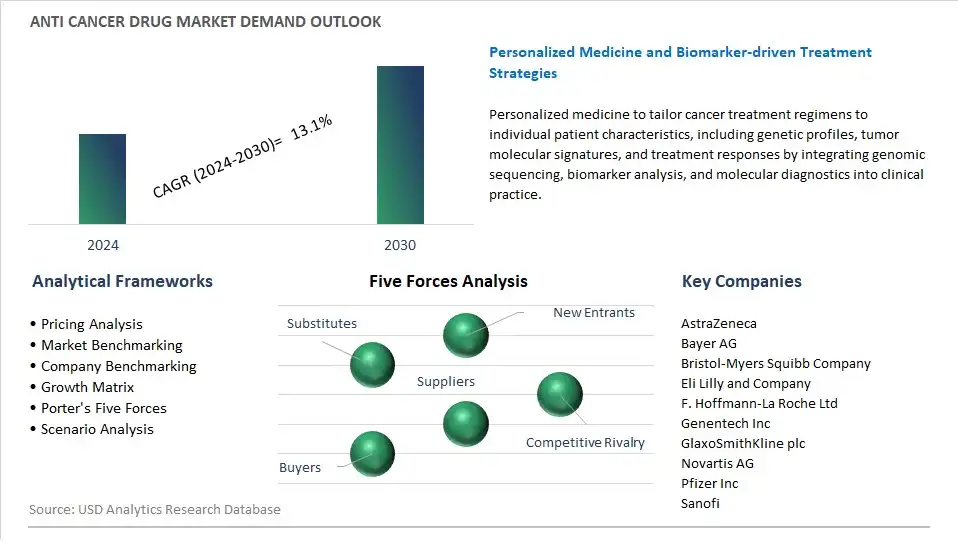
Anti Cancer Drug Market is estimated to increase at a growth rate of 13.1% CAGR over the forecast period from 2024 to 2030.
The Anti Cancer Drug Market study analyzes and forecasts the market size across 6 regions and 24 countries for diverse segments including By Indication (Breast Cancer, Blood Cancer, Prostate Cancer, Gastrointestinal Cancer, Gynaecologic Cancer, Lung Cancer, Others), By Drug (Cytotoxics, Hormonal Therapy, Targeted Therapy, Others), By Route of Administration (Oral, Parenteral, Others), By End-User (Hospitals, Homecare, Specialty Clinics, Others), By Distribution Channel (Hospital Pharmacy, Online Pharmacy, Retail Pharmacy).
An Introduction to Anti Cancer Drug Market in 2024
The Anti-cancer Drug Market in 2024 is experiencing significant growth, driven by the increasing incidence of cancer, advancements in precision medicine, and expanding therapeutic pipelines to address diverse cancer types and molecular targets. Cancer remains a leading cause of morbidity and mortality worldwide, driving the demand for innovative oncology therapies, including chemotherapy, targeted therapies, immunotherapies, and hormonal agents, aimed at inhibiting tumor growth, metastasis, and disease progression. With advancements in drug discovery, biomarker-driven treatment approaches, and combination therapy regimens, the market offers a diverse portfolio of anti-cancer drugs, including small molecules, monoclonal antibodies, and cell-based therapies, tailored to specific tumor types, genetic alterations, and patient characteristics. Moreover, emerging research into novel treatment modalities, such as gene therapy, cancer vaccines, and immune checkpoint inhibitors, holds promise for further advancing cancer treatment options and improving long-term outcomes for patients across the cancer care continuum.
Anti Cancer Drug Market Trend: Advancements in Immunotherapy and Targeted Therapies
A prominent trend in the Anti-Cancer Drug market is the rapid advancement and adoption of immunotherapy and targeted therapies for cancer treatment. Immunotherapy, including immune checkpoint inhibitors and CAR-T cell therapy, has emerged as a revolutionary approach in cancer treatment by harnessing the body's immune system to target and destroy cancer cells. Similarly, targeted therapies, such as small molecule inhibitors and monoclonal antibodies, offer precise targeting of specific molecular pathways implicated in cancer growth and progression. These innovative treatment modalities demonstrate superior efficacy and reduced toxicity compared to traditional chemotherapy, driving their widespread adoption and reshaping the landscape of cancer therapeutics.
Anti Cancer Drug Market Driver: Increasing Incidence and Prevalence of Cancer Worldwide
A primary driver propelling the Anti-Cancer Drug market is the escalating incidence and prevalence of cancer globally. With cancer posing a significant public health burden and accounting for a substantial portion of disease-related morbidity and mortality worldwide, there is a pressing need for effective treatment options to address this growing healthcare challenge. The rising incidence of cancer, fueled by factors such as aging populations, lifestyle changes, environmental exposures, and genetic predispositions, drives the demand for anti-cancer drugs across various cancer types and stages. This sustained demand underpins market growth and incentivizes pharmaceutical companies to invest in research and development efforts to discover and develop novel anti-cancer therapies.
Anti Cancer Drug Market Opportunity: Personalized Medicine and Biomarker-driven Treatment Strategies
An opportunity in the Anti-Cancer Drug market lies in the adoption of personalized medicine and biomarker-driven treatment strategies to optimize patient outcomes. Personalized medicine aims to tailor cancer treatment regimens to individual patient characteristics, including genetic profiles, tumor molecular signatures, and treatment responses. By integrating genomic sequencing, biomarker analysis, and molecular diagnostics into clinical practice, oncologists can identify patients who are most likely to benefit from specific anti-cancer drugs while minimizing the risk of adverse effects in non-responsive individuals. This precision medicine approach not only enhances treatment efficacy but also offers potential cost savings by avoiding unnecessary treatments and reducing healthcare resource utilization. As the field of precision oncology continues to evolve, there is immense opportunity for innovation and growth in developing targeted therapies and companion diagnostics for personalized cancer care.
Anti Cancer Drug Market Segmentation
By Indication
Breast Cancer
Blood Cancer
Prostate Cancer
Gastrointestinal Cancer
Gynaecologic Cancer
Lung Cancer
Others
By Drug
Cytotoxics
Hormonal Therapy
Targeted Therapy
Others
By Route of Administration
Oral
Parenteral
Others
By End-User
Hospitals
Homecare
Specialty Clinics
Others
By Distribution Channel
Hospital Pharmacy
Online Pharmacy
Retail Pharmacy
Geographical Analysis
North America (United States, Canada, Mexico)
Europe (Germany, France, United Kingdom, Spain, Italy, Rest of Europe)
Asia Pacific (China, India, Japan, South Korea, Rest of Asia Pacific)
South America (Brazil, Argentina, Rest of South America)
Middle East and Africa (Saudi Arabia, UAE, Rest of Middle East, South Africa, Egypt, Rest of Africa)
Anti Cancer Drug Market Companies
AstraZeneca
Bayer AG
Bristol-Myers Squibb Company
Eli Lilly and Company
F. Hoffmann-La Roche Ltd
Genentech Inc
GlaxoSmithKline plc
Novartis AG
Pfizer Inc
Sanofi
Reasons to Buy the Anti Cancer Drug Market Study
• Deepen your industry insights and navigate uncertainties for strategy formulation, CAPEX, and Operational decisions
• Gain access to detailed insights on the Anti Cancer Drug Market, encompassing current market size, growth trends, and forecasts till 2030.
• Access detailed competitor analysis, enabling competitive advantage through a thorough understanding of market players, strategies, and potential differentiation opportunities
• Stay ahead of the curve with insights on technological advancements, innovations, and upcoming trends
• Identify lucrative investment avenues and expansion opportunities within the Anti Cancer Drug Market industry, guided by robust, data-backed analysis.
• Understand regional and global markets through country-wise analysis, regional market potential, regulatory nuances, and dynamics
• Execute strategies with confidence and speed through information, analytics, and insights on the industry value chain
• Corporate leaders, strategists, financial experts, shareholders, asset managers, and governmental representatives can make long-term planning scenarios and build an integrated and timely understanding of market dynamics
• Benefit from tailored solutions and expert consultation based on report insights, providing personalized strategies aligned with specific business needs.
TABLE OF CONTENTS
1 Introduction to 2024 Anti Cancer Drug Market
1.1 Market Overview
1.2 Quick Facts
1.3 Scope/Objective of the Study
1.4 Market Definition
1.5 Countries and Regions Analyzed
1.6 Units, Currency, and Conversions
1.7 Industry Value Chain
2 Research Methodology
2.1 Market Size Estimation
2.2 Sources and Research Methodology
2.3 Data Triangulation
2.4 Assumptions and Limitations
3 Executive Summary
3.1 Global Anti Cancer Drug Market Size Outlook, $ Million, 2021 to 2030
3.2 Anti Cancer Drug Market Outlook by Type, $ Million, 2021 to 2030
3.3 Anti Cancer Drug Market Outlook by Product, $ Million, 2021 to 2030
3.4 Anti Cancer Drug Market Outlook by Application, $ Million, 2021 to 2030
3.5 Anti Cancer Drug Market Outlook by Key Countries, $ Million, 2021 to 2030
4 Market Dynamics
4.1 Key Driving Forces of Anti Cancer Drug Market Industry
4.2 Key Market Trends in Anti Cancer Drug Market Industry
4.3 Potential Opportunities in Anti Cancer Drug Market Industry
4.4 Key Challenges in Anti Cancer Drug Market Industry
5 Market Factor Analysis
5.1 Competitive Landscape
5.1.1 Global Anti Cancer Drug Market Share by Company (%), 2023
5.1.2 Product Offerings by Company
5.2 Porter’s Five Forces Analysis
6 Growth Outlook Across Scenarios
6.1 Growth Analysis-Case Scenario Definitions
6.2 Low Growth Scenario Forecasts
6.3 Reference Growth Scenario Forecasts
6.4 High Growth Scenario Forecasts
7 Global Anti Cancer Drug Market Outlook By Segments
7.1 Anti Cancer Drug Market Outlook by Segments
By Indication
Breast Cancer
Blood Cancer
Prostate Cancer
Gastrointestinal Cancer
Gynaecologic Cancer
Lung Cancer
Others
By Drug
Cytotoxics
Hormonal Therapy
Targeted Therapy
Others
By Route of Administration
Oral
Parenteral
Others
By End-User
Hospitals
Homecare
Specialty Clinics
Others
By Distribution Channel
Hospital Pharmacy
Online Pharmacy
Retail Pharmacy
8 North America Anti Cancer Drug Market Analysis And Outlook To 2030
8.1 Introduction to North America Anti Cancer Drug Markets in 2024
8.2 North America Anti Cancer Drug Market Size Outlook by Country, 2021-2030
8.2.1 United States
8.2.2 Canada
8.2.3 Mexico
8.3 North America Anti Cancer Drug Market size Outlook by Segments, 2021-2030
By Indication
Breast Cancer
Blood Cancer
Prostate Cancer
Gastrointestinal Cancer
Gynaecologic Cancer
Lung Cancer
Others
By Drug
Cytotoxics
Hormonal Therapy
Targeted Therapy
Others
By Route of Administration
Oral
Parenteral
Others
By End-User
Hospitals
Homecare
Specialty Clinics
Others
By Distribution Channel
Hospital Pharmacy
Online Pharmacy
Retail Pharmacy
9 Europe Anti Cancer Drug Market Analysis And Outlook To 2030
9.1 Introduction to Europe Anti Cancer Drug Markets in 2024
9.2 Europe Anti Cancer Drug Market Size Outlook by Country, 2021-2030
9.2.1 Germany
9.2.2 France
9.2.3 Spain
9.2.4 United Kingdom
9.2.4 Italy
9.2.5 Russia
9.2.6 Norway
9.2.7 Rest of Europe
9.3 Europe Anti Cancer Drug Market Size Outlook By Segments, 2021-2030
By Indication
Breast Cancer
Blood Cancer
Prostate Cancer
Gastrointestinal Cancer
Gynaecologic Cancer
Lung Cancer
Others
By Drug
Cytotoxics
Hormonal Therapy
Targeted Therapy
Others
By Route of Administration
Oral
Parenteral
Others
By End-User
Hospitals
Homecare
Specialty Clinics
Others
By Distribution Channel
Hospital Pharmacy
Online Pharmacy
Retail Pharmacy
10 Asia Pacific Anti Cancer Drug Market Analysis And Outlook To 2030
10.1 Introduction to Asia Pacific Anti Cancer Drug Markets in 2024
10.2 Asia Pacific Anti Cancer Drug Market Size Outlook by Country, 2021-2030
10.2.1 China
10.2.2 India
10.2.3 Japan
10.2.4 South Korea
10.2.5 Indonesia
10.2.6 Malaysia
10.2.7 Australia
10.2.8 Rest of Asia Pacific
10.3 Asia Pacific Anti Cancer Drug Market size Outlook by Segments, 2021-2030
By Indication
Breast Cancer
Blood Cancer
Prostate Cancer
Gastrointestinal Cancer
Gynaecologic Cancer
Lung Cancer
Others
By Drug
Cytotoxics
Hormonal Therapy
Targeted Therapy
Others
By Route of Administration
Oral
Parenteral
Others
By End-User
Hospitals
Homecare
Specialty Clinics
Others
By Distribution Channel
Hospital Pharmacy
Online Pharmacy
Retail Pharmacy
11 South America Anti Cancer Drug Market Analysis And Outlook To 2030
11.1 Introduction to South America Anti Cancer Drug Markets in 2024
11.2 South America Anti Cancer Drug Market Size Outlook by Country, 2021-2030
11.2.1 Brazil
11.2.2 Argentina
11.2.3 Rest of South America
11.3 South America Anti Cancer Drug Market size Outlook by Segments, 2021-2030
By Indication
Breast Cancer
Blood Cancer
Prostate Cancer
Gastrointestinal Cancer
Gynaecologic Cancer
Lung Cancer
Others
By Drug
Cytotoxics
Hormonal Therapy
Targeted Therapy
Others
By Route of Administration
Oral
Parenteral
Others
By End-User
Hospitals
Homecare
Specialty Clinics
Others
By Distribution Channel
Hospital Pharmacy
Online Pharmacy
Retail Pharmacy
12 Middle East And Africa Anti Cancer Drug Market Analysis And Outlook To 2030
12.1 Introduction to Middle East and Africa Anti Cancer Drug Markets in 2024
12.2 Middle East and Africa Anti Cancer Drug Market Size Outlook by Country, 2021-2030
12.2.1 Saudi Arabia
12.2.2 UAE
12.2.3 Oman
12.2.4 Rest of Middle East
12.2.5 Egypt
12.2.6 Nigeria
12.2.7 South Africa
12.2.8 Rest of Africa
12.3 Middle East and Africa Anti Cancer Drug Market size Outlook by Segments, 2021-2030
By Indication
Breast Cancer
Blood Cancer
Prostate Cancer
Gastrointestinal Cancer
Gynaecologic Cancer
Lung Cancer
Others
By Drug
Cytotoxics
Hormonal Therapy
Targeted Therapy
Others
By Route of Administration
Oral
Parenteral
Others
By End-User
Hospitals
Homecare
Specialty Clinics
Others
By Distribution Channel
Hospital Pharmacy
Online Pharmacy
Retail Pharmacy
13 Company Profiles
13.1 Company Snapshot
13.2 SWOT Profiles
13.3 Products and Services
13.4 Recent Developments
13.5 Financial Profile
List of Companies
AstraZeneca
Bayer AG
Bristol-Myers Squibb Company
Eli Lilly and Company
F. Hoffmann-La Roche Ltd
Genentech Inc
GlaxoSmithKline plc
Novartis AG
Pfizer Inc
Sanofi
14 Appendix
14.1 Customization Offerings
14.2 Subscription Services
14.3 Related Reports
14.4 Publisher Expertise
By Indication
Breast Cancer
Blood Cancer
Prostate Cancer
Gastrointestinal Cancer
Gynaecologic Cancer
Lung Cancer
Others
By Drug
Cytotoxics
Hormonal Therapy
Targeted Therapy
Others
By Route of Administration
Oral
Parenteral
Others
By End-User
Hospitals
Homecare
Specialty Clinics
Others
By Distribution Channel
Hospital Pharmacy
Online Pharmacy
Retail Pharmacy
