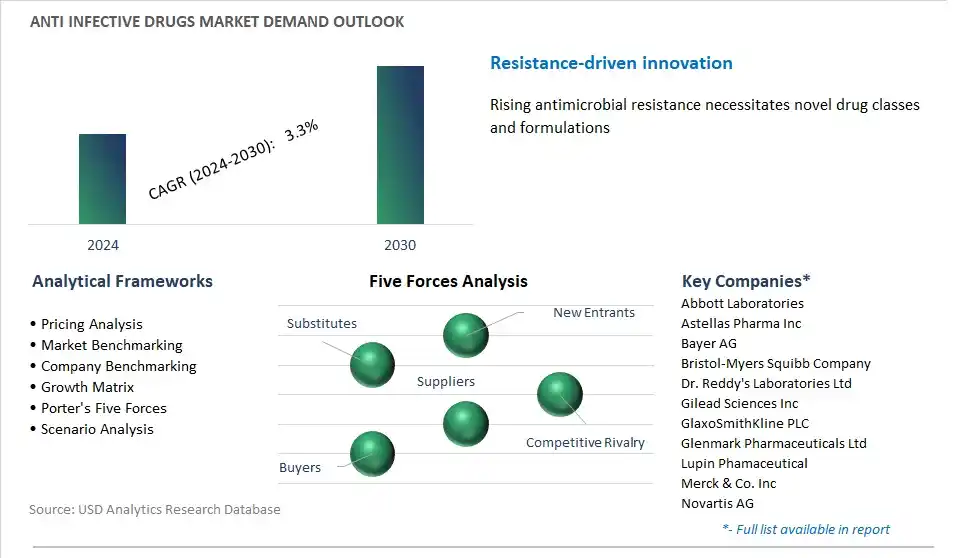
Anti infective Drugs Market is estimated to increase at a Compounded Annual Growth Rate of 3.3% CAGR over the forecast period from 2024 to 2030
The Anti infective Drugs Market study analyzes and forecasts the market size across 6 regions and 24 countries for diverse segments- By Product (Antibiotics, Antivirals, Antifungals, Others), By Indication (HIV Infection, Pneumonia, Respiratory Virus Infection, Sepsis, Tuberculosis, Others), By Distribution Channel (Hospital Pharmacy, Retail Pharmacy, Others).
An Introduction to Anti infective Drugs Market in 2024
In 2024, the market for anti-infective drugs remains essential for addressing infectious diseases caused by bacteria, viruses, fungi, and parasites, spanning a wide range of clinical indications and therapeutic challenges. From antibiotics and antivirals to antifungals and antiparasitic agents, anti-infective drugs target pathogen-specific mechanisms of action, inhibiting microbial growth, replication, and virulence. With the emergence of antimicrobial resistance, healthcare-associated infections, and global pandemics, the demand for novel anti-infective therapies and innovative treatment strategies continues to grow. Moreover, with advancements in drug discovery, pharmacogenomics, and precision medicine approaches, the anti-infective drug market offers personalized treatment options tailored to individual patient characteristics, microbial susceptibilities, and epidemiological trends, ensuring optimal efficacy and safety in infectious disease management.
Market Trend: Increasing Prevalence of Drug-Resistant Pathogens
A significant trend in the anti-infective drugs market is the increasing prevalence of drug-resistant pathogens. The emergence and spread of antimicrobial resistance pose a significant challenge to the effective treatment of infectious diseases worldwide. Drug-resistant bacteria, viruses, fungi, and parasites are rendering many conventional antibiotics, antivirals, and antifungals ineffective, leading to prolonged illness, increased mortality rates, and higher healthcare costs. This trend underscores the urgent need for novel anti-infective drugs and alternative treatment strategies to combat drug-resistant pathogens and address the growing threat of antimicrobial resistance.
Market Driver: Growing Incidence of Infectious Diseases
A key driver for the anti-infective drugs market is the growing incidence of infectious diseases globally. Infectious diseases, caused by bacteria, viruses, fungi, and parasites, continue to pose significant public health challenges, particularly in developing regions with limited access to healthcare resources and sanitation facilities. Factors such as population growth, urbanization, climate change, and globalization contribute to the spread of infectious diseases and the emergence of new pathogens. The increasing incidence of infectious diseases drives the demand for effective anti-infective drugs to prevent, treat, and control infections, thereby reducing disease burden, improving patient outcomes, and mitigating the risk of disease outbreaks.
Market Opportunity: Development of Broad-Spectrum Antimicrobial Agents
An opportunity in the anti-infective drugs market lies in the development of broad-spectrum antimicrobial agents with activity against a wide range of pathogens, including drug-resistant strains. Traditional antimicrobial agents often target specific classes of pathogens or have limited spectrum coverage, leading to the emergence of resistance and the need for combination therapies. Developing broad-spectrum antimicrobial agents that target multiple pathways or virulence factors in different types of pathogens can provide a more comprehensive approach to infection management and reduce the risk of resistance development. Additionally, leveraging advances in genomics, proteomics, and artificial intelligence can facilitate the identification of novel drug targets and the design of rational drug combinations to enhance antimicrobial efficacy and overcome resistance mechanisms. By investing in the development of broad-spectrum antimicrobial agents, companies can address unmet needs in infectious disease treatment, strengthen their product pipelines, and contribute to the global effort to combat antimicrobial resistance.
Anti-infective Drugs Market Share Analysis: Respiratory Virus Infection
The Respiratory Virus Infection segment within the Anti-infective Drugs Market is witnessing rapid growth. Respiratory virus infections, including influenza, respiratory syncytial virus (RSV), adenovirus, and others, pose significant public health challenges worldwide, leading to high morbidity and mortality rates, especially during seasonal outbreaks and pandemics. The demand for effective anti-infective drugs to treat respiratory virus infections is increasing, driven by factors such as the ongoing COVID-19 pandemic, the emergence of new viral strains, and the need to address the burden of other respiratory viruses such as influenza. Anti-viral drugs targeting respiratory viruses, including neuraminidase inhibitors, polymerase inhibitors, and monoclonal antibodies, are crucial in managing respiratory virus infections and reducing disease severity and transmission. As healthcare systems continue to prioritize the prevention and treatment of respiratory virus infections, the Respiratory Virus Infection segment is poised for substantial expansion within the Anti-infective Drugs Market.
Anti infective Drugs Competitive Analysis
The market research study provides in-depth insights into leading companies including the SWOT analyses, product profile, financial details, and recent developments acrossAbbott Laboratories, Astellas Pharma Inc, Bayer AG, Bristol-Myers Squibb Company, Dr. Reddy's Laboratories Ltd, Gilead Sciences Inc, GlaxoSmithKline PLC, Glenmark Pharmaceuticals Ltd, Lupin Phamaceutical, Merck & Co. Inc, Novartis AG, Pfizer Inc, Sanofi SA
Anti infective Drugs Market Segmentation
By Product
Antibiotics
Antivirals
Antifungals
Others
By Indication
HIV Infection
Pneumonia
Respiratory Virus Infection
Sepsis
Tuberculosis
Others
By Distribution Channel
Hospital Pharmacy
Retail Pharmacy
Others
Geographical Analysis
North America (United States, Canada, Mexico)
Europe (Germany, France, United Kingdom, Spain, Italy, Rest of Europe)
Asia Pacific (China, India, Japan, South Korea, Rest of Asia Pacific)
South America (Brazil, Argentina, Rest of South America)
Middle East and Africa (Saudi Arabia, UAE, Rest of Middle East, South Africa, Egypt, Rest of Africa)
Anti infective Drugs Market Companies
Abbott Laboratories
Astellas Pharma Inc
Bayer AG
Bristol-Myers Squibb Company
Dr. Reddy's Laboratories Ltd
Gilead Sciences Inc
GlaxoSmithKline PLC
Glenmark Pharmaceuticals Ltd
Lupin Phamaceutical
Merck & Co. Inc
Novartis AG
Pfizer Inc
Sanofi SA
Reasons to Buy the Anti infective Drugs Market Study
• Deepen your industry insights and navigate uncertainties for strategy formulation, CAPEX, and Operational decisions
• Gain access to detailed insights on the Anti infective Drugs Market, encompassing current market size, growth trends, and forecasts till 2030.
• Access detailed competitor analysis, enabling competitive advantage through a thorough understanding of market players, strategies, and potential differentiation opportunities
• Stay ahead of the curve with insights on technological advancements, innovations, and upcoming trends
• Identify lucrative investment avenues and expansion opportunities within the Anti infective Drugs Market industry, guided by robust, data-backed analysis.
• Understand regional and global markets through country-wise analysis, regional market potential, regulatory nuances, and dynamics
• Execute strategies with confidence and speed through information, analytics, and insights on the industry value chain
• Corporate leaders, strategists, financial experts, shareholders, asset managers, and governmental representatives can make long-term planning scenarios and build an integrated and timely understanding of market dynamics
• Benefit from tailored solutions and expert consultation based on report insights, providing personalized strategies aligned with specific business needs.
TABLE OF CONTENTS
1 Introduction to 2024 Anti infective Drugs Market
1.1 Market Overview
1.2 Quick Facts
1.3 Scope/Objective of the Study
1.4 Market Definition
1.5 Countries and Regions Covered
1.6 Units, Currency, and Conversions
1.7 Industry Value Chain
2 Research Methodology
2.1 Market Size Estimation
2.2 Sources and Research Methodology
2.3 Data Triangulation
2.4 Assumptions and Limitations
3 Executive Summary
3.1 Global Anti infective Drugs Market Size Outlook, $ Million, 2021 to 2030
3.2 Anti infective Drugs Market Outlook by Type, $ Million, 2021 to 2030
3.3 Anti infective Drugs Market Outlook by Product, $ Million, 2021 to 2030
3.4 Anti infective Drugs Market Outlook by Application, $ Million, 2021 to 2030
3.5 Anti infective Drugs Market Outlook by Key Countries, $ Million, 2021 to 2030
4 Market Dynamics
4.1 Key Driving Forces of Anti infective Drugs Industry
4.2 Key Market Trends in Anti infective Drugs Industry
4.3 Potential Opportunities in Anti infective Drugs Industry
4.4 Key Challenges in Anti infective Drugs Industry
5 Market Factor Analysis
5.1 Value Chain Analysis
5.2 Competitive Landscape
5.2.1 Global Anti infective Drugs Market Share by Company (%), 2023
5.2.2 Product Offerings by Company
5.3 Porter’s Five Forces Analysis
5.4 Pricing Analysis and Outlook
6 Growth Outlook Across Scenarios
6.1 Growth Analysis-Case Scenario Definitions
6.2 Low Growth Scenario Forecasts
6.3 Reference Growth Scenario Forecasts
6.4 High Growth Scenario Forecasts
7 Global Anti infective Drugs Market Outlook by Segments
7.1 Anti infective Drugs Market Outlook by Segments, $ Million, 2021- 2030
By Product
Antibiotics
Antivirals
Antifungals
Others
By Indication
HIV Infection
Pneumonia
Respiratory Virus Infection
Sepsis
Tuberculosis
Others
By Distribution Channel
Hospital Pharmacy
Retail Pharmacy
Others
8 North America Anti infective Drugs Market Analysis and Outlook To 2030
8.1 Introduction to North America Anti infective Drugs Markets in 2024
8.2 North America Anti infective Drugs Market Size Outlook by Country, 2021-2030
8.2.1 United States
8.2.2 Canada
8.2.3 Mexico
8.3 North America Anti infective Drugs Market size Outlook by Segments, 2021-2030
By Product
Antibiotics
Antivirals
Antifungals
Others
By Indication
HIV Infection
Pneumonia
Respiratory Virus Infection
Sepsis
Tuberculosis
Others
By Distribution Channel
Hospital Pharmacy
Retail Pharmacy
Others
9 Europe Anti infective Drugs Market Analysis and Outlook To 2030
9.1 Introduction to Europe Anti infective Drugs Markets in 2024
9.2 Europe Anti infective Drugs Market Size Outlook by Country, 2021-2030
9.2.1 Germany
9.2.2 France
9.2.3 Spain
9.2.4 United Kingdom
9.2.4 Italy
9.2.5 Russia
9.2.6 Norway
9.2.7 Rest of Europe
9.3 Europe Anti infective Drugs Market Size Outlook by Segments, 2021-2030
By Product
Antibiotics
Antivirals
Antifungals
Others
By Indication
HIV Infection
Pneumonia
Respiratory Virus Infection
Sepsis
Tuberculosis
Others
By Distribution Channel
Hospital Pharmacy
Retail Pharmacy
Others
10 Asia Pacific Anti infective Drugs Market Analysis and Outlook To 2030
10.1 Introduction to Asia Pacific Anti infective Drugs Markets in 2024
10.2 Asia Pacific Anti infective Drugs Market Size Outlook by Country, 2021-2030
10.2.1 China
10.2.2 India
10.2.3 Japan
10.2.4 South Korea
10.2.5 Indonesia
10.2.6 Malaysia
10.2.7 Australia
10.2.8 Rest of Asia Pacific
10.3 Asia Pacific Anti infective Drugs Market size Outlook by Segments, 2021-2030
By Product
Antibiotics
Antivirals
Antifungals
Others
By Indication
HIV Infection
Pneumonia
Respiratory Virus Infection
Sepsis
Tuberculosis
Others
By Distribution Channel
Hospital Pharmacy
Retail Pharmacy
Others
11 South America Anti infective Drugs Market Analysis and Outlook To 2030
11.1 Introduction to South America Anti infective Drugs Markets in 2024
11.2 South America Anti infective Drugs Market Size Outlook by Country, 2021-2030
11.2.1 Brazil
11.2.2 Argentina
11.2.3 Rest of South America
11.3 South America Anti infective Drugs Market size Outlook by Segments, 2021-2030
By Product
Antibiotics
Antivirals
Antifungals
Others
By Indication
HIV Infection
Pneumonia
Respiratory Virus Infection
Sepsis
Tuberculosis
Others
By Distribution Channel
Hospital Pharmacy
Retail Pharmacy
Others
12 Middle East and Africa Anti infective Drugs Market Analysis and Outlook To 2030
12.1 Introduction to Middle East and Africa Anti infective Drugs Markets in 2024
12.2 Middle East and Africa Anti infective Drugs Market Size Outlook by Country, 2021-2030
12.2.1 Saudi Arabia
12.2.2 UAE
12.2.3 Oman
12.2.4 Rest of Middle East
12.2.5 Egypt
12.2.6 Nigeria
12.2.7 South Africa
12.2.8 Rest of Africa
12.3 Middle East and Africa Anti infective Drugs Market size Outlook by Segments, 2021-2030
By Product
Antibiotics
Antivirals
Antifungals
Others
By Indication
HIV Infection
Pneumonia
Respiratory Virus Infection
Sepsis
Tuberculosis
Others
By Distribution Channel
Hospital Pharmacy
Retail Pharmacy
Others
13 Company Profiles
13.1 Company Snapshot
13.2 SWOT Profiles
13.3 Products and Services
13.4 Recent Developments
13.5 Financial Profile
List of Companies
Abbott Laboratories
Astellas Pharma Inc
Bayer AG
Bristol-Myers Squibb Company
Dr. Reddy's Laboratories Ltd
Gilead Sciences Inc
GlaxoSmithKline PLC
Glenmark Pharmaceuticals Ltd
Lupin Phamaceutical
Merck & Co. Inc
Novartis AG
Pfizer Inc
Sanofi SA
14 Appendix
14.1 Customization Offerings
14.2 Subscription Services
14.3 Related Reports
14.4 Publisher Expertise
By Product
Antibiotics
Antivirals
Antifungals
Others
By Indication
HIV Infection
Pneumonia
Respiratory Virus Infection
Sepsis
Tuberculosis
Others
By Distribution Channel
Hospital Pharmacy
Retail Pharmacy
Others
Countries Analyzed
North America (United States, Canada, Mexico)
Europe (Germany, France, United Kingdom, Spain, Italy, Rest of Europe)
Asia Pacific (China, India, Japan, South Korea, Rest of Asia Pacific)
South America (Brazil, Argentina, Rest of South America)
Middle East and Africa (Saudi Arabia, UAE, Rest of Middle East, South Africa, Egypt, Rest of Africa)
