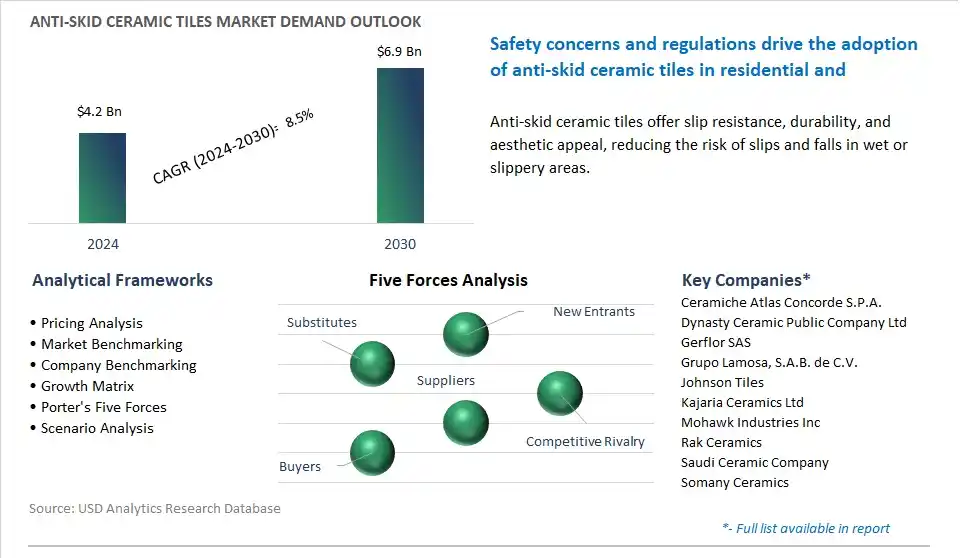
The global Anti-Skid Ceramic Tiles Market is poised to register a 8.5% CAGR from $4.2 Billion in 2024 to $6.9 Billion in 2030.
The global Anti-Skid Ceramic Tiles Market Study analyzes and forecasts the market size across 6 regions and 24 countries for diverse segments -By Type (Wall, Floor), By Application (Manufacturer, Wholesaler), By End-User (Non-Residential, Residential).
An Introduction to Global Anti Skid Ceramic Tiles Market in 2024
The anti-skid ceramic tiles market is evolving with key trends focused on safety, durability, and aesthetic appeal in flooring solutions. With increasing concerns over slip and fall accidents, particularly in wet or high-traffic areas, manufacturers are innovating to develop ceramic tiles with enhanced anti-skid properties. One trend is the incorporation of micro-textured surfaces, nano-coatings, and abrasive particles into tile glazes to improve traction and reduce the risk of slips and falls. Additionally, there is a growing demand for anti-skid tiles with customizable designs, colors, and finishes to complement various architectural styles and interior designs while maintaining safety standards. Moreover, advancements in manufacturing processes such as digital printing and inkjet technology are driving market adoption of anti-skid ceramic tiles with realistic patterns, textures, and visual effects that mimic natural stone, wood, or concrete surfaces. Furthermore, there is a trend towards the development of sustainable and eco-friendly anti-skid tiles made from recycled materials, low-emission glazes, and water-based inks, aligning with green building initiatives and environmental regulations. Overall, the future of the anti-skid ceramic tiles industry lies in innovation, customization, and sustainability to meet evolving customer needs and regulatory requirements for safe and stylish flooring solutions in residential, commercial, and industrial settings.
Anti-Skid Ceramic Tiles Market Competitive Landscape
The market report analyses the leading companies in the industry including Ceramiche Atlas Concorde S.P.A., Dynasty Ceramic Public Company Ltd, Gerflor SAS, Grupo Lamosa, S.A.B. de C.V., Johnson Tiles, Kajaria Ceramics Ltd, Mohawk Industries Inc, Rak Ceramics, Saudi Ceramic Company, Somany Ceramics.
Anti-Skid Ceramic Tiles Market Dynamics
Anti-Skid Ceramic Tiles Market Trend: Growing Emphasis on Safety and Durability
A prominent trend in the anti-skid ceramic tiles market is the growing emphasis on safety and durability in flooring solutions. With an increasing focus on creating safer environments in residential, commercial, and industrial settings, there is a rising demand for anti-skid ceramic tiles that offer enhanced traction and reduce the risk of slips and falls. Additionally, consumers are seeking flooring options that are durable and resistant to wear and tear, leading to the adoption of anti-skid ceramic tiles known for their robustness and longevity. This trend is driving manufacturers to innovate and develop anti-skid tiles with advanced surface textures and coatings to provide superior slip resistance while maintaining aesthetic appeal.
Anti-Skid Ceramic Tiles Market Driver: Regulatory Mandates and Safety Standards
The primary driver for the anti-skid ceramic tiles market is the implementation of regulatory mandates and safety standards pertaining to slip resistance in building codes and construction regulations. Governments and regulatory bodies worldwide impose stringent requirements for flooring materials used in public spaces, workplaces, and residential buildings to ensure the safety of occupants. Anti-skid ceramic tiles that meet or exceed these standards are in high demand as they help builders and property owners comply with safety regulations and reduce liability risks associated with accidents and injuries. As safety regulations continue to evolve and become more stringent, the demand for certified anti-skid ceramic tiles is expected to increase, driving market growth.
Anti-Skid Ceramic Tiles Market Opportunity: Expansion into Niche Applications and Customization
An opportunity for market expansion in the anti-skid ceramic tiles segment lies in the exploration of niche applications and customization options. While anti-skid tiles are commonly used in areas prone to moisture and slipping hazards such as bathrooms, kitchens, and outdoor spaces, there is potential to expand into specialized environments such as healthcare facilities, swimming pools, and sports arenas where slip resistance is critical. Additionally, offering customization options such as varying surface textures, colors, and sizes allows manufacturers to cater to diverse customer preferences and design requirements. By tapping into niche markets and offering tailored solutions, companies can differentiate themselves in the competitive landscape and capitalize on emerging opportunities for growth in the anti-skid ceramic tiles market.
Anti-Skid Ceramic Tiles Market Share Analysis: Floor Tiles generated the highest revenue in 2024
The largest segment in the Anti-Skid Ceramic Tiles Market is floor tiles, primarily due to their extensive application range and heightened safety concerns in various settings. Floor tiles are commonly used in residential, commercial, and industrial spaces, including kitchens, bathrooms, hallways, corridors, and outdoor areas, where slip and fall accidents pose a significant risk. Anti-skid ceramic floor tiles are specially designed with textured surfaces or coatings that provide enhanced traction and grip, reducing the likelihood of slips and falls, particularly in wet or high-traffic areas. Further, floor tiles offer durability, ease of maintenance, and aesthetic appeal, making them a popular choice for flooring solutions across different environments. Additionally, stringent building codes, safety regulations, and insurance requirements mandate the use of anti-skid flooring materials in certain applications, further driving the demand for anti-skid ceramic floor tiles. Furthermore, advancements in tile manufacturing technology have led to the development of innovative anti-skid solutions that combine safety performance with design versatility, catering to diverse customer preferences and project requirements. As safety remains a top priority for property owners, facility managers, and homeowners, the demand for anti-skid ceramic floor tiles is expected to continue its dominance in the market.
Anti-Skid Ceramic Tiles Market Share Analysis: Wholesaler segment is poised to register the fastest growth rate (CAGR) over the forecast period to 2030
The fastest-growing segment in the Anti-Skid Ceramic Tiles Market is the wholesaler segment, driven by the increasing demand for anti-skid ceramic tiles and the expansion of distribution networks. Wholesalers play a vital role in the supply chain by procuring bulk quantities of tiles from manufacturers and distributing them to retailers, contractors, and project developers. As the construction industry experiences growth and urbanization trends continue, there is a rising demand for anti-skid ceramic tiles in residential, commercial, and industrial projects to enhance safety and prevent slip and fall accidents. Wholesalers capitalize on this demand by offering a wide range of anti-skid ceramic tiles in various sizes, designs, and finishes to cater to diverse customer preferences and project requirements. Further, wholesalers leverage their established relationships with manufacturers, logistics providers, and retailers to streamline the procurement and distribution process, ensuring timely delivery and efficient inventory management. Additionally, wholesalers invest in marketing initiatives, promotional campaigns, and customer service strategies to attract new clients and retain existing customers in competitive markets. Furthermore, the proliferation of online platforms, digital marketing channels, and e-commerce capabilities has enabled wholesalers to reach a broader audience and expand their market reach beyond geographical boundaries. As the construction industry continues to grow and safety regulations become more stringent, the demand for anti-skid ceramic tiles through wholesaler channels is expected to experience rapid growth, making it the fastest-growing segment in the market.
Anti-Skid Ceramic Tiles Market Share Analysis: Non-Residential segment is poised to register the fastest growth rate (CAGR) over the forecast period to 2030
The fastest-growing segment in the Anti-Skid Ceramic Tiles Market is the non-residential sector, propelled by stringent safety regulations, increasing awareness of slip and fall hazards, and a surge in commercial construction projects. Non-residential end-users include commercial establishments, institutional buildings, industrial facilities, hospitality venues, healthcare facilities, and public spaces where safety is a paramount concern due to high foot traffic and liability risks. With safety regulations becoming more stringent and liability concerns on the rise, there is a growing demand for anti-skid ceramic tiles in non-residential settings to prevent slip and fall accidents and minimize the risk of injuries and litigation. Further, commercial construction projects, such as office buildings, shopping malls, hotels, restaurants, and entertainment venues, require durable, low-maintenance flooring solutions that offer both safety and aesthetic appeal. Anti-skid ceramic tiles meet these requirements by providing enhanced traction, durability, and design versatility, making them a preferred choice for flooring applications in non-residential environments. Additionally, the adoption of green building practices and sustainability standards has further accelerated the demand for anti-skid ceramic tiles with eco-friendly manufacturing processes and recyclable materials in non-residential projects. Furthermore, the growing emphasis on wellness and occupant comfort in workplace environments has led to the incorporation of anti-skid flooring solutions in ergonomic design strategies to promote employee health and productivity. As commercial construction activity continues to expand globally and safety remains a top priority for non-residential end-users, the demand for anti-skid ceramic tiles in the non-residential sector is expected to experience rapid growth, making it the fastest-growing segment in the market.
Anti-Skid Ceramic Tiles Market Report Segmentation
By Type
Wall
Floor
By Application
Manufacturer
Wholesaler
By End-User
Non-Residential
Residential
Regions Included
North America (US, Canada, Mexico)
Europe (Germany, UK, France, Spain, Italy, Russia, Rest of Europe)
Asia Pacific (China, India, Japan, South Korea, Australia, South East Asia, Rest of Asia)
South America (Brazil, Argentina, Rest of South America)
Middle East and Africa (Saudi Arabia, UAE, Rest of Middle East, South Africa, Egypt, Rest of Africa)
Anti-Skid Ceramic Tiles Companies Profiled in the Market Study
Ceramiche Atlas Concorde S.P.A.
Dynasty Ceramic Public Company Ltd
Gerflor SAS
Grupo Lamosa, S.A.B. de C.V.
Johnson Tiles
Kajaria Ceramics Ltd
Mohawk Industries Inc
Rak Ceramics
Saudi Ceramic Company
Somany Ceramics
*- List Not Exhaustive
TABLE OF CONTENTS
1 Introduction to 2024 Anti-Skid Ceramic Tiles Market
1.1 Market Overview
1.2 Quick Facts
1.3 Scope/Objective of the Study
1.4 Market Definition
1.5 Countries and Regions Covered
1.6 Units, Currency, and Conversions
1.7 Industry Value Chain
2 Research Methodology
2.1 Market Size Estimation
2.2 Sources and Research Methodology
2.3 Data Triangulation
2.4 Assumptions and Limitations
3 Executive Summary
3.1 Global Anti-Skid Ceramic Tiles Market Size Outlook, $ Million, 2021 to 2030
3.2 Anti-Skid Ceramic Tiles Market Outlook by Type, $ Million, 2021 to 2030
3.3 Anti-Skid Ceramic Tiles Market Outlook by Product, $ Million, 2021 to 2030
3.4 Anti-Skid Ceramic Tiles Market Outlook by Application, $ Million, 2021 to 2030
3.5 Anti-Skid Ceramic Tiles Market Outlook by Key Countries, $ Million, 2021 to 2030
4 Market Dynamics
4.1 Key Driving Forces of Anti-Skid Ceramic Tiles Industry
4.2 Key Market Trends in Anti-Skid Ceramic Tiles Industry
4.3 Potential Opportunities in Anti-Skid Ceramic Tiles Industry
4.4 Key Challenges in Anti-Skid Ceramic Tiles Industry
5 Market Factor Analysis
5.1 Value Chain Analysis
5.2 Competitive Landscape
5.2.1 Global Anti-Skid Ceramic Tiles Market Share by Company (%), 2023
5.2.2 Product Offerings by Company
5.3 Porter’s Five Forces Analysis
5.4 Pricing Analysis and Outlook
6 Growth Outlook Across Scenarios
6.1 Growth Analysis-Case Scenario Definitions
6.2 Low Growth Scenario Forecasts
6.3 Reference Growth Scenario Forecasts
6.4 High Growth Scenario Forecasts
7 Global Anti-Skid Ceramic Tiles Market Outlook by Segments
7.1 Anti-Skid Ceramic Tiles Market Outlook by Segments, $ Million, 2021- 2030
By Type
Wall
Floor
By Application
Manufacturer
Wholesaler
By End-User
Non-Residential
Residential
8 North America Anti-Skid Ceramic Tiles Market Analysis and Outlook To 2030
8.1 Introduction to North America Anti-Skid Ceramic Tiles Markets in 2024
8.2 North America Anti-Skid Ceramic Tiles Market Size Outlook by Country, 2021-2030
8.2.1 United States
8.2.2 Canada
8.2.3 Mexico
8.3 North America Anti-Skid Ceramic Tiles Market size Outlook by Segments, 2021-2030
By Type
Wall
Floor
By Application
Manufacturer
Wholesaler
By End-User
Non-Residential
Residential
9 Europe Anti-Skid Ceramic Tiles Market Analysis and Outlook To 2030
9.1 Introduction to Europe Anti-Skid Ceramic Tiles Markets in 2024
9.2 Europe Anti-Skid Ceramic Tiles Market Size Outlook by Country, 2021-2030
9.2.1 Germany
9.2.2 France
9.2.3 Spain
9.2.4 United Kingdom
9.2.4 Italy
9.2.5 Russia
9.2.6 Norway
9.2.7 Rest of Europe
9.3 Europe Anti-Skid Ceramic Tiles Market Size Outlook by Segments, 2021-2030
By Type
Wall
Floor
By Application
Manufacturer
Wholesaler
By End-User
Non-Residential
Residential
10 Asia Pacific Anti-Skid Ceramic Tiles Market Analysis and Outlook To 2030
10.1 Introduction to Asia Pacific Anti-Skid Ceramic Tiles Markets in 2024
10.2 Asia Pacific Anti-Skid Ceramic Tiles Market Size Outlook by Country, 2021-2030
10.2.1 China
10.2.2 India
10.2.3 Japan
10.2.4 South Korea
10.2.5 Indonesia
10.2.6 Malaysia
10.2.7 Australia
10.2.8 Rest of Asia Pacific
10.3 Asia Pacific Anti-Skid Ceramic Tiles Market size Outlook by Segments, 2021-2030
By Type
Wall
Floor
By Application
Manufacturer
Wholesaler
By End-User
Non-Residential
Residential
11 South America Anti-Skid Ceramic Tiles Market Analysis and Outlook To 2030
11.1 Introduction to South America Anti-Skid Ceramic Tiles Markets in 2024
11.2 South America Anti-Skid Ceramic Tiles Market Size Outlook by Country, 2021-2030
11.2.1 Brazil
11.2.2 Argentina
11.2.3 Rest of South America
11.3 South America Anti-Skid Ceramic Tiles Market size Outlook by Segments, 2021-2030
By Type
Wall
Floor
By Application
Manufacturer
Wholesaler
By End-User
Non-Residential
Residential
12 Middle East and Africa Anti-Skid Ceramic Tiles Market Analysis and Outlook To 2030
12.1 Introduction to Middle East and Africa Anti-Skid Ceramic Tiles Markets in 2024
12.2 Middle East and Africa Anti-Skid Ceramic Tiles Market Size Outlook by Country, 2021-2030
12.2.1 Saudi Arabia
12.2.2 UAE
12.2.3 Oman
12.2.4 Rest of Middle East
12.2.5 Egypt
12.2.6 Nigeria
12.2.7 South Africa
12.2.8 Rest of Africa
12.3 Middle East and Africa Anti-Skid Ceramic Tiles Market size Outlook by Segments, 2021-2030
By Type
Wall
Floor
By Application
Manufacturer
Wholesaler
By End-User
Non-Residential
Residential
13 Company Profiles
13.1 Company Snapshot
13.2 SWOT Profiles
13.3 Products and Services
13.4 Recent Developments
13.5 Financial Profile
Ceramiche Atlas Concorde S.P.A.
Dynasty Ceramic Public Company Ltd
Gerflor SAS
Grupo Lamosa, S.A.B. de C.V.
Johnson Tiles
Kajaria Ceramics Ltd
Mohawk Industries Inc
Rak Ceramics
Saudi Ceramic Company
Somany Ceramics
14 Appendix
14.1 Customization Offerings
14.2 Subscription Services
14.3 Related Reports
14.4 Publisher Expertise
By Type
Wall
Floor
By Application
Manufacturer
Wholesaler
By End-User
Non-Residential
Residential
Countries Analyzed
North America (US, Canada, Mexico)
Europe (Germany, UK, France, Spain, Italy, Russia, Rest of Europe)
Asia Pacific (China, India, Japan, South Korea, Australia, South East Asia, Rest of Asia)
South America (Brazil, Argentina, Rest of South America)
Middle East and Africa (Saudi Arabia, UAE, Rest of Middle East, South Africa, Egypt, Rest of Africa)
