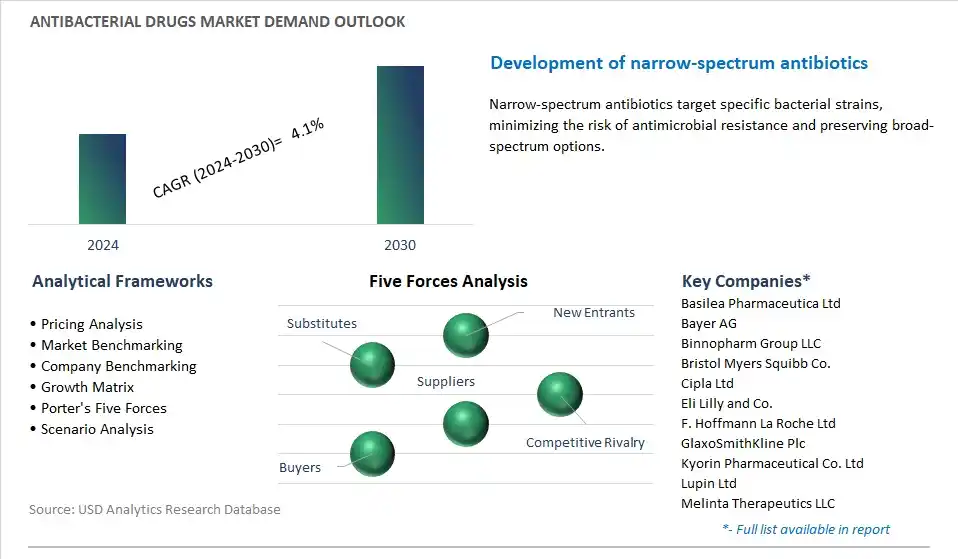
Antibacterial Drugs Market is estimated to increase at a growth rate of 4.1% CAGR over the forecast period from 2024 to 2030.
The global Antibacterial Drugs Market Study analyzes and forecasts the market size across 6 regions and 24 countries for diverse segments including By Drug Class (B-Lactam, Quinolones, Macrolides, Tetracyclines, Others), By Route of Administration (Intravenous, Oral, Others).
An Introduction to Antibacterial Drugs Market in 2024
The Antibacterial Drugs Market in 2024 addresses pharmaceuticals and antibiotics used to treat bacterial infections, targeting bacterial cell walls, protein synthesis, and metabolic pathways to inhibit bacterial growth and replication. These antibacterial agents include beta-lactams, fluoroquinolones, macrolides, and newer classes of antibiotics, addressing antibiotic resistance, multidrug-resistant bacteria, and emerging infectious threats. With a focus on antimicrobial stewardship, infection control, and novel antibiotic development, antibacterial drugs support infectious disease management, public health initiatives, and patient care in bacterial infections.
Antibacterial Drugs Market Competitive Landscape
The global Antibacterial Drugs Industry is highly competitive with a large number of companies focusing on niche market segments. Amidst intense competitive conditions, Antibacterial Drugs Companies are investing in new product launches and strengthening distribution channels. Key companies operating in the Antibacterial Drugs Industry include- Basilea Pharmaceutica Ltd, Bayer AG, Binnopharm Group LLC, Bristol Myers Squibb Co., Cipla Ltd, Eli Lilly and Co., F. Hoffmann La Roche Ltd, GlaxoSmithKline Plc, Kyorin Pharmaceutical Co. Ltd, Lupin Ltd, Melinta Therapeutics LLC, Merck KGaA, Novartis AG, Paratek Pharmaceuticals Inc, Pfizer Inc, Sanofi, Shionogi and Co. Ltd, Sun Pharmaceutical Industries Ltd, Teva Pharmaceutical Industries Ltd.
Antibacterial Drugs Market Trend: Increasing Prevalence of Antibiotic Resistance
In the Antibacterial Drugs market, a significant trend is the increasing prevalence of antibiotic resistance. With the overuse and misuse of antibiotics leading to the emergence of resistant bacterial strains, there's a growing urgency to develop new antibacterial drugs that can overcome resistance mechanisms and combat multidrug-resistant infections. This trend drives market growth by fostering research and development efforts to discover and develop novel antibiotics, alternative therapies, and combination approaches to address the evolving threat of antibiotic-resistant bacteria and improve treatment outcomes for infectious diseases.
Antibacterial Drugs Market Driver: Persistent Need for Effective Antibacterial Treatments
A key driver for the Antibacterial Drugs market is the persistent need for effective antibacterial treatments to combat infectious diseases. Despite advances in medicine and public health, bacterial infections remain a significant cause of morbidity and mortality worldwide, particularly in vulnerable populations, healthcare settings, and regions with limited access to healthcare resources. As bacterial pathogens continue to evolve and develop resistance to existing antibiotics, there's an ongoing demand for new antibacterial drugs that can effectively target and eradicate bacterial infections, driving market demand for antibacterial agents and research investments in drug discovery and development.
Antibacterial Drugs Market Opportunity: Exploration of Novel Drug Targets and Therapeutic Approaches
An opportunity exists in the exploration of novel drug targets and therapeutic approaches for antibacterial drug development. By leveraging advances in genomics, proteomics, and systems biology, there's potential to identify new vulnerabilities in bacterial pathogens and develop targeted therapies that disrupt essential biological processes or virulence factors. This includes the exploration of novel antibacterial targets, such as bacterial cell wall synthesis, protein synthesis, and bacterial metabolism, as well as innovative therapeutic modalities, such as bacteriophage therapy, antimicrobial peptides, and immune-modulating agents, offering new avenues for market differentiation and therapeutic innovation in the Antibacterial Drugs segment.
Market Share Analysis: Quinolones is the fastest growing segment in the Antibacterial Drugs industry
Among the different drug classes in the antibacterial drugs market, Quinolones are experiencing the fastest growth. Quinolones, a class of synthetic broad-spectrum antibiotics, are highly effective against a wide range of bacterial infections. They work by inhibiting the bacterial DNA gyrase or topoisomerase IV enzymes, disrupting bacterial DNA replication and ultimately leading to bacterial cell death. Quinolones are particularly favored for their potency against gram-negative bacteria, including strains resistant to other classes of antibiotics. The rapid growth of quinolones can be attributed to several factors. Firstly, their broad-spectrum activity makes them suitable for treating a variety of bacterial infections, ranging from urinary tract infections to respiratory tract infections. Secondly, advancements in quinolone formulations and development of newer generations with improved efficacy and reduced side effects have contributed to their increased adoption. Lastly, the rise in antibiotic-resistant bacterial strains has fueled the demand for quinolones as alternative treatment options, further driving their growth within the antibacterial drugs market.
Antibacterial Drugs Market Segmentation
By Drug Class
B-Lactam
Quinolones
Macrolides
Tetracyclines
Others
By Route of Administration
Intravenous
Oral
Others
Geographical Analysis
North America (United States, Canada, Mexico)
Europe (Germany, France, United Kingdom, Spain, Italy, Rest of Europe)
Asia Pacific (China, India, Japan, South Korea, Rest of Asia Pacific)
South America (Brazil, Argentina, Rest of South America)
Middle East and Africa (Saudi Arabia, UAE, Rest of Middle East, South Africa, Egypt, Rest of Africa)
Antibacterial Drugs Companies
Basilea Pharmaceutica Ltd
Bayer AG
Binnopharm Group LLC
Bristol Myers Squibb Co.
Cipla Ltd
Eli Lilly and Co.
F. Hoffmann La Roche Ltd
GlaxoSmithKline Plc
Kyorin Pharmaceutical Co. Ltd
Lupin Ltd
Melinta Therapeutics LLC
Merck KGaA
Novartis AG
Paratek Pharmaceuticals Inc
Pfizer Inc
Sanofi
Shionogi and Co. Ltd
Sun Pharmaceutical Industries Ltd
Teva Pharmaceutical Industries Ltd
* List not Exhaustive
Reasons to Buy the Antibacterial Drugs Market Study
• Deepen your industry insights and navigate uncertainties for strategy formulation, CAPEX, and Operational decisions
• Gain access to detailed insights on the Antibacterial Drugs Market, encompassing current market size, growth trends, and forecasts till 2030.
• Access detailed competitor analysis, enabling competitive advantage through a thorough understanding of market players, strategies, and potential differentiation opportunities
• Stay ahead of the curve with insights on technological advancements, innovations, and upcoming trends
• Identify lucrative investment avenues and expansion opportunities within the Antibacterial Drugs Industry, guided by robust, data-backed analysis.
• Understand regional and global markets through country-wise analysis, regional market potential, regulatory nuances, and dynamics
• Execute strategies with confidence and speed through information, analytics, and insights on the industry value chain
• Corporate leaders, strategists, financial experts, shareholders, asset managers, and governmental representatives can make long-term planning scenarios and build an integrated and timely understanding of market dynamics
• Benefit from tailored solutions and expert consultation based on report insights, providing personalized strategies aligned with specific business needs.
TABLE OF CONTENTS
1 Introduction to 2024 Antibacterial Drugs Market
1.1 Market Overview
1.2 Quick Facts
1.3 Scope/Objective of the Study
1.4 Market Definition
1.5 Countries and Regions Analyzed
1.6 Units, Currency, and Conversions
1.7 Industry Value Chain
2 Research Methodology
2.1 Market Size Estimation
2.2 Sources and Research Methodology
2.3 Data Triangulation
2.4 Assumptions and Limitations
3 Executive Summary
3.1 Global Antibacterial Drugs Market Size Outlook, $ Million, 2021 to 2030
3.2 Antibacterial Drugs Market Outlook by Type, $ Million, 2021 to 2030
3.3 Antibacterial Drugs Market Outlook by Product, $ Million, 2021 to 2030
3.4 Antibacterial Drugs Market Outlook by Application, $ Million, 2021 to 2030
3.5 Antibacterial Drugs Market Outlook by Key Countries, $ Million, 2021 to 2030
4 Market Dynamics
4.1 Key Driving Forces of Antibacterial Drugs Industry
4.2 Key Market Trends in Antibacterial Drugs Industry
4.3 Potential Opportunities in Antibacterial Drugs Industry
4.4 Key Challenges in Antibacterial Drugs Industry
5 Market Factor Analysis
5.1 Value Chain Analysis
5.2 Competitive Landscape
5.2.1 Global Antibacterial Drugs Market Share by Company (%), 2023
5.2.2 Product Offerings by Company
5.3 Porter’s Five Forces Analysis
5.4 Pricing Analysis and Outlook
6 Growth Outlook Across Scenarios
6.1 Growth Analysis-Case Scenario Definitions
6.2 Low Growth Scenario Forecasts
6.3 Reference Growth Scenario Forecasts
6.4 High Growth Scenario Forecasts
7 Global Antibacterial Drugs Market Outlook by Segments
7.1 Antibacterial Drugs Market Outlook by Segments, $ Million, 2021- 2030
By Drug Class
B-Lactam
Quinolones
Macrolides
Tetracyclines
Others
By Route of Administration
Intravenous
Oral
Others
8 North America Antibacterial Drugs Market Analysis and Outlook To 2030
8.1 Introduction to North America Antibacterial Drugs Markets in 2024
8.2 North America Antibacterial Drugs Market Size Outlook by Country, 2021-2030
8.2.1 United States
8.2.2 Canada
8.2.3 Mexico
8.3 North America Antibacterial Drugs Market size Outlook by Segments, 2021-2030
By Drug Class
B-Lactam
Quinolones
Macrolides
Tetracyclines
Others
By Route of Administration
Intravenous
Oral
Others
9 Europe Antibacterial Drugs Market Analysis and Outlook To 2030
9.1 Introduction to Europe Antibacterial Drugs Markets in 2024
9.2 Europe Antibacterial Drugs Market Size Outlook by Country, 2021-2030
9.2.1 Germany
9.2.2 France
9.2.3 Spain
9.2.4 United Kingdom
9.2.4 Italy
9.2.5 Russia
9.2.6 Norway
9.2.7 Rest of Europe
9.3 Europe Antibacterial Drugs Market Size Outlook by Segments, 2021-2030
By Drug Class
B-Lactam
Quinolones
Macrolides
Tetracyclines
Others
By Route of Administration
Intravenous
Oral
Others
10 Asia Pacific Antibacterial Drugs Market Analysis and Outlook To 2030
10.1 Introduction to Asia Pacific Antibacterial Drugs Markets in 2024
10.2 Asia Pacific Antibacterial Drugs Market Size Outlook by Country, 2021-2030
10.2.1 China
10.2.2 India
10.2.3 Japan
10.2.4 South Korea
10.2.5 Indonesia
10.2.6 Malaysia
10.2.7 Australia
10.2.8 Rest of Asia Pacific
10.3 Asia Pacific Antibacterial Drugs Market size Outlook by Segments, 2021-2030
By Drug Class
B-Lactam
Quinolones
Macrolides
Tetracyclines
Others
By Route of Administration
Intravenous
Oral
Others
11 South America Antibacterial Drugs Market Analysis and Outlook To 2030
11.1 Introduction to South America Antibacterial Drugs Markets in 2024
11.2 South America Antibacterial Drugs Market Size Outlook by Country, 2021-2030
11.2.1 Brazil
11.2.2 Argentina
11.2.3 Rest of South America
11.3 South America Antibacterial Drugs Market size Outlook by Segments, 2021-2030
By Drug Class
B-Lactam
Quinolones
Macrolides
Tetracyclines
Others
By Route of Administration
Intravenous
Oral
Others
12 Middle East and Africa Antibacterial Drugs Market Analysis and Outlook To 2030
12.1 Introduction to Middle East and Africa Antibacterial Drugs Markets in 2024
12.2 Middle East and Africa Antibacterial Drugs Market Size Outlook by Country, 2021-2030
12.2.1 Saudi Arabia
12.2.2 UAE
12.2.3 Oman
12.2.4 Rest of Middle East
12.2.5 Egypt
12.2.6 Nigeria
12.2.7 South Africa
12.2.8 Rest of Africa
12.3 Middle East and Africa Antibacterial Drugs Market size Outlook by Segments, 2021-2030
By Drug Class
B-Lactam
Quinolones
Macrolides
Tetracyclines
Others
By Route of Administration
Intravenous
Oral
Others
13 Company Profiles
13.1 Company Snapshot
13.2 SWOT Profiles
13.3 Products and Services
13.4 Recent Developments
13.5 Financial Profile
List of Companies
Basilea Pharmaceutica Ltd
Bayer AG
Binnopharm Group LLC
Bristol Myers Squibb Co.
Cipla Ltd
Eli Lilly and Co.
F. Hoffmann La Roche Ltd
GlaxoSmithKline Plc
Kyorin Pharmaceutical Co. Ltd
Lupin Ltd
Melinta Therapeutics LLC
Merck KGaA
Novartis AG
Paratek Pharmaceuticals Inc
Pfizer Inc
Sanofi
Shionogi and Co. Ltd
Sun Pharmaceutical Industries Ltd
Teva Pharmaceutical Industries Ltd
14 Appendix
14.1 Customization Offerings
14.2 Subscription Services
14.3 Related Reports
14.4 Publisher Expertise
