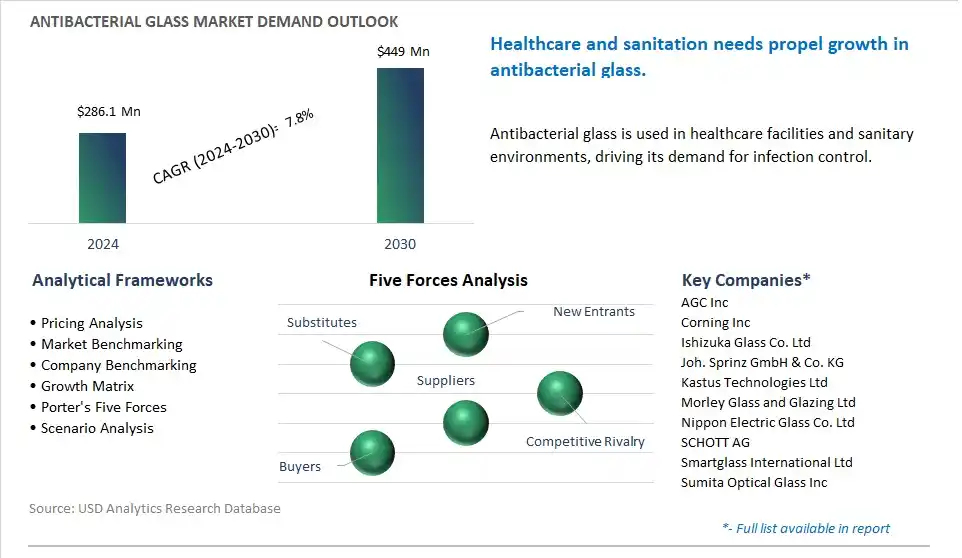
The global Antibacterial Glass Market is poised to register a 7.8% CAGR from $286.1 Million in 2024 to $449 Million in 2030.
The global Antibacterial Glass Market Study analyzes and forecasts the market size across 6 regions and 24 countries for diverse segments -By Active Ingredient (Silver, Copper, Zinc, Others), By Glass (Clear Glass, Painted Glass, Laminated Glass, Acoustic Laminated Glass, Others), By Application (FMCG Goods, Military Equipment, Household Products, Residential & Commercial Interiors, Electronics & Consumer Goods, Medical Devices & Equipment, Others), By End-User (Building & Construction, Electrical & Electronics, Food & Beverages, Aerospace & Defense, Healthcare & Pharmaceutical, Industrial, Others).
An Introduction to Global Antibacterial Glass Market in 2024
The antibacterial glass market is witnessing significant growth driven by increasing awareness of hygiene and infection control in healthcare facilities, public spaces, and household environments. Key trends shaping the future of the industry include the growing demand for glass surfaces with antimicrobial properties to inhibit the growth of bacteria, viruses, and fungi and reduce the risk of healthcare-associated infections (HAIs) and cross-contamination. Moreover, there's a rising emphasis on durable and long-lasting antibacterial coatings and treatments that maintain efficacy over time and withstand harsh cleaning agents and environmental conditions. Additionally, advancements in glass manufacturing technology, surface modification methods, and antimicrobial agents are driving innovation and market expansion, enabling glass manufacturers to offer safe, hygienic, and aesthetically pleasing solutions for diverse architectural, medical, and consumer applications in the global antibacterial glass market.
Antibacterial Glass Market Competitive Landscape
The market report analyses the leading companies in the industry including AGC Inc, Corning Inc, Ishizuka Glass Co. Ltd, Joh. Sprinz GmbH & Co. KG, Kastus Technologies Ltd, Morley Glass and Glazing Ltd, Nippon Electric Glass Co. Ltd, SCHOTT AG, Smartglass International Ltd, Sumita Optical Glass Inc.
Antibacterial Glass Market Dynamics
Antibacterial Glass Market Trend: Growing Emphasis on Hygiene and Infection Control
A prominent market trend for antibacterial glass is the growing emphasis on hygiene and infection control, particularly in healthcare facilities, public spaces, and high-traffic areas. With the increasing awareness of infectious diseases and the importance of maintaining clean and sterile environments, there's a rising demand for antibacterial glass products that inhibit the growth of harmful bacteria and pathogens on surfaces. Antibacterial glass, embedded with antimicrobial agents such as silver ions or titanium dioxide, offers an effective solution for reducing the transmission of bacteria and promoting cleaner, safer environments. The trend towards prioritizing hygiene and infection control drives market demand for antibacterial glass as a key component in architectural design and building materials for healthcare facilities, laboratories, schools, and commercial spaces.
Antibacterial Glass Market Driver: Heightened Concerns About Healthcare-Associated Infections (HAIs)
A significant driver for the antibacterial glass market is the heightened concerns about healthcare-associated infections (HAIs) and the need to reduce transmission of pathogens in healthcare settings. HAIs, including infections acquired in hospitals, clinics, and long-term care facilities, pose significant risks to patient safety, increase healthcare costs, and strain healthcare resources. Antibacterial glass surfaces, installed in hospital rooms, surgical suites, and medical devices, help mitigate the risk of bacterial contamination and reduce the incidence of HAIs by inhibiting the growth of bacteria on surfaces. As healthcare providers prioritize infection prevention and patient safety, there's a growing demand for antibacterial glass products that contribute to a cleaner and safer healthcare environment, driving market growth for antibacterial glass in the healthcare sector.
Antibacterial Glass Market Opportunity: Expansion into Architectural and Interior Design Applications
An opportunity for the antibacterial glass market lies in the expansion into architectural and interior design applications beyond healthcare settings. While antibacterial glass has traditionally been used in hospitals and medical facilities, there's potential to explore broader applications in commercial buildings, residential homes, transportation infrastructure, and public spaces. By positioning antibacterial glass as a premium building material that offers enhanced hygiene and cleanliness benefits, manufacturers can cater to diverse market segments including offices, schools, retail spaces, hospitality venues, and transportation hubs. Additionally, there's opportunity to collaborate with architects, interior designers, and building developers to integrate antibacterial glass solutions into architectural designs, building facades, partitions, countertops, and touch surfaces, thereby creating healthier and more hygienic environments for occupants. By capitalizing on the expanding market demand for antibacterial solutions, manufacturers can seize opportunities to innovate and diversify their product offerings for broader applications in architectural and interior design.
Antibacterial Glass Market Share Analysis: Silver segment generated the highest revenue in the industry
The largest segment in the Antibacterial Glass Market is Silver, and this dominance is driven by Silver has long been recognized for its antimicrobial properties, making it a preferred choice for incorporating into glass surfaces to inhibit the growth of bacteria and other harmful microorganisms. Silver ions have a broad-spectrum antimicrobial effect, effectively targeting and neutralizing a wide range of bacteria, viruses, and fungi. This makes silver an ideal active ingredient for antibacterial glass used in various applications, including healthcare facilities, food processing facilities, public transportation, and residential buildings. Additionally, silver-based antibacterial glass offers diverse advantages, including long-lasting efficacy, compatibility with glass manufacturing processes, and minimal impact on glass transparency and aesthetics. In addition, the increasing emphasis on hygiene, infection control, and public health safety drives the demand for antibacterial glass solutions, with silver being a preferred choice due to its proven efficacy and widespread acceptance in the market. Further, advancements in nanotechnology and materials science have led to the development of innovative silver-based antibacterial glass formulations, further enhancing their antimicrobial properties and market competitiveness. Over the forecast period, the dominance of Silver in the Antibacterial Glass Market is driven by its strong antimicrobial efficacy, versatility, and suitability for addressing the growing demand for hygienic and safe environments across various industries and applications.
Antibacterial Glass Market Share Analysis: Laminated Glass Segment is poised to register the fastest growth rate (CAGR) over the forecast period to 2030
The fastest-growing segment in the Antibacterial Glass Market is Laminated Glass, and this growth is driven by Laminated glass is composed of two or more layers of glass bonded together with an interlayer of polyvinyl butyral (PVB) or ethylene-vinyl acetate (EVA) resin. This construction provides enhanced strength, durability, and safety compared to standard monolithic glass. In recent years, there has been a growing awareness of the importance of maintaining hygienic and safe environments in various settings, including healthcare facilities, commercial buildings, and public transportation. Laminated glass, with its inherent strength and safety features, is increasingly being adopted in these environments to provide not only protection against impact and breakage but also antibacterial properties. Manufacturers have developed innovative laminated glass formulations infused with antibacterial agents such as silver ions, which inhibit the growth of bacteria and other harmful microorganisms on glass surfaces. Additionally, the versatility of laminated glass allows for the incorporation of antibacterial properties without compromising on transparency or aesthetics, making it an attractive choice for architects, designers, and building owners. Further, the COVID-19 pandemic has heightened awareness of the importance of hygiene and infection control, leading to increased demand for antibacterial solutions in public spaces and high-traffic areas. As a result, the market for antibacterial laminated glass is experiencing significant growth as it addresses the dual needs for safety and hygiene in various applications. Over the forecast period, the rapid growth of the Laminated Glass segment in the Antibacterial Glass Market is driven by its enhanced safety features, antibacterial properties, and increasing demand for hygienic building materials in response to evolving public health concerns.
Antibacterial Glass Market Share Analysis: Residential & Commercial Interiors Segment is poised to register the fastest growth rate (CAGR) over the forecast period to 2030
The fastest-growing segment in the Antibacterial Glass Market is Residential & Commercial Interiors, and this growth is driven by With the increasing focus on hygiene and cleanliness, especially in light of the COVID-19 pandemic, there is a growing demand for antibacterial solutions in residential and commercial environments. Antibacterial glass offers an effective way to inhibit the growth of bacteria and other harmful microorganisms on various surfaces commonly found in interiors, including windows, doors, partitions, countertops, and furniture. In residential settings, antibacterial glass is increasingly being used in kitchens, bathrooms, and living spaces to promote a cleaner and safer living environment. Similarly, in commercial spaces such as offices, retail stores, restaurants, and healthcare facilities, antibacterial glass helps maintain hygiene standards and reduce the risk of cross-contamination among occupants and visitors. Additionally, antibacterial glass is compatible with a wide range of architectural and interior design styles, allowing for seamless integration into both modern and traditional spaces. Further, advancements in glass manufacturing technology and the availability of innovative antibacterial coatings and treatments contribute to the growing adoption of antibacterial glass in residential and commercial interiors. Over the forecast period, the rapid growth of the Residential & Commercial Interiors segment in the Antibacterial Glass Market is driven by the increasing awareness of hygiene, the need for safer indoor environments, and the versatility of antibacterial glass solutions in enhancing cleanliness and hygiene standards in various interior applications.
Antibacterial Glass Market Report Segmentation
By Active Ingredient
Silver
Copper
Zinc
Others
By Glass
Clear Glass
Painted Glass
Laminated Glass
Acoustic Laminated Glass
Others
By Application
FMCG Goods
Military Equipment
Household Products
Residential & Commercial Interiors
Electronics & Consumer Goods
Medical Devices & Equipment
Others
By End-User
Building & Construction
Electrical & Electronics
Food & Beverages
Aerospace & Defense
Healthcare & Pharmaceutical
Industrial
Others
Regions Included
North America (US, Canada, Mexico)
Europe (Germany, UK, France, Spain, Italy, Russia, Rest of Europe)
Asia Pacific (China, India, Japan, South Korea, Australia, South East Asia, Rest of Asia)
South America (Brazil, Argentina, Rest of South America)
Middle East and Africa (Saudi Arabia, UAE, Rest of Middle East, South Africa, Egypt, Rest of Africa)
Antibacterial Glass Companies Profiled in the Market Study
AGC Inc
Corning Inc
Ishizuka Glass Co. Ltd
Joh. Sprinz GmbH & Co. KG
Kastus Technologies Ltd
Morley Glass and Glazing Ltd
Nippon Electric Glass Co. Ltd
SCHOTT AG
Smartglass International Ltd
Sumita Optical Glass Inc
*- List Not Exhaustive
TABLE OF CONTENTS
1 Introduction to 2024 Antibacterial Glass Market
1.1 Market Overview
1.2 Quick Facts
1.3 Scope/Objective of the Study
1.4 Market Definition
1.5 Countries and Regions Covered
1.6 Units, Currency, and Conversions
1.7 Industry Value Chain
2 Research Methodology
2.1 Market Size Estimation
2.2 Sources and Research Methodology
2.3 Data Triangulation
2.4 Assumptions and Limitations
3 Executive Summary
3.1 Global Antibacterial Glass Market Size Outlook, $ Million, 2021 to 2030
3.2 Antibacterial Glass Market Outlook by Type, $ Million, 2021 to 2030
3.3 Antibacterial Glass Market Outlook by Product, $ Million, 2021 to 2030
3.4 Antibacterial Glass Market Outlook by Application, $ Million, 2021 to 2030
3.5 Antibacterial Glass Market Outlook by Key Countries, $ Million, 2021 to 2030
4 Market Dynamics
4.1 Key Driving Forces of Antibacterial Glass Industry
4.2 Key Market Trends in Antibacterial Glass Industry
4.3 Potential Opportunities in Antibacterial Glass Industry
4.4 Key Challenges in Antibacterial Glass Industry
5 Market Factor Analysis
5.1 Value Chain Analysis
5.2 Competitive Landscape
5.2.1 Global Antibacterial Glass Market Share by Company (%), 2023
5.2.2 Product Offerings by Company
5.3 Porter’s Five Forces Analysis
5.4 Pricing Analysis and Outlook
6 Growth Outlook Across Scenarios
6.1 Growth Analysis-Case Scenario Definitions
6.2 Low Growth Scenario Forecasts
6.3 Reference Growth Scenario Forecasts
6.4 High Growth Scenario Forecasts
7 Global Antibacterial Glass Market Outlook by Segments
7.1 Antibacterial Glass Market Outlook by Segments, $ Million, 2021- 2030
By Active Ingredient
Silver
Copper
Zinc
Others
By Glass
Clear Glass
Painted Glass
Laminated Glass
Acoustic Laminated Glass
Others
By Application
FMCG Goods
Military Equipment
Household Products
Residential & Commercial Interiors
Electronics & Consumer Goods
Medical Devices & Equipment
Others
By End-User
Building & Construction
Electrical & Electronics
Food & Beverages
Aerospace & Defense
Healthcare & Pharmaceutical
Industrial
Others
8 North America Antibacterial Glass Market Analysis and Outlook To 2030
8.1 Introduction to North America Antibacterial Glass Markets in 2024
8.2 North America Antibacterial Glass Market Size Outlook by Country, 2021-2030
8.2.1 United States
8.2.2 Canada
8.2.3 Mexico
8.3 North America Antibacterial Glass Market size Outlook by Segments, 2021-2030
By Active Ingredient
Silver
Copper
Zinc
Others
By Glass
Clear Glass
Painted Glass
Laminated Glass
Acoustic Laminated Glass
Others
By Application
FMCG Goods
Military Equipment
Household Products
Residential & Commercial Interiors
Electronics & Consumer Goods
Medical Devices & Equipment
Others
By End-User
Building & Construction
Electrical & Electronics
Food & Beverages
Aerospace & Defense
Healthcare & Pharmaceutical
Industrial
Others
9 Europe Antibacterial Glass Market Analysis and Outlook To 2030
9.1 Introduction to Europe Antibacterial Glass Markets in 2024
9.2 Europe Antibacterial Glass Market Size Outlook by Country, 2021-2030
9.2.1 Germany
9.2.2 France
9.2.3 Spain
9.2.4 United Kingdom
9.2.4 Italy
9.2.5 Russia
9.2.6 Norway
9.2.7 Rest of Europe
9.3 Europe Antibacterial Glass Market Size Outlook by Segments, 2021-2030
By Active Ingredient
Silver
Copper
Zinc
Others
By Glass
Clear Glass
Painted Glass
Laminated Glass
Acoustic Laminated Glass
Others
By Application
FMCG Goods
Military Equipment
Household Products
Residential & Commercial Interiors
Electronics & Consumer Goods
Medical Devices & Equipment
Others
By End-User
Building & Construction
Electrical & Electronics
Food & Beverages
Aerospace & Defense
Healthcare & Pharmaceutical
Industrial
Others
10 Asia Pacific Antibacterial Glass Market Analysis and Outlook To 2030
10.1 Introduction to Asia Pacific Antibacterial Glass Markets in 2024
10.2 Asia Pacific Antibacterial Glass Market Size Outlook by Country, 2021-2030
10.2.1 China
10.2.2 India
10.2.3 Japan
10.2.4 South Korea
10.2.5 Indonesia
10.2.6 Malaysia
10.2.7 Australia
10.2.8 Rest of Asia Pacific
10.3 Asia Pacific Antibacterial Glass Market size Outlook by Segments, 2021-2030
By Active Ingredient
Silver
Copper
Zinc
Others
By Glass
Clear Glass
Painted Glass
Laminated Glass
Acoustic Laminated Glass
Others
By Application
FMCG Goods
Military Equipment
Household Products
Residential & Commercial Interiors
Electronics & Consumer Goods
Medical Devices & Equipment
Others
By End-User
Building & Construction
Electrical & Electronics
Food & Beverages
Aerospace & Defense
Healthcare & Pharmaceutical
Industrial
Others
11 South America Antibacterial Glass Market Analysis and Outlook To 2030
11.1 Introduction to South America Antibacterial Glass Markets in 2024
11.2 South America Antibacterial Glass Market Size Outlook by Country, 2021-2030
11.2.1 Brazil
11.2.2 Argentina
11.2.3 Rest of South America
11.3 South America Antibacterial Glass Market size Outlook by Segments, 2021-2030
By Active Ingredient
Silver
Copper
Zinc
Others
By Glass
Clear Glass
Painted Glass
Laminated Glass
Acoustic Laminated Glass
Others
By Application
FMCG Goods
Military Equipment
Household Products
Residential & Commercial Interiors
Electronics & Consumer Goods
Medical Devices & Equipment
Others
By End-User
Building & Construction
Electrical & Electronics
Food & Beverages
Aerospace & Defense
Healthcare & Pharmaceutical
Industrial
Others
12 Middle East and Africa Antibacterial Glass Market Analysis and Outlook To 2030
12.1 Introduction to Middle East and Africa Antibacterial Glass Markets in 2024
12.2 Middle East and Africa Antibacterial Glass Market Size Outlook by Country, 2021-2030
12.2.1 Saudi Arabia
12.2.2 UAE
12.2.3 Oman
12.2.4 Rest of Middle East
12.2.5 Egypt
12.2.6 Nigeria
12.2.7 South Africa
12.2.8 Rest of Africa
12.3 Middle East and Africa Antibacterial Glass Market size Outlook by Segments, 2021-2030
By Active Ingredient
Silver
Copper
Zinc
Others
By Glass
Clear Glass
Painted Glass
Laminated Glass
Acoustic Laminated Glass
Others
By Application
FMCG Goods
Military Equipment
Household Products
Residential & Commercial Interiors
Electronics & Consumer Goods
Medical Devices & Equipment
Others
By End-User
Building & Construction
Electrical & Electronics
Food & Beverages
Aerospace & Defense
Healthcare & Pharmaceutical
Industrial
Others
13 Company Profiles
13.1 Company Snapshot
13.2 SWOT Profiles
13.3 Products and Services
13.4 Recent Developments
13.5 Financial Profile
AGC Inc
Corning Inc
Ishizuka Glass Co. Ltd
Joh. Sprinz GmbH & Co. KG
Kastus Technologies Ltd
Morley Glass and Glazing Ltd
Nippon Electric Glass Co. Ltd
SCHOTT AG
Smartglass International Ltd
Sumita Optical Glass Inc
14 Appendix
14.1 Customization Offerings
14.2 Subscription Services
14.3 Related Reports
14.4 Publisher Expertise
By Active Ingredient
Silver
Copper
Zinc
Others
By Glass
Clear Glass
Painted Glass
Laminated Glass
Acoustic Laminated Glass
Others
By Application
FMCG Goods
Military Equipment
Household Products
Residential & Commercial Interiors
Electronics & Consumer Goods
Medical Devices & Equipment
Others
By End-User
Building & Construction
Electrical & Electronics
Food & Beverages
Aerospace & Defense
Healthcare & Pharmaceutical
Industrial
Others
Countries Analyzed
North America (US, Canada, Mexico)
Europe (Germany, UK, France, Spain, Italy, Russia, Rest of Europe)
Asia Pacific (China, India, Japan, South Korea, Australia, South East Asia, Rest of Asia)
South America (Brazil, Argentina, Rest of South America)
Middle East and Africa (Saudi Arabia, UAE, Rest of Middle East, South Africa, Egypt, Rest of Africa)
