Antihistamine Market is estimated to increase at a Compounded Annual Growth Rate of 8.2% CAGR over the forecast period from 2024 to 2030
The Antihistamine Market study analyzes and forecasts the market size across 6 regions and 24 countries for diverse segments- By Drug Class (H1 Antihistamine, H2 Antihistamine, H3 Antihistamine), By Dosage Form (Oral route, Parenteral, Others), By Type (OTC, Prescription-Based), By Disease (Allergic Disorders, Stomach Disorders, Central Nervous System Disorders, Others).
An Introduction to Antihistamine Market in 2024
In 2024, the market for antihistamines addresses the widespread prevalence of allergic diseases and histamine-mediated conditions, offering relief from symptoms such as sneezing, itching, rhinorrhea, and urticaria. Antihistamines antagonize the effects of histamine by blocking histamine receptors, thereby alleviating allergic responses and inflammatory reactions triggered by allergen exposure. With various generations of antihistamines available, including first-generation sedating antihistamines and second-generation non-sedating antihistamines, treatment regimens can be tailored to individual patient preferences and symptom profiles. Moreover, with advancements in drug formulations, combination therapies, and novel antihistamine agents, the antihistamine market continues to evolve, offering improved efficacy, safety, and patient satisfaction in the management of allergic conditions and histamine-related disorders.
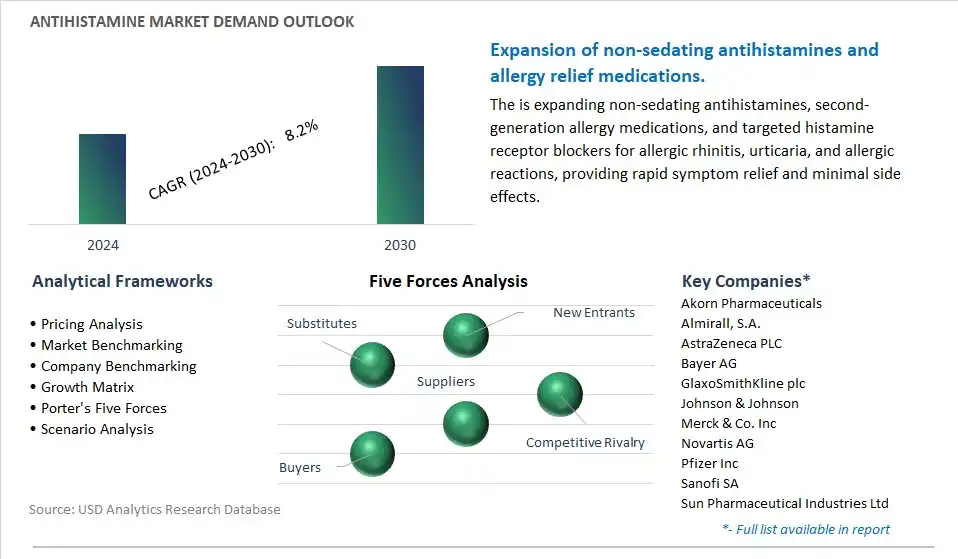
Market Trend: Increased Demand for Non-Sedating Antihistamines
A significant trend in the antihistamine market is the increased demand for non-sedating antihistamines. Traditionally, antihistamines were associated with sedative effects, leading to drowsiness and reduced cognitive function, which limited their use in daytime activities. However, there is a growing preference for non-sedating antihistamines, which offer effective relief from allergy symptoms such as sneezing, itching, and nasal congestion without causing significant drowsiness. This trend reflects a shift towards antihistamine formulations that allow individuals to manage their allergy symptoms while maintaining normal daily activities and productivity.
Market Driver: Rising Prevalence of Allergic Conditions
A key driver for the antihistamine market is the rising prevalence of allergic conditions such as allergic rhinitis, allergic conjunctivitis, and urticaria. Allergic diseases affect millions of people worldwide and can significantly impact the quality of life, causing symptoms such as itching, sneezing, runny nose, and skin rashes. Factors contributing to the increasing prevalence of allergies include environmental factors such as pollution and climate change, changes in lifestyle and dietary habits, and genetic predisposition. As the prevalence of allergic conditions continues to rise, there is a growing demand for effective antihistamine medications to alleviate allergy symptoms and improve patients' overall well-being.
Market Opportunity: Development of Targeted Antihistamine Therapies
An opportunity in the antihistamine market lies in the development of targeted antihistamine therapies that offer personalized treatment options for individuals with specific allergic conditions or symptom profiles. While traditional antihistamines provide broad-spectrum relief from allergy symptoms, there is potential to develop formulations that target specific histamine receptors or inflammatory pathways implicated in different types of allergies. By targeting specific receptors or pathways, targeted antihistamine therapies can offer enhanced efficacy, reduced side effects, and improved treatment outcomes for patients with allergic conditions such as seasonal allergies, allergic asthma, or chronic urticaria. Additionally, there is an opportunity to explore novel drug delivery technologies, such as nasal sprays, eye drops, or sublingual tablets, that can provide localized relief from allergy symptoms while minimizing systemic exposure and adverse effects. By investing in the development of targeted antihistamine therapies, companies can address unmet needs in allergy management, differentiate their product offerings, and capture market share in the rapidly growing antihistamine market.
Antihistamine Market Share Analysis: OTC (Over-the-Counter)
The Over-the-Counter (OTC) segment within the Antihistamine Market is witnessing rapid growth. OTC antihistamines are medications available without a prescription and are commonly used to relieve symptoms associated with allergic reactions, such as sneezing, itching, watery eyes, and runny nose. OTC antihistamines are widely accessible to consumers through pharmacies, drug stores, supermarkets, and online retailers, allowing individuals to self-manage mild allergic symptoms conveniently. With increasing consumer awareness about allergy management and the availability of a wide range of OTC antihistamine products, the demand for OTC antihistamines is growing steadily. Additionally, the convenience and cost-effectiveness of OTC antihistamines compared to prescription-based alternatives further contribute to their popularity among consumers. As allergic disorders continue to affect a significant portion of the population globally, the OTC segment of the Antihistamine Market is poised for substantial expansion.
Antihistamine Competitive Analysis
The market research study provides in-depth insights into leading companies including the SWOT analyses, product profile, financial details, and recent developments acrossAkorn Pharmaceuticals, Almirall, S.A., AstraZeneca PLC, Bayer AG, GlaxoSmithKline plc, Johnson & Johnson, Merck & Co. Inc, Novartis AG, Pfizer Inc, Sanofi SA, Sun Pharmaceutical Industries Ltd, Teva Pharmaceutical Industries Ltd
Antihistamine Market Segmentation
By Drug Class
H1 Antihistamine
H2 Antihistamine
H3 Antihistamine
By Dosage Form
Oral route
Parenteral
Others
By Type
OTC
Prescription-Based
By Disease
Allergic Disorders
Stomach Disorders
Central Nervous System Disorders
Others
Geographical Analysis
North America (United States, Canada, Mexico)
Europe (Germany, France, United Kingdom, Spain, Italy, Rest of Europe)
Asia Pacific (China, India, Japan, South Korea, Rest of Asia Pacific)
South America (Brazil, Argentina, Rest of South America)
Middle East and Africa (Saudi Arabia, UAE, Rest of Middle East, South Africa, Egypt, Rest of Africa)
Antihistamine Market Companies
Akorn Pharmaceuticals
Almirall, S.A.
AstraZeneca PLC
Bayer AG
GlaxoSmithKline plc
Johnson & Johnson
Merck & Co. Inc
Novartis AG
Pfizer Inc
Sanofi SA
Sun Pharmaceutical Industries Ltd
Teva Pharmaceutical Industries Ltd
Reasons to Buy the Antihistamine Market Study
• Deepen your industry insights and navigate uncertainties for strategy formulation, CAPEX, and Operational decisions
• Gain access to detailed insights on the Antihistamine Market, encompassing current market size, growth trends, and forecasts till 2030.
• Access detailed competitor analysis, enabling competitive advantage through a thorough understanding of market players, strategies, and potential differentiation opportunities
• Stay ahead of the curve with insights on technological advancements, innovations, and upcoming trends
• Identify lucrative investment avenues and expansion opportunities within the Antihistamine Market industry, guided by robust, data-backed analysis.
• Understand regional and global markets through country-wise analysis, regional market potential, regulatory nuances, and dynamics
• Execute strategies with confidence and speed through information, analytics, and insights on the industry value chain
• Corporate leaders, strategists, financial experts, shareholders, asset managers, and governmental representatives can make long-term planning scenarios and build an integrated and timely understanding of market dynamics
• Benefit from tailored solutions and expert consultation based on report insights, providing personalized strategies aligned with specific business needs.
TABLE OF CONTENTS
1 Introduction to 2024 Antihistamine Market
1.1 Market Overview
1.2 Quick Facts
1.3 Scope/Objective of the Study
1.4 Market Definition
1.5 Countries and Regions Covered
1.6 Units, Currency, and Conversions
1.7 Industry Value Chain
2 Research Methodology
2.1 Market Size Estimation
2.2 Sources and Research Methodology
2.3 Data Triangulation
2.4 Assumptions and Limitations
3 Executive Summary
3.1 Global Antihistamine Market Size Outlook, $ Million, 2021 to 2030
3.2 Antihistamine Market Outlook by Type, $ Million, 2021 to 2030
3.3 Antihistamine Market Outlook by Product, $ Million, 2021 to 2030
3.4 Antihistamine Market Outlook by Application, $ Million, 2021 to 2030
3.5 Antihistamine Market Outlook by Key Countries, $ Million, 2021 to 2030
4 Market Dynamics
4.1 Key Driving Forces of Antihistamine Industry
4.2 Key Market Trends in Antihistamine Industry
4.3 Potential Opportunities in Antihistamine Industry
4.4 Key Challenges in Antihistamine Industry
5 Market Factor Analysis
5.1 Value Chain Analysis
5.2 Competitive Landscape
5.2.1 Global Antihistamine Market Share by Company (%), 2023
5.2.2 Product Offerings by Company
5.3 Porter’s Five Forces Analysis
5.4 Pricing Analysis and Outlook
6 Growth Outlook Across Scenarios
6.1 Growth Analysis-Case Scenario Definitions
6.2 Low Growth Scenario Forecasts
6.3 Reference Growth Scenario Forecasts
6.4 High Growth Scenario Forecasts
7 Global Antihistamine Market Outlook by Segments
7.1 Antihistamine Market Outlook by Segments, $ Million, 2021- 2030
By Drug Class
H1 Antihistamine
H2 Antihistamine
H3 Antihistamine
By Dosage Form
Oral route
Parenteral
Others
By Type
OTC
Prescription-Based
By Disease
Allergic Disorders
Stomach Disorders
Central Nervous System Disorders
Others
8 North America Antihistamine Market Analysis and Outlook To 2030
8.1 Introduction to North America Antihistamine Markets in 2024
8.2 North America Antihistamine Market Size Outlook by Country, 2021-2030
8.2.1 United States
8.2.2 Canada
8.2.3 Mexico
8.3 North America Antihistamine Market size Outlook by Segments, 2021-2030
By Drug Class
H1 Antihistamine
H2 Antihistamine
H3 Antihistamine
By Dosage Form
Oral route
Parenteral
Others
By Type
OTC
Prescription-Based
By Disease
Allergic Disorders
Stomach Disorders
Central Nervous System Disorders
Others
9 Europe Antihistamine Market Analysis and Outlook To 2030
9.1 Introduction to Europe Antihistamine Markets in 2024
9.2 Europe Antihistamine Market Size Outlook by Country, 2021-2030
9.2.1 Germany
9.2.2 France
9.2.3 Spain
9.2.4 United Kingdom
9.2.4 Italy
9.2.5 Russia
9.2.6 Norway
9.2.7 Rest of Europe
9.3 Europe Antihistamine Market Size Outlook by Segments, 2021-2030
By Drug Class
H1 Antihistamine
H2 Antihistamine
H3 Antihistamine
By Dosage Form
Oral route
Parenteral
Others
By Type
OTC
Prescription-Based
By Disease
Allergic Disorders
Stomach Disorders
Central Nervous System Disorders
Others
10 Asia Pacific Antihistamine Market Analysis and Outlook To 2030
10.1 Introduction to Asia Pacific Antihistamine Markets in 2024
10.2 Asia Pacific Antihistamine Market Size Outlook by Country, 2021-2030
10.2.1 China
10.2.2 India
10.2.3 Japan
10.2.4 South Korea
10.2.5 Indonesia
10.2.6 Malaysia
10.2.7 Australia
10.2.8 Rest of Asia Pacific
10.3 Asia Pacific Antihistamine Market size Outlook by Segments, 2021-2030
By Drug Class
H1 Antihistamine
H2 Antihistamine
H3 Antihistamine
By Dosage Form
Oral route
Parenteral
Others
By Type
OTC
Prescription-Based
By Disease
Allergic Disorders
Stomach Disorders
Central Nervous System Disorders
Others
11 South America Antihistamine Market Analysis and Outlook To 2030
11.1 Introduction to South America Antihistamine Markets in 2024
11.2 South America Antihistamine Market Size Outlook by Country, 2021-2030
11.2.1 Brazil
11.2.2 Argentina
11.2.3 Rest of South America
11.3 South America Antihistamine Market size Outlook by Segments, 2021-2030
By Drug Class
H1 Antihistamine
H2 Antihistamine
H3 Antihistamine
By Dosage Form
Oral route
Parenteral
Others
By Type
OTC
Prescription-Based
By Disease
Allergic Disorders
Stomach Disorders
Central Nervous System Disorders
Others
12 Middle East and Africa Antihistamine Market Analysis and Outlook To 2030
12.1 Introduction to Middle East and Africa Antihistamine Markets in 2024
12.2 Middle East and Africa Antihistamine Market Size Outlook by Country, 2021-2030
12.2.1 Saudi Arabia
12.2.2 UAE
12.2.3 Oman
12.2.4 Rest of Middle East
12.2.5 Egypt
12.2.6 Nigeria
12.2.7 South Africa
12.2.8 Rest of Africa
12.3 Middle East and Africa Antihistamine Market size Outlook by Segments, 2021-2030
By Drug Class
H1 Antihistamine
H2 Antihistamine
H3 Antihistamine
By Dosage Form
Oral route
Parenteral
Others
By Type
OTC
Prescription-Based
By Disease
Allergic Disorders
Stomach Disorders
Central Nervous System Disorders
Others
13 Company Profiles
13.1 Company Snapshot
13.2 SWOT Profiles
13.3 Products and Services
13.4 Recent Developments
13.5 Financial Profile
List of Companies
Akorn Pharmaceuticals
Almirall, S.A.
AstraZeneca PLC
Bayer AG
GlaxoSmithKline plc
Johnson & Johnson
Merck & Co. Inc
Novartis AG
Pfizer Inc
Sanofi SA
Sun Pharmaceutical Industries Ltd
Teva Pharmaceutical Industries Ltd
14 Appendix
14.1 Customization Offerings
14.2 Subscription Services
14.3 Related Reports
14.4 Publisher Expertise
By Drug Class
H1 Antihistamine
H2 Antihistamine
H3 Antihistamine
By Dosage Form
Oral route
Parenteral
Others
By Type
OTC
Prescription-Based
By Disease
Allergic Disorders
Stomach Disorders
Central Nervous System Disorders
Others
Countries Analyzed
North America (United States, Canada, Mexico)
Europe (Germany, France, United Kingdom, Spain, Italy, Rest of Europe)
Asia Pacific (China, India, Japan, South Korea, Rest of Asia Pacific)
South America (Brazil, Argentina, Rest of South America)
Middle East and Africa (Saudi Arabia, UAE, Rest of Middle East, South Africa, Egypt, Rest of Africa)
