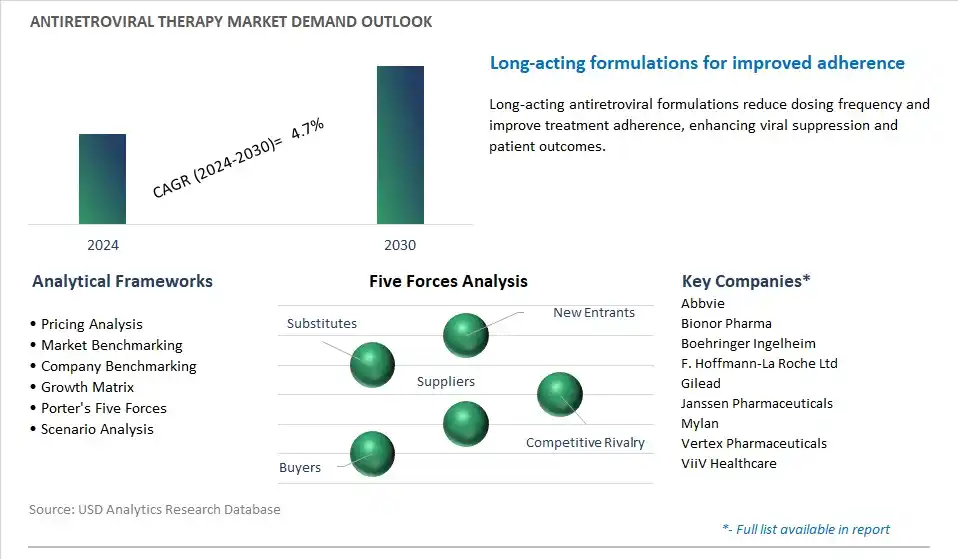
Antiretroviral Therapy Market is estimated to increase at a growth rate of 4.7% CAGR over the forecast period from 2024 to 2030.
The global Antiretroviral Therapy Market Study analyzes and forecasts the market size across 6 regions and 24 countries for diverse segments including By Class (Nucleoside Reverse Transcriptase Inhibitors, HIV Protease Inhibitors, Non-nucleoside Reverse Transcriptase Inhibitors, Nucleotide Reverse Transcriptase Inhibitors, HIV Fusion Inhibitors, Others), By Route of Administration (Oral, Parenteral, Others), By End-User (Hospitals, Specialty Clinics, Others), By Distribution Channel (Hospital Pharmacy, Retail Pharmacy, Others).
An Introduction to Antiretroviral Therapy Market in 2024
The Antiretroviral Therapy Market in 2024 focuses on pharmaceuticals and medications used in the treatment of HIV/AIDS, targeting viral replication, immune system modulation, and viral load suppression. These antiretroviral drugs include NRTIs (nucleoside reverse transcriptase inhibitors), NNRTIs (non-nucleoside reverse transcriptase inhibitors), protease inhibitors, and integrase inhibitors, providing combination therapy for HIV infection management and disease progression prevention. With a focus on HIV treatment adherence, viral suppression goals, and multidrug regimens, antiretroviral therapy supports HIV/AIDS patient care, viral load monitoring, and HIV transmission prevention efforts.
Antiretroviral Therapy Market Competitive Landscape
The global Antiretroviral Therapy Industry is highly competitive with a large number of companies focusing on niche market segments. Amidst intense competitive conditions, Antiretroviral Therapy Companies are investing in new product launches and strengthening distribution channels. Key companies operating in the Antiretroviral Therapy Industry include- Abbvie, Bionor Pharma, Boehringer Ingelheim, F. Hoffmann-La Roche Ltd, Gilead, Janssen Pharmaceuticals, Mylan, Vertex Pharmaceuticals, ViiV Healthcare.
Antiretroviral Therapy Market Trend: Expansion of Treatment Access and HIV Prevention Strategies
In the Antiretroviral Therapy market, a significant trend is the expansion of treatment access and HIV prevention strategies. With increased global efforts to combat the HIV/AIDS pandemic, there's a growing focus on scaling up antiretroviral therapy (ART) coverage to reach more people living with HIV/AIDS (PLWHA) and implementing pre-exposure prophylaxis (PrEP) programs to prevent new HIV infections. This trend drives market growth by increasing demand for antiretroviral drugs, fixed-dose combinations, and innovative delivery approaches, such as long-acting injectables and implantable devices, to improve treatment adherence, reduce viral transmission, and achieve the UNAIDS 95-95-95 targets for HIV/AIDS control.
Antiretroviral Therapy Market Driver: Rising HIV Incidence and Global Health Initiatives
A key driver for the Antiretroviral Therapy market is the rising HIV incidence and global health initiatives to combat the HIV/AIDS pandemic. Despite significant progress in HIV prevention, treatment, and care, HIV/AIDS remains a major public health challenge, particularly in low- and middle-income countries with high HIV burden. As efforts intensify to reach underserved populations, improve HIV testing and diagnosis, and optimize treatment outcomes, there's a growing demand for affordable, safe, and effective antiretroviral drugs that can suppress viral replication, restore immune function, and prolong survival in PLWHA, driving market demand for antiretroviral therapies and HIV/AIDS control programs.
Antiretroviral Therapy Market Opportunity: Innovation in Long-Acting Antiretroviral Formulations and Delivery Systems
An opportunity exists in innovation in long-acting antiretroviral formulations and delivery systems for improved treatment outcomes and HIV prevention. By leveraging advancements in drug delivery technologies, nanomedicine, and pharmacology, there's potential to develop long-acting antiretroviral drugs that offer sustained drug release, improved pharmacokinetics, and reduced dosing frequency, enhancing treatment adherence and reducing pill burden for PLWHA. Additionally, exploring novel delivery routes, such as injectables, implants, or transdermal patches, may offer opportunities to overcome barriers to adherence, stigma, and treatment fatigue, further advancing HIV/AIDS management and control efforts in the Antiretroviral Therapy segment.
Market Share Analysis: HIV Protease Inhibitors is the fastest growing segment in the Antiretroviral Therapy industry
Among the classes of antiretroviral therapy, HIV Protease Inhibitors (PIs) emerge as the fastest-growing segment. HIV PIs are a crucial component of combination antiretroviral therapy (ART) used in the treatment of HIV/AIDS. They work by inhibiting the activity of the HIV protease enzyme, which plays a key role in viral replication, thereby suppressing the virus's ability to multiply and spread within the body. Recent advancements in the development of next-generation HIV PIs with improved efficacy, tolerability, and reduced side effects have contributed to the rapid growth of this segment. Additionally, the rising prevalence of HIV infections globally, coupled with increasing awareness, screening initiatives, and access to treatment, has fueled the demand for effective antiretroviral therapies, including HIV PIs. Furthermore, the expansion of healthcare infrastructure, especially in hospitals and specialty clinics, along with the availability of HIV PIs through various distribution channels such as hospital and retail pharmacies, has facilitated their widespread adoption. As efforts to combat the HIV/AIDS pandemic intensify, the demand for innovative and effective HIV PIs is expected to continue driving the growth of this segment in the antiretroviral therapy market.
Antiretroviral Therapy Market Segmentation
By Class
Nucleoside Reverse Transcriptase Inhibitors
HIV Protease Inhibitors
Non-nucleoside Reverse Transcriptase Inhibitors
Nucleotide Reverse Transcriptase Inhibitors
HIV Fusion Inhibitors
Others
By Route of Administration
Oral
Parenteral
Others
By End-User
Hospitals
Specialty Clinics
Others
By Distribution Channel
Hospital Pharmacy
Retail Pharmacy
Others
Geographical Analysis
North America (United States, Canada, Mexico)
Europe (Germany, France, United Kingdom, Spain, Italy, Rest of Europe)
Asia Pacific (China, India, Japan, South Korea, Rest of Asia Pacific)
South America (Brazil, Argentina, Rest of South America)
Middle East and Africa (Saudi Arabia, UAE, Rest of Middle East, South Africa, Egypt, Rest of Africa)
Antiretroviral Therapy Companies
Abbvie
Bionor Pharma
Boehringer Ingelheim
F. Hoffmann-La Roche Ltd
Gilead
Janssen Pharmaceuticals
Mylan
Vertex Pharmaceuticals
ViiV Healthcare
* List not Exhaustive
Reasons to Buy the Antiretroviral Therapy Market Study
• Deepen your industry insights and navigate uncertainties for strategy formulation, CAPEX, and Operational decisions
• Gain access to detailed insights on the Antiretroviral Therapy Market, encompassing current market size, growth trends, and forecasts till 2030.
• Access detailed competitor analysis, enabling competitive advantage through a thorough understanding of market players, strategies, and potential differentiation opportunities
• Stay ahead of the curve with insights on technological advancements, innovations, and upcoming trends
• Identify lucrative investment avenues and expansion opportunities within the Antiretroviral Therapy Industry, guided by robust, data-backed analysis.
• Understand regional and global markets through country-wise analysis, regional market potential, regulatory nuances, and dynamics
• Execute strategies with confidence and speed through information, analytics, and insights on the industry value chain
• Corporate leaders, strategists, financial experts, shareholders, asset managers, and governmental representatives can make long-term planning scenarios and build an integrated and timely understanding of market dynamics
• Benefit from tailored solutions and expert consultation based on report insights, providing personalized strategies aligned with specific business needs.
TABLE OF CONTENTS
1 Introduction to 2024 Antiretroviral Therapy Market
1.1 Market Overview
1.2 Quick Facts
1.3 Scope/Objective of the Study
1.4 Market Definition
1.5 Countries and Regions Analyzed
1.6 Units, Currency, and Conversions
1.7 Industry Value Chain
2 Research Methodology
2.1 Market Size Estimation
2.2 Sources and Research Methodology
2.3 Data Triangulation
2.4 Assumptions and Limitations
3 Executive Summary
3.1 Global Antiretroviral Therapy Market Size Outlook, $ Million, 2021 to 2030
3.2 Antiretroviral Therapy Market Outlook by Type, $ Million, 2021 to 2030
3.3 Antiretroviral Therapy Market Outlook by Product, $ Million, 2021 to 2030
3.4 Antiretroviral Therapy Market Outlook by Application, $ Million, 2021 to 2030
3.5 Antiretroviral Therapy Market Outlook by Key Countries, $ Million, 2021 to 2030
4 Market Dynamics
4.1 Key Driving Forces of Antiretroviral Therapy Industry
4.2 Key Market Trends in Antiretroviral Therapy Industry
4.3 Potential Opportunities in Antiretroviral Therapy Industry
4.4 Key Challenges in Antiretroviral Therapy Industry
5 Market Factor Analysis
5.1 Value Chain Analysis
5.2 Competitive Landscape
5.2.1 Global Antiretroviral Therapy Market Share by Company (%), 2023
5.2.2 Product Offerings by Company
5.3 Porter’s Five Forces Analysis
5.4 Pricing Analysis and Outlook
6 Growth Outlook Across Scenarios
6.1 Growth Analysis-Case Scenario Definitions
6.2 Low Growth Scenario Forecasts
6.3 Reference Growth Scenario Forecasts
6.4 High Growth Scenario Forecasts
7 Global Antiretroviral Therapy Market Outlook by Segments
7.1 Antiretroviral Therapy Market Outlook by Segments, $ Million, 2021- 2030
By Class
Nucleoside Reverse Transcriptase Inhibitors
HIV Protease Inhibitors
Non-nucleoside Reverse Transcriptase Inhibitors
Nucleotide Reverse Transcriptase Inhibitors
HIV Fusion Inhibitors
Others
By Route of Administration
Oral
Parenteral
Others
By End-User
Hospitals
Specialty Clinics
Others
By Distribution Channel
Hospital Pharmacy
Retail Pharmacy
Others
8 North America Antiretroviral Therapy Market Analysis and Outlook To 2030
8.1 Introduction to North America Antiretroviral Therapy Markets in 2024
8.2 North America Antiretroviral Therapy Market Size Outlook by Country, 2021-2030
8.2.1 United States
8.2.2 Canada
8.2.3 Mexico
8.3 North America Antiretroviral Therapy Market size Outlook by Segments, 2021-2030
By Class
Nucleoside Reverse Transcriptase Inhibitors
HIV Protease Inhibitors
Non-nucleoside Reverse Transcriptase Inhibitors
Nucleotide Reverse Transcriptase Inhibitors
HIV Fusion Inhibitors
Others
By Route of Administration
Oral
Parenteral
Others
By End-User
Hospitals
Specialty Clinics
Others
By Distribution Channel
Hospital Pharmacy
Retail Pharmacy
Others
9 Europe Antiretroviral Therapy Market Analysis and Outlook To 2030
9.1 Introduction to Europe Antiretroviral Therapy Markets in 2024
9.2 Europe Antiretroviral Therapy Market Size Outlook by Country, 2021-2030
9.2.1 Germany
9.2.2 France
9.2.3 Spain
9.2.4 United Kingdom
9.2.4 Italy
9.2.5 Russia
9.2.6 Norway
9.2.7 Rest of Europe
9.3 Europe Antiretroviral Therapy Market Size Outlook by Segments, 2021-2030
By Class
Nucleoside Reverse Transcriptase Inhibitors
HIV Protease Inhibitors
Non-nucleoside Reverse Transcriptase Inhibitors
Nucleotide Reverse Transcriptase Inhibitors
HIV Fusion Inhibitors
Others
By Route of Administration
Oral
Parenteral
Others
By End-User
Hospitals
Specialty Clinics
Others
By Distribution Channel
Hospital Pharmacy
Retail Pharmacy
Others
10 Asia Pacific Antiretroviral Therapy Market Analysis and Outlook To 2030
10.1 Introduction to Asia Pacific Antiretroviral Therapy Markets in 2024
10.2 Asia Pacific Antiretroviral Therapy Market Size Outlook by Country, 2021-2030
10.2.1 China
10.2.2 India
10.2.3 Japan
10.2.4 South Korea
10.2.5 Indonesia
10.2.6 Malaysia
10.2.7 Australia
10.2.8 Rest of Asia Pacific
10.3 Asia Pacific Antiretroviral Therapy Market size Outlook by Segments, 2021-2030
By Class
Nucleoside Reverse Transcriptase Inhibitors
HIV Protease Inhibitors
Non-nucleoside Reverse Transcriptase Inhibitors
Nucleotide Reverse Transcriptase Inhibitors
HIV Fusion Inhibitors
Others
By Route of Administration
Oral
Parenteral
Others
By End-User
Hospitals
Specialty Clinics
Others
By Distribution Channel
Hospital Pharmacy
Retail Pharmacy
Others
11 South America Antiretroviral Therapy Market Analysis and Outlook To 2030
11.1 Introduction to South America Antiretroviral Therapy Markets in 2024
11.2 South America Antiretroviral Therapy Market Size Outlook by Country, 2021-2030
11.2.1 Brazil
11.2.2 Argentina
11.2.3 Rest of South America
11.3 South America Antiretroviral Therapy Market size Outlook by Segments, 2021-2030
By Class
Nucleoside Reverse Transcriptase Inhibitors
HIV Protease Inhibitors
Non-nucleoside Reverse Transcriptase Inhibitors
Nucleotide Reverse Transcriptase Inhibitors
HIV Fusion Inhibitors
Others
By Route of Administration
Oral
Parenteral
Others
By End-User
Hospitals
Specialty Clinics
Others
By Distribution Channel
Hospital Pharmacy
Retail Pharmacy
Others
12 Middle East and Africa Antiretroviral Therapy Market Analysis and Outlook To 2030
12.1 Introduction to Middle East and Africa Antiretroviral Therapy Markets in 2024
12.2 Middle East and Africa Antiretroviral Therapy Market Size Outlook by Country, 2021-2030
12.2.1 Saudi Arabia
12.2.2 UAE
12.2.3 Oman
12.2.4 Rest of Middle East
12.2.5 Egypt
12.2.6 Nigeria
12.2.7 South Africa
12.2.8 Rest of Africa
12.3 Middle East and Africa Antiretroviral Therapy Market size Outlook by Segments, 2021-2030
By Class
Nucleoside Reverse Transcriptase Inhibitors
HIV Protease Inhibitors
Non-nucleoside Reverse Transcriptase Inhibitors
Nucleotide Reverse Transcriptase Inhibitors
HIV Fusion Inhibitors
Others
By Route of Administration
Oral
Parenteral
Others
By End-User
Hospitals
Specialty Clinics
Others
By Distribution Channel
Hospital Pharmacy
Retail Pharmacy
Others
13 Company Profiles
13.1 Company Snapshot
13.2 SWOT Profiles
13.3 Products and Services
13.4 Recent Developments
13.5 Financial Profile
List of Companies
Abbvie
Bionor Pharma
Boehringer Ingelheim
F. Hoffmann-La Roche Ltd
Gilead
Janssen Pharmaceuticals
Mylan
Vertex Pharmaceuticals
ViiV Healthcare
14 Appendix
14.1 Customization Offerings
14.2 Subscription Services
14.3 Related Reports
14.4 Publisher Expertise
