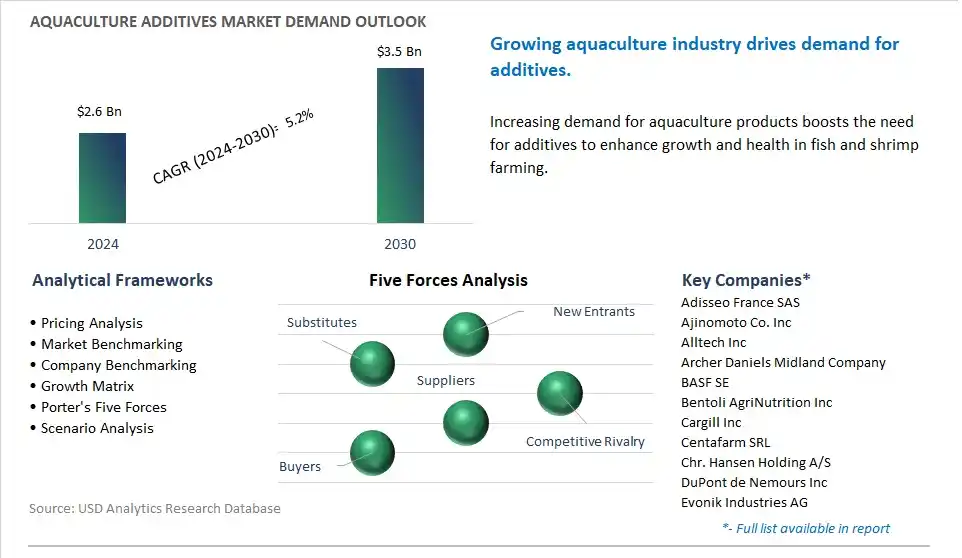
The global Aquaculture Additives Market is poised to register a 5.2% CAGR from $2.6 Billion in 2024 to $3.5 Billion in 2030.
The global Aquaculture Additives Market Study analyzes and forecasts the market size across 6 regions and 24 countries for diverse segments -By Product (Amino Acids, Antibiotics, Vitamins, Feed Acidifiers, Anesthetic and Sedation Materials, Anti-Parasitics, Others), By Application (Carp, Mollusks, Salmon, Shrimps, Tilapia, Catfish, Sea Bass, Trout, Others).
An Introduction to Global Aquaculture Additives Market in 2024
The aquaculture additives market is experiencing robust growth driven by increasing demand for sustainable aquaculture practices, improved feed efficiency, and disease prevention in fish and shrimp farming. Key trends shaping the future of the industry include the growing adoption of aquaculture feed additives such as probiotics, enzymes, and immunostimulants to enhance gut health, nutrient utilization, and immune response in aquaculture species, leading to improved growth performance and disease resistance. Moreover, there's a rising emphasis on natural and eco-friendly additives derived from microbial fermentation, plant extracts, and marine sources to meet consumer preferences for clean-label and organic aquaculture products. Additionally, advancements in additive formulation, encapsulation technology, and delivery systems are driving innovation and market differentiation, enabling additive manufacturers to offer effective and sustainable solutions for aquafeed producers and farmers in the global aquaculture additives market.
Aquaculture Additives Market Competitive Landscape
The market report analyses the leading companies in the industry including Adisseo France SAS, Ajinomoto Co. Inc, Alltech Inc, Archer Daniels Midland Company, BASF SE, Bentoli AgriNutrition Inc, Cargill Inc, Centafarm SRL, Chr. Hansen Holding A/S, DuPont de Nemours Inc, Evonik Industries AG, Global Nutrition International, Kemin Industries Inc, Novozymes A/S, Novus International Inc, NUQO Feed Additives, Nutreco N.V., Palital Feed Additives B.V., Royal DSM N.V., TEGASA, S.A..
Aquaculture Additives Market Dynamics
Aquaculture Additives Market Trend: Rising Demand for Sustainable Aquaculture Practices
A prominent market trend for aquaculture additives is the rising demand for sustainable aquaculture practices. With increasing concerns about environmental sustainability, pollution, and overfishing in traditional fisheries, there's a growing shift towards aquaculture as a means to meet global seafood demand. As aquaculture production expands, there's a corresponding need for additives that enhance the health, growth, and productivity of farmed aquatic species while minimizing environmental impact. Consumers and regulatory agencies are increasingly prioritizing aquaculture practices that promote animal welfare, reduce reliance on antibiotics and chemicals, and minimize ecological footprint. This trend drives market demand for aquaculture additives that support sustainable aquaculture practices and contribute to responsible seafood production.
Aquaculture Additives Market Driver: Growth in Global Aquaculture Industry
A significant driver for the aquaculture additives market is the growth in the global aquaculture industry. Aquaculture serves as a critical source of seafood, providing fish, shellfish, and aquatic plants for human consumption, aquafeed production, and ornamental trade. With increasing population growth, urbanization, and changing dietary preferences towards seafood, there's a rising demand for aquaculture products worldwide. Aquaculture additives, including probiotics, vitamins, minerals, enzymes, and water conditioners, play essential roles in maintaining water quality, optimizing feed efficiency, and enhancing the health and performance of farmed aquatic species. As the aquaculture industry continues to expand to meet growing demand for seafood, there's a corresponding increase in demand for aquaculture additives as indispensable components in aquafeed formulations and farm management practices.
Aquaculture Additives Market Opportunity: Development of Natural and Bio-Based Additive Solutions
An opportunity for the aquaculture additives market lies in the development of natural and bio-based additive solutions that align with consumer preferences for clean label and sustainable products. While conventional aquaculture additives may include synthetic chemicals, antibiotics, and growth promoters, there's increasing interest in natural alternatives derived from plant extracts, marine sources, and beneficial microorganisms. Manufacturers have the opportunity to innovate and commercialize natural additives that offer similar performance benefits in terms of disease prevention, growth promotion, and feed conversion efficiency while minimizing environmental impact and improving product safety. Additionally, there's potential to develop bio-based additives that enhance water quality, reduce waste production, and promote ecological balance in aquaculture systems. By focusing on the development of natural and bio-based additive solutions, manufacturers can capitalize on market demand for sustainable aquaculture practices and differentiate their products in the competitive aquaculture additives market.
Aquaculture Additives Market Share Analysis: Feed Acidifiers segment generated the highest revenue in the industry
Among the various products in the Aquaculture Additives Market, feed acidifiers stand out as the largest segment, and diverse factors contribute to this status. Feed acidifiers play a crucial role in aquaculture by optimizing the pH balance in fish and shrimp diets, thus enhancing nutrient utilization and promoting Over the forecast period health. With the global aquaculture industry witnessing significant expansion to meet the growing demand for seafood, the need for effective feed additives to ensure optimal growth and disease prevention in aquatic species becomes paramount. Feed acidifiers not only aid in maintaining gut health and improving feed efficiency but also help in mitigating the adverse effects of mycotoxins, thereby ensuring the safety and quality of aquafeed. In addition, the rising awareness among aquaculture farmers regarding the benefits of feed acidifiers in enhancing production efficiency and reducing environmental impact further drives the dominance of this segment in the market. As aquaculture continues to play a crucial role in global food security, the demand for feed acidifiers is expected to remain robust, positioning it as the largest segment in the Aquaculture Additives Market.
Aquaculture Additives Market Share Analysis: Shrimps Segment is poised to register the fastest growth rate (CAGR) over the forecast period to 2030
The shrimp segment is the fastest-growing sector within the Aquaculture Additives Market due to diverse key factors. Shrimp aquaculture has witnessed remarkable growth globally, driven by increasing consumer demand for shrimp products and favorable market conditions. As one of the most traded seafood commodities worldwide, shrimp farming has expanded rapidly, particularly in regions like Asia-Pacific and Latin America. To meet the escalating demand and ensure sustainable production, shrimp farmers are increasingly adopting advanced aquaculture practices and utilizing additives to enhance shrimp health, growth, and productivity. Additives play a crucial role in shrimp aquaculture by improving feed efficiency, disease resistance, and water quality management. Additionally, the rising incidence of diseases such as EMS (Early Mortality Syndrome) and WSSV (White Spot Syndrome Virus) in shrimp farms underscores the importance of effective additives for disease prevention and management. With ongoing technological advancements and growing awareness among shrimp farmers regarding the benefits of aquaculture additives, the shrimp segment is expected to witness robust growth in the coming years, driving the Over the forecast period expansion of the Aquaculture Additives Market.
Aquaculture Additives Market Report Segmentation
By Product
Amino Acids
Antibiotics
Vitamins
Feed Acidifiers
Anesthetic and Sedation Materials
Anti-Parasitics
Others
By Application
Carp
Mollusks
Salmon
Shrimps
Tilapia
Catfish
Sea Bass
Trout
Others
Regions Included
North America (US, Canada, Mexico)
Europe (Germany, UK, France, Spain, Italy, Russia, Rest of Europe)
Asia Pacific (China, India, Japan, South Korea, Australia, South East Asia, Rest of Asia)
South America (Brazil, Argentina, Rest of South America)
Middle East and Africa (Saudi Arabia, UAE, Rest of Middle East, South Africa, Egypt, Rest of Africa)
Aquaculture Additives Companies Profiled in the Market Study
Adisseo France SAS
Ajinomoto Co. Inc
Alltech Inc
Archer Daniels Midland Company
BASF SE
Bentoli AgriNutrition Inc
Cargill Inc
Centafarm SRL
Chr. Hansen Holding A/S
DuPont de Nemours Inc
Evonik Industries AG
Global Nutrition International
Kemin Industries Inc
Novozymes A/S
Novus International Inc
NUQO Feed Additives
Nutreco N.V.
Palital Feed Additives B.V.
Royal DSM N.V.
TEGASA, S.A.
*- List Not Exhaustive
TABLE OF CONTENTS
1 Introduction to 2024 Aquaculture Additives Market
1.1 Market Overview
1.2 Quick Facts
1.3 Scope/Objective of the Study
1.4 Market Definition
1.5 Countries and Regions Covered
1.6 Units, Currency, and Conversions
1.7 Industry Value Chain
2 Research Methodology
2.1 Market Size Estimation
2.2 Sources and Research Methodology
2.3 Data Triangulation
2.4 Assumptions and Limitations
3 Executive Summary
3.1 Global Aquaculture Additives Market Size Outlook, $ Million, 2021 to 2030
3.2 Aquaculture Additives Market Outlook by Type, $ Million, 2021 to 2030
3.3 Aquaculture Additives Market Outlook by Product, $ Million, 2021 to 2030
3.4 Aquaculture Additives Market Outlook by Application, $ Million, 2021 to 2030
3.5 Aquaculture Additives Market Outlook by Key Countries, $ Million, 2021 to 2030
4 Market Dynamics
4.1 Key Driving Forces of Aquaculture Additives Industry
4.2 Key Market Trends in Aquaculture Additives Industry
4.3 Potential Opportunities in Aquaculture Additives Industry
4.4 Key Challenges in Aquaculture Additives Industry
5 Market Factor Analysis
5.1 Value Chain Analysis
5.2 Competitive Landscape
5.2.1 Global Aquaculture Additives Market Share by Company (%), 2023
5.2.2 Product Offerings by Company
5.3 Porter’s Five Forces Analysis
5.4 Pricing Analysis and Outlook
6 Growth Outlook Across Scenarios
6.1 Growth Analysis-Case Scenario Definitions
6.2 Low Growth Scenario Forecasts
6.3 Reference Growth Scenario Forecasts
6.4 High Growth Scenario Forecasts
7 Global Aquaculture Additives Market Outlook by Segments
7.1 Aquaculture Additives Market Outlook by Segments, $ Million, 2021- 2030
By Product
Amino Acids
Antibiotics
Vitamins
Feed Acidifiers
Anesthetic and Sedation Materials
Anti-Parasitics
Others
By Application
Carp
Mollusks
Salmon
Shrimps
Tilapia
Catfish
Sea Bass
Trout
Others
8 North America Aquaculture Additives Market Analysis and Outlook To 2030
8.1 Introduction to North America Aquaculture Additives Markets in 2024
8.2 North America Aquaculture Additives Market Size Outlook by Country, 2021-2030
8.2.1 United States
8.2.2 Canada
8.2.3 Mexico
8.3 North America Aquaculture Additives Market size Outlook by Segments, 2021-2030
By Product
Amino Acids
Antibiotics
Vitamins
Feed Acidifiers
Anesthetic and Sedation Materials
Anti-Parasitics
Others
By Application
Carp
Mollusks
Salmon
Shrimps
Tilapia
Catfish
Sea Bass
Trout
Others
9 Europe Aquaculture Additives Market Analysis and Outlook To 2030
9.1 Introduction to Europe Aquaculture Additives Markets in 2024
9.2 Europe Aquaculture Additives Market Size Outlook by Country, 2021-2030
9.2.1 Germany
9.2.2 France
9.2.3 Spain
9.2.4 United Kingdom
9.2.4 Italy
9.2.5 Russia
9.2.6 Norway
9.2.7 Rest of Europe
9.3 Europe Aquaculture Additives Market Size Outlook by Segments, 2021-2030
By Product
Amino Acids
Antibiotics
Vitamins
Feed Acidifiers
Anesthetic and Sedation Materials
Anti-Parasitics
Others
By Application
Carp
Mollusks
Salmon
Shrimps
Tilapia
Catfish
Sea Bass
Trout
Others
10 Asia Pacific Aquaculture Additives Market Analysis and Outlook To 2030
10.1 Introduction to Asia Pacific Aquaculture Additives Markets in 2024
10.2 Asia Pacific Aquaculture Additives Market Size Outlook by Country, 2021-2030
10.2.1 China
10.2.2 India
10.2.3 Japan
10.2.4 South Korea
10.2.5 Indonesia
10.2.6 Malaysia
10.2.7 Australia
10.2.8 Rest of Asia Pacific
10.3 Asia Pacific Aquaculture Additives Market size Outlook by Segments, 2021-2030
By Product
Amino Acids
Antibiotics
Vitamins
Feed Acidifiers
Anesthetic and Sedation Materials
Anti-Parasitics
Others
By Application
Carp
Mollusks
Salmon
Shrimps
Tilapia
Catfish
Sea Bass
Trout
Others
11 South America Aquaculture Additives Market Analysis and Outlook To 2030
11.1 Introduction to South America Aquaculture Additives Markets in 2024
11.2 South America Aquaculture Additives Market Size Outlook by Country, 2021-2030
11.2.1 Brazil
11.2.2 Argentina
11.2.3 Rest of South America
11.3 South America Aquaculture Additives Market size Outlook by Segments, 2021-2030
By Product
Amino Acids
Antibiotics
Vitamins
Feed Acidifiers
Anesthetic and Sedation Materials
Anti-Parasitics
Others
By Application
Carp
Mollusks
Salmon
Shrimps
Tilapia
Catfish
Sea Bass
Trout
Others
12 Middle East and Africa Aquaculture Additives Market Analysis and Outlook To 2030
12.1 Introduction to Middle East and Africa Aquaculture Additives Markets in 2024
12.2 Middle East and Africa Aquaculture Additives Market Size Outlook by Country, 2021-2030
12.2.1 Saudi Arabia
12.2.2 UAE
12.2.3 Oman
12.2.4 Rest of Middle East
12.2.5 Egypt
12.2.6 Nigeria
12.2.7 South Africa
12.2.8 Rest of Africa
12.3 Middle East and Africa Aquaculture Additives Market size Outlook by Segments, 2021-2030
By Product
Amino Acids
Antibiotics
Vitamins
Feed Acidifiers
Anesthetic and Sedation Materials
Anti-Parasitics
Others
By Application
Carp
Mollusks
Salmon
Shrimps
Tilapia
Catfish
Sea Bass
Trout
Others
13 Company Profiles
13.1 Company Snapshot
13.2 SWOT Profiles
13.3 Products and Services
13.4 Recent Developments
13.5 Financial Profile
Adisseo France SAS
Ajinomoto Co. Inc
Alltech Inc
Archer Daniels Midland Company
BASF SE
Bentoli AgriNutrition Inc
Cargill Inc
Centafarm SRL
Chr. Hansen Holding A/S
DuPont de Nemours Inc
Evonik Industries AG
Global Nutrition International
Kemin Industries Inc
Novozymes A/S
Novus International Inc
NUQO Feed Additives
Nutreco N.V.
Palital Feed Additives B.V.
Royal DSM N.V.
TEGASA, S.A.
14 Appendix
14.1 Customization Offerings
14.2 Subscription Services
14.3 Related Reports
14.4 Publisher Expertise
By Product
Amino Acids
Antibiotics
Vitamins
Feed Acidifiers
Anesthetic and Sedation Materials
Anti-Parasitics
Others
By Application
Carp
Mollusks
Salmon
Shrimps
Tilapia
Catfish
Sea Bass
Trout
Others
Countries Analyzed
North America (US, Canada, Mexico)
Europe (Germany, UK, France, Spain, Italy, Russia, Rest of Europe)
Asia Pacific (China, India, Japan, South Korea, Australia, South East Asia, Rest of Asia)
South America (Brazil, Argentina, Rest of South America)
Middle East and Africa (Saudi Arabia, UAE, Rest of Middle East, South Africa, Egypt, Rest of Africa)
