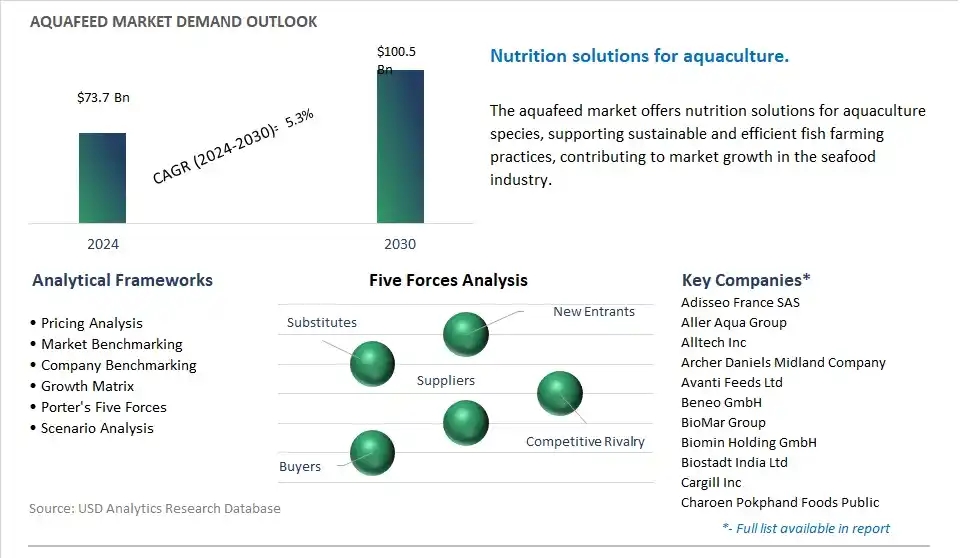
The global Aquafeed Market is poised to register a 5.3% CAGR from $73.7 Billion in 2024 to $100.5 Billion in 2030.
The global Aquafeed Market Study analyzes and forecasts the market size across 6 regions and 24 countries for diverse segments -By Ingredient (Soybean, Corn, Fishmeal, Fish Oil, Additives, Others), By Additives (Antibiotics, Vitamins & Minerals, Antioxidants, Amino Acids, Enzymes, Probiotics & Prebiotics, Others), By Species (Fish, Crustaceans, Crustaceans, Others), By Form (Dry, Moist, Wet), By Lifecycle (Starter Feed, Grower Feed, Finisher Feed, Brooder Feed).
An Introduction to Global Aquafeed Market in 2024
The market for aquafeed is experiencing robust growth driven by the expansion of the aquaculture industry and the increasing demand for sustainable protein sources. Key trends shaping the future of this industry include the development of aquafeed formulations tailored to the nutritional requirements of different aquatic species, life stages, and production systems, optimizing growth, health, and feed efficiency. Additionally, advancements in ingredient sourcing and processing techniques enable the incorporation of alternative protein sources such as plant proteins, algae, and insect meal into aquafeed formulations, reducing reliance on fishmeal and addressing sustainability concerns. Moreover, the adoption of functional additives such as probiotics, enzymes, and immunostimulants enhances gut health, disease resistance, and overall performance in farmed fish and crustaceans. As the aquaculture industry continues to expand to meet global seafood demand, the demand for high-quality aquafeed is expected to continue growing, driving innovation and market expansion in this sector.
Aquafeed Market Competitive Landscape
The market report analyses the leading companies in the industry including Adisseo France SAS, Aller Aqua Group, Alltech Inc, Archer Daniels Midland Company, Avanti Feeds Ltd, Beneo GmbH, BioMar Group, Biomin Holding GmbH, Biostadt India Ltd, Cargill Inc, Charoen Pokphand Foods Public Company Ltd, Growel Feeds Pvt. Ltd, Japfa Ltd, Kent Nutrition Group Inc, Lifecircle Nutrition Pvt. Ltd, Marubeni Nisshin Feed Co. Ltd, Marvesa Holding N.V., Nestlé Purina PetCare Company, Norel S.A., Novus International Inc, Nutreco N.V., Ridley Corp Ltd, Royal De Heus B.V., Sonac BV, The Waterbase Ltd.
Aquafeed Market Dynamics
Aquafeed Market Trend: Increasing Demand for Sustainable Aquafeed Ingredients
A prominent trend in the aquafeed market is the increasing demand for sustainable ingredients driven by environmental concerns, regulatory pressures, and consumer preferences for responsibly sourced seafood products. As the aquaculture industry continues to grow to meet the rising global demand for seafood, there is a growing emphasis on reducing the environmental impact of aquafeed production, including the sourcing of feed ingredients. Consumers are increasingly seeking seafood products that are produced using sustainable practices, including aquafeed made from responsibly sourced and environmentally friendly ingredients. This is driving the development and adoption of alternative protein sources, such as plant-based proteins, insect meal, and single-cell proteins, in aquafeed formulations, as well as sustainable fishmeal and fish oil alternatives, leading to a shift towards more sustainable and eco-friendly aquafeed solutions.
Aquafeed Market Driver: Growth of the Aquaculture Industry
A key driver propelling the aquafeed market is the growth of the aquaculture industry, fueled by increasing global demand for seafood, declining wild fish stocks, and advancements in aquaculture technology and practices. Aquaculture has become an essential source of protein and a significant contributor to global food security, providing a sustainable alternative to wild-caught seafood. As aquaculture production expands to meet growing consumer demand, the demand for high-quality aquafeed also increases. Aquafeed plays a crucial role in the growth, health, and performance of farmed fish and shrimp, providing essential nutrients, vitamins, and minerals for optimal growth and development. With the aquaculture industry projected to continue its growth trajectory, driven by rising incomes, changing dietary preferences, and the need to meet protein demands, the demand for aquafeed is expected to rise correspondingly, creating opportunities for feed manufacturers and suppliers to expand their product offerings and market presence.
Aquafeed Market Opportunity: Development of Functional and Value-added Aquafeed Products
An opportunity for the aquafeed market lies in the development of functional and value-added aquafeed products that offer enhanced nutritional profiles, health benefits, and performance advantages for farmed fish and shrimp. With advancements in feed formulation technology, ingredient sourcing, and nutritional science, there is potential to develop specialized aquafeed formulations tailored to specific species, life stages, and production systems, addressing the unique nutritional requirements and health challenges of different aquatic species. Additionally, there is opportunity to incorporate functional additives, such as probiotics, prebiotics, immunostimulants, and enzymes, into aquafeed formulations to improve feed efficiency, disease resistance, and overall performance of farmed animals. By developing innovative and value-added aquafeed products, feed manufacturers aim to gain market shares in the market, meet the evolving needs of aquaculture producers, and contribute to the sustainability and profitability of the aquaculture industry.
Aquafeed Market Ecosystem
The aquafeed market relies on well-defined value chain segments and industry players. The raw material acquisition involves sourcing high-quality ingredients including fishmeal, soybean meal, grains, and fish oil from companies including Cargill, Archer Daniels Midland Company, and Louis Dreyfus Company, along with fishmeal and fish oil producers.
Feed formulation is crucial for developing balanced and nutritious aquafeed formulations tailored to different aquatic species and life stages, with aquafeed manufacturers and independent feed formulation consultants leading this stage. Feed manufacturing transforms raw materials into complete aquafeed using various techniques, with companies including Cargill Aqua Nutrition, Skretting, and Nutreco N.V. playing significant roles in this process.
Packaging and storage ensure the preservation of aquafeed freshness and quality, managed by aquafeed manufacturers and specialty packaging companies. Distribution and sales involve direct sales to aquaculture farms, distribution through feed dealers and distributors, and online retail, with aquafeed manufacturers and aquaculture feed distributors being key players. Further, end-users, ranging from small-scale to large-scale aquaculture operations, utilize aquafeed to feed farmed fish and shrimp, optimizing feeding practices for growth, health, and economic efficiency in aquaculture farms.
Aquafeed Market Share Analysis: Fishmeal held the dominant revenue share in 2024
Fishmeal is the largest segment in the aquafeed market due to its high nutritional value and essential role in promoting the growth and health of aquatic species. Fishmeal is a concentrated protein source derived from fish, comprising small pelagic species like anchovies, sardines, and herring. It is prized for its balanced amino acid profile, high digestibility, and rich content of essential nutrients such as omega-3 fatty acids, vitamins, and minerals, which are vital for the development and well-being of farmed fish and shrimp. Additionally, fishmeal serves as a palatable and readily digestible feed ingredient, promoting efficient feed conversion and optimal growth rates in aquaculture species. Its superior nutritional properties make it a preferred choice for formulating aquafeeds across various life stages of aquatic organisms, from juveniles to adults. In addition, the increasing demand for high-quality seafood products, coupled with the expansion of the aquaculture industry to meet global protein requirements, drives the demand for fishmeal in aquafeed formulations. As aquaculture continues to grow and diversify, fishmeal remains indispensable as a key ingredient in formulating nutritionally balanced feeds, thereby maintaining its dominance in the aquafeed market.
Aquafeed Market Share Analysis: Probiotics and Prebiotics is the fastest growing market segment over the forecast period to 2030
Probiotics and prebiotics have emerged as the fastest-growing segment in the aquafeed market due to the increasing recognition of their role in enhancing gut health and improving overall performance in aquatic species. Probiotics are beneficial microorganisms that colonize the gut and promote a healthy microbial balance, while prebiotics are non-digestible fibers that serve as food for these beneficial microbes. Together, they contribute to better digestion, nutrient absorption, and immune function in fish and shrimp, leading to improved growth rates, feed efficiency, and disease resistance. The growing concerns over the use of antibiotics in aquaculture, coupled with stricter regulations and consumer preferences for antibiotic-free products, drive the demand for alternative strategies to promote animal health and productivity. Probiotics and prebiotics offer a natural and sustainable solution to address these challenges, making them increasingly popular among aquafeed manufacturers and producers. In addition, ongoing research and advancements in probiotic and prebiotic formulations tailored for aquatic species further contribute to their rapid growth in the aquafeed market. As the aquaculture industry continues to expand and prioritize sustainable practices, probiotics, and prebiotics are poised to play a crucial role in optimizing feed efficiency, reducing environmental impact, and ensuring the long-term viability of aquafeed production.
Aquafeed Market Share Analysis: Crustaceans is the fastest growing market segment over the forecast period to 2030
Crustaceans emerge as the fastest-growing segment in the aquafeed market due to diverse factors contributing to the expansion of crustacean aquaculture and the demand for specialized feed formulations. Crustaceans, including shrimp and prawns, are among the most valuable and widely farmed species in the aquaculture industry, prized for their high market value and increasing global consumption. The growing popularity of crustaceans as a premium seafood choice has led to a surge in crustacean aquaculture production, particularly in regions like Asia-Pacific and Latin America. To support the intensive farming of crustaceans and optimize their growth, health, and product quality, there is a growing demand for high-quality aquafeeds tailored to the nutritional requirements and feeding habits of crustaceans. Additionally, advancements in aquafeed formulations, incorporating specialized ingredients such as crustacean meal, marine proteins, and amino acids, contribute to the growth of the crustacean aquafeed market. In addition, the increasing focus on sustainability and environmental responsibility in aquaculture drives the development of eco-friendly feed solutions for crustaceans, further fueling the growth of this segment in the aquafeed market. As crustacean aquaculture continues to expand and diversify, the demand for specialized and nutritionally optimized aquafeeds is expected to rise, driving the rapid growth of the crustacean segment in the aquafeed market.
Aquafeed Market Report Scope-
By Ingredient
Soybean
Corn
Fishmeal
Fish Oil
Additives
Others
By Additives
Antibiotics
Vitamins & Minerals
Antioxidants
Amino Acids
Enzymes
Probiotics & Prebiotics
Others
By Species
Fish
-Tilapia
-Salmon
-Carp
-Trout
-Others
Crustaceans
-Crabs
-Krill
-Shrimp
-Others
Crustaceans
-Oysters
-Mussels
-Others
Others
By Form
Dry
Moist
Wet
By Lifecycle
Starter Feed
Grower Feed
Finisher Feed
Brooder Feed
Aquafeed Market Companies Profiled
Adisseo France SAS
Aller Aqua Group
Alltech Inc
Archer Daniels Midland Company
Avanti Feeds Ltd
Beneo GmbH
BioMar Group
Biomin Holding GmbH
Biostadt India Ltd
Cargill Inc
Charoen Pokphand Foods Public Company Ltd
Growel Feeds Pvt. Ltd
Japfa Ltd
Kent Nutrition Group Inc
Lifecircle Nutrition Pvt. Ltd
Marubeni Nisshin Feed Co. Ltd
Marvesa Holding N.V.
Nestlé Purina PetCare Company
Norel S.A.
Novus International Inc
Nutreco N.V.
Ridley Corp Ltd
Royal De Heus B.V.
Sonac BV
The Waterbase Ltd
*- List Not Exhaustive
TABLE OF CONTENTS
1 Introduction to 2024 Aquafeed Market
1.1 Market Overview
1.2 Quick Facts
1.3 Scope/Objective of the Study
1.4 Market Definition
1.5 Countries and Regions Covered
1.6 Units, Currency, and Conversions
1.7 Industry Value Chain
2 Research Methodology
2.1 Market Size Estimation
2.2 Sources and Research Methodology
2.3 Data Triangulation
2.4 Assumptions and Limitations
3 Executive Summary
3.1 Global Aquafeed Market Size Outlook, $ Million, 2021 to 2030
3.2 Aquafeed Market Outlook by Type, $ Million, 2021 to 2030
3.3 Aquafeed Market Outlook by Product, $ Million, 2021 to 2030
3.4 Aquafeed Market Outlook by Application, $ Million, 2021 to 2030
3.5 Aquafeed Market Outlook by Key Countries, $ Million, 2021 to 2030
4 Market Dynamics
4.1 Key Driving Forces of Aquafeed Industry
4.2 Key Market Trends in Aquafeed Industry
4.3 Potential Opportunities in Aquafeed Industry
4.4 Key Challenges in Aquafeed Industry
5 Market Factor Analysis
5.1 Value Chain Analysis
5.2 Competitive Landscape
5.2.1 Global Aquafeed Market Share by Company (%), 2023
5.2.2 Product Offerings by Company
5.3 Porter’s Five Forces Analysis
5.4 Pricing Analysis and Outlook
6 Growth Outlook Across Scenarios
6.1 Growth Analysis-Case Scenario Definitions
6.2 Low Growth Scenario Forecasts
6.3 Reference Growth Scenario Forecasts
6.4 High Growth Scenario Forecasts
7 Global Aquafeed Market Outlook by Segments
7.1 Aquafeed Market Outlook by Segments, $ Million, 2021- 2030
By Ingredient
Soybean
Corn
Fishmeal
Fish Oil
Additives
Others
By Additives
Antibiotics
Vitamins & Minerals
Antioxidants
Amino Acids
Enzymes
Probiotics & Prebiotics
Others
By Species
Fish
-Tilapia
-Salmon
-Carp
-Trout
-Others
Crustaceans
-Crabs
-Krill
-Shrimp
-Others
Crustaceans
-Oysters
-Mussels
-Others
Others
By Form
Dry
Moist
Wet
By Lifecycle
Starter Feed
Grower Feed
Finisher Feed
Brooder Feed
8 North America Aquafeed Market Analysis and Outlook To 2030
8.1 Introduction to North America Aquafeed Markets in 2024
8.2 North America Aquafeed Market Size Outlook by Country, 2021-2030
8.2.1 United States
8.2.2 Canada
8.2.3 Mexico
8.3 North America Aquafeed Market size Outlook by Segments, 2021-2030
By Ingredient
Soybean
Corn
Fishmeal
Fish Oil
Additives
Others
By Additives
Antibiotics
Vitamins & Minerals
Antioxidants
Amino Acids
Enzymes
Probiotics & Prebiotics
Others
By Species
Fish
-Tilapia
-Salmon
-Carp
-Trout
-Others
Crustaceans
-Crabs
-Krill
-Shrimp
-Others
Crustaceans
-Oysters
-Mussels
-Others
Others
By Form
Dry
Moist
Wet
By Lifecycle
Starter Feed
Grower Feed
Finisher Feed
Brooder Feed
9 Europe Aquafeed Market Analysis and Outlook To 2030
9.1 Introduction to Europe Aquafeed Markets in 2024
9.2 Europe Aquafeed Market Size Outlook by Country, 2021-2030
9.2.1 Germany
9.2.2 France
9.2.3 Spain
9.2.4 United Kingdom
9.2.4 Italy
9.2.5 Russia
9.2.6 Norway
9.2.7 Rest of Europe
9.3 Europe Aquafeed Market Size Outlook by Segments, 2021-2030
By Ingredient
Soybean
Corn
Fishmeal
Fish Oil
Additives
Others
By Additives
Antibiotics
Vitamins & Minerals
Antioxidants
Amino Acids
Enzymes
Probiotics & Prebiotics
Others
By Species
Fish
-Tilapia
-Salmon
-Carp
-Trout
-Others
Crustaceans
-Crabs
-Krill
-Shrimp
-Others
Crustaceans
-Oysters
-Mussels
-Others
Others
By Form
Dry
Moist
Wet
By Lifecycle
Starter Feed
Grower Feed
Finisher Feed
Brooder Feed
10 Asia Pacific Aquafeed Market Analysis and Outlook To 2030
10.1 Introduction to Asia Pacific Aquafeed Markets in 2024
10.2 Asia Pacific Aquafeed Market Size Outlook by Country, 2021-2030
10.2.1 China
10.2.2 India
10.2.3 Japan
10.2.4 South Korea
10.2.5 Indonesia
10.2.6 Malaysia
10.2.7 Australia
10.2.8 Rest of Asia Pacific
10.3 Asia Pacific Aquafeed Market size Outlook by Segments, 2021-2030
By Ingredient
Soybean
Corn
Fishmeal
Fish Oil
Additives
Others
By Additives
Antibiotics
Vitamins & Minerals
Antioxidants
Amino Acids
Enzymes
Probiotics & Prebiotics
Others
By Species
Fish
-Tilapia
-Salmon
-Carp
-Trout
-Others
Crustaceans
-Crabs
-Krill
-Shrimp
-Others
Crustaceans
-Oysters
-Mussels
-Others
Others
By Form
Dry
Moist
Wet
By Lifecycle
Starter Feed
Grower Feed
Finisher Feed
Brooder Feed
11 South America Aquafeed Market Analysis and Outlook To 2030
11.1 Introduction to South America Aquafeed Markets in 2024
11.2 South America Aquafeed Market Size Outlook by Country, 2021-2030
11.2.1 Brazil
11.2.2 Argentina
11.2.3 Rest of South America
11.3 South America Aquafeed Market size Outlook by Segments, 2021-2030
By Ingredient
Soybean
Corn
Fishmeal
Fish Oil
Additives
Others
By Additives
Antibiotics
Vitamins & Minerals
Antioxidants
Amino Acids
Enzymes
Probiotics & Prebiotics
Others
By Species
Fish
-Tilapia
-Salmon
-Carp
-Trout
-Others
Crustaceans
-Crabs
-Krill
-Shrimp
-Others
Crustaceans
-Oysters
-Mussels
-Others
Others
By Form
Dry
Moist
Wet
By Lifecycle
Starter Feed
Grower Feed
Finisher Feed
Brooder Feed
12 Middle East and Africa Aquafeed Market Analysis and Outlook To 2030
12.1 Introduction to Middle East and Africa Aquafeed Markets in 2024
12.2 Middle East and Africa Aquafeed Market Size Outlook by Country, 2021-2030
12.2.1 Saudi Arabia
12.2.2 UAE
12.2.3 Oman
12.2.4 Rest of Middle East
12.2.5 Egypt
12.2.6 Nigeria
12.2.7 South Africa
12.2.8 Rest of Africa
12.3 Middle East and Africa Aquafeed Market size Outlook by Segments, 2021-2030
By Ingredient
Soybean
Corn
Fishmeal
Fish Oil
Additives
Others
By Additives
Antibiotics
Vitamins & Minerals
Antioxidants
Amino Acids
Enzymes
Probiotics & Prebiotics
Others
By Species
Fish
-Tilapia
-Salmon
-Carp
-Trout
-Others
Crustaceans
-Crabs
-Krill
-Shrimp
-Others
Crustaceans
-Oysters
-Mussels
-Others
Others
By Form
Dry
Moist
Wet
By Lifecycle
Starter Feed
Grower Feed
Finisher Feed
Brooder Feed
13 Company Profiles
13.1 Company Snapshot
13.2 SWOT Profiles
13.3 Products and Services
13.4 Recent Developments
13.5 Financial Profile
Adisseo France SAS
Aller Aqua Group
Alltech Inc
Archer Daniels Midland Company
Avanti Feeds Ltd
Beneo GmbH
BioMar Group
Biomin Holding GmbH
Biostadt India Ltd
Cargill Inc
Charoen Pokphand Foods Public Company Ltd
Growel Feeds Pvt. Ltd
Japfa Ltd
Kent Nutrition Group Inc
Lifecircle Nutrition Pvt. Ltd
Marubeni Nisshin Feed Co. Ltd
Marvesa Holding N.V.
Nestlé Purina PetCare Company
Norel S.A.
Novus International Inc
Nutreco N.V.
Ridley Corp Ltd
Royal De Heus B.V.
Sonac BV
The Waterbase Ltd
14 Appendix
14.1 Customization Offerings
14.2 Subscription Services
14.3 Related Reports
14.4 Publisher Expertise
By Ingredient
Soybean
Corn
Fishmeal
Fish Oil
Additives
Others
By Additives
Antibiotics
Vitamins & Minerals
Antioxidants
Amino Acids
Enzymes
Probiotics & Prebiotics
Others
By Species
Fish
-Tilapia
-Salmon
-Carp
-Trout
-Others
Crustaceans
-Crabs
-Krill
-Shrimp
-Others
Crustaceans
-Oysters
-Mussels
-Others
Others
By Form
Dry
Moist
Wet
By Lifecycle
Starter Feed
Grower Feed
Finisher Feed
Brooder Feed
Countries Analyzed
North America (US, Canada, Mexico)
Europe (Germany, UK, France, Spain, Italy, Russia, Rest of Europe)
Asia Pacific (China, India, Japan, South Korea, Australia, South East Asia, Rest of Asia)
South America (Brazil, Argentina, Rest of South America)
Middle East and Africa (Saudi Arabia, UAE, Rest of Middle East, South Africa, Egypt, Rest of Africa)
