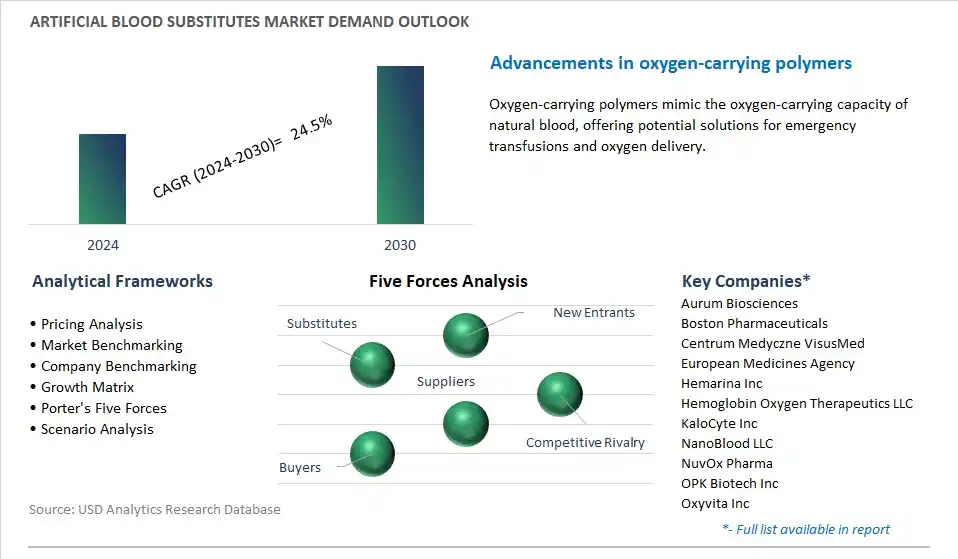
Artificial Blood Substitutes Market is estimated to increase at a growth rate of 24.5% CAGR over the forecast period from 2024 to 2030.
The global Artificial Blood Substitutes Market Study analyzes and forecasts the market size across 6 regions and 24 countries for diverse segments including By Product (Perflurocarbon (PFCs), Hemoglobin-Based Oxygen Carries (HBOCs), By Source (Human Blood, Animal Blood, Microorganism Based Recombinant HB, Synthetic Polymers and Stem Cells), By Application (Cardiovascular Diseases, Malignant Neoplasma, Injuries, Neonatal Conditions, Organ Transplant and Maternal Condition), By End-User (Hospital and Clinics, Blood Banks, Others).
An Introduction to Artificial Blood Substitutes Market in 2024
The Artificial Blood Substitutes Market in 2024 addresses hematology and transfusion medicine products used as blood alternatives for oxygen transport, volume expansion, and hemodynamic stabilization in critical care, trauma, and emergency medicine settings. These artificial blood substitutes include hemoglobin-based oxygen carriers (HBOCs), perfluorocarbon emulsions, and oxygen-carrying solutions, offering oxygenation support, blood loss replacement, and resuscitation options in situations where whole blood or packed red blood cells are not readily available. With a focus on oxygen delivery capacity, safety profiles, and compatibility with blood products, artificial blood substitutes play a role in resuscitation strategies, hemorrhagic shock management, and blood conservation practices in healthcare.
Artificial Blood Substitutes Market Competitive Landscape
The global Artificial Blood Substitutes Industry is highly competitive with a large number of companies focusing on niche market segments. Amidst intense competitive conditions, Artificial Blood Substitutes Companies are investing in new product launches and strengthening distribution channels. Key companies operating in the Artificial Blood Substitutes Industry include- Aurum Biosciences, Boston Pharmaceuticals, Centrum Medyczne VisusMed, European Medicines Agency, Hemarina Inc, Hemoglobin Oxygen Therapeutics LLC, KaloCyte Inc, NanoBlood LLC, NuvOx Pharma, OPK Biotech Inc, Oxyvita Inc, Prolong Pharmaceuticals Llc, SpheriTech Ltd.
Artificial Blood Substitutes Market Trend: Development of Oxygen-Carrying Hemoglobin Solutions
In the Artificial Blood Substitutes market, a prominent trend is the development of oxygen-carrying hemoglobin solutions as alternatives to traditional blood transfusions. Researchers and manufacturers are focusing on creating synthetic hemoglobin-based products capable of carrying and delivering oxygen to tissues, mimicking the functionality of red blood cells. This trend addresses the limitations and risks associated with blood transfusions, such as infection transmission and blood type matching requirements, while providing a stable and shelf-stable solution for emergency situations and surgical procedures.
Artificial Blood Substitutes Market Driver: Increasing Demand for Blood Transfusion Alternatives
A key driver for the Artificial Blood Substitutes market is the increasing demand for blood transfusion alternatives due to shortages, safety concerns, and logistical challenges associated with traditional blood banking. Factors such as blood supply shortages, transfusion reactions, and the risk of infectious diseases transmission drive the need for safe and effective alternatives to blood transfusions. Artificial blood substitutes offer a viable solution by providing oxygen-carrying capabilities without the need for blood typing or cross-matching, thereby addressing critical needs in emergency medicine, trauma care, and surgical settings.
Artificial Blood Substitutes Market Opportunity: Applications in Remote and Resource-Limited Settings
An opportunity exists in the application of artificial blood substitutes in remote and resource-limited settings where access to conventional blood banking infrastructure is limited. By providing a stable and easily transportable solution for oxygen delivery, artificial blood substitutes can address the challenges of blood supply logistics in rural areas, disaster zones, and military operations. Moreover, these substitutes offer potential benefits in specialized medical procedures where traditional blood transfusions may not be readily available or feasible, such as in space exploration, remote field missions, and prolonged transportation of critically ill patients. This opportunity opens up new markets and use cases for artificial blood substitutes, driving innovation and market expansion in the Artificial Blood Substitutes segment.
Market Share Analysis: Hemoglobin-Based Oxygen Carriers (HBOCs) is the fastest growing segment in the Artificial Blood Substitutes industry
Among the segmented artificial blood substitutes by product, Hemoglobin-Based Oxygen Carriers (HBOCs) emerge as the fastest-growing segment. HBOCs are synthetic molecules designed to mimic the oxygen-carrying capacity of red blood cells. They offer several advantages over traditional blood transfusions, including longer shelf life, no need for blood typing or cross-matching, and reduced risk of transmitting infections. The growth of HBOCs is primarily driven by their potential to address critical blood shortages and provide an alternative to donated blood, especially in emergency situations where immediate access to compatible blood is limited. Additionally, ongoing advancements in biotechnology and material science have led to the development of safer and more efficient HBOCs, further fueling their adoption in various medical applications. Despite challenges such as regulatory hurdles and concerns regarding adverse reactions, the HBOCs market is expected to witness substantial growth due to the increasing demand for blood substitutes in cardiovascular diseases, traumatic injuries, and neonatal conditions, among others.
Artificial Blood Substitutes Market Segmentation
By Product
Perflurocarbon (PFCs)
Hemoglobin-Based Oxygen Carries (HBOCs)
By Source
Human Blood
Animal Blood
Microorganism Based Recombinant HB
Synthetic Polymers and Stem Cells
By Application
Cardiovascular Diseases
Malignant Neoplasma
Injuries
Neonatal Conditions
Organ Transplant and Maternal Condition
By End-User
Hospital and Clinics
Blood Banks
Others
Geographical Analysis
North America (United States, Canada, Mexico)
Europe (Germany, France, United Kingdom, Spain, Italy, Rest of Europe)
Asia Pacific (China, India, Japan, South Korea, Rest of Asia Pacific)
South America (Brazil, Argentina, Rest of South America)
Middle East and Africa (Saudi Arabia, UAE, Rest of Middle East, South Africa, Egypt, Rest of Africa)
Artificial Blood Substitutes Companies
Aurum Biosciences
Boston Pharmaceuticals
Centrum Medyczne VisusMed
European Medicines Agency
Hemarina Inc
Hemoglobin Oxygen Therapeutics LLC
KaloCyte Inc
NanoBlood LLC
NuvOx Pharma
OPK Biotech Inc
Oxyvita Inc
Prolong Pharmaceuticals Llc
SpheriTech Ltd
* List not Exhaustive
Reasons to Buy the Artificial Blood Substitutes Market Study
• Deepen your industry insights and navigate uncertainties for strategy formulation, CAPEX, and Operational decisions
• Gain access to detailed insights on the Artificial Blood Substitutes Market, encompassing current market size, growth trends, and forecasts till 2030.
• Access detailed competitor analysis, enabling competitive advantage through a thorough understanding of market players, strategies, and potential differentiation opportunities
• Stay ahead of the curve with insights on technological advancements, innovations, and upcoming trends
• Identify lucrative investment avenues and expansion opportunities within the Artificial Blood Substitutes Industry, guided by robust, data-backed analysis.
• Understand regional and global markets through country-wise analysis, regional market potential, regulatory nuances, and dynamics
• Execute strategies with confidence and speed through information, analytics, and insights on the industry value chain
• Corporate leaders, strategists, financial experts, shareholders, asset managers, and governmental representatives can make long-term planning scenarios and build an integrated and timely understanding of market dynamics
• Benefit from tailored solutions and expert consultation based on report insights, providing personalized strategies aligned with specific business needs.
TABLE OF CONTENTS
1 Introduction to 2024 Artificial Blood Substitutes Market
1.1 Market Overview
1.2 Quick Facts
1.3 Scope/Objective of the Study
1.4 Market Definition
1.5 Countries and Regions Analyzed
1.6 Units, Currency, and Conversions
1.7 Industry Value Chain
2 Research Methodology
2.1 Market Size Estimation
2.2 Sources and Research Methodology
2.3 Data Triangulation
2.4 Assumptions and Limitations
3 Executive Summary
3.1 Global Artificial Blood Substitutes Market Size Outlook, $ Million, 2021 to 2030
3.2 Artificial Blood Substitutes Market Outlook by Type, $ Million, 2021 to 2030
3.3 Artificial Blood Substitutes Market Outlook by Product, $ Million, 2021 to 2030
3.4 Artificial Blood Substitutes Market Outlook by Application, $ Million, 2021 to 2030
3.5 Artificial Blood Substitutes Market Outlook by Key Countries, $ Million, 2021 to 2030
4 Market Dynamics
4.1 Key Driving Forces of Artificial Blood Substitutes Industry
4.2 Key Market Trends in Artificial Blood Substitutes Industry
4.3 Potential Opportunities in Artificial Blood Substitutes Industry
4.4 Key Challenges in Artificial Blood Substitutes Industry
5 Market Factor Analysis
5.1 Value Chain Analysis
5.2 Competitive Landscape
5.2.1 Global Artificial Blood Substitutes Market Share by Company (%), 2023
5.2.2 Product Offerings by Company
5.3 Porter’s Five Forces Analysis
5.4 Pricing Analysis and Outlook
6 Growth Outlook Across Scenarios
6.1 Growth Analysis-Case Scenario Definitions
6.2 Low Growth Scenario Forecasts
6.3 Reference Growth Scenario Forecasts
6.4 High Growth Scenario Forecasts
7 Global Artificial Blood Substitutes Market Outlook by Segments
7.1 Artificial Blood Substitutes Market Outlook by Segments, $ Million, 2021- 2030
By Product
Perflurocarbon (PFCs)
Hemoglobin-Based Oxygen Carries (HBOCs)
By Source
Human Blood
Animal Blood
Microorganism Based Recombinant HB
Synthetic Polymers and Stem Cells
By Application
Cardiovascular Diseases
Malignant Neoplasma
Injuries
Neonatal Conditions
Organ Transplant and Maternal Condition
By End-User
Hospital and Clinics
Blood Banks
Others
8 North America Artificial Blood Substitutes Market Analysis and Outlook To 2030
8.1 Introduction to North America Artificial Blood Substitutes Markets in 2024
8.2 North America Artificial Blood Substitutes Market Size Outlook by Country, 2021-2030
8.2.1 United States
8.2.2 Canada
8.2.3 Mexico
8.3 North America Artificial Blood Substitutes Market size Outlook by Segments, 2021-2030
By Product
Perflurocarbon (PFCs)
Hemoglobin-Based Oxygen Carries (HBOCs)
By Source
Human Blood
Animal Blood
Microorganism Based Recombinant HB
Synthetic Polymers and Stem Cells
By Application
Cardiovascular Diseases
Malignant Neoplasma
Injuries
Neonatal Conditions
Organ Transplant and Maternal Condition
By End-User
Hospital and Clinics
Blood Banks
Others
9 Europe Artificial Blood Substitutes Market Analysis and Outlook To 2030
9.1 Introduction to Europe Artificial Blood Substitutes Markets in 2024
9.2 Europe Artificial Blood Substitutes Market Size Outlook by Country, 2021-2030
9.2.1 Germany
9.2.2 France
9.2.3 Spain
9.2.4 United Kingdom
9.2.4 Italy
9.2.5 Russia
9.2.6 Norway
9.2.7 Rest of Europe
9.3 Europe Artificial Blood Substitutes Market Size Outlook by Segments, 2021-2030
By Product
Perflurocarbon (PFCs)
Hemoglobin-Based Oxygen Carries (HBOCs)
By Source
Human Blood
Animal Blood
Microorganism Based Recombinant HB
Synthetic Polymers and Stem Cells
By Application
Cardiovascular Diseases
Malignant Neoplasma
Injuries
Neonatal Conditions
Organ Transplant and Maternal Condition
By End-User
Hospital and Clinics
Blood Banks
Others
10 Asia Pacific Artificial Blood Substitutes Market Analysis and Outlook To 2030
10.1 Introduction to Asia Pacific Artificial Blood Substitutes Markets in 2024
10.2 Asia Pacific Artificial Blood Substitutes Market Size Outlook by Country, 2021-2030
10.2.1 China
10.2.2 India
10.2.3 Japan
10.2.4 South Korea
10.2.5 Indonesia
10.2.6 Malaysia
10.2.7 Australia
10.2.8 Rest of Asia Pacific
10.3 Asia Pacific Artificial Blood Substitutes Market size Outlook by Segments, 2021-2030
By Product
Perflurocarbon (PFCs)
Hemoglobin-Based Oxygen Carries (HBOCs)
By Source
Human Blood
Animal Blood
Microorganism Based Recombinant HB
Synthetic Polymers and Stem Cells
By Application
Cardiovascular Diseases
Malignant Neoplasma
Injuries
Neonatal Conditions
Organ Transplant and Maternal Condition
By End-User
Hospital and Clinics
Blood Banks
Others
11 South America Artificial Blood Substitutes Market Analysis and Outlook To 2030
11.1 Introduction to South America Artificial Blood Substitutes Markets in 2024
11.2 South America Artificial Blood Substitutes Market Size Outlook by Country, 2021-2030
11.2.1 Brazil
11.2.2 Argentina
11.2.3 Rest of South America
11.3 South America Artificial Blood Substitutes Market size Outlook by Segments, 2021-2030
By Product
Perflurocarbon (PFCs)
Hemoglobin-Based Oxygen Carries (HBOCs)
By Source
Human Blood
Animal Blood
Microorganism Based Recombinant HB
Synthetic Polymers and Stem Cells
By Application
Cardiovascular Diseases
Malignant Neoplasma
Injuries
Neonatal Conditions
Organ Transplant and Maternal Condition
By End-User
Hospital and Clinics
Blood Banks
Others
12 Middle East and Africa Artificial Blood Substitutes Market Analysis and Outlook To 2030
12.1 Introduction to Middle East and Africa Artificial Blood Substitutes Markets in 2024
12.2 Middle East and Africa Artificial Blood Substitutes Market Size Outlook by Country, 2021-2030
12.2.1 Saudi Arabia
12.2.2 UAE
12.2.3 Oman
12.2.4 Rest of Middle East
12.2.5 Egypt
12.2.6 Nigeria
12.2.7 South Africa
12.2.8 Rest of Africa
12.3 Middle East and Africa Artificial Blood Substitutes Market size Outlook by Segments, 2021-2030
By Product
Perflurocarbon (PFCs)
Hemoglobin-Based Oxygen Carries (HBOCs)
By Source
Human Blood
Animal Blood
Microorganism Based Recombinant HB
Synthetic Polymers and Stem Cells
By Application
Cardiovascular Diseases
Malignant Neoplasma
Injuries
Neonatal Conditions
Organ Transplant and Maternal Condition
By End-User
Hospital and Clinics
Blood Banks
Others
13 Company Profiles
13.1 Company Snapshot
13.2 SWOT Profiles
13.3 Products and Services
13.4 Recent Developments
13.5 Financial Profile
List of Companies
Aurum Biosciences
Boston Pharmaceuticals
Centrum Medyczne VisusMed
European Medicines Agency
Hemarina Inc
Hemoglobin Oxygen Therapeutics LLC
KaloCyte Inc
NanoBlood LLC
NuvOx Pharma
OPK Biotech Inc
Oxyvita Inc
Prolong Pharmaceuticals Llc
SpheriTech Ltd
14 Appendix
14.1 Customization Offerings
14.2 Subscription Services
14.3 Related Reports
14.4 Publisher Expertise
