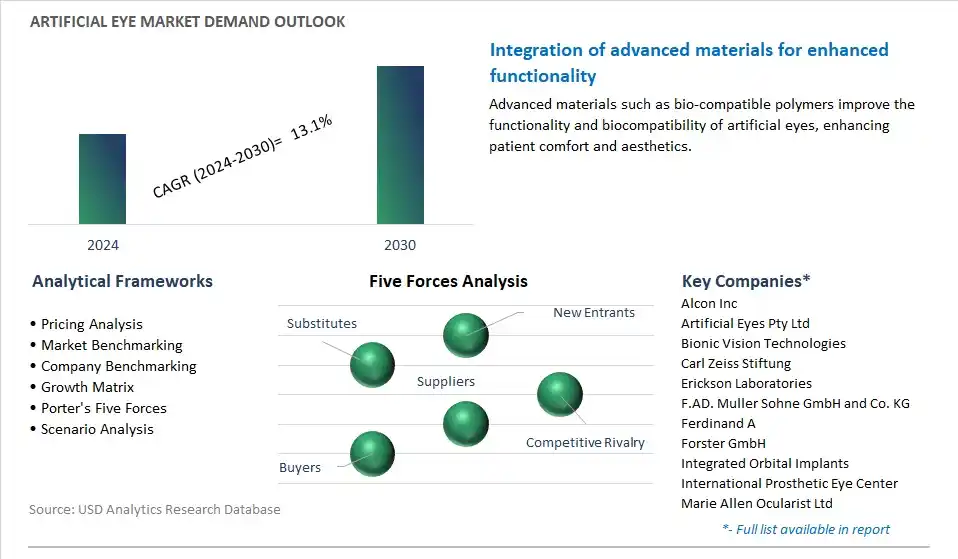
Artificial Eye Market is estimated to increase at a growth rate of 13.1% CAGR over the forecast period from 2024 to 2030.
The global Artificial Eye Market Study analyzes and forecasts the market size across 6 regions and 24 countries for diverse segments including By Technology (Mechanical, Electronic), By Product (Integrated Prosthetic Eye, Non-Integrated Prosthetic Eye, Retinal Prosthetics).
An Introduction to Artificial Eye Market in 2024
The Artificial Eye Market in 2024 encompasses ophthalmic prosthetics, ocular implants, and artificial eyes used in ophthalmology and optometry for restoring eye aesthetics, improving visual appearance, and enhancing patient confidence after eye removal (enucleation) or severe eye injury. These artificial eye devices include customized ocular prostheses, scleral shells, and orbital implants, offering natural eye contours, iris color matching, and eyelid movement simulation for enhanced cosmetic outcomes and emotional well-being. With advancements in prosthetic materials, digital imaging technologies, and patient-specific designs, artificial eyes contribute to ocular rehabilitation, facial symmetry restoration, and patient satisfaction in ocular prosthetics.
Artificial Eye Market Competitive Landscape
The global Artificial Eye Industry is highly competitive with a large number of companies focusing on niche market segments. Amidst intense competitive conditions, Artificial Eye Companies are investing in new product launches and strengthening distribution channels. Key companies operating in the Artificial Eye Industry include- Alcon Inc, Artificial Eyes Pty Ltd, Bionic Vision Technologies, Carl Zeiss Stiftung, Erickson Laboratories, F.AD. Muller Sohne GmbH and Co. KG, Ferdinand A, Forster GmbH, Integrated Orbital Implants, International Prosthetic Eye Center, Marie Allen Ocularist Ltd, Midwest Eye Laboratories Inc, Nano Retina, National Artificial Eye Services, NIDEK Co. Ltd, Nova Eye Medical Ltd, Ocular Prosthetics Inc, PIXIUM VISION, Rocky Mountain Anaplastology Inc.
Artificial Eye Market Trend: Advancements in Ocular Prosthetics
In the Artificial Eye market, a significant trend is the continual advancements in ocular prosthetics technology. Innovations in materials science, manufacturing techniques, and customization capabilities are driving the development of artificial eyes that closely mimic the appearance and functionality of natural eyes. This trend is facilitating improved comfort, aesthetics, and mobility for individuals who have lost an eye due to trauma, disease, or congenital conditions. Enhanced realism and comfort in artificial eyes are becoming increasingly important, leading to the adoption of innovative materials and manufacturing processes to meet patient needs.
Artificial Eye Market Driver: Growing Demand for Aesthetic and Functional Restoration
A key driver for the Artificial Eye market is the growing demand for aesthetic and functional restoration among individuals with ocular defects or loss. Factors such as ocular trauma, congenital anomalies, and eye diseases contribute to the need for artificial eyes as a solution for restoring facial symmetry, self-esteem, and visual function. Additionally, advancements in surgical techniques and rehabilitation services are expanding the patient pool eligible for artificial eye implantation, driving market demand for high-quality, customized ocular prosthetics that offer natural appearance, comfort, and durability.
Artificial Eye Market Opportunity: Integration of Digital Imaging and 3D Printing Technologies
An opportunity exists in the integration of digital imaging and 3D printing technologies for the fabrication of custom artificial eyes. By leveraging digital scanning technologies to capture precise anatomical data and CAD/CAM software to design patient-specific prosthetics, there's potential to enhance the accuracy and customization of artificial eyes. Furthermore, 3D printing enables rapid prototyping and production of ocular prosthetics with intricate details and lifelike features, allowing for better customization and aesthetic outcomes. Collaboration with ophthalmologists, maxillofacial surgeons, and technology developers can drive innovation in digital imaging and 3D printing applications for artificial eyes, leading to improved patient satisfaction and market growth in the Artificial Eye segment.
Market Share Analysis: Electronic Artificial Eye is the fastest growing segment in the Artificial Eye industry
The fastest-growing segment in the artificial eye market is electronic artificial eyes. Unlike mechanical artificial eyes, which are static and provide a cosmetic solution only, electronic artificial eyes incorporate advanced technology to restore some degree of vision for individuals with visual impairments or blindness. These electronic prosthetic eyes are equipped with miniature cameras and sensors that capture visual information and transmit it to the brain through electrical stimulation of the remaining optic nerves or visual processing centers. This technology allows recipients to perceive light, shapes, and movement, enhancing their overall visual experience and quality of life. The increasing demand for electronic artificial eyes is driven by advancements in microelectronics, implantable devices, and neuroprosthetics, as well as growing awareness and acceptance of vision restoration technologies.
Artificial Eye Market Segmentation
By Technology
Mechanical
Electronic
By Product
Integrated Prosthetic Eye
Non-Integrated Prosthetic Eye
Retinal Prosthetics
Geographical Analysis
North America (United States, Canada, Mexico)
Europe (Germany, France, United Kingdom, Spain, Italy, Rest of Europe)
Asia Pacific (China, India, Japan, South Korea, Rest of Asia Pacific)
South America (Brazil, Argentina, Rest of South America)
Middle East and Africa (Saudi Arabia, UAE, Rest of Middle East, South Africa, Egypt, Rest of Africa)
Artificial Eye Companies
Alcon Inc
Artificial Eyes Pty Ltd
Bionic Vision Technologies
Carl Zeiss Stiftung
Erickson Laboratories
F.AD. Muller Sohne GmbH and Co. KG
Ferdinand A
Forster GmbH
Integrated Orbital Implants
International Prosthetic Eye Center
Marie Allen Ocularist Ltd
Midwest Eye Laboratories Inc
Nano Retina
National Artificial Eye Services
NIDEK Co. Ltd
Nova Eye Medical Ltd
Ocular Prosthetics Inc
PIXIUM VISION
Rocky Mountain Anaplastology Inc
* List not Exhaustive
Reasons to Buy the Artificial Eye Market Study
• Deepen your industry insights and navigate uncertainties for strategy formulation, CAPEX, and Operational decisions
• Gain access to detailed insights on the Artificial Eye Market, encompassing current market size, growth trends, and forecasts till 2030.
• Access detailed competitor analysis, enabling competitive advantage through a thorough understanding of market players, strategies, and potential differentiation opportunities
• Stay ahead of the curve with insights on technological advancements, innovations, and upcoming trends
• Identify lucrative investment avenues and expansion opportunities within the Artificial Eye Industry, guided by robust, data-backed analysis.
• Understand regional and global markets through country-wise analysis, regional market potential, regulatory nuances, and dynamics
• Execute strategies with confidence and speed through information, analytics, and insights on the industry value chain
• Corporate leaders, strategists, financial experts, shareholders, asset managers, and governmental representatives can make long-term planning scenarios and build an integrated and timely understanding of market dynamics
• Benefit from tailored solutions and expert consultation based on report insights, providing personalized strategies aligned with specific business needs.
TABLE OF CONTENTS
1 Introduction to 2024 Artificial Eye Market
1.1 Market Overview
1.2 Quick Facts
1.3 Scope/Objective of the Study
1.4 Market Definition
1.5 Countries and Regions Analyzed
1.6 Units, Currency, and Conversions
1.7 Industry Value Chain
2 Research Methodology
2.1 Market Size Estimation
2.2 Sources and Research Methodology
2.3 Data Triangulation
2.4 Assumptions and Limitations
3 Executive Summary
3.1 Global Artificial Eye Market Size Outlook, $ Million, 2021 to 2030
3.2 Artificial Eye Market Outlook by Type, $ Million, 2021 to 2030
3.3 Artificial Eye Market Outlook by Product, $ Million, 2021 to 2030
3.4 Artificial Eye Market Outlook by Application, $ Million, 2021 to 2030
3.5 Artificial Eye Market Outlook by Key Countries, $ Million, 2021 to 2030
4 Market Dynamics
4.1 Key Driving Forces of Artificial Eye Industry
4.2 Key Market Trends in Artificial Eye Industry
4.3 Potential Opportunities in Artificial Eye Industry
4.4 Key Challenges in Artificial Eye Industry
5 Market Factor Analysis
5.1 Value Chain Analysis
5.2 Competitive Landscape
5.2.1 Global Artificial Eye Market Share by Company (%), 2023
5.2.2 Product Offerings by Company
5.3 Porter’s Five Forces Analysis
5.4 Pricing Analysis and Outlook
6 Growth Outlook Across Scenarios
6.1 Growth Analysis-Case Scenario Definitions
6.2 Low Growth Scenario Forecasts
6.3 Reference Growth Scenario Forecasts
6.4 High Growth Scenario Forecasts
7 Global Artificial Eye Market Outlook by Segments
7.1 Artificial Eye Market Outlook by Segments, $ Million, 2021- 2030
By Technology
Mechanical
Electronic
By Product
Integrated Prosthetic Eye
Non-Integrated Prosthetic Eye
Retinal Prosthetics
8 North America Artificial Eye Market Analysis and Outlook To 2030
8.1 Introduction to North America Artificial Eye Markets in 2024
8.2 North America Artificial Eye Market Size Outlook by Country, 2021-2030
8.2.1 United States
8.2.2 Canada
8.2.3 Mexico
8.3 North America Artificial Eye Market size Outlook by Segments, 2021-2030
By Technology
Mechanical
Electronic
By Product
Integrated Prosthetic Eye
Non-Integrated Prosthetic Eye
Retinal Prosthetics
9 Europe Artificial Eye Market Analysis and Outlook To 2030
9.1 Introduction to Europe Artificial Eye Markets in 2024
9.2 Europe Artificial Eye Market Size Outlook by Country, 2021-2030
9.2.1 Germany
9.2.2 France
9.2.3 Spain
9.2.4 United Kingdom
9.2.4 Italy
9.2.5 Russia
9.2.6 Norway
9.2.7 Rest of Europe
9.3 Europe Artificial Eye Market Size Outlook by Segments, 2021-2030
By Technology
Mechanical
Electronic
By Product
Integrated Prosthetic Eye
Non-Integrated Prosthetic Eye
Retinal Prosthetics
10 Asia Pacific Artificial Eye Market Analysis and Outlook To 2030
10.1 Introduction to Asia Pacific Artificial Eye Markets in 2024
10.2 Asia Pacific Artificial Eye Market Size Outlook by Country, 2021-2030
10.2.1 China
10.2.2 India
10.2.3 Japan
10.2.4 South Korea
10.2.5 Indonesia
10.2.6 Malaysia
10.2.7 Australia
10.2.8 Rest of Asia Pacific
10.3 Asia Pacific Artificial Eye Market size Outlook by Segments, 2021-2030
By Technology
Mechanical
Electronic
By Product
Integrated Prosthetic Eye
Non-Integrated Prosthetic Eye
Retinal Prosthetics
11 South America Artificial Eye Market Analysis and Outlook To 2030
11.1 Introduction to South America Artificial Eye Markets in 2024
11.2 South America Artificial Eye Market Size Outlook by Country, 2021-2030
11.2.1 Brazil
11.2.2 Argentina
11.2.3 Rest of South America
11.3 South America Artificial Eye Market size Outlook by Segments, 2021-2030
By Technology
Mechanical
Electronic
By Product
Integrated Prosthetic Eye
Non-Integrated Prosthetic Eye
Retinal Prosthetics
12 Middle East and Africa Artificial Eye Market Analysis and Outlook To 2030
12.1 Introduction to Middle East and Africa Artificial Eye Markets in 2024
12.2 Middle East and Africa Artificial Eye Market Size Outlook by Country, 2021-2030
12.2.1 Saudi Arabia
12.2.2 UAE
12.2.3 Oman
12.2.4 Rest of Middle East
12.2.5 Egypt
12.2.6 Nigeria
12.2.7 South Africa
12.2.8 Rest of Africa
12.3 Middle East and Africa Artificial Eye Market size Outlook by Segments, 2021-2030
By Technology
Mechanical
Electronic
By Product
Integrated Prosthetic Eye
Non-Integrated Prosthetic Eye
Retinal Prosthetics
13 Company Profiles
13.1 Company Snapshot
13.2 SWOT Profiles
13.3 Products and Services
13.4 Recent Developments
13.5 Financial Profile
List of Companies
Alcon Inc
Artificial Eyes Pty Ltd
Bionic Vision Technologies
Carl Zeiss Stiftung
Erickson Laboratories
F.AD. Muller Sohne GmbH and Co. KG
Ferdinand A
Forster GmbH
Integrated Orbital Implants
International Prosthetic Eye Center
Marie Allen Ocularist Ltd
Midwest Eye Laboratories Inc
Nano Retina
National Artificial Eye Services
NIDEK Co. Ltd
Nova Eye Medical Ltd
Ocular Prosthetics Inc
PIXIUM VISION
Rocky Mountain Anaplastology Inc
14 Appendix
14.1 Customization Offerings
14.2 Subscription Services
14.3 Related Reports
14.4 Publisher Expertise
