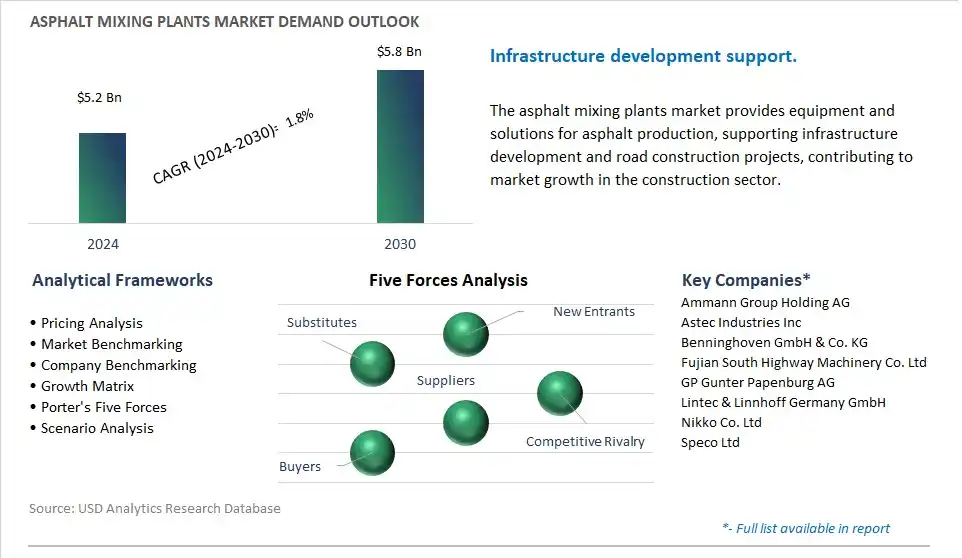
The global Asphalt Mixing Plants Market is poised to register a 1.8% CAGR from $5.2 Billion in 2024 to $5.8 Billion in 2030.
The global Asphalt Mixing Plants Market Study analyzes and forecasts the market size across 6 regions and 24 countries for diverse segments -By Product (Batch Mix, Drum Mix, Continuous Mix), By Application (Road Construction, Parking Lots, Pedestrian Paths, Bridge), By Production Capacity (Below 240t/H, 240 to 320t/H, Above 320t/H), By End-User (Residential, Non-Residential).
An Introduction to Global Asphalt Mixing Plants Market in 2024
The market for asphalt mixing plants is experiencing growth driven by the demand for efficient and flexible production facilities that meet the diverse requirements of road construction projects. Key trends shaping the future of this industry include the development of modular and mobile asphalt plants with advanced control systems, automation, and energy-efficient technologies, enabling rapid deployment and adjustment to project needs and site conditions. Additionally, advancements in plant design and process optimization improve mixing accuracy, quality control, and environmental performance, reducing emissions, energy consumption, and material waste in asphalt production. Moreover, the integration of digital technologies such as IoT sensors, data analytics, and predictive maintenance enhances plant reliability, uptime, and productivity, ensuring continuous operation and optimized resource utilization. As infrastructure investment and road development projects increase globally, the demand for asphalt mixing plants is expected to continue growing, driving innovation and market expansion in this sector.
Asphalt Mixing Plants Market Competitive Landscape
The market report analyses the leading companies in the industry including Ammann Group Holding AG, Astec Industries Inc, Benninghoven GmbH & Co. KG, Fujian South Highway Machinery Co. Ltd, GP Gunter Papenburg AG, Lintec & Linnhoff Germany GmbH, Nikko Co. Ltd, Speco Ltd.
Asphalt Mixing Plants Market Dynamics
Asphalt Mixing Plants Market Trend: Adoption of Advanced Automation and Digitalization
A prominent trend in the asphalt mixing plants market is the increasing adoption of advanced automation and digitalization technologies in plant design and operation. As the construction industry seeks to improve efficiency, productivity, and sustainability, asphalt plant manufacturers are integrating automation, control systems, and data analytics into their equipment to optimize plant performance, reduce downtime, and minimize environmental impact. This is driven by the need for real-time monitoring, process control, and predictive maintenance capabilities to enhance plant operations, ensure quality asphalt production, and meet stringent regulatory requirements. Advanced features such as remote monitoring, intelligent sensors, and data-driven insights are becoming standard offerings in modern asphalt mixing plants, enabling contractors and producers to achieve higher levels of operational efficiency and competitiveness.
Asphalt Mixing Plants Market Driver: Infrastructure Development and Road Construction
A key driver propelling the asphalt mixing plants market is the global infrastructure development and road construction activities driven by population growth, urbanization, and economic development. As governments and private sectors invest in transportation infrastructure projects, there is a continuous demand for asphalt mixtures to build and maintain roads, highways, airports, and parking lots. Asphalt mixing plants play a crucial role in producing quality asphalt mixtures that meet project specifications and performance requirements. The growing need for efficient, reliable, and high-capacity asphalt production facilities to meet the increasing demand for asphalt pavements drives investments in asphalt mixing plants worldwide. Additionally, the adoption of innovative technologies and sustainable practices in asphalt production, such as warm mix asphalt (WMA) and recycled asphalt pavement (RAP), further fuels the demand for modern and environmentally friendly asphalt mixing plants.
Asphalt Mixing Plants Market Opportunity: Development of Modular and Mobile Asphalt Plants
An opportunity for the asphalt mixing plants market lies in the development of modular and mobile plant solutions that offer flexibility, scalability, and rapid deployment for construction projects of varying scales and locations. With the trend towards decentralized construction and the need for agile and adaptable asphalt production facilities, there is demand for modular and mobile plants that can be easily transported, assembled, and operated on-site. Modular asphalt plants allow for customization and expansion as project requirements evolve, while mobile plants enable contractors to produce asphalt directly at project sites, reducing transportation costs and logistics challenges. By offering modular and mobile plant solutions, manufacturers can address the needs of diverse customers, including small to medium-sized contractors, remote infrastructure projects, and temporary construction sites, and capitalize on opportunities in the growing market for portable asphalt production equipment.
Asphalt Mixing Plants Market Ecosystem
The asphalt mixing plants industry involves diverse stages, with key players contributing to manufacturing, quality control and testing, distribution and sales, installation and commissioning, after-sales services, and end-user utilization. Manufacturing focuses on designing and fabricating asphalt mixing plants, with companies including Ammann Group, Wirtgen GmbH, and Astec Industries leading the industry, integrating advanced technologies for enhanced functionality and performance. Distribution and sales efforts target construction companies and government agencies, facilitated by direct sales teams, authorized distributors, and online platforms, providing access to a wide range of asphalt mixing plants.
Installation and commissioning involve on-site setup and performance testing, characterized by the presence of manufacturers or specialized construction crews, ensuring proper installation and functionality of the plant. After-sales services encompass ongoing support including spare parts supply, maintenance, technical assistance, and operator training provided by manufacturers' dedicated departments or independent service providers.
End-users, including construction companies with asphalt paving divisions and government road construction agencies, utilize asphalt mixing plants for producing asphalt mixtures tailored to project specifications, ensuring efficient and cost-effective asphalt production.
Asphalt Mixing Plants Market Share Analysis: Batch Mix held the dominant revenue share in 2024
Batch mix plants emerge as the largest segment in the asphalt mixing plants market due to their versatility, reliability, and widespread adoption in various construction projects. Batch mix plants are highly efficient and flexible, capable of producing asphalt mixtures in precise batches according to specific project requirements. This modular approach allows for greater control over the quality, composition, and consistency of the asphalt mix, making batch mix plants suitable for a wide range of applications, including road construction, maintenance, and repair. Additionally, batch mix plants offer advantages such as ease of operation, rapid setup and mobilization, and the ability to produce different types of asphalt mixtures, including hot mix, warm mix, and cold mix, depending on project specifications and environmental conditions. The batch mix process involves heating and drying aggregates separately before mixing them with asphalt binder, ensuring thorough coating and uniform distribution of materials for optimal performance in the finished pavement. Further, the growing demand for high-quality asphalt pavements with superior durability and performance characteristics drives the preference for batch mix plants among contractors, governments, and infrastructure developers. As infrastructure investment continues to rise globally and the need for efficient and sustainable road construction solutions grows, the dominance of batch mix plants in the asphalt mixing plants market is expected to persist, driving their continued growth and innovation in the industry.
Asphalt Mixing Plants Market Share Analysis: Parking Lots is the fastest growing market segment over the forecast period to 2030
Parking lots emerge as the fastest-growing segment in the asphalt mixing plants market due to the increasing demand for asphalt pavements in commercial and residential parking facilities. Parking lots are essential infrastructures that accommodate vehicles for various purposes, including shopping centers, office buildings, residential complexes, and recreational facilities. As urbanization and vehicle ownership rates continue to rise globally, the construction and expansion of parking lots become increasingly prevalent, driving the demand for asphalt mixing plants tailored for parking lot applications. Asphalt pavements offer diverse advantages for parking lots, including durability, smoothness, and ease of maintenance, making them the preferred choice for surfacing parking areas. Additionally, the aesthetic appeal of asphalt pavements, coupled with the ability to incorporate markings, signage, and safety features, enhances the functionality and attractiveness of parking lots for users. The versatility of asphalt mixing plants allows for the efficient production of asphalt mixtures tailored to the specific requirements of parking lot projects, including traffic loadings, environmental conditions, and aesthetic preferences. Further, the growing emphasis on sustainable and eco-friendly parking lot designs drives the adoption of advanced asphalt technologies, such as warm mix asphalt and recycled materials, further fueling the demand for asphalt mixing plants in this segment. As urbanization trends persist and the need for efficient parking infrastructure grows, the parking lots segment is poised for rapid growth in the asphalt mixing plants market, driving innovation and expansion in the industry.
Asphalt Mixing Plants Market Share Analysis: Above 320t/H is the fastest growing market segment over the forecast period to 2030
The segment of asphalt mixing plants with production capacities above 320t/h is the fastest-growing segment in the market due to diverse factors driving the demand for high-capacity asphalt production facilities. Infrastructure projects, such as highway construction, airport expansion, and large-scale commercial developments, require significant volumes of asphalt mixtures to meet the demands of extensive road networks and high traffic volumes. Asphalt mixing plants with production capacities above 320t/h offer the capability to produce large quantities of asphalt mixtures efficiently and effectively, ensuring continuous supply for major construction projects. In addition, the growing trend toward mega-infrastructure projects and urbanization drives the need for high-capacity asphalt plants capable of meeting the scale and pace of construction activities. Additionally, advancements in technology and automation in asphalt plant design and operation enhance the efficiency, productivity, and reliability of high-capacity plants, further fueling their growth. As governments and private investors continue to invest in infrastructure development and transportation networks worldwide, the demand for asphalt mixing plants with production capacities above 320t/h is expected to soar, driving the rapid growth of this segment in the market.
Asphalt Mixing Plants Market Report Scope-
By Product
Batch Mix
Drum Mix
Continuous Mix
By Application
Road Construction
Parking Lots
Pedestrian Paths
Bridge
By Production Capacity
Below 240t/H
240 to 320t/H
Above 320t/H
By End-User
Residential
Non-Residential
Asphalt Mixing Plants Market Companies Profiled
Ammann Group Holding AG
Astec Industries Inc
Benninghoven GmbH & Co. KG
Fujian South Highway Machinery Co. Ltd
GP Gunter Papenburg AG
Lintec & Linnhoff Germany GmbH
Nikko Co. Ltd
Speco Ltd
*- List Not Exhaustive
TABLE OF CONTENTS
1 Introduction to 2024 Asphalt Mixing Plants Market
1.1 Market Overview
1.2 Quick Facts
1.3 Scope/Objective of the Study
1.4 Market Definition
1.5 Countries and Regions Covered
1.6 Units, Currency, and Conversions
1.7 Industry Value Chain
2 Research Methodology
2.1 Market Size Estimation
2.2 Sources and Research Methodology
2.3 Data Triangulation
2.4 Assumptions and Limitations
3 Executive Summary
3.1 Global Asphalt Mixing Plants Market Size Outlook, $ Million, 2021 to 2030
3.2 Asphalt Mixing Plants Market Outlook by Type, $ Million, 2021 to 2030
3.3 Asphalt Mixing Plants Market Outlook by Product, $ Million, 2021 to 2030
3.4 Asphalt Mixing Plants Market Outlook by Application, $ Million, 2021 to 2030
3.5 Asphalt Mixing Plants Market Outlook by Key Countries, $ Million, 2021 to 2030
4 Market Dynamics
4.1 Key Driving Forces of Asphalt Mixing Plants Industry
4.2 Key Market Trends in Asphalt Mixing Plants Industry
4.3 Potential Opportunities in Asphalt Mixing Plants Industry
4.4 Key Challenges in Asphalt Mixing Plants Industry
5 Market Factor Analysis
5.1 Value Chain Analysis
5.2 Competitive Landscape
5.2.1 Global Asphalt Mixing Plants Market Share by Company (%), 2023
5.2.2 Product Offerings by Company
5.3 Porter’s Five Forces Analysis
5.4 Pricing Analysis and Outlook
6 Growth Outlook Across Scenarios
6.1 Growth Analysis-Case Scenario Definitions
6.2 Low Growth Scenario Forecasts
6.3 Reference Growth Scenario Forecasts
6.4 High Growth Scenario Forecasts
7 Global Asphalt Mixing Plants Market Outlook by Segments
7.1 Asphalt Mixing Plants Market Outlook by Segments, $ Million, 2021- 2030
By Product
Batch Mix
Drum Mix
Continuous Mix
By Application
Road Construction
Parking Lots
Pedestrian Paths
Bridge
By Production Capacity
Below 240t/H
240 to 320t/H
Above 320t/H
By End-User
Residential
Non-Residential
8 North America Asphalt Mixing Plants Market Analysis and Outlook To 2030
8.1 Introduction to North America Asphalt Mixing Plants Markets in 2024
8.2 North America Asphalt Mixing Plants Market Size Outlook by Country, 2021-2030
8.2.1 United States
8.2.2 Canada
8.2.3 Mexico
8.3 North America Asphalt Mixing Plants Market size Outlook by Segments, 2021-2030
By Product
Batch Mix
Drum Mix
Continuous Mix
By Application
Road Construction
Parking Lots
Pedestrian Paths
Bridge
By Production Capacity
Below 240t/H
240 to 320t/H
Above 320t/H
By End-User
Residential
Non-Residential
9 Europe Asphalt Mixing Plants Market Analysis and Outlook To 2030
9.1 Introduction to Europe Asphalt Mixing Plants Markets in 2024
9.2 Europe Asphalt Mixing Plants Market Size Outlook by Country, 2021-2030
9.2.1 Germany
9.2.2 France
9.2.3 Spain
9.2.4 United Kingdom
9.2.4 Italy
9.2.5 Russia
9.2.6 Norway
9.2.7 Rest of Europe
9.3 Europe Asphalt Mixing Plants Market Size Outlook by Segments, 2021-2030
By Product
Batch Mix
Drum Mix
Continuous Mix
By Application
Road Construction
Parking Lots
Pedestrian Paths
Bridge
By Production Capacity
Below 240t/H
240 to 320t/H
Above 320t/H
By End-User
Residential
Non-Residential
10 Asia Pacific Asphalt Mixing Plants Market Analysis and Outlook To 2030
10.1 Introduction to Asia Pacific Asphalt Mixing Plants Markets in 2024
10.2 Asia Pacific Asphalt Mixing Plants Market Size Outlook by Country, 2021-2030
10.2.1 China
10.2.2 India
10.2.3 Japan
10.2.4 South Korea
10.2.5 Indonesia
10.2.6 Malaysia
10.2.7 Australia
10.2.8 Rest of Asia Pacific
10.3 Asia Pacific Asphalt Mixing Plants Market size Outlook by Segments, 2021-2030
By Product
Batch Mix
Drum Mix
Continuous Mix
By Application
Road Construction
Parking Lots
Pedestrian Paths
Bridge
By Production Capacity
Below 240t/H
240 to 320t/H
Above 320t/H
By End-User
Residential
Non-Residential
11 South America Asphalt Mixing Plants Market Analysis and Outlook To 2030
11.1 Introduction to South America Asphalt Mixing Plants Markets in 2024
11.2 South America Asphalt Mixing Plants Market Size Outlook by Country, 2021-2030
11.2.1 Brazil
11.2.2 Argentina
11.2.3 Rest of South America
11.3 South America Asphalt Mixing Plants Market size Outlook by Segments, 2021-2030
By Product
Batch Mix
Drum Mix
Continuous Mix
By Application
Road Construction
Parking Lots
Pedestrian Paths
Bridge
By Production Capacity
Below 240t/H
240 to 320t/H
Above 320t/H
By End-User
Residential
Non-Residential
12 Middle East and Africa Asphalt Mixing Plants Market Analysis and Outlook To 2030
12.1 Introduction to Middle East and Africa Asphalt Mixing Plants Markets in 2024
12.2 Middle East and Africa Asphalt Mixing Plants Market Size Outlook by Country, 2021-2030
12.2.1 Saudi Arabia
12.2.2 UAE
12.2.3 Oman
12.2.4 Rest of Middle East
12.2.5 Egypt
12.2.6 Nigeria
12.2.7 South Africa
12.2.8 Rest of Africa
12.3 Middle East and Africa Asphalt Mixing Plants Market size Outlook by Segments, 2021-2030
By Product
Batch Mix
Drum Mix
Continuous Mix
By Application
Road Construction
Parking Lots
Pedestrian Paths
Bridge
By Production Capacity
Below 240t/H
240 to 320t/H
Above 320t/H
By End-User
Residential
Non-Residential
13 Company Profiles
13.1 Company Snapshot
13.2 SWOT Profiles
13.3 Products and Services
13.4 Recent Developments
13.5 Financial Profile
Ammann Group Holding AG
Astec Industries Inc
Benninghoven GmbH & Co. KG
Fujian South Highway Machinery Co. Ltd
GP Gunter Papenburg AG
Lintec & Linnhoff Germany GmbH
Nikko Co. Ltd
Speco Ltd
14 Appendix
14.1 Customization Offerings
14.2 Subscription Services
14.3 Related Reports
14.4 Publisher Expertise
By Product
Batch Mix
Drum Mix
Continuous Mix
By Application
Road Construction
Parking Lots
Pedestrian Paths
Bridge
By Production Capacity
Below 240t/H
240 to 320t/H
Above 320t/H
By End-User
Residential
Non-Residential
Countries Analyzed
North America (US, Canada, Mexico)
Europe (Germany, UK, France, Spain, Italy, Russia, Rest of Europe)
Asia Pacific (China, India, Japan, South Korea, Australia, South East Asia, Rest of Asia)
South America (Brazil, Argentina, Rest of South America)
Middle East and Africa (Saudi Arabia, UAE, Rest of Middle East, South Africa, Egypt, Rest of Africa)
