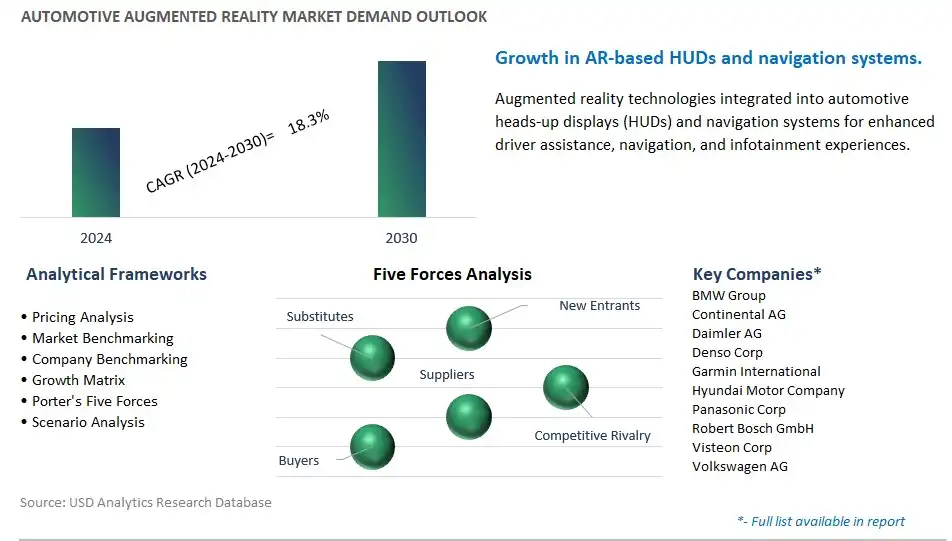
Automotive Augmented Reality Market is estimated to increase at a growth rate of 18.3% CAGR over the forecast period from 2024 to 2030.
The global Automotive Augmented Reality Market study analyzes and forecasts the market size across 6 regions and 24 countries for diverse segments including By Application (Passenger Car, Commercial Vehicle), By Function (Standard AR HUD, AR HUD based Navigation, AR HUD based Adaptive Cruise Control, AR HUD based Lane Departure Warning), By Sensor Technology (Radar, LiDar, CCD/CMOS Image Sensor, Sensor Fusion).
An Introduction to Global Automotive Augmented Reality Market, 2024
The Automotive Augmented Reality market represents a cutting-edge fusion of technology and automotive applications, offering immersive and interactive experiences to enhance vehicle design, manufacturing, maintenance, and customer engagement. Augmented reality (AR) overlays digital information, such as 3D models, graphics, and instructions, onto the real-world environment, providing users with real-time insights and visualizations. In the automotive industry, AR technology finds applications in design prototyping, assembly line optimization, remote assistance, and interactive user manuals. With the automotive industry's focus on digitalization, automation, and connected services, the demand for AR solutions continues to grow. Manufacturers and service providers in this market focus on developing AR platforms and applications tailored to automotive use cases, offering features such as virtual car configurators, AR-based maintenance guides, and augmented reality showrooms to enhance customer experiences and streamline operations. Moreover, advancements in AR hardware, software, and connectivity drive innovation, enabling seamless integration with existing automotive systems and workflows. Additionally, as vehicle ownership models evolve and consumer expectations for digital experiences increase, the automotive AR market is poised for sustained growth and innovation, with opportunities for product development, customization, and market expansion across vehicle segments and regions.
Automotive Augmented Reality Competitive Landscape
The global Automotive Augmented Reality market is highly competitive with a large number of companies focusing on niche market segments. Amidst intense competitive conditions, Automotive Augmented Reality Companies are investing in new product launches and strengthening distribution channels. Key companies operating in the Automotive Augmented Reality Market Industry include- BMW Group, Continental AG, Daimler AG, Denso Corp, Garmin International, Hyundai Motor Company, Panasonic Corp, Robert Bosch GmbH, Visteon Corp, Volkswagen AG.
Automotive Augmented Reality Market Trend: Integration of Augmented Reality (AR) in Automotive Navigation and Infotainment Systems
The most prominent trend in the Automotive Augmented Reality Market is the integration of AR technology into automotive navigation and infotainment systems. As vehicles become increasingly connected and technologically advanced, automakers are incorporating AR features to enhance the driving experience and provide real-time information to drivers. AR navigation systems overlay digital information, such as directions, points of interest, and traffic data, onto the driver's field of view, allowing for more intuitive and immersive navigation experiences. Additionally, AR-infused infotainment systems offer interactive features, such as virtual dashboard displays, gesture controls, and augmented reality head-up displays (AR-HUDs), providing drivers with enhanced situational awareness and entertainment options while on the road. This trend reflects the industry's efforts to leverage AR technology to revolutionize automotive interfaces and improve driver safety and convenience.
Automotive Augmented Reality Market Driver: Demand for Enhanced Driver Assistance and Safety Systems
A major driver propelling the growth of the Automotive Augmented Reality Market is the demand for enhanced driver assistance and safety systems. With an increasing emphasis on road safety and accident prevention, there is a growing need for advanced technologies that can assist drivers in navigating complex traffic scenarios and avoiding collisions. AR-based driver assistance systems utilize real-time sensor data and computer vision algorithms to provide drivers with visual cues and alerts about potential hazards, road signs, and navigation instructions directly within their field of view. These systems enhance driver awareness and decision-making capabilities, reducing the risk of accidents and improving overall road safety. The demand for enhanced driver assistance and safety systems drives the adoption of AR technology in the automotive industry, fueling market growth and innovation in the Automotive Augmented Reality Market.
Automotive Augmented Reality Market Opportunity: Integration of AR in Vehicle Maintenance and Service
An opportunity for significant expansion in the Automotive Augmented Reality Market lies in the integration of AR technology in vehicle maintenance and service operations. Automakers and service providers can leverage AR-based maintenance applications to streamline repair and maintenance tasks, improve technician efficiency, and reduce downtime for vehicle servicing. AR-enabled service manuals and diagnostic tools overlay digital instructions, diagrams, and animations onto physical vehicle components, guiding technicians through repair procedures and troubleshooting steps with precision and accuracy. Additionally, AR-powered remote assistance platforms enable technicians to collaborate with experts in real-time, regardless of their physical location, enhancing problem-solving capabilities and reducing the need for onsite support. By integrating AR technology into vehicle maintenance and service operations, automakers and service providers can enhance service quality, reduce costs, and improve customer satisfaction, thereby unlocking new revenue opportunities and strengthening their position in the Automotive Augmented Reality Market.
Automotive Augmented Reality Market Segmentation
By Application
Passenger Car
Commercial Vehicle
By Function
Standard AR HUD
AR HUD based Navigation
AR HUD based Adaptive Cruise Control
AR HUD based Lane Departure Warning
By Sensor Technology
Radar
LiDar
CCD/CMOS Image Sensor
Sensor Fusion
Geographical Analysis
North America (United States, Canada, Mexico)
Europe (Germany, France, United Kingdom, Spain, Italy, Rest of Europe)
Asia Pacific (China, India, Japan, South Korea, Rest of Asia Pacific)
South America (Brazil, Argentina, Rest of South America)
Middle East and Africa (Saudi Arabia, UAE, Rest of Middle East, South Africa, Egypt, Rest of Africa
Automotive Augmented Reality Companies
BMW Group
Continental AG
Daimler AG
Denso Corp
Garmin International
Hyundai Motor Company
Panasonic Corp
Robert Bosch GmbH
Visteon Corp
Volkswagen AG
*- List not Exhaustive
TABLE OF CONTENTS
1 Introduction to 2024 Automotive Augmented Reality Market
1.1 Market Overview
1.2 Quick Facts
1.3 Scope/Objective of the Study
1.4 Market Definition
1.5 Countries and Regions Analyzed
1.6 Units, Currency, and Conversions
1.7 Industry Value Chain
2 Research Methodology
2.1 Market Size Estimation
2.2 Sources and Research Methodology
2.3 Data Triangulation
2.4 Assumptions and Limitations
3 Executive Summary
3.1 Global Automotive Augmented Reality Market Size Outlook, $ Million, 2021 to 2030
3.2 Automotive Augmented Reality Market Outlook by Type, $ Million, 2021 to 2030
3.3 Automotive Augmented Reality Market Outlook by Product, $ Million, 2021 to 2030
3.4 Automotive Augmented Reality Market Outlook by Application, $ Million, 2021 to 2030
3.5 Automotive Augmented Reality Market Outlook by Key Countries, $ Million, 2021 to 2030
4 Market Dynamics
4.1 Key Driving Forces of Automotive Augmented Reality Industry
4.2 Key Market Trends in Automotive Augmented Reality Industry
4.3 Potential Opportunities in Automotive Augmented Reality Industry
4.4 Key Challenges in Automotive Augmented Reality Industry
5 Market Factor Analysis
5.1 Value Chain Analysis
5.2 Competitive Landscape
5.2.1 Global Automotive Augmented Reality Market Share by Company (%), 2023
5.2.2 Product Offerings by Company
5.3 Porter’s Five Forces Analysis
5.4 Pricing Analysis and Outlook
6 Growth Outlook Across Scenarios
6.1 Growth Analysis-Case Scenario Definitions
6.2 Low Growth Scenario Forecasts
6.3 Reference Growth Scenario Forecasts
6.4 High Growth Scenario Forecasts
7 Global Automotive Augmented Reality Market Outlook by Segments
7.1 Automotive Augmented Reality Market Outlook by Segments, $ Million, 2021- 2030
By Application
Passenger Car
Commercial Vehicle
By Function
Standard AR HUD
AR HUD based Navigation
AR HUD based Adaptive Cruise Control
AR HUD based Lane Departure Warning
By Sensor Technology
Radar
LiDar
CCD/CMOS Image Sensor
Sensor Fusion
8 North America Automotive Augmented Reality Market Analysis and Outlook To 2030
8.1 Introduction to North America Automotive Augmented Reality Markets in 2024
8.2 North America Automotive Augmented Reality Market Size Outlook by Country, 2021-2030
8.2.1 United States
8.2.2 Canada
8.2.3 Mexico
8.3 North America Automotive Augmented Reality Market size Outlook by Segments, 2021-2030
By Application
Passenger Car
Commercial Vehicle
By Function
Standard AR HUD
AR HUD based Navigation
AR HUD based Adaptive Cruise Control
AR HUD based Lane Departure Warning
By Sensor Technology
Radar
LiDar
CCD/CMOS Image Sensor
Sensor Fusion
9 Europe Automotive Augmented Reality Market Analysis and Outlook To 2030
9.1 Introduction to Europe Automotive Augmented Reality Markets in 2024
9.2 Europe Automotive Augmented Reality Market Size Outlook by Country, 2021-2030
9.2.1 Germany
9.2.2 France
9.2.3 Spain
9.2.4 United Kingdom
9.2.4 Italy
9.2.5 Russia
9.2.6 Norway
9.2.7 Rest of Europe
9.3 Europe Automotive Augmented Reality Market Size Outlook by Segments, 2021-2030
By Application
Passenger Car
Commercial Vehicle
By Function
Standard AR HUD
AR HUD based Navigation
AR HUD based Adaptive Cruise Control
AR HUD based Lane Departure Warning
By Sensor Technology
Radar
LiDar
CCD/CMOS Image Sensor
Sensor Fusion
10 Asia Pacific Automotive Augmented Reality Market Analysis and Outlook To 2030
10.1 Introduction to Asia Pacific Automotive Augmented Reality Markets in 2024
10.2 Asia Pacific Automotive Augmented Reality Market Size Outlook by Country, 2021-2030
10.2.1 China
10.2.2 India
10.2.3 Japan
10.2.4 South Korea
10.2.5 Indonesia
10.2.6 Malaysia
10.2.7 Australia
10.2.8 Rest of Asia Pacific
10.3 Asia Pacific Automotive Augmented Reality Market size Outlook by Segments, 2021-2030
By Application
Passenger Car
Commercial Vehicle
By Function
Standard AR HUD
AR HUD based Navigation
AR HUD based Adaptive Cruise Control
AR HUD based Lane Departure Warning
By Sensor Technology
Radar
LiDar
CCD/CMOS Image Sensor
Sensor Fusion
11 South America Automotive Augmented Reality Market Analysis and Outlook To 2030
11.1 Introduction to South America Automotive Augmented Reality Markets in 2024
11.2 South America Automotive Augmented Reality Market Size Outlook by Country, 2021-2030
11.2.1 Brazil
11.2.2 Argentina
11.2.3 Rest of South America
11.3 South America Automotive Augmented Reality Market size Outlook by Segments, 2021-2030
By Application
Passenger Car
Commercial Vehicle
By Function
Standard AR HUD
AR HUD based Navigation
AR HUD based Adaptive Cruise Control
AR HUD based Lane Departure Warning
By Sensor Technology
Radar
LiDar
CCD/CMOS Image Sensor
Sensor Fusion
12 Middle East and Africa Automotive Augmented Reality Market Analysis and Outlook To 2030
12.1 Introduction to Middle East and Africa Automotive Augmented Reality Markets in 2024
12.2 Middle East and Africa Automotive Augmented Reality Market Size Outlook by Country, 2021-2030
12.2.1 Saudi Arabia
12.2.2 UAE
12.2.3 Oman
12.2.4 Rest of Middle East
12.2.5 Egypt
12.2.6 Nigeria
12.2.7 South Africa
12.2.8 Rest of Africa
12.3 Middle East and Africa Automotive Augmented Reality Market size Outlook by Segments, 2021-2030
By Application
Passenger Car
Commercial Vehicle
By Function
Standard AR HUD
AR HUD based Navigation
AR HUD based Adaptive Cruise Control
AR HUD based Lane Departure Warning
By Sensor Technology
Radar
LiDar
CCD/CMOS Image Sensor
Sensor Fusion
13 Company Profiles
13.1 Company Snapshot
13.2 SWOT Profiles
13.3 Products and Services
13.4 Recent Developments
13.5 Financial Profile
List of Companies
BMW Group
Continental AG
Daimler AG
Denso Corp
Garmin International
Hyundai Motor Company
Panasonic Corp
Robert Bosch GmbH
Visteon Corp
Volkswagen AG
14 Appendix
14.1 Customization Offerings
14.2 Subscription Services
14.3 Related Reports
14.4 Publisher Expertise
By Application
Passenger Car
Commercial Vehicle
By Function
Standard AR HUD
AR HUD based Navigation
AR HUD based Adaptive Cruise Control
AR HUD based Lane Departure Warning
By Sensor Technology
Radar
LiDar
CCD/CMOS Image Sensor
Sensor Fusion
