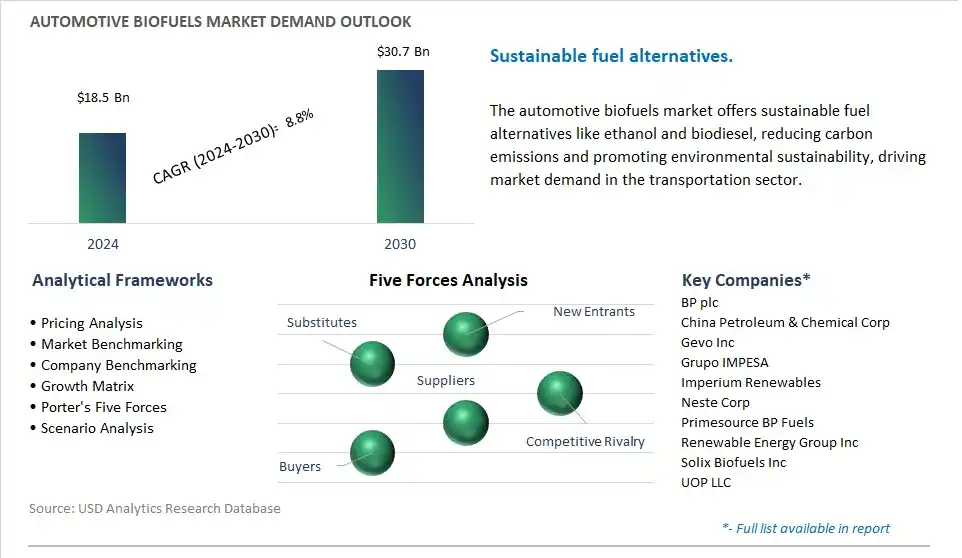
The global Automotive Biofuels Market is poised to register a 8.8% CAGR from $18.5 Billion in 2024 to $30.7 Billion in 2030.
The global Automotive Biofuels Market Study analyzes and forecasts the market size across 6 regions and 24 countries for diverse segments -By Process (Biochemical, Thermochemical), By Fuel (Biodiesel, Bio Butanol, Bio DME, Cellulosic Ethanol, Biohydrogen, Algal, Others), By Feedstock (Simple Lignocellulose, Complex Lignocellulose, Algae, Others), By Application (Electricity, Heating, Cooling, Cooking, Others), By End-User (Chemical & Petrochemical, Oil & Gas, Energy & Power, Automotive, Food & Beverages, Others).
An Introduction to Global Automotive Biofuels Market in 2024
The market for automotive biofuels is experiencing significant growth as the automotive industry seeks sustainable alternatives to traditional fossil fuels. Key trends shaping the future of this industry include the development of advanced biofuel technologies such as cellulosic ethanol, biodiesel, and renewable diesel, which utilize feedstocks like agricultural residues, algae, and waste oils to reduce greenhouse gas emissions and reliance on finite fossil fuel resources. Additionally, advancements in biofuel blending, engine compatibility, and infrastructure expansion facilitate the adoption of biofuels in conventional and hybrid vehicles, providing consumers with cleaner and renewable fuel options. Moreover, the implementation of government mandates, carbon pricing mechanisms, and incentives further drives investment in biofuel production and distribution infrastructure, fostering market growth and innovation in the automotive biofuels sector. As the automotive industry transitions towards low-carbon and sustainable mobility solutions, the demand for biofuels is expected to continue growing, driving further innovation and market expansion in this sector.
Automotive Biofuels Market Competitive Landscape
The market report analyses the leading companies in the industry including BP plc, China Petroleum & Chemical Corp, Gevo Inc, Grupo IMPESA, Imperium Renewables, Neste Corp, Primesource BP Fuels, Renewable Energy Group Inc, Solix Biofuels Inc, UOP LLC.
Automotive Biofuels Market Dynamics
Automotive Biofuels Market Trend: Shift Towards Sustainable and Renewable Energy Sources
A prominent trend in the automotive biofuels market is the increasing shift towards sustainable and renewable energy sources to reduce greenhouse gas emissions and mitigate environmental impact. With growing concerns about climate change and air pollution, there is a rising demand for alternative fuels that offer lower carbon intensity and better environmental performance compared to conventional fossil fuels. Automotive biofuels, such as ethanol and biodiesel derived from renewable feedstocks like corn, sugarcane, soybeans, and waste oils, are gaining traction as viable alternatives to gasoline and diesel for powering vehicles. This is driven by regulatory mandates, government incentives, and consumer preferences for cleaner and greener transportation fuels, leading to investments in biofuel production infrastructure and the expansion of biofuel blending mandates worldwide.
Automotive Biofuels Market Driver: Government Policies and Renewable Energy Targets
A key driver propelling the automotive biofuels market is the implementation of government policies, regulations, and renewable energy targets aimed at reducing dependence on fossil fuels and promoting the use of renewable energy sources in the transportation sector. Many countries have established biofuel blending mandates, tax incentives, and renewable fuel standards to encourage the production, distribution, and use of biofuels in gasoline and diesel blends. These policies create a favorable regulatory environment for biofuel producers and stimulate investments in biofuel production facilities, research and development, and infrastructure development. Additionally, renewable energy targets set by governments and international organizations drive the adoption of biofuels as part of broader strategies to achieve carbon neutrality and transition to a low-carbon economy, driving demand for automotive biofuels and creating opportunities for market growth and expansion.
Automotive Biofuels Market Opportunity: Expansion of Advanced Biofuel Technologies
An opportunity for the automotive biofuels market lies in the expansion of advanced biofuel technologies that offer improved efficiency, performance, and sustainability compared to first-generation biofuels. Advanced biofuels, such as cellulosic ethanol, renewable diesel, and drop-in biofuels produced from non-food biomass sources, agricultural residues, algae, and waste feedstocks, hold promise for delivering higher energy yields, lower emissions, and reduced environmental impact compared to traditional biofuels. Investments in research and development, process optimization, and commercial-scale production of advanced biofuels present opportunities for biofuel producers, technology developers, and investors to diversify their product portfolios, enhance competitiveness, and meet evolving regulatory requirements and market demands. By focusing on innovation and technology advancement, the automotive biofuels industry can unlock new opportunities for sustainable transportation fuels and contribute to the transition towards a more sustainable and resilient energy future.
Automotive Biofuels Market Ecosystem
The automotive biofuels market involves diverse key stages, with feedstock production, where energy crops are cultivated or organic waste materials collected for biofuel production, handled by specialized farms and waste collection companies. Pre-processing steps entail processes including crushing or esterification, managed by independent facilities or integrated within biofuel producers.
Biofuel production, predominantly biodiesel and ethanol, is characterized by the presence of dedicated producers including Neste, Bunge Limited, and Raízen, as well as oil refineries with biofuel capabilities. Blending biofuels with conventional fuels, distribution, and storage are essential stages, facilitated by logistics firms, biofuel producers, and terminal operators, ensuring availability at gas stations and fueling stations, managed by chains or independent retailers.
End users, including individual vehicle owners and fleet operators, utilize biofuels, potentially reducing greenhouse gas emissions and supporting renewable energy, contributing to the sustainable evolution of the automotive industry.
Automotive Biofuels Market Share Analysis: Biochemical Process held the dominant revenue share in 2024
The biochemical process is the largest segment in the automotive biofuel market due to its widespread adoption and established infrastructure for biofuel production. Biochemical processes involve the conversion of biomass, such as agricultural crops, waste materials, and algae, into biofuels through biological fermentation or enzymatic reactions. This process utilizes feedstocks rich in carbohydrates, such as sugar, starch, or cellulose, which are broken down into simple sugars and then fermented into biofuels, such as ethanol and biodiesel. The biochemical process benefits from existing technologies and well-established supply chains for feedstock sourcing, fermentation, and refining, making it a cost-effective and scalable solution for biofuel production. Additionally, the biochemical process offers environmental benefits, including reduced greenhouse gas emissions and dependence on fossil fuels, contributing to sustainability goals and regulatory compliance in the automotive sector. As governments and industries worldwide prioritize renewable energy sources and decarbonization strategies, the biochemical process remains at the forefront of automotive biofuel production, driving its dominance in the market.
Automotive Biofuels Market Share Analysis: Cellulosic Ethanol is the fastest growing market segment over the forecast period to 2030
Cellulosic ethanol is the fastest-growing segment in the automotive biofuels market due to its significant potential for sustainable fuel production from non-food biomass sources. Unlike traditional ethanol produced from starch or sugar crops, cellulosic ethanol is derived from lignocellulosic materials such as agricultural residues, forest residues, energy crops, and municipal solid waste. The conversion process involves breaking down the complex cellulose and hemicellulose structures present in these feedstocks into fermentable sugars using enzymatic or thermochemical methods, followed by fermentation into ethanol. Cellulosic ethanol offers diverse advantages, including reduced competition with food crops, lower greenhouse gas emissions, and the potential for utilizing abundant and low-cost feedstocks. In addition, advancements in technology and process optimization have improved the efficiency and cost-effectiveness of cellulosic ethanol production, making it increasingly competitive with traditional biofuels. As governments implement policies to promote renewable fuels and reduce carbon emissions in the transportation sector, the demand for cellulosic ethanol is expected to surge, driving its rapid growth in the automotive biofuels market. Additionally, partnerships between biofuel producers, technology developers, and automotive manufacturers further accelerate the commercialization and adoption of cellulosic ethanol as a viable alternative fuel, consolidating its position as a key driver of growth in the market.
Automotive Biofuels Market Share Analysis: Algae is the fastest growing market segment over the forecast period to 2030
Algae is the fastest-growing segment in the automotive biofuels market due to its unparalleled potential for sustainable and high-yield biofuel production. Algae-based biofuels offer diverse advantages over traditional feedstocks, including rapid growth rates, high lipid content, and the ability to thrive in diverse environments, including non-arable land and wastewater. Algae can be cultivated using a variety of cultivation methods, including open ponds, photobioreactors, and closed-loop systems, providing flexibility and scalability in production. Additionally, algae biofuels have the potential to significantly reduce greenhouse gas emissions compared to conventional fossil fuels and other biofuels, making them an attractive option for addressing climate change concerns. Further, ongoing research and development efforts in algae biotechnology and cultivation techniques continue to improve the efficiency and economics of algae-based biofuel production, driving its rapid growth in the automotive biofuels market. As governments, industries, and consumers increasingly prioritize renewable energy sources and environmental sustainability, the demand for algae biofuels is expected to surge, propelling the segment to the forefront of the automotive biofuels market.
Automotive Biofuels Market Report Scope-
By Process
Biochemical
Thermochemical
By Fuel
Biodiesel
Bio Butanol
Bio DME
Cellulosic Ethanol
Biohydrogen
Algal
Others
By Feedstock
Simple Lignocellulose
Complex Lignocellulose
Algae
Others
By Application
Electricity
Heating
Cooling
Cooking
Others
By End-User
Chemical & Petrochemical
Oil & Gas
Energy & Power
Automotive
Food & Beverages
Others
Automotive Biofuels Market Companies Profiled
BP plc
China Petroleum & Chemical Corp
Gevo Inc
Grupo IMPESA
Imperium Renewables
Neste Corp
Primesource BP Fuels
Renewable Energy Group Inc
Solix Biofuels Inc
UOP LLC
*- List Not Exhaustive
TABLE OF CONTENTS
1 Introduction to 2024 Automotive Biofuels Market
1.1 Market Overview
1.2 Quick Facts
1.3 Scope/Objective of the Study
1.4 Market Definition
1.5 Countries and Regions Covered
1.6 Units, Currency, and Conversions
1.7 Industry Value Chain
2 Research Methodology
2.1 Market Size Estimation
2.2 Sources and Research Methodology
2.3 Data Triangulation
2.4 Assumptions and Limitations
3 Executive Summary
3.1 Global Automotive Biofuels Market Size Outlook, $ Million, 2021 to 2030
3.2 Automotive Biofuels Market Outlook by Type, $ Million, 2021 to 2030
3.3 Automotive Biofuels Market Outlook by Product, $ Million, 2021 to 2030
3.4 Automotive Biofuels Market Outlook by Application, $ Million, 2021 to 2030
3.5 Automotive Biofuels Market Outlook by Key Countries, $ Million, 2021 to 2030
4 Market Dynamics
4.1 Key Driving Forces of Automotive Biofuels Industry
4.2 Key Market Trends in Automotive Biofuels Industry
4.3 Potential Opportunities in Automotive Biofuels Industry
4.4 Key Challenges in Automotive Biofuels Industry
5 Market Factor Analysis
5.1 Value Chain Analysis
5.2 Competitive Landscape
5.2.1 Global Automotive Biofuels Market Share by Company (%), 2023
5.2.2 Product Offerings by Company
5.3 Porter’s Five Forces Analysis
5.4 Pricing Analysis and Outlook
6 Growth Outlook Across Scenarios
6.1 Growth Analysis-Case Scenario Definitions
6.2 Low Growth Scenario Forecasts
6.3 Reference Growth Scenario Forecasts
6.4 High Growth Scenario Forecasts
7 Global Automotive Biofuels Market Outlook by Segments
7.1 Automotive Biofuels Market Outlook by Segments, $ Million, 2021- 2030
By Process
Biochemical
Thermochemical
By Fuel
Biodiesel
Bio Butanol
Bio DME
Cellulosic Ethanol
Biohydrogen
Algal
Others
By Feedstock
Simple Lignocellulose
Complex Lignocellulose
Algae
Others
By Application
Electricity
Heating
Cooling
Cooking
Others
By End-User
Chemical & Petrochemical
Oil & Gas
Energy & Power
Automotive
Food & Beverages
Others
8 North America Automotive Biofuels Market Analysis and Outlook To 2030
8.1 Introduction to North America Automotive Biofuels Markets in 2024
8.2 North America Automotive Biofuels Market Size Outlook by Country, 2021-2030
8.2.1 United States
8.2.2 Canada
8.2.3 Mexico
8.3 North America Automotive Biofuels Market size Outlook by Segments, 2021-2030
By Process
Biochemical
Thermochemical
By Fuel
Biodiesel
Bio Butanol
Bio DME
Cellulosic Ethanol
Biohydrogen
Algal
Others
By Feedstock
Simple Lignocellulose
Complex Lignocellulose
Algae
Others
By Application
Electricity
Heating
Cooling
Cooking
Others
By End-User
Chemical & Petrochemical
Oil & Gas
Energy & Power
Automotive
Food & Beverages
Others
9 Europe Automotive Biofuels Market Analysis and Outlook To 2030
9.1 Introduction to Europe Automotive Biofuels Markets in 2024
9.2 Europe Automotive Biofuels Market Size Outlook by Country, 2021-2030
9.2.1 Germany
9.2.2 France
9.2.3 Spain
9.2.4 United Kingdom
9.2.4 Italy
9.2.5 Russia
9.2.6 Norway
9.2.7 Rest of Europe
9.3 Europe Automotive Biofuels Market Size Outlook by Segments, 2021-2030
By Process
Biochemical
Thermochemical
By Fuel
Biodiesel
Bio Butanol
Bio DME
Cellulosic Ethanol
Biohydrogen
Algal
Others
By Feedstock
Simple Lignocellulose
Complex Lignocellulose
Algae
Others
By Application
Electricity
Heating
Cooling
Cooking
Others
By End-User
Chemical & Petrochemical
Oil & Gas
Energy & Power
Automotive
Food & Beverages
Others
10 Asia Pacific Automotive Biofuels Market Analysis and Outlook To 2030
10.1 Introduction to Asia Pacific Automotive Biofuels Markets in 2024
10.2 Asia Pacific Automotive Biofuels Market Size Outlook by Country, 2021-2030
10.2.1 China
10.2.2 India
10.2.3 Japan
10.2.4 South Korea
10.2.5 Indonesia
10.2.6 Malaysia
10.2.7 Australia
10.2.8 Rest of Asia Pacific
10.3 Asia Pacific Automotive Biofuels Market size Outlook by Segments, 2021-2030
By Process
Biochemical
Thermochemical
By Fuel
Biodiesel
Bio Butanol
Bio DME
Cellulosic Ethanol
Biohydrogen
Algal
Others
By Feedstock
Simple Lignocellulose
Complex Lignocellulose
Algae
Others
By Application
Electricity
Heating
Cooling
Cooking
Others
By End-User
Chemical & Petrochemical
Oil & Gas
Energy & Power
Automotive
Food & Beverages
Others
11 South America Automotive Biofuels Market Analysis and Outlook To 2030
11.1 Introduction to South America Automotive Biofuels Markets in 2024
11.2 South America Automotive Biofuels Market Size Outlook by Country, 2021-2030
11.2.1 Brazil
11.2.2 Argentina
11.2.3 Rest of South America
11.3 South America Automotive Biofuels Market size Outlook by Segments, 2021-2030
By Process
Biochemical
Thermochemical
By Fuel
Biodiesel
Bio Butanol
Bio DME
Cellulosic Ethanol
Biohydrogen
Algal
Others
By Feedstock
Simple Lignocellulose
Complex Lignocellulose
Algae
Others
By Application
Electricity
Heating
Cooling
Cooking
Others
By End-User
Chemical & Petrochemical
Oil & Gas
Energy & Power
Automotive
Food & Beverages
Others
12 Middle East and Africa Automotive Biofuels Market Analysis and Outlook To 2030
12.1 Introduction to Middle East and Africa Automotive Biofuels Markets in 2024
12.2 Middle East and Africa Automotive Biofuels Market Size Outlook by Country, 2021-2030
12.2.1 Saudi Arabia
12.2.2 UAE
12.2.3 Oman
12.2.4 Rest of Middle East
12.2.5 Egypt
12.2.6 Nigeria
12.2.7 South Africa
12.2.8 Rest of Africa
12.3 Middle East and Africa Automotive Biofuels Market size Outlook by Segments, 2021-2030
By Process
Biochemical
Thermochemical
By Fuel
Biodiesel
Bio Butanol
Bio DME
Cellulosic Ethanol
Biohydrogen
Algal
Others
By Feedstock
Simple Lignocellulose
Complex Lignocellulose
Algae
Others
By Application
Electricity
Heating
Cooling
Cooking
Others
By End-User
Chemical & Petrochemical
Oil & Gas
Energy & Power
Automotive
Food & Beverages
Others
13 Company Profiles
13.1 Company Snapshot
13.2 SWOT Profiles
13.3 Products and Services
13.4 Recent Developments
13.5 Financial Profile
BP plc
China Petroleum & Chemical Corp
Gevo Inc
Grupo IMPESA
Imperium Renewables
Neste Corp
Primesource BP Fuels
Renewable Energy Group Inc
Solix Biofuels Inc
UOP LLC
14 Appendix
14.1 Customization Offerings
14.2 Subscription Services
14.3 Related Reports
14.4 Publisher Expertise
By Process
Biochemical
Thermochemical
By Fuel
Biodiesel
Bio Butanol
Bio DME
Cellulosic Ethanol
Biohydrogen
Algal
Others
By Feedstock
Simple Lignocellulose
Complex Lignocellulose
Algae
Others
By Application
Electricity
Heating
Cooling
Cooking
Others
By End-User
Chemical & Petrochemical
Oil & Gas
Energy & Power
Automotive
Food & Beverages
Others
Countries Analyzed
North America (US, Canada, Mexico)
Europe (Germany, UK, France, Spain, Italy, Russia, Rest of Europe)
Asia Pacific (China, India, Japan, South Korea, Australia, South East Asia, Rest of Asia)
South America (Brazil, Argentina, Rest of South America)
Middle East and Africa (Saudi Arabia, UAE, Rest of Middle East, South Africa, Egypt, Rest of Africa)
