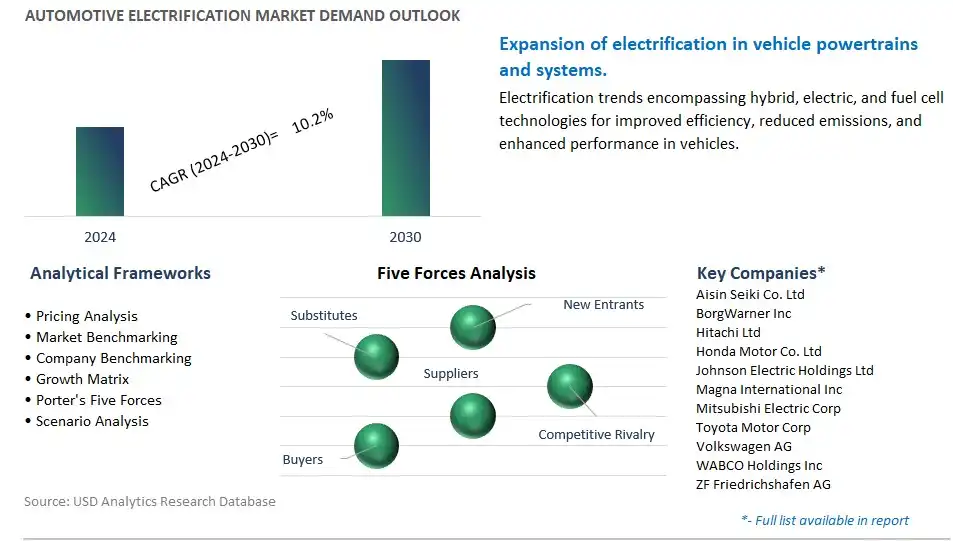
Automotive Electrification Market is estimated to increase at a growth rate of 10.2% CAGR over the forecast period from 2024 to 2030.
The global Automotive Electrification Market study analyzes and forecasts the market size across 6 regions and 24 countries for diverse segments including By Type (Internal Combustion Engine (ICE), Hybrid Electric Vehicle (HEV), Plug-In Hybrid Electric Vehicle (PHEV), Battery Electric Vehicle (BEV)), By Application (Passenger Vehicles, Light Commercial Vehicles, Heavy Commercial Vehicles).
An Introduction to Global Automotive Electrification Market, 2024
The Automotive Electrification market represents a paradigm shift in vehicle propulsion technology, driven by the increasing adoption of electric and hybrid powertrains to reduce emissions and dependence on fossil fuels. Electrification encompasses a wide range of technologies, including battery electric vehicles (BEVs), hybrid electric vehicles (HEVs), and plug-in hybrid electric vehicles (PHEVs), each offering different levels of electrification and environmental benefits. With the automotive industry's focus on sustainability, regulatory compliance, and consumer demand for cleaner transportation options, the demand for electrified vehicles continues to grow. Manufacturers in this market focus on developing electric drivetrains, battery systems, and charging infrastructure to support the widespread adoption of electrified vehicles. Moreover, advancements in electrification technology, including high-energy-density batteries, fast-charging solutions, and energy-efficient motors, drive innovation, enabling improved range, performance, and affordability of electric vehicles. Additionally, as vehicle designs evolve to incorporate more autonomous features and connected services, the Automotive Electrification market presents opportunities for further innovation and integration to meet the evolving needs of vehicle manufacturers and consumers, ensuring sustainable and efficient mobility solutions for the future.
Automotive Electrification Competitive Landscape
The global Automotive Electrification market is highly competitive with a large number of companies focusing on niche market segments. Amidst intense competitive conditions, Automotive Electrification Companies are investing in new product launches and strengthening distribution channels. Key companies operating in the Automotive Electrification Market Industry include- Aisin Seiki Co. Ltd, BorgWarner Inc, Hitachi Ltd, Honda Motor Co. Ltd, Johnson Electric Holdings Ltd, Magna International Inc, Mitsubishi Electric Corp, Toyota Motor Corp, Volkswagen AG, WABCO Holdings Inc, ZF Friedrichshafen AG.
Automotive Electrification Market Trend: Accelerated Adoption of Electric Powertrains
A prominent trend in the automotive electrification market is the accelerated adoption of electric powertrains. With increasing concerns about environmental sustainability and the need to reduce greenhouse gas emissions, there's a global shift towards electrification in the automotive industry. This trend encompasses various electrification technologies, including battery electric vehicles (BEVs), hybrid electric vehicles (HEVs), and plug-in hybrid electric vehicles (PHEVs). As automakers introduce an expanding lineup of electrified vehicles to meet regulatory requirements and consumer preferences, the demand for electric drivetrain components and infrastructure continues to grow rapidly.
Automotive Electrification Market Driver: Stringent Emission Regulations and Fuel Efficiency Standards
A significant driver shaping the automotive electrification market is the imposition of stringent emission regulations and fuel efficiency standards worldwide. Governments and regulatory bodies are implementing increasingly strict emissions standards and fuel economy targets to mitigate environmental impact and reduce reliance on fossil fuels. Electrification technologies offer a pathway to meet these regulations by providing cleaner, more fuel-efficient alternatives to traditional internal combustion engine vehicles. As automakers race to comply with regulatory requirements and develop electrified vehicle offerings, the demand for electrification solutions is driven by the need to reduce emissions and improve fuel efficiency across the automotive industry.
Automotive Electrification Market Opportunity: Expansion of Charging Infrastructure
An emerging opportunity in the automotive electrification market lies in the expansion of charging infrastructure. As the adoption of electric vehicles (EVs) continues to increase, there's a growing need for reliable and accessible charging infrastructure to support EV ownership and usage. This includes public charging stations, workplace charging facilities, residential charging solutions, and fast charging networks along highways. The expansion of charging infrastructure presents opportunities for investment and collaboration among governments, utilities, charging network operators, and automotive manufacturers to accelerate the transition to electrified transportation. By addressing the challenges associated with charging infrastructure deployment, stakeholders can facilitate the widespread adoption of electric vehicles and drive growth in the automotive electrification market.
Automotive Electrification Market Segmentation
By Type
Internal Combustion Engine (ICE)
Hybrid Electric Vehicle (HEV)
Plug-In Hybrid Electric Vehicle (PHEV)
Battery Electric Vehicle (BEV)
By Application
Passenger Vehicles
Light Commercial Vehicles
Heavy Commercial VehiclesGeographical Analysis
North America (United States, Canada, Mexico)
Europe (Germany, France, United Kingdom, Spain, Italy, Rest of Europe)
Asia Pacific (China, India, Japan, South Korea, Rest of Asia Pacific)
South America (Brazil, Argentina, Rest of South America)
Middle East and Africa (Saudi Arabia, UAE, Rest of Middle East, South Africa, Egypt, Rest of Africa
Automotive Electrification Companies
Aisin Seiki Co. Ltd
BorgWarner Inc
Hitachi Ltd
Honda Motor Co. Ltd
Johnson Electric Holdings Ltd
Magna International Inc
Mitsubishi Electric Corp
Toyota Motor Corp
Volkswagen AG
WABCO Holdings Inc
ZF Friedrichshafen AG
*- List not Exhaustive
TABLE OF CONTENTS
1 Introduction to 2024 Automotive Electrification Market
1.1 Market Overview
1.2 Quick Facts
1.3 Scope/Objective of the Study
1.4 Market Definition
1.5 Countries and Regions Analyzed
1.6 Units, Currency, and Conversions
1.7 Industry Value Chain
2 Research Methodology
2.1 Market Size Estimation
2.2 Sources and Research Methodology
2.3 Data Triangulation
2.4 Assumptions and Limitations
3 Executive Summary
3.1 Global Automotive Electrification Market Size Outlook, $ Million, 2021 to 2030
3.2 Automotive Electrification Market Outlook by Type, $ Million, 2021 to 2030
3.3 Automotive Electrification Market Outlook by Product, $ Million, 2021 to 2030
3.4 Automotive Electrification Market Outlook by Application, $ Million, 2021 to 2030
3.5 Automotive Electrification Market Outlook by Key Countries, $ Million, 2021 to 2030
4 Market Dynamics
4.1 Key Driving Forces of Automotive Electrification Industry
4.2 Key Market Trends in Automotive Electrification Industry
4.3 Potential Opportunities in Automotive Electrification Industry
4.4 Key Challenges in Automotive Electrification Industry
5 Market Factor Analysis
5.1 Value Chain Analysis
5.2 Competitive Landscape
5.2.1 Global Automotive Electrification Market Share by Company (%), 2023
5.2.2 Product Offerings by Company
5.3 Porter’s Five Forces Analysis
5.4 Pricing Analysis and Outlook
6 Growth Outlook Across Scenarios
6.1 Growth Analysis-Case Scenario Definitions
6.2 Low Growth Scenario Forecasts
6.3 Reference Growth Scenario Forecasts
6.4 High Growth Scenario Forecasts
7 Global Automotive Electrification Market Outlook by Segments
7.1 Automotive Electrification Market Outlook by Segments, $ Million, 2021- 2030
By Type
Internal Combustion Engine (ICE)
Hybrid Electric Vehicle (HEV)
Plug-In Hybrid Electric Vehicle (PHEV)
Battery Electric Vehicle (BEV)
By Application
Passenger Vehicles
Light Commercial Vehicles
Heavy Commercial Vehicles
8 North America Automotive Electrification Market Analysis and Outlook To 2030
8.1 Introduction to North America Automotive Electrification Markets in 2024
8.2 North America Automotive Electrification Market Size Outlook by Country, 2021-2030
8.2.1 United States
8.2.2 Canada
8.2.3 Mexico
8.3 North America Automotive Electrification Market size Outlook by Segments, 2021-2030
By Type
Internal Combustion Engine (ICE)
Hybrid Electric Vehicle (HEV)
Plug-In Hybrid Electric Vehicle (PHEV)
Battery Electric Vehicle (BEV)
By Application
Passenger Vehicles
Light Commercial Vehicles
Heavy Commercial Vehicles
9 Europe Automotive Electrification Market Analysis and Outlook To 2030
9.1 Introduction to Europe Automotive Electrification Markets in 2024
9.2 Europe Automotive Electrification Market Size Outlook by Country, 2021-2030
9.2.1 Germany
9.2.2 France
9.2.3 Spain
9.2.4 United Kingdom
9.2.4 Italy
9.2.5 Russia
9.2.6 Norway
9.2.7 Rest of Europe
9.3 Europe Automotive Electrification Market Size Outlook by Segments, 2021-2030
By Type
Internal Combustion Engine (ICE)
Hybrid Electric Vehicle (HEV)
Plug-In Hybrid Electric Vehicle (PHEV)
Battery Electric Vehicle (BEV)
By Application
Passenger Vehicles
Light Commercial Vehicles
Heavy Commercial Vehicles
10 Asia Pacific Automotive Electrification Market Analysis and Outlook To 2030
10.1 Introduction to Asia Pacific Automotive Electrification Markets in 2024
10.2 Asia Pacific Automotive Electrification Market Size Outlook by Country, 2021-2030
10.2.1 China
10.2.2 India
10.2.3 Japan
10.2.4 South Korea
10.2.5 Indonesia
10.2.6 Malaysia
10.2.7 Australia
10.2.8 Rest of Asia Pacific
10.3 Asia Pacific Automotive Electrification Market size Outlook by Segments, 2021-2030
By Type
Internal Combustion Engine (ICE)
Hybrid Electric Vehicle (HEV)
Plug-In Hybrid Electric Vehicle (PHEV)
Battery Electric Vehicle (BEV)
By Application
Passenger Vehicles
Light Commercial Vehicles
Heavy Commercial Vehicles
11 South America Automotive Electrification Market Analysis and Outlook To 2030
11.1 Introduction to South America Automotive Electrification Markets in 2024
11.2 South America Automotive Electrification Market Size Outlook by Country, 2021-2030
11.2.1 Brazil
11.2.2 Argentina
11.2.3 Rest of South America
11.3 South America Automotive Electrification Market size Outlook by Segments, 2021-2030
By Type
Internal Combustion Engine (ICE)
Hybrid Electric Vehicle (HEV)
Plug-In Hybrid Electric Vehicle (PHEV)
Battery Electric Vehicle (BEV)
By Application
Passenger Vehicles
Light Commercial Vehicles
Heavy Commercial Vehicles
12 Middle East and Africa Automotive Electrification Market Analysis and Outlook To 2030
12.1 Introduction to Middle East and Africa Automotive Electrification Markets in 2024
12.2 Middle East and Africa Automotive Electrification Market Size Outlook by Country, 2021-2030
12.2.1 Saudi Arabia
12.2.2 UAE
12.2.3 Oman
12.2.4 Rest of Middle East
12.2.5 Egypt
12.2.6 Nigeria
12.2.7 South Africa
12.2.8 Rest of Africa
12.3 Middle East and Africa Automotive Electrification Market size Outlook by Segments, 2021-2030
By Type
Internal Combustion Engine (ICE)
Hybrid Electric Vehicle (HEV)
Plug-In Hybrid Electric Vehicle (PHEV)
Battery Electric Vehicle (BEV)
By Application
Passenger Vehicles
Light Commercial Vehicles
Heavy Commercial Vehicles
13 Company Profiles
13.1 Company Snapshot
13.2 SWOT Profiles
13.3 Products and Services
13.4 Recent Developments
13.5 Financial Profile
List of Companies
Aisin Seiki Co. Ltd
BorgWarner Inc
Hitachi Ltd
Honda Motor Co. Ltd
Johnson Electric Holdings Ltd
Magna International Inc
Mitsubishi Electric Corp
Toyota Motor Corp
Volkswagen AG
WABCO Holdings Inc
ZF Friedrichshafen AG
14 Appendix
14.1 Customization Offerings
14.2 Subscription Services
14.3 Related Reports
14.4 Publisher Expertise
By Type
Internal Combustion Engine (ICE)
Hybrid Electric Vehicle (HEV)
Plug-In Hybrid Electric Vehicle (PHEV)
Battery Electric Vehicle (BEV)
By Application
Passenger Vehicles
Light Commercial Vehicles
Heavy Commercial Vehicles
