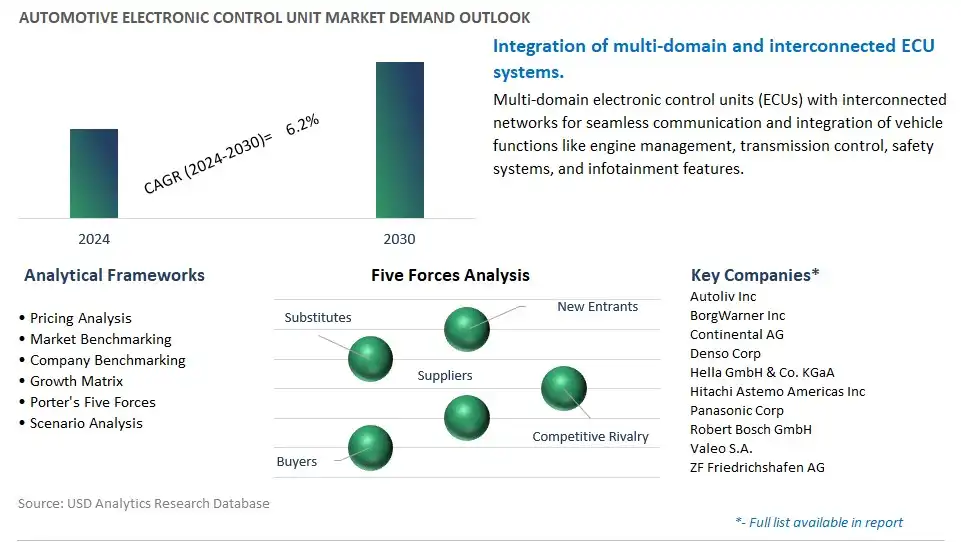
Automotive Electronic Control Unit Market is estimated to increase at a growth rate of 6.2% CAGR over the forecast period from 2024 to 2030.
The global Automotive Electronic Control Unit Market study analyzes and forecasts the market size across 6 regions and 24 countries for diverse segments including By Capacity (16-bit, 32-bit, 64-bit), By Vehicle (Passenger Cars, Commercial Vehicle), By Application (ADAS & Safety System, Body Electronics, Powertrain, Infotainment, Others), By Propulsion (Battery Powered, Hybrid, Internal Combustion Engine).
An Introduction to Global Automotive Electronic Control Unit Market, 2024
The Automotive Electronic Control Unit (ECU) market is a cornerstone of vehicle electronics, serving as the brain of the vehicle's control systems and facilitating communication between various subsystems. ECUs are responsible for monitoring and regulating engine performance, emissions, transmission, braking, and other critical functions, contributing to vehicle efficiency, safety, and performance. With the automotive industry's increasing complexity and reliance on electronics, the demand for advanced and reliable ECUs continues to grow. Manufacturers in this market focus on developing ECUs with powerful microprocessors, sophisticated software algorithms, and robust communication protocols to meet the stringent requirements of modern vehicles. Moreover, advancements in ECU technology, including multicore processors, artificial intelligence, and cybersecurity measures, drive innovation, enabling improved processing power, real-time responsiveness, and protection against cyber threats. Additionally, as vehicle designs evolve to incorporate more electrification, connectivity, and autonomous features, the Automotive ECU market presents opportunities for further innovation and customization to meet the evolving needs of vehicle manufacturers and consumers, ensuring optimal vehicle performance, safety, and functionality.
Automotive Electronic Control Unit Competitive Landscape
The global Automotive Electronic Control Unit market is highly competitive with a large number of companies focusing on niche market segments. Amidst intense competitive conditions, Automotive Electronic Control Unit Companies are investing in new product launches and strengthening distribution channels. Key companies operating in the Automotive Electronic Control Unit Market Industry include- Autoliv Inc, BorgWarner Inc, Continental AG, Denso Corp, Hella GmbH & Co. KGaA, Hitachi Astemo Americas Inc, Panasonic Corp, Robert Bosch GmbH, Valeo S.A., ZF Friedrichshafen AG.
Automotive Electronic Control Unit Market Trend: Increasing Vehicle Electrification and Connectivity
A prominent trend in the automotive electronic control unit (ECU) market is the increasing vehicle electrification and connectivity. Modern vehicles are equipped with a multitude of electronic systems and components, ranging from engine management and transmission control to infotainment and driver assistance systems. As automotive technology advances, there's a growing demand for ECUs that can support the integration of various electronic functions and facilitate seamless communication between vehicle systems. This trend towards increased vehicle electrification and connectivity is driving the demand for advanced ECUs with higher processing power, memory capacity, and networking capabilities to meet the evolving needs of the automotive industry.
Automotive Electronic Control Unit Market Driver: Growing Emphasis on Vehicle Safety and Efficiency
A significant driver shaping the automotive electronic control unit market is the growing emphasis on vehicle safety and efficiency. With rising concerns about road safety, emissions, and fuel consumption, automakers are under pressure to develop vehicles that are safer, more fuel-efficient, and environmentally friendly. ECUs play a crucial role in achieving these objectives by controlling and optimizing various vehicle functions, such as engine performance, emissions control, braking, and stability control. As automakers incorporate advanced safety features, such as advanced driver assistance systems (ADAS) and vehicle-to-everything (V2X) communication, the demand for ECUs capable of supporting these functionalities is expected to increase, driving market growth.
Automotive Electronic Control Unit Market Opportunity: Integration of Artificial Intelligence and Machine Learning
An emerging opportunity in the automotive electronic control unit market lies in the integration of artificial intelligence (AI) and machine learning (ML) technologies. AI and ML algorithms can analyze vast amounts of data generated by vehicle sensors and systems in real time, enabling ECUs to make intelligent decisions and adapt to changing driving conditions more effectively. By integrating AI and ML capabilities into ECUs, automakers can enhance vehicle performance, safety, and efficiency, while also enabling new features such as predictive maintenance and personalized driving experiences. This integration presents an opportunity for ECUs to evolve from mere controllers to intelligent systems that continuously learn and optimize vehicle operations, driving innovation and competitiveness in the automotive industry.
Automotive Electronic Control Unit Market Segmentation
By Capacity
16-Bit
32-Bit
64-Bit
By Vehicle
Passenger Cars
Commercial Vehicle
By Application
ADAS & Safety System
Body Electronics
Powertrain
Infotainment
Others
By Propulsion
Battery Powered
Hybrid
Internal Combustion EngineGeographical Analysis
North America (United States, Canada, Mexico)
Europe (Germany, France, United Kingdom, Spain, Italy, Rest of Europe)
Asia Pacific (China, India, Japan, South Korea, Rest of Asia Pacific)
South America (Brazil, Argentina, Rest of South America)
Middle East and Africa (Saudi Arabia, UAE, Rest of Middle East, South Africa, Egypt, Rest of Africa
Automotive Electronic Control Unit Companies
Autoliv Inc
BorgWarner Inc
Continental AG
Denso Corp
Hella GmbH & Co. KGaA
Hitachi Astemo Americas Inc
Panasonic Corp
Robert Bosch GmbH
Valeo S.A.
ZF Friedrichshafen AG
*- List not Exhaustive
TABLE OF CONTENTS
1 Introduction to 2024 Automotive Electronic Control Unit Market
1.1 Market Overview
1.2 Quick Facts
1.3 Scope/Objective of the Study
1.4 Market Definition
1.5 Countries and Regions Analyzed
1.6 Units, Currency, and Conversions
1.7 Industry Value Chain
2 Research Methodology
2.1 Market Size Estimation
2.2 Sources and Research Methodology
2.3 Data Triangulation
2.4 Assumptions and Limitations
3 Executive Summary
3.1 Global Automotive Electronic Control Unit Market Size Outlook, $ Million, 2021 to 2030
3.2 Automotive Electronic Control Unit Market Outlook by Type, $ Million, 2021 to 2030
3.3 Automotive Electronic Control Unit Market Outlook by Product, $ Million, 2021 to 2030
3.4 Automotive Electronic Control Unit Market Outlook by Application, $ Million, 2021 to 2030
3.5 Automotive Electronic Control Unit Market Outlook by Key Countries, $ Million, 2021 to 2030
4 Market Dynamics
4.1 Key Driving Forces of Automotive Electronic Control Unit Industry
4.2 Key Market Trends in Automotive Electronic Control Unit Industry
4.3 Potential Opportunities in Automotive Electronic Control Unit Industry
4.4 Key Challenges in Automotive Electronic Control Unit Industry
5 Market Factor Analysis
5.1 Value Chain Analysis
5.2 Competitive Landscape
5.2.1 Global Automotive Electronic Control Unit Market Share by Company (%), 2023
5.2.2 Product Offerings by Company
5.3 Porter’s Five Forces Analysis
5.4 Pricing Analysis and Outlook
6 Growth Outlook Across Scenarios
6.1 Growth Analysis-Case Scenario Definitions
6.2 Low Growth Scenario Forecasts
6.3 Reference Growth Scenario Forecasts
6.4 High Growth Scenario Forecasts
7 Global Automotive Electronic Control Unit Market Outlook by Segments
7.1 Automotive Electronic Control Unit Market Outlook by Segments, $ Million, 2021- 2030
By Capacity
16-Bit
32-Bit
64-Bit
By Vehicle
Passenger Cars
Commercial Vehicle
By Application
ADAS & Safety System
Body Electronics
Powertrain
Infotainment
Others
By Propulsion
Battery Powered
Hybrid
Internal Combustion Engine
8 North America Automotive Electronic Control Unit Market Analysis and Outlook To 2030
8.1 Introduction to North America Automotive Electronic Control Unit Markets in 2024
8.2 North America Automotive Electronic Control Unit Market Size Outlook by Country, 2021-2030
8.2.1 United States
8.2.2 Canada
8.2.3 Mexico
8.3 North America Automotive Electronic Control Unit Market size Outlook by Segments, 2021-2030
By Capacity
16-Bit
32-Bit
64-Bit
By Vehicle
Passenger Cars
Commercial Vehicle
By Application
ADAS & Safety System
Body Electronics
Powertrain
Infotainment
Others
By Propulsion
Battery Powered
Hybrid
Internal Combustion Engine
9 Europe Automotive Electronic Control Unit Market Analysis and Outlook To 2030
9.1 Introduction to Europe Automotive Electronic Control Unit Markets in 2024
9.2 Europe Automotive Electronic Control Unit Market Size Outlook by Country, 2021-2030
9.2.1 Germany
9.2.2 France
9.2.3 Spain
9.2.4 United Kingdom
9.2.4 Italy
9.2.5 Russia
9.2.6 Norway
9.2.7 Rest of Europe
9.3 Europe Automotive Electronic Control Unit Market Size Outlook by Segments, 2021-2030
By Capacity
16-Bit
32-Bit
64-Bit
By Vehicle
Passenger Cars
Commercial Vehicle
By Application
ADAS & Safety System
Body Electronics
Powertrain
Infotainment
Others
By Propulsion
Battery Powered
Hybrid
Internal Combustion Engine
10 Asia Pacific Automotive Electronic Control Unit Market Analysis and Outlook To 2030
10.1 Introduction to Asia Pacific Automotive Electronic Control Unit Markets in 2024
10.2 Asia Pacific Automotive Electronic Control Unit Market Size Outlook by Country, 2021-2030
10.2.1 China
10.2.2 India
10.2.3 Japan
10.2.4 South Korea
10.2.5 Indonesia
10.2.6 Malaysia
10.2.7 Australia
10.2.8 Rest of Asia Pacific
10.3 Asia Pacific Automotive Electronic Control Unit Market size Outlook by Segments, 2021-2030
By Capacity
16-Bit
32-Bit
64-Bit
By Vehicle
Passenger Cars
Commercial Vehicle
By Application
ADAS & Safety System
Body Electronics
Powertrain
Infotainment
Others
By Propulsion
Battery Powered
Hybrid
Internal Combustion Engine
11 South America Automotive Electronic Control Unit Market Analysis and Outlook To 2030
11.1 Introduction to South America Automotive Electronic Control Unit Markets in 2024
11.2 South America Automotive Electronic Control Unit Market Size Outlook by Country, 2021-2030
11.2.1 Brazil
11.2.2 Argentina
11.2.3 Rest of South America
11.3 South America Automotive Electronic Control Unit Market size Outlook by Segments, 2021-2030
By Capacity
16-Bit
32-Bit
64-Bit
By Vehicle
Passenger Cars
Commercial Vehicle
By Application
ADAS & Safety System
Body Electronics
Powertrain
Infotainment
Others
By Propulsion
Battery Powered
Hybrid
Internal Combustion Engine
12 Middle East and Africa Automotive Electronic Control Unit Market Analysis and Outlook To 2030
12.1 Introduction to Middle East and Africa Automotive Electronic Control Unit Markets in 2024
12.2 Middle East and Africa Automotive Electronic Control Unit Market Size Outlook by Country, 2021-2030
12.2.1 Saudi Arabia
12.2.2 UAE
12.2.3 Oman
12.2.4 Rest of Middle East
12.2.5 Egypt
12.2.6 Nigeria
12.2.7 South Africa
12.2.8 Rest of Africa
12.3 Middle East and Africa Automotive Electronic Control Unit Market size Outlook by Segments, 2021-2030
By Capacity
16-Bit
32-Bit
64-Bit
By Vehicle
Passenger Cars
Commercial Vehicle
By Application
ADAS & Safety System
Body Electronics
Powertrain
Infotainment
Others
By Propulsion
Battery Powered
Hybrid
Internal Combustion Engine
13 Company Profiles
13.1 Company Snapshot
13.2 SWOT Profiles
13.3 Products and Services
13.4 Recent Developments
13.5 Financial Profile
List of Companies
Autoliv Inc
BorgWarner Inc
Continental AG
Denso Corp
Hella GmbH & Co. KGaA
Hitachi Astemo Americas Inc
Panasonic Corp
Robert Bosch GmbH
Valeo S.A.
ZF Friedrichshafen AG
14 Appendix
14.1 Customization Offerings
14.2 Subscription Services
14.3 Related Reports
14.4 Publisher Expertise
By Capacity
16-Bit
32-Bit
64-Bit
By Vehicle
Passenger Cars
Commercial Vehicle
By Application
ADAS & Safety System
Body Electronics
Powertrain
Infotainment
Others
By Propulsion
Battery Powered
Hybrid
Internal Combustion Engine
