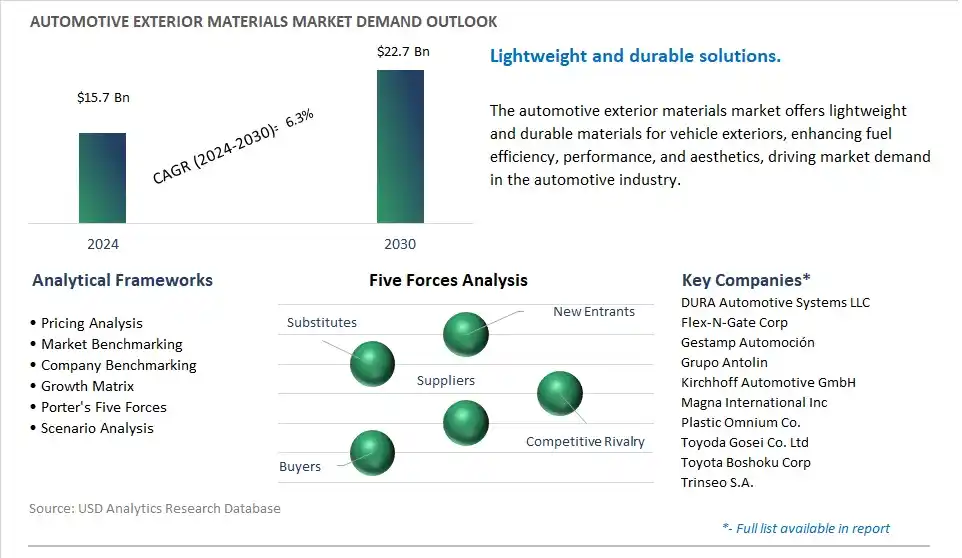
The global Automotive Exterior Materials Market is poised to register a 6.3% CAGR from $15.7 Billion in 2024 to $22.7 Billion in 2030.
The global Automotive Exterior Materials Market Study analyzes and forecasts the market size across 6 regions and 24 countries for diverse segments -By Product (Steel, Aluminum, Plastics, Glass Composites, Carbon Composites, Others), By Application (Bumpers, Fenders, Doors, Hoods, Tailgates, Others).
An Introduction to Global Automotive Exterior Materials Market in 2024
The market for automotive exterior materials is evolving to meet the demands for lightweighting, durability, and aesthetic appeal in vehicle design and manufacturing. Key trends shaping the future of this industry include the adoption of advanced materials such as aluminum alloys, carbon fiber composites, and high-strength steels, which offer superior strength-to-weight ratios and corrosion resistance compared to traditional materials like steel and plastics. Additionally, advancements in surface treatments, coatings, and paint technologies enhance the weatherability, scratch resistance, and color retention of automotive exterior components, ensuring long-lasting performance and visual appeal. Moreover, the integration of functional features such as aerodynamics, acoustics, and sensor compatibility into exterior materials supports vehicle performance, safety, and connectivity in response to evolving consumer preferences and regulatory requirements. As automakers strive to differentiate their vehicles through innovative design and technology, the demand for advanced automotive exterior materials is expected to continue growing, driving innovation and market expansion in this sector.
Automotive Exterior Materials Market Competitive Landscape
The market report analyses the leading companies in the industry including DURA Automotive Systems LLC, Flex-N-Gate Corp, Gestamp Automoción, Grupo Antolin, Kirchhoff Automotive GmbH, Magna International Inc, Plastic Omnium Co., Toyoda Gosei Co. Ltd, Toyota Boshoku Corp, Trinseo S.A..
Automotive Exterior Materials Market Dynamics
Automotive Exterior Materials Market Trend: Shift Towards Lightweight and High-Performance Materials
A prominent trend in the automotive exterior materials market is the shift towards lightweight and high-performance materials to meet the demand for fuel efficiency, vehicle electrification, and enhanced performance. Automakers are increasingly replacing traditional steel components with advanced materials such as aluminum, carbon fiber composites, and high-strength polymers to reduce vehicle weight, improve aerodynamics, and enhance structural integrity. This is driven by regulatory pressure to meet stringent emissions standards, as well as consumer preferences for vehicles with better fuel economy and driving dynamics. Accordingly, there is a growing adoption of innovative exterior materials that offer a balance of lightweight design, durability, and aesthetic appeal to differentiate vehicles in the competitive automotive market.
Automotive Exterior Materials Market Driver: Emphasis on Design Innovation and Brand Differentiation
A key driver propelling the automotive exterior materials market is the emphasis on design innovation and brand differentiation by automakers seeking to attract consumers and gain a competitive edge. Exterior styling plays a crucial role in shaping consumer perceptions and influencing purchasing decisions, driving automakers to invest in distinctive designs, sleek profiles, and premium finishes for their vehicles. Advanced materials offer designers greater flexibility, enabling the creation of complex shapes, unique textures, and dynamic color options that enhance the visual appeal and brand identity of vehicles. Additionally, the use of lightweight materials allows for improved vehicle performance, handling, and overall driving experience, contributing to customer satisfaction and loyalty. As automakers strive to differentiate their products in a crowded marketplace, there is a growing demand for innovative exterior materials that offer both functional benefits and aesthetic appeal to align with brand positioning and customer preferences.
Automotive Exterior Materials Market Opportunity: Integration of Smart and Functional Features
An opportunity for the automotive exterior materials market lies in the integration of smart and functional features into exterior components to enhance vehicle performance, safety, and user experience. As automotive technology continues to advance, there is a growing demand for exterior materials that can accommodate sensors, cameras, lighting elements, and other intelligent systems for autonomous driving, connectivity, and active safety features. For example, lightweight composite materials with embedded sensors can be used for exterior panels to provide real-time data on structural integrity, temperature, and impact resistance, improving vehicle diagnostics and maintenance. Additionally, there is opportunity to develop exterior materials with self-healing properties, hydrophobic coatings, and anti-fog surfaces to enhance durability and visibility in various driving conditions. By offering innovative exterior materials that integrate smart functionalities, manufacturers can address emerging market needs, enhance vehicle performance, and create new opportunities for differentiation and value creation in the automotive industry.
Automotive Exterior Materials Market Ecosystem
The automotive exterior materials market involves diverse stages, beginning with raw material acquisition, where companies including ArcelorMittal and Nippon Steel Corporation provide steel, while Alcoa Corporation and Rio Tinto Group supply aluminum. BASF SE and Dow Inc. contribute plastics, and Asahi Glass Co., Ltd., and Saint-Gobain provide glass. Processing and refining activities include steel mills and aluminum refiners transforming raw materials into usable forms, while plastics and glass manufacturers produce resins and treated glass, respectively.
Material treatment and coating, although optional, involves processes including galvanization and painting for steel, anodizing for aluminum, and painting for plastics, with companies including PPG Industries and BASF SE supplying coatings. Parts manufacturing, led by Tier 1 automotive suppliers including Magna International Inc. and Faurecia SE, shapes materials into various exterior components using processes including stamping, die casting, and injection molding.
Automakers including Toyota and Volkswagen oversee assembly and integration, ensuring proper fit and finish of exterior parts onto vehicle bodies. Aftermarket and repair activities involve aftermarket parts manufacturers and collision repair shops supplying replacement parts for damaged exterior components.
Automotive Exterior Materials Market Share Analysis: Steel held the dominant revenue share in 2024
Steel is the largest segment in the automotive exterior materials market due to its long-standing history, widespread availability, and proven performance in automotive manufacturing. Steel has been a staple material in vehicle construction for decades, offering exceptional strength, durability, and crashworthiness, making it an ideal choice for various exterior components such as body panels, chassis, and structural reinforcements. Additionally, steel's affordability and ease of manufacturing contribute to its dominance in the automotive industry, particularly in mass-produced vehicles where cost efficiency is paramount. Despite the growing popularity of alternative materials such as aluminum, plastics, and composites, steel remains a preferred choice for automakers due to its balance of performance, cost-effectiveness, and recyclability. Further, advancements in steel technology, including high-strength and advanced high-strength steels, continue to enhance its capabilities, allowing for lightweight and improved fuel efficiency without compromising safety or structural integrity. As automotive manufacturers strive to meet stringent safety standards, reduce emissions, and enhance vehicle performance, steel remains a cornerstone material in the automotive exterior materials market, maintaining its dominant position for the foreseeable future.
Automotive Exterior Materials Market Share Analysis: Doors is the fastest growing market segment over the forecast period to 2030
The segment of doors is the fastest-growing segment in the automotive exterior materials market due to diverse key factors influencing its demand and adoption. Doors are critical components of vehicles, requiring materials that offer a combination of strength, durability, and design flexibility to meet stringent performance and safety standards. As automotive manufacturers focus on lightweighting strategies to improve fuel efficiency and reduce emissions, the demand for innovative materials for indoor construction is on the rise. Additionally, doors represent a significant surface area of vehicles, making them prime targets for material substitution to achieve weight savings without compromising structural integrity or safety. Further, advancements in material science and manufacturing processes enable the development of lightweight yet robust materials such as advanced high-strength steel, aluminum alloys, and composite materials, which offer superior performance characteristics compared to traditional materials like steel and plastics. In addition, doors play a crucial role in enhancing the overall aesthetic appeal and design of vehicles, driving the demand for materials that offer design flexibility and customization options. As automotive exterior materials evolve to meet the demands for performance, sustainability, and aesthetics, the doors segment experiences rapid growth in the automotive industry, reflecting the ongoing innovation and advancement in material technologies.
Automotive Exterior Materials Market Report Scope-
By Product
Steel
Aluminum
Plastics
Glass Composites
Carbon Composites
Others
By Application
Bumpers
Fenders
Doors
Hoods
Tailgates
Others
Automotive Exterior Materials Market Companies Profiled
DURA Automotive Systems LLC
Flex-N-Gate Corp
Gestamp Automoción
Grupo Antolin
Kirchhoff Automotive GmbH
Magna International Inc
Plastic Omnium Co.
Toyoda Gosei Co. Ltd
Toyota Boshoku Corp
Trinseo S.A.
*- List Not Exhaustive
TABLE OF CONTENTS
1 Introduction to 2024 Automotive Exterior Materials Market
1.1 Market Overview
1.2 Quick Facts
1.3 Scope/Objective of the Study
1.4 Market Definition
1.5 Countries and Regions Covered
1.6 Units, Currency, and Conversions
1.7 Industry Value Chain
2 Research Methodology
2.1 Market Size Estimation
2.2 Sources and Research Methodology
2.3 Data Triangulation
2.4 Assumptions and Limitations
3 Executive Summary
3.1 Global Automotive Exterior Materials Market Size Outlook, $ Million, 2021 to 2030
3.2 Automotive Exterior Materials Market Outlook by Type, $ Million, 2021 to 2030
3.3 Automotive Exterior Materials Market Outlook by Product, $ Million, 2021 to 2030
3.4 Automotive Exterior Materials Market Outlook by Application, $ Million, 2021 to 2030
3.5 Automotive Exterior Materials Market Outlook by Key Countries, $ Million, 2021 to 2030
4 Market Dynamics
4.1 Key Driving Forces of Automotive Exterior Materials Industry
4.2 Key Market Trends in Automotive Exterior Materials Industry
4.3 Potential Opportunities in Automotive Exterior Materials Industry
4.4 Key Challenges in Automotive Exterior Materials Industry
5 Market Factor Analysis
5.1 Value Chain Analysis
5.2 Competitive Landscape
5.2.1 Global Automotive Exterior Materials Market Share by Company (%), 2023
5.2.2 Product Offerings by Company
5.3 Porter’s Five Forces Analysis
5.4 Pricing Analysis and Outlook
6 Growth Outlook Across Scenarios
6.1 Growth Analysis-Case Scenario Definitions
6.2 Low Growth Scenario Forecasts
6.3 Reference Growth Scenario Forecasts
6.4 High Growth Scenario Forecasts
7 Global Automotive Exterior Materials Market Outlook by Segments
7.1 Automotive Exterior Materials Market Outlook by Segments, $ Million, 2021- 2030
By Product
Steel
Aluminum
Plastics
Glass Composites
Carbon Composites
Others
By Application
Bumpers
Fenders
Doors
Hoods
Tailgates
Others
8 North America Automotive Exterior Materials Market Analysis and Outlook To 2030
8.1 Introduction to North America Automotive Exterior Materials Markets in 2024
8.2 North America Automotive Exterior Materials Market Size Outlook by Country, 2021-2030
8.2.1 United States
8.2.2 Canada
8.2.3 Mexico
8.3 North America Automotive Exterior Materials Market size Outlook by Segments, 2021-2030
By Product
Steel
Aluminum
Plastics
Glass Composites
Carbon Composites
Others
By Application
Bumpers
Fenders
Doors
Hoods
Tailgates
Others
9 Europe Automotive Exterior Materials Market Analysis and Outlook To 2030
9.1 Introduction to Europe Automotive Exterior Materials Markets in 2024
9.2 Europe Automotive Exterior Materials Market Size Outlook by Country, 2021-2030
9.2.1 Germany
9.2.2 France
9.2.3 Spain
9.2.4 United Kingdom
9.2.4 Italy
9.2.5 Russia
9.2.6 Norway
9.2.7 Rest of Europe
9.3 Europe Automotive Exterior Materials Market Size Outlook by Segments, 2021-2030
By Product
Steel
Aluminum
Plastics
Glass Composites
Carbon Composites
Others
By Application
Bumpers
Fenders
Doors
Hoods
Tailgates
Others
10 Asia Pacific Automotive Exterior Materials Market Analysis and Outlook To 2030
10.1 Introduction to Asia Pacific Automotive Exterior Materials Markets in 2024
10.2 Asia Pacific Automotive Exterior Materials Market Size Outlook by Country, 2021-2030
10.2.1 China
10.2.2 India
10.2.3 Japan
10.2.4 South Korea
10.2.5 Indonesia
10.2.6 Malaysia
10.2.7 Australia
10.2.8 Rest of Asia Pacific
10.3 Asia Pacific Automotive Exterior Materials Market size Outlook by Segments, 2021-2030
By Product
Steel
Aluminum
Plastics
Glass Composites
Carbon Composites
Others
By Application
Bumpers
Fenders
Doors
Hoods
Tailgates
Others
11 South America Automotive Exterior Materials Market Analysis and Outlook To 2030
11.1 Introduction to South America Automotive Exterior Materials Markets in 2024
11.2 South America Automotive Exterior Materials Market Size Outlook by Country, 2021-2030
11.2.1 Brazil
11.2.2 Argentina
11.2.3 Rest of South America
11.3 South America Automotive Exterior Materials Market size Outlook by Segments, 2021-2030
By Product
Steel
Aluminum
Plastics
Glass Composites
Carbon Composites
Others
By Application
Bumpers
Fenders
Doors
Hoods
Tailgates
Others
12 Middle East and Africa Automotive Exterior Materials Market Analysis and Outlook To 2030
12.1 Introduction to Middle East and Africa Automotive Exterior Materials Markets in 2024
12.2 Middle East and Africa Automotive Exterior Materials Market Size Outlook by Country, 2021-2030
12.2.1 Saudi Arabia
12.2.2 UAE
12.2.3 Oman
12.2.4 Rest of Middle East
12.2.5 Egypt
12.2.6 Nigeria
12.2.7 South Africa
12.2.8 Rest of Africa
12.3 Middle East and Africa Automotive Exterior Materials Market size Outlook by Segments, 2021-2030
By Product
Steel
Aluminum
Plastics
Glass Composites
Carbon Composites
Others
By Application
Bumpers
Fenders
Doors
Hoods
Tailgates
Others
13 Company Profiles
13.1 Company Snapshot
13.2 SWOT Profiles
13.3 Products and Services
13.4 Recent Developments
13.5 Financial Profile
DURA Automotive Systems LLC
Flex-N-Gate Corp
Gestamp Automoción
Grupo Antolin
Kirchhoff Automotive GmbH
Magna International Inc
Plastic Omnium Co.
Toyoda Gosei Co. Ltd
Toyota Boshoku Corp
Trinseo S.A.
14 Appendix
14.1 Customization Offerings
14.2 Subscription Services
14.3 Related Reports
14.4 Publisher Expertise
By Product
Steel
Aluminum
Plastics
Glass Composites
Carbon Composites
Others
By Application
Bumpers
Fenders
Doors
Hoods
Tailgates
Others
Countries Analyzed
North America (US, Canada, Mexico)
Europe (Germany, UK, France, Spain, Italy, Russia, Rest of Europe)
Asia Pacific (China, India, Japan, South Korea, Australia, South East Asia, Rest of Asia)
South America (Brazil, Argentina, Rest of South America)
Middle East and Africa (Saudi Arabia, UAE, Rest of Middle East, South Africa, Egypt, Rest of Africa)
