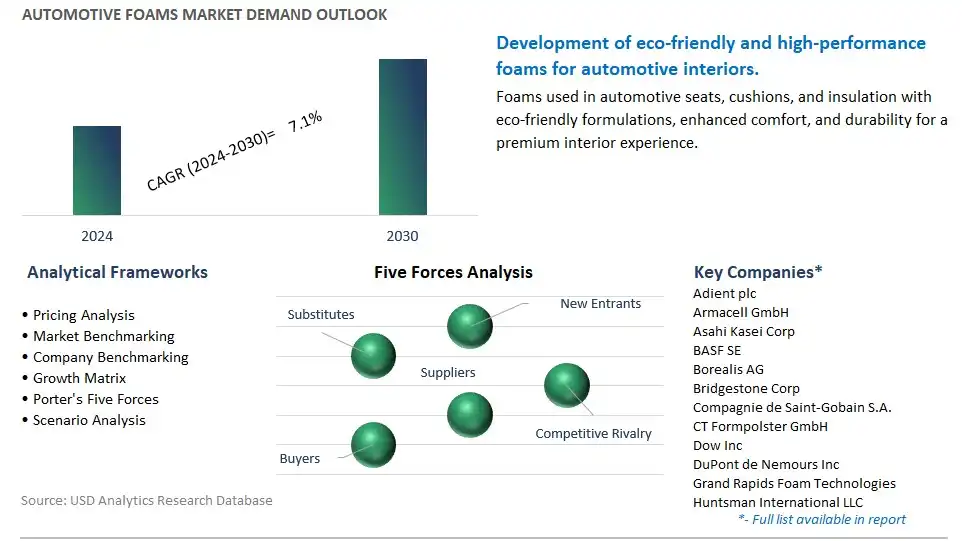
Automotive Foams Market is estimated to increase at a growth rate of 7.1% CAGR over the forecast period from 2024 to 2030.
The global Automotive Foams Market study analyzes and forecasts the market size across 6 regions and 24 countries for diverse segments including By Type (Polyurethane (PU) Foam, Polyolefin (PO) Foam, Others), By Application (Interior, Exterior), By End-User (Passenger Cars, Light Commercial Vehicle (LCV), Heavy Commercial Vehicle (HCV)).
An Introduction to Global Automotive Foams Market, 2024
The Automotive Foams market encompasses a wide range of foam materials used in vehicle interiors, exteriors, and insulation applications. These foams provide comfort, noise reduction, impact absorption, and thermal insulation, contributing to the overall comfort, safety, and aesthetics of vehicles. With the automotive industry's focus on interior comfort, weight reduction, and NVH (Noise, Vibration, and Harshness) control, the demand for high-quality automotive foams continues to grow. Manufacturers in this market focus on developing foams with advanced formulations, precise molding techniques, and sustainable materials to meet the diverse needs of vehicle manufacturers and consumers. Moreover, advancements in foam technology, including lightweight formulations, enhanced durability, and improved fire-retardant properties, drive innovation, enabling improved comfort, safety, and environmental sustainability. Additionally, as vehicle designs evolve to incorporate more electrification and autonomous features, the Automotive Foams market presents opportunities for further innovation and customization to meet the evolving needs of vehicle interiors, ensuring optimal comfort and passenger experience.
Automotive Foams Competitive Landscape
The global Automotive Foams market is highly competitive with a large number of companies focusing on niche market segments. Amidst intense competitive conditions, Automotive Foams Companies are investing in new product launches and strengthening distribution channels. Key companies operating in the Automotive Foams Market Industry include- Adient plc, Armacell GmbH, Asahi Kasei Corp, BASF SE, Borealis AG, Bridgestone Corp, Compagnie de Saint-Gobain S.A., CT Formpolster GmbH, Dow Inc, DuPont de Nemours Inc, Grand Rapids Foam Technologies, Huntsman International LLC, Paul Bauder GmbH & Co. KG, Recticel NV, Sekisui Voltek Llc, Sheela Foam Ltd, Sondor Performance Foams, Vita Group, Woodbridge Foam Corp.
Automotive Foams Market Trend: Increasing Demand for Lightweight and Energy-Efficient Vehicles
A prominent trend in the automotive foams market is the increasing demand for lightweight and energy-efficient vehicles. Automakers are under pressure to meet stringent fuel efficiency standards and reduce emissions, driving the need for lightweight materials in vehicle construction. Foam materials, such as polyurethane (PU) foam and polystyrene (PS) foam, offer excellent weight-saving properties while providing sound insulation, thermal insulation, and impact absorption. As automakers prioritize lightweighting initiatives to improve vehicle performance and fuel economy, the demand for automotive foams as a lightweight material solution is expected to rise.
Automotive Foams Market Driver: Growth in Vehicle Production and Sales
A significant driver shaping the automotive foams market is the growth in vehicle production and sales worldwide. With increasing urbanization, rising disposable incomes, and expanding middle-class populations in emerging economies, there's a growing demand for automobiles across various regions. Automotive foams are used in a wide range of applications, including seating, interior trim, insulation, and acoustic management, making them integral components in modern vehicles. As vehicle production and sales continue to grow, particularly in emerging markets, the demand for automotive foams is expected to increase proportionally, driving market expansion in the automotive foam segment.
Automotive Foams Market Opportunity: Development of Sustainable and Recyclable Foam Solutions
An emerging opportunity in the automotive foams market lies in the development of sustainable and recyclable foam solutions. With increasing awareness of environmental sustainability and circular economy principles, automakers and foam manufacturers are exploring alternative materials and manufacturing processes that minimize environmental impact. Manufacturers have the opportunity to develop foam materials using bio-based or recycled content, as well as incorporating innovative manufacturing techniques that reduce energy consumption and waste generation. Additionally, designing foams for easy disassembly and recycling at the end of vehicle life presents an opportunity to create closed-loop systems and reduce the environmental footprint of automotive foam production. By capitalizing on this opportunity and offering sustainable foam solutions, manufacturers can meet the evolving needs of automakers and consumers for environmentally friendly materials in vehicle construction, while also contributing to environmental stewardship and corporate responsibility initiatives.
Automotive Foams Market Segmentation
By Type
Polyurethane (PU) Foam
Polyolefin (PO) Foam
Others
By Application
Interior
-Seating
-Instrument Panels
-Headliners
-Door Panels & Water shields
-Seals
-Gaskets & NVH
Exterior
-Bumper System
-Others
By End-User
Passenger Cars
Light Commercial Vehicle (LCV)
Heavy Commercial Vehicle (HCV)Geographical Analysis
North America (United States, Canada, Mexico)
Europe (Germany, France, United Kingdom, Spain, Italy, Rest of Europe)
Asia Pacific (China, India, Japan, South Korea, Rest of Asia Pacific)
South America (Brazil, Argentina, Rest of South America)
Middle East and Africa (Saudi Arabia, UAE, Rest of Middle East, South Africa, Egypt, Rest of Africa
Automotive Foams Companies
Adient plc
Armacell GmbH
Asahi Kasei Corp
BASF SE
Borealis AG
Bridgestone Corp
Compagnie de Saint-Gobain S.A.
CT Formpolster GmbH
Dow Inc
DuPont de Nemours Inc
Grand Rapids Foam Technologies
Huntsman International LLC
Paul Bauder GmbH & Co. KG
Recticel NV
Sekisui Voltek Llc
Sheela Foam Ltd
Sondor Performance Foams
Vita Group
Woodbridge Foam Corp
*- List not Exhaustive
TABLE OF CONTENTS
1 Introduction to 2024 Automotive Foams Market
1.1 Market Overview
1.2 Quick Facts
1.3 Scope/Objective of the Study
1.4 Market Definition
1.5 Countries and Regions Analyzed
1.6 Units, Currency, and Conversions
1.7 Industry Value Chain
2 Research Methodology
2.1 Market Size Estimation
2.2 Sources and Research Methodology
2.3 Data Triangulation
2.4 Assumptions and Limitations
3 Executive Summary
3.1 Global Automotive Foams Market Size Outlook, $ Million, 2021 to 2030
3.2 Automotive Foams Market Outlook by Type, $ Million, 2021 to 2030
3.3 Automotive Foams Market Outlook by Product, $ Million, 2021 to 2030
3.4 Automotive Foams Market Outlook by Application, $ Million, 2021 to 2030
3.5 Automotive Foams Market Outlook by Key Countries, $ Million, 2021 to 2030
4 Market Dynamics
4.1 Key Driving Forces of Automotive Foams Industry
4.2 Key Market Trends in Automotive Foams Industry
4.3 Potential Opportunities in Automotive Foams Industry
4.4 Key Challenges in Automotive Foams Industry
5 Market Factor Analysis
5.1 Value Chain Analysis
5.2 Competitive Landscape
5.2.1 Global Automotive Foams Market Share by Company (%), 2023
5.2.2 Product Offerings by Company
5.3 Porter’s Five Forces Analysis
5.4 Pricing Analysis and Outlook
6 Growth Outlook Across Scenarios
6.1 Growth Analysis-Case Scenario Definitions
6.2 Low Growth Scenario Forecasts
6.3 Reference Growth Scenario Forecasts
6.4 High Growth Scenario Forecasts
7 Global Automotive Foams Market Outlook by Segments
7.1 Automotive Foams Market Outlook by Segments, $ Million, 2021- 2030
By Type
Polyurethane (PU) Foam
Polyolefin (PO) Foam
Others
By Application
Interior
-Seating
-Instrument Panels
-Headliners
-Door Panels & Water shields
-Seals
-Gaskets & NVH
Exterior
-Bumper System
-Others
By End-User
Passenger Cars
Light Commercial Vehicle (LCV)
Heavy Commercial Vehicle (HCV)
8 North America Automotive Foams Market Analysis and Outlook To 2030
8.1 Introduction to North America Automotive Foams Markets in 2024
8.2 North America Automotive Foams Market Size Outlook by Country, 2021-2030
8.2.1 United States
8.2.2 Canada
8.2.3 Mexico
8.3 North America Automotive Foams Market size Outlook by Segments, 2021-2030
By Type
Polyurethane (PU) Foam
Polyolefin (PO) Foam
Others
By Application
Interior
-Seating
-Instrument Panels
-Headliners
-Door Panels & Water shields
-Seals
-Gaskets & NVH
Exterior
-Bumper System
-Others
By End-User
Passenger Cars
Light Commercial Vehicle (LCV)
Heavy Commercial Vehicle (HCV)
9 Europe Automotive Foams Market Analysis and Outlook To 2030
9.1 Introduction to Europe Automotive Foams Markets in 2024
9.2 Europe Automotive Foams Market Size Outlook by Country, 2021-2030
9.2.1 Germany
9.2.2 France
9.2.3 Spain
9.2.4 United Kingdom
9.2.4 Italy
9.2.5 Russia
9.2.6 Norway
9.2.7 Rest of Europe
9.3 Europe Automotive Foams Market Size Outlook by Segments, 2021-2030
By Type
Polyurethane (PU) Foam
Polyolefin (PO) Foam
Others
By Application
Interior
-Seating
-Instrument Panels
-Headliners
-Door Panels & Water shields
-Seals
-Gaskets & NVH
Exterior
-Bumper System
-Others
By End-User
Passenger Cars
Light Commercial Vehicle (LCV)
Heavy Commercial Vehicle (HCV)
10 Asia Pacific Automotive Foams Market Analysis and Outlook To 2030
10.1 Introduction to Asia Pacific Automotive Foams Markets in 2024
10.2 Asia Pacific Automotive Foams Market Size Outlook by Country, 2021-2030
10.2.1 China
10.2.2 India
10.2.3 Japan
10.2.4 South Korea
10.2.5 Indonesia
10.2.6 Malaysia
10.2.7 Australia
10.2.8 Rest of Asia Pacific
10.3 Asia Pacific Automotive Foams Market size Outlook by Segments, 2021-2030
By Type
Polyurethane (PU) Foam
Polyolefin (PO) Foam
Others
By Application
Interior
-Seating
-Instrument Panels
-Headliners
-Door Panels & Water shields
-Seals
-Gaskets & NVH
Exterior
-Bumper System
-Others
By End-User
Passenger Cars
Light Commercial Vehicle (LCV)
Heavy Commercial Vehicle (HCV)
11 South America Automotive Foams Market Analysis and Outlook To 2030
11.1 Introduction to South America Automotive Foams Markets in 2024
11.2 South America Automotive Foams Market Size Outlook by Country, 2021-2030
11.2.1 Brazil
11.2.2 Argentina
11.2.3 Rest of South America
11.3 South America Automotive Foams Market size Outlook by Segments, 2021-2030
By Type
Polyurethane (PU) Foam
Polyolefin (PO) Foam
Others
By Application
Interior
-Seating
-Instrument Panels
-Headliners
-Door Panels & Water shields
-Seals
-Gaskets & NVH
Exterior
-Bumper System
-Others
By End-User
Passenger Cars
Light Commercial Vehicle (LCV)
Heavy Commercial Vehicle (HCV)
12 Middle East and Africa Automotive Foams Market Analysis and Outlook To 2030
12.1 Introduction to Middle East and Africa Automotive Foams Markets in 2024
12.2 Middle East and Africa Automotive Foams Market Size Outlook by Country, 2021-2030
12.2.1 Saudi Arabia
12.2.2 UAE
12.2.3 Oman
12.2.4 Rest of Middle East
12.2.5 Egypt
12.2.6 Nigeria
12.2.7 South Africa
12.2.8 Rest of Africa
12.3 Middle East and Africa Automotive Foams Market size Outlook by Segments, 2021-2030
By Type
Polyurethane (PU) Foam
Polyolefin (PO) Foam
Others
By Application
Interior
-Seating
-Instrument Panels
-Headliners
-Door Panels & Water shields
-Seals
-Gaskets & NVH
Exterior
-Bumper System
-Others
By End-User
Passenger Cars
Light Commercial Vehicle (LCV)
Heavy Commercial Vehicle (HCV)
13 Company Profiles
13.1 Company Snapshot
13.2 SWOT Profiles
13.3 Products and Services
13.4 Recent Developments
13.5 Financial Profile
List of Companies
Adient plc
Armacell GmbH
Asahi Kasei Corp
BASF SE
Borealis AG
Bridgestone Corp
Compagnie de Saint-Gobain S.A.
CT Formpolster GmbH
Dow Inc
DuPont de Nemours Inc
Grand Rapids Foam Technologies
Huntsman International LLC
Paul Bauder GmbH & Co. KG
Recticel NV
Sekisui Voltek Llc
Sheela Foam Ltd
Sondor Performance Foams
Vita Group
Woodbridge Foam Corp
14 Appendix
14.1 Customization Offerings
14.2 Subscription Services
14.3 Related Reports
14.4 Publisher Expertise
By Type
Polyurethane (PU) Foam
Polyolefin (PO) Foam
Others
By Application
Interior
-Seating
-Instrument Panels
-Headliners
-Door Panels & Water shields
-Seals
-Gaskets & NVH
Exterior
-Bumper System
-Others
By End-User
Passenger Cars
Light Commercial Vehicle (LCV)
Heavy Commercial Vehicle (HCV)
