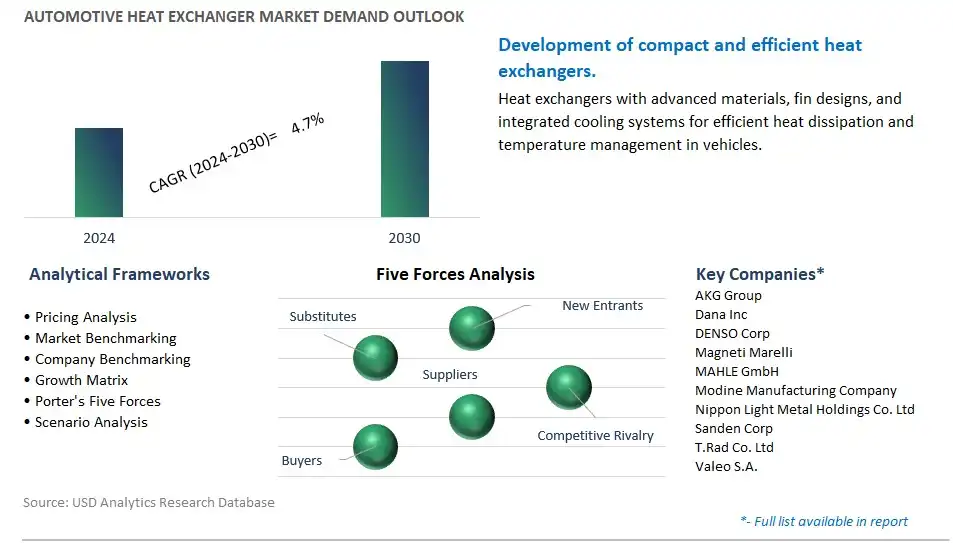
Automotive Heat Exchanger Market is estimated to increase at a growth rate of 4.7% CAGR over the forecast period from 2024 to 2030.
The global Automotive Heat Exchanger Market study analyzes and forecasts the market size across 6 regions and 24 countries for diverse segments including By Powertrain (ICE, EV), By Design (Plate Bar, Tube Fin, Others), By Vehicle (Passenger Car, LCV, Truck, Bus), By Off-Highway Vehicle (Agricultural Equipment, Construction Equipment), By Electric Vehicle (BEV, PHEV, HEV).
An Introduction to Global Automotive Heat Exchanger Market, 2024
The Automotive Heat Exchanger Market encompasses a variety of components used for transferring heat between fluids in vehicles, including radiators, intercoolers, and oil coolers. Heat exchangers play a critical role in cooling engine coolant, transmission fluid, and engine oil to maintain optimal operating temperatures and prevent overheating. With the automotive industry's increasing focus on thermal management, engine efficiency, and emissions reduction, the demand for high-performance heat exchangers continues to rise. Manufacturers in this market focus on developing exchangers with advanced materials, optimized designs, and enhanced thermal conductivity to meet the stringent requirements of modern vehicles and regulatory standards. Moreover, advancements in heat exchanger technology, including microchannel designs, variable flow control, and integrated cooling systems, drive innovation, enabling improved efficiency, durability, and packaging flexibility. Additionally, as vehicle designs evolve to incorporate more electrification and alternative powertrains, the Automotive Heat Exchanger Market presents opportunities for further innovation and integration to meet the evolving needs of vehicle manufacturers and ensure optimal thermal management and performance.
Automotive Heat Exchanger Competitive Landscape
The global Automotive Heat Exchanger market is highly competitive with a large number of companies focusing on niche market segments. Amidst intense competitive conditions, Automotive Heat Exchanger Companies are investing in new product launches and strengthening distribution channels. Key companies operating in the Automotive Heat Exchanger Market Industry include- AKG Group, Dana Inc, DENSO Corp, Magneti Marelli, MAHLE GmbH, Modine Manufacturing Company, Nippon Light Metal Holdings Co. Ltd, Sanden Corp, T.Rad Co. Ltd, Valeo S.A..
Automotive Heat Exchanger Market Trend: Adoption of Lightweight and Compact Heat Exchanger Designs
A prominent trend in the automotive heat exchanger market is the adoption of lightweight and compact heat exchanger designs. As vehicle manufacturers strive to improve fuel efficiency and reduce emissions, there's a growing demand for heat exchangers that are more lightweight and space-efficient. Advanced materials and manufacturing techniques enable the development of heat exchangers with reduced weight and size while maintaining or even enhancing thermal performance. These lightweight and compact designs not only contribute to improved vehicle efficiency but also offer packaging flexibility, allowing for more efficient use of space within the vehicle engine compartment. The trend towards lightweight and compact heat exchanger designs aligns with the automotive industry's push towards lightweighting and optimization of vehicle components for improved performance.
Automotive Heat Exchanger Market Driver: Stringent Emission Regulations and Thermal Management Requirements
A significant driver shaping the automotive heat exchanger market is the enforcement of stringent emission regulations and thermal management requirements. Regulatory authorities worldwide impose strict limits on vehicle emissions to address environmental concerns and meet emission reduction targets. Additionally, efficient thermal management is essential for optimizing engine performance, ensuring component reliability, and enhancing passenger comfort. Heat exchangers play a crucial role in dissipating excess heat generated by the engine, transmission, and other vehicle systems while maintaining optimal operating temperatures. As emission regulations become more stringent and vehicle thermal management requirements evolve, the demand for high-performance heat exchanger solutions that meet regulatory standards and address thermal challenges is expected to grow, driving market expansion in this segment.
Automotive Heat Exchanger Market Opportunity: Development of Advanced Cooling Technologies
An emerging opportunity in the automotive heat exchanger market lies in the development of advanced cooling technologies. With the rise of electric and hybrid vehicles, there's a growing need for heat exchangers capable of efficiently dissipating heat from battery packs, electric motors, and power electronics. Innovative cooling solutions such as microchannel heat exchangers, phase-change materials, and advanced cooling fluids offer improved thermal performance and reliability for electric vehicle applications. Additionally, the integration of thermal management systems with vehicle connectivity and predictive maintenance capabilities allows for real-time monitoring and optimization of cooling performance. By investing in the development of advanced cooling technologies, manufacturers can capitalize on the growing demand for heat exchangers in electric and hybrid vehicles and position themselves as leaders in the evolving automotive thermal management market.
Automotive Heat Exchanger Market Segmentation
By Powertrain
ICE
-Engine Radiator
-Condenser
-Evaporator
-Oil Cooler
-Heater
-Charge Air Cooler
-Exhaust Gas Recovery
EV
-Battery Cooling System
-Engine Radiator
-Condenser
-Evaporator
-Oil Cooler
-Heater
-Charge Air Cooler
-Exhaust Gas Recovery
By Design
Plate Bar
Tube Fin
Others
By Vehicle
Passenger Car
LCV
Truck
Bus
By Off-Highway Vehicle
Agricultural Equipment
Construction Equipment
By Electric Vehicle
BEV
PHEV
HEVGeographical Analysis
North America (United States, Canada, Mexico)
Europe (Germany, France, United Kingdom, Spain, Italy, Rest of Europe)
Asia Pacific (China, India, Japan, South Korea, Rest of Asia Pacific)
South America (Brazil, Argentina, Rest of South America)
Middle East and Africa (Saudi Arabia, UAE, Rest of Middle East, South Africa, Egypt, Rest of Africa
Automotive Heat Exchanger Companies
AKG Group
Dana Inc
DENSO Corp
Magneti Marelli
MAHLE GmbH
Modine Manufacturing Company
Nippon Light Metal Holdings Co. Ltd
Sanden Corp
T.Rad Co. Ltd
Valeo S.A.
*- List not Exhaustive
TABLE OF CONTENTS
1 Introduction to 2024 Automotive Heat Exchanger Market
1.1 Market Overview
1.2 Quick Facts
1.3 Scope/Objective of the Study
1.4 Market Definition
1.5 Countries and Regions Analyzed
1.6 Units, Currency, and Conversions
1.7 Industry Value Chain
2 Research Methodology
2.1 Market Size Estimation
2.2 Sources and Research Methodology
2.3 Data Triangulation
2.4 Assumptions and Limitations
3 Executive Summary
3.1 Global Automotive Heat Exchanger Market Size Outlook, $ Million, 2021 to 2030
3.2 Automotive Heat Exchanger Market Outlook by Type, $ Million, 2021 to 2030
3.3 Automotive Heat Exchanger Market Outlook by Product, $ Million, 2021 to 2030
3.4 Automotive Heat Exchanger Market Outlook by Application, $ Million, 2021 to 2030
3.5 Automotive Heat Exchanger Market Outlook by Key Countries, $ Million, 2021 to 2030
4 Market Dynamics
4.1 Key Driving Forces of Automotive Heat Exchanger Industry
4.2 Key Market Trends in Automotive Heat Exchanger Industry
4.3 Potential Opportunities in Automotive Heat Exchanger Industry
4.4 Key Challenges in Automotive Heat Exchanger Industry
5 Market Factor Analysis
5.1 Value Chain Analysis
5.2 Competitive Landscape
5.2.1 Global Automotive Heat Exchanger Market Share by Company (%), 2023
5.2.2 Product Offerings by Company
5.3 Porter’s Five Forces Analysis
5.4 Pricing Analysis and Outlook
6 Growth Outlook Across Scenarios
6.1 Growth Analysis-Case Scenario Definitions
6.2 Low Growth Scenario Forecasts
6.3 Reference Growth Scenario Forecasts
6.4 High Growth Scenario Forecasts
7 Global Automotive Heat Exchanger Market Outlook by Segments
7.1 Automotive Heat Exchanger Market Outlook by Segments, $ Million, 2021- 2030
By Powertrain
ICE
-Engine Radiator
-Condenser
-Evaporator
-Oil Cooler
-Heater
-Charge Air Cooler
-Exhaust Gas Recovery
EV
-Battery Cooling System
-Engine Radiator
-Condenser
-Evaporator
-Oil Cooler
-Heater
-Charge Air Cooler
-Exhaust Gas Recovery
By Design
Plate Bar
Tube Fin
Others
By Vehicle
Passenger Car
LCV
Truck
Bus
By Off-Highway Vehicle
Agricultural Equipment
Construction Equipment
By Electric Vehicle
BEV
PHEV
HEV
8 North America Automotive Heat Exchanger Market Analysis and Outlook To 2030
8.1 Introduction to North America Automotive Heat Exchanger Markets in 2024
8.2 North America Automotive Heat Exchanger Market Size Outlook by Country, 2021-2030
8.2.1 United States
8.2.2 Canada
8.2.3 Mexico
8.3 North America Automotive Heat Exchanger Market size Outlook by Segments, 2021-2030
By Powertrain
ICE
-Engine Radiator
-Condenser
-Evaporator
-Oil Cooler
-Heater
-Charge Air Cooler
-Exhaust Gas Recovery
EV
-Battery Cooling System
-Engine Radiator
-Condenser
-Evaporator
-Oil Cooler
-Heater
-Charge Air Cooler
-Exhaust Gas Recovery
By Design
Plate Bar
Tube Fin
Others
By Vehicle
Passenger Car
LCV
Truck
Bus
By Off-Highway Vehicle
Agricultural Equipment
Construction Equipment
By Electric Vehicle
BEV
PHEV
HEV
9 Europe Automotive Heat Exchanger Market Analysis and Outlook To 2030
9.1 Introduction to Europe Automotive Heat Exchanger Markets in 2024
9.2 Europe Automotive Heat Exchanger Market Size Outlook by Country, 2021-2030
9.2.1 Germany
9.2.2 France
9.2.3 Spain
9.2.4 United Kingdom
9.2.4 Italy
9.2.5 Russia
9.2.6 Norway
9.2.7 Rest of Europe
9.3 Europe Automotive Heat Exchanger Market Size Outlook by Segments, 2021-2030
By Powertrain
ICE
-Engine Radiator
-Condenser
-Evaporator
-Oil Cooler
-Heater
-Charge Air Cooler
-Exhaust Gas Recovery
EV
-Battery Cooling System
-Engine Radiator
-Condenser
-Evaporator
-Oil Cooler
-Heater
-Charge Air Cooler
-Exhaust Gas Recovery
By Design
Plate Bar
Tube Fin
Others
By Vehicle
Passenger Car
LCV
Truck
Bus
By Off-Highway Vehicle
Agricultural Equipment
Construction Equipment
By Electric Vehicle
BEV
PHEV
HEV
10 Asia Pacific Automotive Heat Exchanger Market Analysis and Outlook To 2030
10.1 Introduction to Asia Pacific Automotive Heat Exchanger Markets in 2024
10.2 Asia Pacific Automotive Heat Exchanger Market Size Outlook by Country, 2021-2030
10.2.1 China
10.2.2 India
10.2.3 Japan
10.2.4 South Korea
10.2.5 Indonesia
10.2.6 Malaysia
10.2.7 Australia
10.2.8 Rest of Asia Pacific
10.3 Asia Pacific Automotive Heat Exchanger Market size Outlook by Segments, 2021-2030
By Powertrain
ICE
-Engine Radiator
-Condenser
-Evaporator
-Oil Cooler
-Heater
-Charge Air Cooler
-Exhaust Gas Recovery
EV
-Battery Cooling System
-Engine Radiator
-Condenser
-Evaporator
-Oil Cooler
-Heater
-Charge Air Cooler
-Exhaust Gas Recovery
By Design
Plate Bar
Tube Fin
Others
By Vehicle
Passenger Car
LCV
Truck
Bus
By Off-Highway Vehicle
Agricultural Equipment
Construction Equipment
By Electric Vehicle
BEV
PHEV
HEV
11 South America Automotive Heat Exchanger Market Analysis and Outlook To 2030
11.1 Introduction to South America Automotive Heat Exchanger Markets in 2024
11.2 South America Automotive Heat Exchanger Market Size Outlook by Country, 2021-2030
11.2.1 Brazil
11.2.2 Argentina
11.2.3 Rest of South America
11.3 South America Automotive Heat Exchanger Market size Outlook by Segments, 2021-2030
By Powertrain
ICE
-Engine Radiator
-Condenser
-Evaporator
-Oil Cooler
-Heater
-Charge Air Cooler
-Exhaust Gas Recovery
EV
-Battery Cooling System
-Engine Radiator
-Condenser
-Evaporator
-Oil Cooler
-Heater
-Charge Air Cooler
-Exhaust Gas Recovery
By Design
Plate Bar
Tube Fin
Others
By Vehicle
Passenger Car
LCV
Truck
Bus
By Off-Highway Vehicle
Agricultural Equipment
Construction Equipment
By Electric Vehicle
BEV
PHEV
HEV
12 Middle East and Africa Automotive Heat Exchanger Market Analysis and Outlook To 2030
12.1 Introduction to Middle East and Africa Automotive Heat Exchanger Markets in 2024
12.2 Middle East and Africa Automotive Heat Exchanger Market Size Outlook by Country, 2021-2030
12.2.1 Saudi Arabia
12.2.2 UAE
12.2.3 Oman
12.2.4 Rest of Middle East
12.2.5 Egypt
12.2.6 Nigeria
12.2.7 South Africa
12.2.8 Rest of Africa
12.3 Middle East and Africa Automotive Heat Exchanger Market size Outlook by Segments, 2021-2030
By Powertrain
ICE
-Engine Radiator
-Condenser
-Evaporator
-Oil Cooler
-Heater
-Charge Air Cooler
-Exhaust Gas Recovery
EV
-Battery Cooling System
-Engine Radiator
-Condenser
-Evaporator
-Oil Cooler
-Heater
-Charge Air Cooler
-Exhaust Gas Recovery
By Design
Plate Bar
Tube Fin
Others
By Vehicle
Passenger Car
LCV
Truck
Bus
By Off-Highway Vehicle
Agricultural Equipment
Construction Equipment
By Electric Vehicle
BEV
PHEV
HEV
13 Company Profiles
13.1 Company Snapshot
13.2 SWOT Profiles
13.3 Products and Services
13.4 Recent Developments
13.5 Financial Profile
List of Companies
AKG Group
Dana Inc
DENSO Corp
Magneti Marelli
MAHLE GmbH
Modine Manufacturing Company
Nippon Light Metal Holdings Co. Ltd
Sanden Corp
T.Rad Co. Ltd
Valeo S.A.
14 Appendix
14.1 Customization Offerings
14.2 Subscription Services
14.3 Related Reports
14.4 Publisher Expertise
By Powertrain
ICE
-Engine Radiator
-Condenser
-Evaporator
-Oil Cooler
-Heater
-Charge Air Cooler
-Exhaust Gas Recovery
EV
-Battery Cooling System
-Engine Radiator
-Condenser
-Evaporator
-Oil Cooler
-Heater
-Charge Air Cooler
-Exhaust Gas Recovery
By Design
Plate Bar
Tube Fin
Others
By Vehicle
Passenger Car
LCV
Truck
Bus
By Off-Highway Vehicle
Agricultural Equipment
Construction Equipment
By Electric Vehicle
BEV
PHEV
HEV
