
The global Automotive HVAC Ducts Market study analyzes and forecasts the market size across 6 regions and 24 countries for diverse segments including By Type (Rear Outlet HVAC Duct, HVAC Ducts, Windshield Demist Duct, Mini Uses Bolton Plastics HVAC Ducts), By Application (Passenger Vehicle, Commercial Vehicle), By Process (Process Twin Sheet Forming, Blow Moulding), By Material (Plastics, Aluminum, Others), By Nature (Gas Duct, Liquid Duct).
The Automotive HVAC Ducts Market provides essential components for heating, ventilation, and air conditioning (HVAC) systems in vehicles, ensuring comfortable cabin temperatures and airflow for occupants. HVAC ducts distribute heated or cooled air from the HVAC unit to various locations within the vehicle cabin, including dash vents, floor vents, and rear-seat vents. With the automotive industry's increasing focus on passenger comfort, interior air quality, and thermal management, the demand for high-quality HVAC ducts continues to rise. Manufacturers in this market focus on developing ducts with durable materials, optimized designs, and efficient airflow distribution to meet the rigorous demands of modern vehicles and HVAC systems. Moreover, advancements in HVAC duct technology, including modular designs, variable airflow control, and integrated filtration systems, drive innovation, enabling improved comfort, air quality, and energy efficiency. Additionally, as vehicle interiors evolve to become more connected and climate-controlled, the Automotive HVAC Ducts Market presents opportunities for further innovation and customization to meet the evolving needs of vehicle manufacturers and ensure optimal cabin comfort and air distribution.
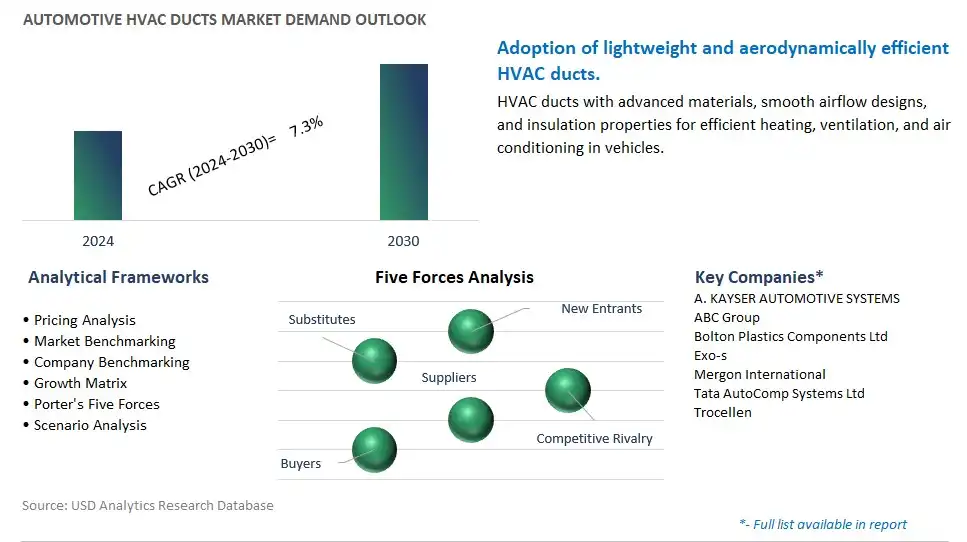
The global Automotive HVAC Ducts market is highly competitive with a large number of companies focusing on niche market segments. Amidst intense competitive conditions, Automotive HVAC Ducts Companies are investing in new product launches and strengthening distribution channels. Key companies operating in the Automotive HVAC Ducts Market Industry include- A. KAYSER AUTOMOTIVE SYSTEMS, ABC Group, Bolton Plastics Components Ltd, Exo-s, Mergon International, Tata AutoComp Systems Ltd, Trocellen.
A prominent trend in the automotive HVAC ducts market is the shift towards lightweight and high-efficiency materials. As automakers strive to improve fuel efficiency and reduce vehicle emissions, there's a growing demand for HVAC duct systems that are lightweight yet durable. Manufacturers are increasingly adopting advanced materials such as thermoplastics, aluminum alloys, and composite materials to replace traditional metal ducts. These lightweight materials offer advantages such as reduced weight, improved thermal insulation, and corrosion resistance, contributing to enhanced HVAC system efficiency and overall vehicle performance.
A significant driver shaping the automotive HVAC ducts market is the increasing demand for comfort and cabin air quality. With consumers spending more time in their vehicles and expecting a comfortable driving experience, automakers are prioritizing HVAC systems that provide efficient heating, ventilation, and air conditioning. HVAC ducts play a critical role in distributing conditioned air throughout the vehicle cabin while ensuring optimal airflow and temperature control. Additionally, there's a growing awareness of indoor air quality and allergen filtration, driving the demand for HVAC ducts with advanced filtration systems and anti-microbial coatings to improve cabin air quality and enhance passenger comfort.
An emerging opportunity in the automotive HVAC ducts market lies in the integration of smart HVAC control systems. With the rise of connected vehicles and IoT technology, there's potential to develop HVAC duct systems that are integrated with smart control systems and vehicle connectivity platforms. Smart HVAC control systems can dynamically adjust airflow, temperature, and fan speed based on real-time data such as ambient temperature, humidity levels, and passenger preferences. Additionally, these systems can offer remote control capabilities via smartphone apps or voice assistants, allowing s to pre-condition the vehicle cabin before entering. By capitalizing on the integration of smart HVAC control systems, manufacturers can offer differentiated products that enhance convenience, comfort, and energy efficiency, catering to the evolving needs of modern vehicle owners.
By Type
Rear Outlet HVAC Duct
HVAC Ducts
Windshield Demist Duct
Mini Uses Bolton Plastics HVAC Ducts
By Application
Passenger Vehicle
Commercial Vehicle
By Process
Process Twin Sheet Forming
Blow Moulding
By Material
Plastics
Aluminum
Others
By Nature
Gas Duct
Liquid DuctGeographical Analysis
North America (United States, Canada, Mexico)
Europe (Germany, France, United Kingdom, Spain, Italy, Rest of Europe)
Asia Pacific (China, India, Japan, South Korea, Rest of Asia Pacific)
South America (Brazil, Argentina, Rest of South America)
Middle East and Africa (Saudi Arabia, UAE, Rest of Middle East, South Africa, Egypt, Rest of Africa
A. KAYSER AUTOMOTIVE SYSTEMS
ABC Group
Bolton Plastics Components Ltd
Exo-s
Mergon International
Tata AutoComp Systems Ltd
Trocellen
*- List not Exhaustive
TABLE OF CONTENTS
1 Introduction to 2024 Automotive HVAC Ducts Market
1.1 Market Overview
1.2 Quick Facts
1.3 Scope/Objective of the Study
1.4 Market Definition
1.5 Countries and Regions Analyzed
1.6 Units, Currency, and Conversions
1.7 Industry Value Chain
2 Research Methodology
2.1 Market Size Estimation
2.2 Sources and Research Methodology
2.3 Data Triangulation
2.4 Assumptions and Limitations
3 Executive Summary
3.1 Global Automotive HVAC Ducts Market Size Outlook, $ Million, 2021 to 2030
3.2 Automotive HVAC Ducts Market Outlook by Type, $ Million, 2021 to 2030
3.3 Automotive HVAC Ducts Market Outlook by Product, $ Million, 2021 to 2030
3.4 Automotive HVAC Ducts Market Outlook by Application, $ Million, 2021 to 2030
3.5 Automotive HVAC Ducts Market Outlook by Key Countries, $ Million, 2021 to 2030
4 Market Dynamics
4.1 Key Driving Forces of Automotive HVAC Ducts Industry
4.2 Key Market Trends in Automotive HVAC Ducts Industry
4.3 Potential Opportunities in Automotive HVAC Ducts Industry
4.4 Key Challenges in Automotive HVAC Ducts Industry
5 Market Factor Analysis
5.1 Value Chain Analysis
5.2 Competitive Landscape
5.2.1 Global Automotive HVAC Ducts Market Share by Company (%), 2023
5.2.2 Product Offerings by Company
5.3 Porter’s Five Forces Analysis
5.4 Pricing Analysis and Outlook
6 Growth Outlook Across Scenarios
6.1 Growth Analysis-Case Scenario Definitions
6.2 Low Growth Scenario Forecasts
6.3 Reference Growth Scenario Forecasts
6.4 High Growth Scenario Forecasts
7 Global Automotive HVAC Ducts Market Outlook by Segments
7.1 Automotive HVAC Ducts Market Outlook by Segments, $ Million, 2021- 2030
By Type
Rear Outlet HVAC Duct
HVAC Ducts
Windshield Demist Duct
Mini Uses Bolton Plastics HVAC Ducts
By Application
Passenger Vehicle
Commercial Vehicle
By Process
Process Twin Sheet Forming
Blow Moulding
By Material
Plastics
Aluminum
Others
By Nature
Gas Duct
Liquid Duct
8 North America Automotive HVAC Ducts Market Analysis and Outlook To 2030
8.1 Introduction to North America Automotive HVAC Ducts Markets in 2024
8.2 North America Automotive HVAC Ducts Market Size Outlook by Country, 2021-2030
8.2.1 United States
8.2.2 Canada
8.2.3 Mexico
8.3 North America Automotive HVAC Ducts Market size Outlook by Segments, 2021-2030
By Type
Rear Outlet HVAC Duct
HVAC Ducts
Windshield Demist Duct
Mini Uses Bolton Plastics HVAC Ducts
By Application
Passenger Vehicle
Commercial Vehicle
By Process
Process Twin Sheet Forming
Blow Moulding
By Material
Plastics
Aluminum
Others
By Nature
Gas Duct
Liquid Duct
9 Europe Automotive HVAC Ducts Market Analysis and Outlook To 2030
9.1 Introduction to Europe Automotive HVAC Ducts Markets in 2024
9.2 Europe Automotive HVAC Ducts Market Size Outlook by Country, 2021-2030
9.2.1 Germany
9.2.2 France
9.2.3 Spain
9.2.4 United Kingdom
9.2.4 Italy
9.2.5 Russia
9.2.6 Norway
9.2.7 Rest of Europe
9.3 Europe Automotive HVAC Ducts Market Size Outlook by Segments, 2021-2030
By Type
Rear Outlet HVAC Duct
HVAC Ducts
Windshield Demist Duct
Mini Uses Bolton Plastics HVAC Ducts
By Application
Passenger Vehicle
Commercial Vehicle
By Process
Process Twin Sheet Forming
Blow Moulding
By Material
Plastics
Aluminum
Others
By Nature
Gas Duct
Liquid Duct
10 Asia Pacific Automotive HVAC Ducts Market Analysis and Outlook To 2030
10.1 Introduction to Asia Pacific Automotive HVAC Ducts Markets in 2024
10.2 Asia Pacific Automotive HVAC Ducts Market Size Outlook by Country, 2021-2030
10.2.1 China
10.2.2 India
10.2.3 Japan
10.2.4 South Korea
10.2.5 Indonesia
10.2.6 Malaysia
10.2.7 Australia
10.2.8 Rest of Asia Pacific
10.3 Asia Pacific Automotive HVAC Ducts Market size Outlook by Segments, 2021-2030
By Type
Rear Outlet HVAC Duct
HVAC Ducts
Windshield Demist Duct
Mini Uses Bolton Plastics HVAC Ducts
By Application
Passenger Vehicle
Commercial Vehicle
By Process
Process Twin Sheet Forming
Blow Moulding
By Material
Plastics
Aluminum
Others
By Nature
Gas Duct
Liquid Duct
11 South America Automotive HVAC Ducts Market Analysis and Outlook To 2030
11.1 Introduction to South America Automotive HVAC Ducts Markets in 2024
11.2 South America Automotive HVAC Ducts Market Size Outlook by Country, 2021-2030
11.2.1 Brazil
11.2.2 Argentina
11.2.3 Rest of South America
11.3 South America Automotive HVAC Ducts Market size Outlook by Segments, 2021-2030
By Type
Rear Outlet HVAC Duct
HVAC Ducts
Windshield Demist Duct
Mini Uses Bolton Plastics HVAC Ducts
By Application
Passenger Vehicle
Commercial Vehicle
By Process
Process Twin Sheet Forming
Blow Moulding
By Material
Plastics
Aluminum
Others
By Nature
Gas Duct
Liquid Duct
12 Middle East and Africa Automotive HVAC Ducts Market Analysis and Outlook To 2030
12.1 Introduction to Middle East and Africa Automotive HVAC Ducts Markets in 2024
12.2 Middle East and Africa Automotive HVAC Ducts Market Size Outlook by Country, 2021-2030
12.2.1 Saudi Arabia
12.2.2 UAE
12.2.3 Oman
12.2.4 Rest of Middle East
12.2.5 Egypt
12.2.6 Nigeria
12.2.7 South Africa
12.2.8 Rest of Africa
12.3 Middle East and Africa Automotive HVAC Ducts Market size Outlook by Segments, 2021-2030
By Type
Rear Outlet HVAC Duct
HVAC Ducts
Windshield Demist Duct
Mini Uses Bolton Plastics HVAC Ducts
By Application
Passenger Vehicle
Commercial Vehicle
By Process
Process Twin Sheet Forming
Blow Moulding
By Material
Plastics
Aluminum
Others
By Nature
Gas Duct
Liquid Duct
13 Company Profiles
13.1 Company Snapshot
13.2 SWOT Profiles
13.3 Products and Services
13.4 Recent Developments
13.5 Financial Profile
List of Companies
A. KAYSER AUTOMOTIVE SYSTEMS
ABC Group
Bolton Plastics Components Ltd
Exo-s
Mergon International
Tata AutoComp Systems Ltd
Trocellen
14 Appendix
14.1 Customization Offerings
14.2 Subscription Services
14.3 Related Reports
14.4 Publisher Expertise
By Type
Rear Outlet HVAC Duct
HVAC Ducts
Windshield Demist Duct
Mini Uses Bolton Plastics HVAC Ducts
By Application
Passenger Vehicle
Commercial Vehicle
By Process
Process Twin Sheet Forming
Blow Moulding
By Material
Plastics
Aluminum
Others
By Nature
Gas Duct
Liquid Duct
The global Automotive HVAC Ducts Market is one of the lucrative growth markets, poised to register a 7.3% growth (CAGR) between 2024 and 2030.
Emerging Markets across Asia Pacific, Europe, and Americas present robust growth prospects.
A. KAYSER AUTOMOTIVE SYSTEMS, ABC Group, Bolton Plastics Components Ltd, Exo-s, Mergon International, Tata AutoComp Systems Ltd, Trocellen
Base Year- 2023; Estimated Year- 2024; Historic Period- 2018-2023; Forecast period- 2024 to 2030; Currency: USD; Volume