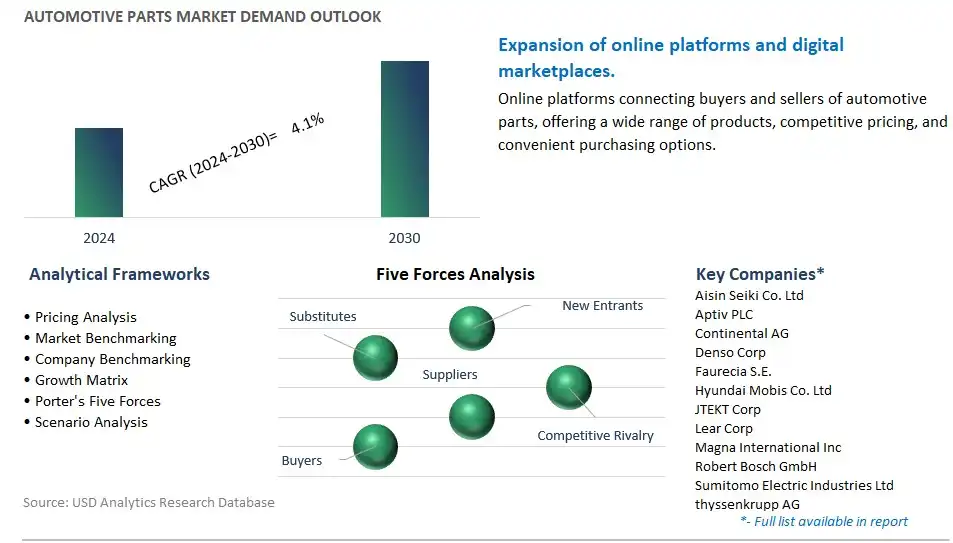
Automotive Parts Market is estimated to increase at a growth rate of 4.1% CAGR over the forecast period from 2024 to 2030.
The global Automotive Parts Market study analyzes and forecasts the market size across 6 regions and 24 countries for diverse segments including By Type (Bodies and Parts, Windshields, Chassis and Drivetrain Parts, Electrical and Electric Components, Engines and Parts, Miscellaneous Parts), By Sales Channel (OEM, After Market).
An Introduction to Global Automotive Parts Market, 2024
The Automotive Parts Market encompasses the production, distribution, and sale of various components and accessories used in vehicle assembly, maintenance, and repair. This market includes a wide range of products, such as engine parts, chassis components, electrical systems, braking systems, and interior/exterior accessories. With the automotive industry's continuous growth and vehicle parc expansion, the demand for replacement parts and aftermarket accessories remains robust. Manufacturers and suppliers in this market focus on delivering high-quality, reliable parts that meet or exceed original equipment manufacturer (OEM) standards. Moreover, advancements in manufacturing processes, materials, and technologies drive innovation, leading to improved performance, durability, and compatibility of automotive parts. Additionally, as vehicle designs become more complex and incorporate advanced features, the Automotive Parts Market presents opportunities for further innovation and customization to meet the evolving needs of vehicle owners, repair shops, and aftermarket distributors.
Automotive Parts Competitive Landscape
The global Automotive Parts market is highly competitive with a large number of companies focusing on niche market segments. Amidst intense competitive conditions, Automotive Parts Companies are investing in new product launches and strengthening distribution channels. Key companies operating in the Automotive Parts Market Industry include- Aisin Seiki Co. Ltd, Aptiv PLC, Continental AG, Denso Corp, Faurecia S.E., Hyundai Mobis Co. Ltd, JTEKT Corp, Lear Corp, Magna International Inc, Robert Bosch GmbH, Sumitomo Electric Industries Ltd, thyssenkrupp AG, Valeo S.A., Yazaki Corp, ZF Friedrichshafen AG.
Automotive Parts Market Trend: Shift Towards Electric and Hybrid Vehicles
A prominent trend in the automotive parts market is the ongoing shift towards electric and hybrid vehicles. With increasing concerns about environmental sustainability and stricter emissions regulations worldwide, there has been a significant rise in the adoption of electric and hybrid vehicles. This shift is driving the demand for various automotive parts specifically designed for electric and hybrid powertrains, including batteries, electric motors, inverters, and charging systems. As automakers continue to invest in electrification efforts, the demand for these specialized automotive parts is expected to grow rapidly, reshaping the landscape of the automotive parts market.
Automotive Parts Market Driver: Increasing Vehicle Sales and Vehicle Age
A key driver fueling the automotive parts market is the increasing sales of vehicles globally, coupled with the aging vehicle population. As the global economy grows and disposable incomes rise, the demand for passenger and commercial vehicles continues to increase, leading to higher vehicle sales volumes. Additionally, the average age of vehicles on the road has been steadily rising, resulting in higher demand for replacement parts due to wear and tear, accidents, and maintenance requirements. This trend is driving the aftermarket segment of the automotive parts market, as vehicle owners seek high-quality replacement parts to maintain and repair their vehicles, creating lucrative opportunities for parts manufacturers and suppliers.
Automotive Parts Market Opportunity: Growth of Online Retail Channels
An opportunity for the automotive parts market lies in the growth of online retail channels. With the proliferation of e-commerce platforms and the increasing preference for online shopping among consumers, there is a growing trend towards purchasing automotive parts and accessories online. Online retail channels offer convenience, a wide selection of products, competitive pricing, and easy comparison shopping, attracting both individual vehicle owners and professional mechanics. Parts manufacturers and retailers can capitalize on this trend by establishing robust online presence, optimizing their e-commerce platforms, and providing seamless purchasing experiences to customers. By embracing online retail channels, automotive parts suppliers can expand their reach, tap into new customer segments, and drive growth in the aftermarket automotive parts market.
Automotive Parts Market Segmentation
By Type
Bodies and Parts
Windshields
Chassis and Drivetrain Parts
Electrical and Electric Components
Engines and Parts
Miscellaneous Parts
By Sales Channel
OEM
After MarketGeographical Analysis
North America (United States, Canada, Mexico)
Europe (Germany, France, United Kingdom, Spain, Italy, Rest of Europe)
Asia Pacific (China, India, Japan, South Korea, Rest of Asia Pacific)
South America (Brazil, Argentina, Rest of South America)
Middle East and Africa (Saudi Arabia, UAE, Rest of Middle East, South Africa, Egypt, Rest of Africa
Automotive Parts Companies
Aisin Seiki Co. Ltd
Aptiv PLC
Continental AG
Denso Corp
Faurecia S.E.
Hyundai Mobis Co. Ltd
JTEKT Corp
Lear Corp
Magna International Inc
Robert Bosch GmbH
Sumitomo Electric Industries Ltd
thyssenkrupp AG
Valeo S.A.
Yazaki Corp
ZF Friedrichshafen AG
*- List not Exhaustive
TABLE OF CONTENTS
1 Introduction to 2024 Automotive Parts Market
1.1 Market Overview
1.2 Quick Facts
1.3 Scope/Objective of the Study
1.4 Market Definition
1.5 Countries and Regions Analyzed
1.6 Units, Currency, and Conversions
1.7 Industry Value Chain
2 Research Methodology
2.1 Market Size Estimation
2.2 Sources and Research Methodology
2.3 Data Triangulation
2.4 Assumptions and Limitations
3 Executive Summary
3.1 Global Automotive Parts Market Size Outlook, $ Million, 2021 to 2030
3.2 Automotive Parts Market Outlook by Type, $ Million, 2021 to 2030
3.3 Automotive Parts Market Outlook by Product, $ Million, 2021 to 2030
3.4 Automotive Parts Market Outlook by Application, $ Million, 2021 to 2030
3.5 Automotive Parts Market Outlook by Key Countries, $ Million, 2021 to 2030
4 Market Dynamics
4.1 Key Driving Forces of Automotive Parts Industry
4.2 Key Market Trends in Automotive Parts Industry
4.3 Potential Opportunities in Automotive Parts Industry
4.4 Key Challenges in Automotive Parts Industry
5 Market Factor Analysis
5.1 Value Chain Analysis
5.2 Competitive Landscape
5.2.1 Global Automotive Parts Market Share by Company (%), 2023
5.2.2 Product Offerings by Company
5.3 Porter’s Five Forces Analysis
5.4 Pricing Analysis and Outlook
6 Growth Outlook Across Scenarios
6.1 Growth Analysis-Case Scenario Definitions
6.2 Low Growth Scenario Forecasts
6.3 Reference Growth Scenario Forecasts
6.4 High Growth Scenario Forecasts
7 Global Automotive Parts Market Outlook by Segments
7.1 Automotive Parts Market Outlook by Segments, $ Million, 2021- 2030
By Type
Bodies and Parts
Windshields
Chassis and Drivetrain Parts
Electrical and Electric Components
Engines and Parts
Miscellaneous Parts
By Sales Channel
OEM
After Market
8 North America Automotive Parts Market Analysis and Outlook To 2030
8.1 Introduction to North America Automotive Parts Markets in 2024
8.2 North America Automotive Parts Market Size Outlook by Country, 2021-2030
8.2.1 United States
8.2.2 Canada
8.2.3 Mexico
8.3 North America Automotive Parts Market size Outlook by Segments, 2021-2030
By Type
Bodies and Parts
Windshields
Chassis and Drivetrain Parts
Electrical and Electric Components
Engines and Parts
Miscellaneous Parts
By Sales Channel
OEM
After Market
9 Europe Automotive Parts Market Analysis and Outlook To 2030
9.1 Introduction to Europe Automotive Parts Markets in 2024
9.2 Europe Automotive Parts Market Size Outlook by Country, 2021-2030
9.2.1 Germany
9.2.2 France
9.2.3 Spain
9.2.4 United Kingdom
9.2.4 Italy
9.2.5 Russia
9.2.6 Norway
9.2.7 Rest of Europe
9.3 Europe Automotive Parts Market Size Outlook by Segments, 2021-2030
By Type
Bodies and Parts
Windshields
Chassis and Drivetrain Parts
Electrical and Electric Components
Engines and Parts
Miscellaneous Parts
By Sales Channel
OEM
After Market
10 Asia Pacific Automotive Parts Market Analysis and Outlook To 2030
10.1 Introduction to Asia Pacific Automotive Parts Markets in 2024
10.2 Asia Pacific Automotive Parts Market Size Outlook by Country, 2021-2030
10.2.1 China
10.2.2 India
10.2.3 Japan
10.2.4 South Korea
10.2.5 Indonesia
10.2.6 Malaysia
10.2.7 Australia
10.2.8 Rest of Asia Pacific
10.3 Asia Pacific Automotive Parts Market size Outlook by Segments, 2021-2030
By Type
Bodies and Parts
Windshields
Chassis and Drivetrain Parts
Electrical and Electric Components
Engines and Parts
Miscellaneous Parts
By Sales Channel
OEM
After Market
11 South America Automotive Parts Market Analysis and Outlook To 2030
11.1 Introduction to South America Automotive Parts Markets in 2024
11.2 South America Automotive Parts Market Size Outlook by Country, 2021-2030
11.2.1 Brazil
11.2.2 Argentina
11.2.3 Rest of South America
11.3 South America Automotive Parts Market size Outlook by Segments, 2021-2030
By Type
Bodies and Parts
Windshields
Chassis and Drivetrain Parts
Electrical and Electric Components
Engines and Parts
Miscellaneous Parts
By Sales Channel
OEM
After Market
12 Middle East and Africa Automotive Parts Market Analysis and Outlook To 2030
12.1 Introduction to Middle East and Africa Automotive Parts Markets in 2024
12.2 Middle East and Africa Automotive Parts Market Size Outlook by Country, 2021-2030
12.2.1 Saudi Arabia
12.2.2 UAE
12.2.3 Oman
12.2.4 Rest of Middle East
12.2.5 Egypt
12.2.6 Nigeria
12.2.7 South Africa
12.2.8 Rest of Africa
12.3 Middle East and Africa Automotive Parts Market size Outlook by Segments, 2021-2030
By Type
Bodies and Parts
Windshields
Chassis and Drivetrain Parts
Electrical and Electric Components
Engines and Parts
Miscellaneous Parts
By Sales Channel
OEM
After Market
13 Company Profiles
13.1 Company Snapshot
13.2 SWOT Profiles
13.3 Products and Services
13.4 Recent Developments
13.5 Financial Profile
List of Companies
Aisin Seiki Co. Ltd
Aptiv PLC
Continental AG
Denso Corp
Faurecia S.E.
Hyundai Mobis Co. Ltd
JTEKT Corp
Lear Corp
Magna International Inc
Robert Bosch GmbH
Sumitomo Electric Industries Ltd
thyssenkrupp AG
Valeo S.A.
Yazaki Corp
ZF Friedrichshafen AG
14 Appendix
14.1 Customization Offerings
14.2 Subscription Services
14.3 Related Reports
14.4 Publisher Expertise
By Type
Bodies and Parts
Windshields
Chassis and Drivetrain Parts
Electrical and Electric Components
Engines and Parts
Miscellaneous Parts
By Sales Channel
OEM
After Market
