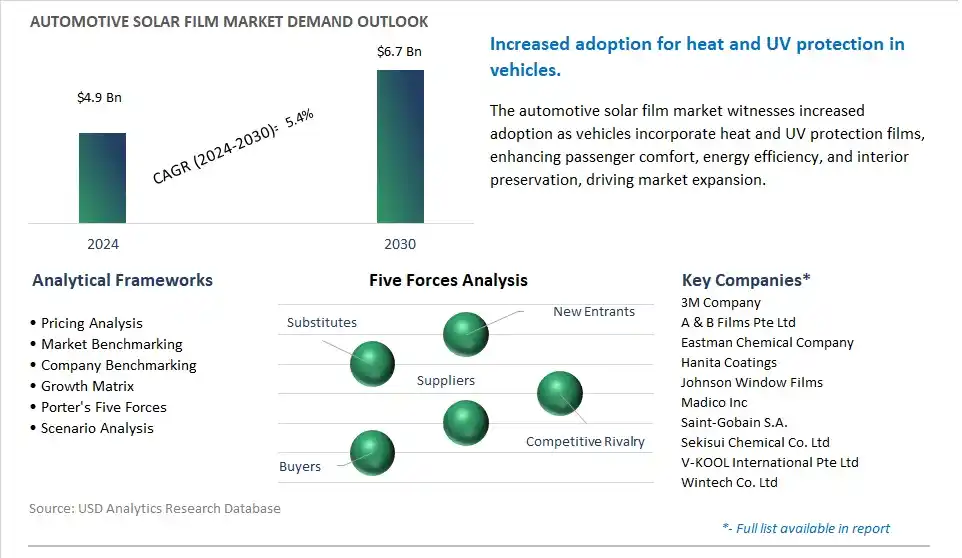
The global Automotive Solar Film Market is poised to register a 5.4% CAGR from $4.9 Billion in 2024 to $6.7 Billion in 2030.
The global Automotive Solar Film Market Study analyzes and forecasts the market size across 6 regions and 24 countries for diverse segments -By Type (Automotive Window Films, Automotive Wrap Films, Paint Protection Films), By Vehicle (Passenger Cars, Light Commercial Vehicles, Heavy Commercial Vehicles).
An Introduction to Global Automotive Solar Film Market in 2024
The market for automotive solar film is witnessing growth as vehicle owners seek to improve interior comfort, protect occupants from UV radiation, and enhance energy efficiency. Key trends shaping the future of this industry include the development of advanced solar film technologies with superior heat rejection, glare reduction, and UV blocking properties, which help maintain a comfortable cabin temperature and protect interior surfaces from fading and degradation. Additionally, advancements in film manufacturing processes and material science enable the production of thin, optically clear films that adhere seamlessly to vehicle windows without affecting visibility or aesthetics. Moreover, the adoption of smart solar film solutions with variable tinting capabilities and integrated electronics enhances user control and customization options, further optimizing cabin comfort and privacy. As consumers increasingly prioritize comfort, convenience, and sustainability in their vehicles, the demand for automotive solar film is expected to continue growing, driving innovation and market expansion in this sector.
Automotive Solar Film Market Competitive Landscape
The market report analyses the leading companies in the industry including 3M Company, A & B Films Pte Ltd, Eastman Chemical Company, Hanita Coatings, Johnson Window Films, Madico Inc, Saint-Gobain S.A., Sekisui Chemical Co. Ltd, V-KOOL International Pte Ltd, Wintech Co. Ltd.
Automotive Solar Film Market Dynamics
Automotive Solar Film Market Trend: Growing Demand for Energy-Efficient Vehicles and Sustainability
A prominent trend in the automotive industry is the growing demand for energy-efficient vehicles and sustainability, driving the adoption of automotive solar film. With increasing concerns about climate change and fuel consumption, consumers and automakers alike are seeking innovative solutions to reduce carbon emissions and improve vehicle efficiency. Automotive solar film offers a sustainable solution by harnessing solar energy to power auxiliary systems, such as air conditioning and electronics, thereby reducing the load on the vehicle's electrical system and improving fuel economy. Additionally, solar film can help mitigate the greenhouse gas emissions associated with traditional vehicle operation, aligning with the industry's efforts towards environmental stewardship and sustainable mobility solutions. As the focus on energy efficiency and sustainability continues to intensify, the demand for automotive solar film is expected to rise, driving market growth.
Automotive Solar Film Market Driver: Regulatory Incentives and Emission Reduction Policies
A key driver behind the increasing demand for automotive solar film is the implementation of regulatory incentives and emission reduction policies by governments worldwide. Many countries and regions are introducing initiatives to incentivize the adoption of clean and renewable energy technologies in vehicles, including solar-powered solutions. Government subsidies, tax credits, and rebates for electric and hybrid vehicles equipped with solar film are encouraging automakers and consumers to invest in this technology as a means to reduce greenhouse gas emissions and dependence on fossil fuels. Moreover, stringent emission regulations and fuel economy standards are pushing automakers to explore innovative technologies, such as automotive solar film, to meet regulatory requirements and improve the environmental performance of their vehicles. As regulatory pressure intensifies, the demand for automotive solar film as a sustainable energy solution is expected to grow, creating opportunities for market expansion.
Automotive Solar Film Market Opportunity: Integration with Advanced Vehicle Technologies
An emerging opportunity for the automotive solar film market lies in the integration with advanced vehicle technologies, such as electric propulsion systems and autonomous driving capabilities. As the automotive industry undergoes a transformation towards electrification and autonomy, there is a growing need for energy-efficient solutions that can complement and enhance the performance of these advanced technologies. Automotive solar film can be integrated into electric vehicles to provide supplementary power for charging the battery, extending the driving range, and reducing reliance on grid-based electricity. Furthermore, solar film can enhance the energy efficiency of autonomous vehicles by powering onboard sensors, computing systems, and communication devices, thereby reducing the overall energy consumption of these vehicles. By leveraging the synergies between automotive solar film and advanced vehicle technologies, manufacturers can create value-added solutions that address the evolving needs of the automotive market while driving innovation and differentiation in the industry.
Automotive Solar Film Market Ecosystem
The automotive solar film market begins with material production, where companies including Eastman Chemical Company and Mitsubishi Chemical Corporation manufacture base films including polyester, and develop functional coatings including UV absorbers and scratch-resistant layers. These materials are then converted into solar film products through coating processes by manufacturers including Llumar, 3M Company, and Johnson Window Films.
Distribution and sales channels play a crucial role, with distribution companies specializing in automotive aftermarket products and solar film manufacturers utilizing established networks to reach consumers through wholesale or direct sales channels. Installation is a key stage where professional window tinting shops ensure the proper application of solar film while adhering to regulatory requirements. Further, aftermarket sales and service involve limited roles, mainly concerning replacement film, with window tinting shops serving as the primary point of contact for consumers seeking these services.
Automotive Solar Film Market Share Analysis: Automotive Window Films held the dominant revenue share in 2024
The segment of automotive window films is the largest segment in the automotive solar film market due to its widespread application and multifaceted benefits. Automotive window films offer various advantages, including heat rejection, UV protection, glare reduction, and enhanced privacy, making them a popular choice among vehicle owners worldwide. These films are applied to the windows of cars, trucks, and other vehicles to improve interior comfort, protect occupants from harmful UV radiation, and enhance the overall aesthetic appeal of the vehicle. In addition, automotive window films contribute to energy efficiency by reducing the need for air conditioning, thus improving fuel economy and reducing carbon emissions. As consumer awareness regarding the importance of sun protection and energy conservation grows, the demand for automotive window films is expected to continue its upward trajectory. Additionally, advancements in film technology, such as nanotechnology-based films offering superior heat rejection and optical clarity, further bolster the dominance of automotive window films in the market. Overall, the combination of practical benefits and technological advancements positions automotive window films as the largest segment in the automotive solar film market.
Automotive Solar Film Market Share Analysis: Passenger Cars is the fastest growing market segment over the forecast period to 2030
The segment of passenger cars is the fastest-growing segment in the automotive solar film market due to diverse key factors influencing its accelerated demand and adoption. Passenger cars represent the largest segment of the automotive market globally, with a significant portion of consumers prioritizing comfort, privacy, and UV protection in their vehicles. Automotive solar films offer an effective solution to address these needs by providing heat rejection, UV protection, glare reduction, and enhanced privacy for passengers. In addition, the rising trend toward vehicle customization and personalization further drives the demand for automotive solar films among passenger car owners who seek to improve the aesthetics and functionality of their vehicles. Additionally, the increasing awareness of the harmful effects of UV radiation on skin health and interior vehicle components prompts more consumers to invest in solar films to protect themselves and their vehicles. Further, advancements in film technology, such as ceramic and Nano-ceramic films offering superior heat rejection and optical clarity, contribute to the growing popularity of automotive solar films among passenger car owners. As the demand for passenger cars continues to rise globally, driven by urbanization, economic growth, and changing consumer preferences, the segment is expected to maintain its rapid growth trajectory in the automotive solar film market.
Automotive Solar Film Market Report Scope-
By Type
Automotive Window Films
Automotive Wrap Films
Paint Protection Films
By Vehicle
Passenger Cars
Light Commercial Vehicles
Heavy Commercial Vehicles
Automotive Solar Film Market Companies Profiled
3M Company
A & B Films Pte Ltd
Eastman Chemical Company
Hanita Coatings
Johnson Window Films
Madico Inc
Saint-Gobain S.A.
Sekisui Chemical Co. Ltd
V-KOOL International Pte Ltd
Wintech Co. Ltd
*- List Not Exhaustive
TABLE OF CONTENTS
1 Introduction to 2024 Automotive Solar Film Market
1.1 Market Overview
1.2 Quick Facts
1.3 Scope/Objective of the Study
1.4 Market Definition
1.5 Countries and Regions Covered
1.6 Units, Currency, and Conversions
1.7 Industry Value Chain
2 Research Methodology
2.1 Market Size Estimation
2.2 Sources and Research Methodology
2.3 Data Triangulation
2.4 Assumptions and Limitations
3 Executive Summary
3.1 Global Automotive Solar Film Market Size Outlook, $ Million, 2021 to 2030
3.2 Automotive Solar Film Market Outlook by Type, $ Million, 2021 to 2030
3.3 Automotive Solar Film Market Outlook by Product, $ Million, 2021 to 2030
3.4 Automotive Solar Film Market Outlook by Application, $ Million, 2021 to 2030
3.5 Automotive Solar Film Market Outlook by Key Countries, $ Million, 2021 to 2030
4 Market Dynamics
4.1 Key Driving Forces of Automotive Solar Film Industry
4.2 Key Market Trends in Automotive Solar Film Industry
4.3 Potential Opportunities in Automotive Solar Film Industry
4.4 Key Challenges in Automotive Solar Film Industry
5 Market Factor Analysis
5.1 Value Chain Analysis
5.2 Competitive Landscape
5.2.1 Global Automotive Solar Film Market Share by Company (%), 2023
5.2.2 Product Offerings by Company
5.3 Porter’s Five Forces Analysis
5.4 Pricing Analysis and Outlook
6 Growth Outlook Across Scenarios
6.1 Growth Analysis-Case Scenario Definitions
6.2 Low Growth Scenario Forecasts
6.3 Reference Growth Scenario Forecasts
6.4 High Growth Scenario Forecasts
7 Global Automotive Solar Film Market Outlook by Segments
7.1 Automotive Solar Film Market Outlook by Segments, $ Million, 2021- 2030
By Type
Automotive Window Films
Automotive Wrap Films
Paint Protection Films
By Vehicle
Passenger Cars
Light Commercial Vehicles
Heavy Commercial Vehicles
8 North America Automotive Solar Film Market Analysis and Outlook To 2030
8.1 Introduction to North America Automotive Solar Film Markets in 2024
8.2 North America Automotive Solar Film Market Size Outlook by Country, 2021-2030
8.2.1 United States
8.2.2 Canada
8.2.3 Mexico
8.3 North America Automotive Solar Film Market size Outlook by Segments, 2021-2030
By Type
Automotive Window Films
Automotive Wrap Films
Paint Protection Films
By Vehicle
Passenger Cars
Light Commercial Vehicles
Heavy Commercial Vehicles
9 Europe Automotive Solar Film Market Analysis and Outlook To 2030
9.1 Introduction to Europe Automotive Solar Film Markets in 2024
9.2 Europe Automotive Solar Film Market Size Outlook by Country, 2021-2030
9.2.1 Germany
9.2.2 France
9.2.3 Spain
9.2.4 United Kingdom
9.2.4 Italy
9.2.5 Russia
9.2.6 Norway
9.2.7 Rest of Europe
9.3 Europe Automotive Solar Film Market Size Outlook by Segments, 2021-2030
By Type
Automotive Window Films
Automotive Wrap Films
Paint Protection Films
By Vehicle
Passenger Cars
Light Commercial Vehicles
Heavy Commercial Vehicles
10 Asia Pacific Automotive Solar Film Market Analysis and Outlook To 2030
10.1 Introduction to Asia Pacific Automotive Solar Film Markets in 2024
10.2 Asia Pacific Automotive Solar Film Market Size Outlook by Country, 2021-2030
10.2.1 China
10.2.2 India
10.2.3 Japan
10.2.4 South Korea
10.2.5 Indonesia
10.2.6 Malaysia
10.2.7 Australia
10.2.8 Rest of Asia Pacific
10.3 Asia Pacific Automotive Solar Film Market size Outlook by Segments, 2021-2030
By Type
Automotive Window Films
Automotive Wrap Films
Paint Protection Films
By Vehicle
Passenger Cars
Light Commercial Vehicles
Heavy Commercial Vehicles
11 South America Automotive Solar Film Market Analysis and Outlook To 2030
11.1 Introduction to South America Automotive Solar Film Markets in 2024
11.2 South America Automotive Solar Film Market Size Outlook by Country, 2021-2030
11.2.1 Brazil
11.2.2 Argentina
11.2.3 Rest of South America
11.3 South America Automotive Solar Film Market size Outlook by Segments, 2021-2030
By Type
Automotive Window Films
Automotive Wrap Films
Paint Protection Films
By Vehicle
Passenger Cars
Light Commercial Vehicles
Heavy Commercial Vehicles
12 Middle East and Africa Automotive Solar Film Market Analysis and Outlook To 2030
12.1 Introduction to Middle East and Africa Automotive Solar Film Markets in 2024
12.2 Middle East and Africa Automotive Solar Film Market Size Outlook by Country, 2021-2030
12.2.1 Saudi Arabia
12.2.2 UAE
12.2.3 Oman
12.2.4 Rest of Middle East
12.2.5 Egypt
12.2.6 Nigeria
12.2.7 South Africa
12.2.8 Rest of Africa
12.3 Middle East and Africa Automotive Solar Film Market size Outlook by Segments, 2021-2030
By Type
Automotive Window Films
Automotive Wrap Films
Paint Protection Films
By Vehicle
Passenger Cars
Light Commercial Vehicles
Heavy Commercial Vehicles
13 Company Profiles
13.1 Company Snapshot
13.2 SWOT Profiles
13.3 Products and Services
13.4 Recent Developments
13.5 Financial Profile
3M Company
A & B Films Pte Ltd
Eastman Chemical Company
Hanita Coatings
Johnson Window Films
Madico Inc
Saint-Gobain S.A.
Sekisui Chemical Co. Ltd
V-KOOL International Pte Ltd
Wintech Co. Ltd
14 Appendix
14.1 Customization Offerings
14.2 Subscription Services
14.3 Related Reports
14.4 Publisher Expertise
By Type
Automotive Window Films
Automotive Wrap Films
Paint Protection Films
By Vehicle
Passenger Cars
Light Commercial Vehicles
Heavy Commercial Vehicles
Countries Analyzed
North America (US, Canada, Mexico)
Europe (Germany, UK, France, Spain, Italy, Russia, Rest of Europe)
Asia Pacific (China, India, Japan, South Korea, Australia, South East Asia, Rest of Asia)
South America (Brazil, Argentina, Rest of South America)
Middle East and Africa (Saudi Arabia, UAE, Rest of Middle East, South Africa, Egypt, Rest of Africa)
