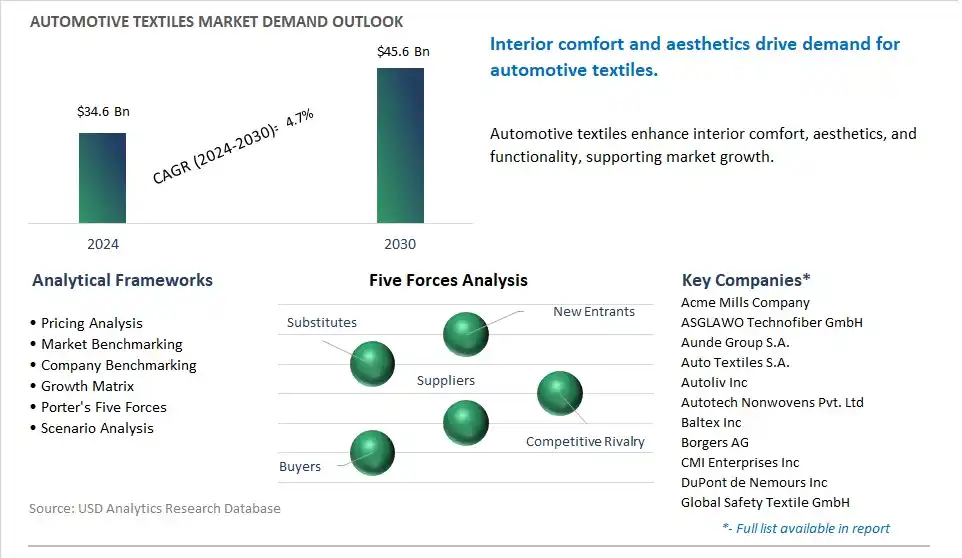
The global Automotive Textiles Market is poised to register a 4.7% CAGR from $34.6 Billion in 2024 to $45.6 Billion in 2030.
The global Automotive Textiles Market Study analyzes and forecasts the market size across 6 regions and 24 countries for diverse segments -By Product (Woven, Nonwoven, Composites, Others), By Application (Upholstery, Tires, Safety Devices, Engine Components, Others).
An Introduction to Global Automotive Textiles Market in 2024
The automotive textiles market is witnessing steady growth driven by increasing demand for interior comfort, aesthetics, and safety features in vehicles. Key trends shaping the future of the industry include the growing adoption of high-performance textiles for automotive upholstery, carpets, and headliners to enhance passenger comfort, durability, and acoustic insulation. Moreover, there's a rising emphasis on sustainable and eco-friendly textile materials such as recycled fibers, bio-based polymers, and natural fibers like wool and cotton, addressing environmental concerns and consumer preferences for green automotive solutions. Additionally, advancements in textile manufacturing technologies, antimicrobial treatments, and flame-retardant finishes are driving innovation and market expansion, enabling textile suppliers to offer innovative and customizable solutions for automotive OEMs and interior trim manufacturers in the global automotive textiles market.
Automotive Textiles Market Competitive Landscape
The market report analyses the leading companies in the industry including Acme Mills Company, ASGLAWO Technofiber GmbH, Aunde Group S.A., Auto Textiles S.A., Autoliv Inc, Autotech Nonwovens Pvt. Ltd, Baltex Inc, Borgers AG, CMI Enterprises Inc, DuPont de Nemours Inc, Global Safety Textile GmbH, International Textile Group Inc, Johnson Controls International plc, Lear Corp, Reliance Industries Ltd, Sage Automotive Interiors Inc, SMS Auto Fabrics Inc, Suminoe Textile Co. Ltd, Toyota Boshoku Corp.
Automotive Textiles Market Dynamics
Automotive Textiles Market Trend: Integration of Smart Textiles and Functional Fabrics
A prominent market trend for automotive textiles is the integration of smart textiles and functional fabrics into vehicle interiors. As automotive manufacturers prioritize innovation and differentiation in vehicle design, there's a growing demand for textiles that offer not only aesthetic appeal but also enhanced functionality and comfort. Smart textiles embedded with sensors, conductive threads, and heating elements are being incorporated into seating, upholstery, and interior surfaces to provide advanced features such as temperature regulation, moisture management, and occupant monitoring. Additionally, functional fabrics with properties such as stain resistance, flame retardancy, and noise reduction are gaining popularity, reflecting consumer preferences for durable and versatile materials in automotive interiors. This trend underscores the convergence of technology and textiles in the automotive industry, driving the adoption of innovative textile solutions to enhance the overall driving experience.
Automotive Textiles Market Driver: Consumer Demand for Comfort, Safety, and Customization
A significant driver for the automotive textiles market is consumer demand for comfort, safety, and customization in vehicle interiors. As consumers spend increasing amounts of time in their vehicles, they prioritize comfort and convenience features that enhance the driving experience. Automotive textiles play a vital role in meeting these expectations by providing soft-touch surfaces, ergonomic seating, and customizable interior options that cater to individual preferences. Additionally, with growing awareness of vehicle safety and health concerns, there's a demand for textiles that offer antimicrobial properties, UV protection, and allergen resistance to promote a clean and healthy interior environment. Furthermore, the desire for personalization drives the demand for customizable textiles, allowing vehicle owners to express their style and individuality through unique fabric patterns, colors, and textures. Consumer preferences for comfort, safety, and customization act as key drivers for the automotive textiles market, influencing the adoption of innovative textile solutions by automotive manufacturers and suppliers.
Automotive Textiles Market Opportunity: Development of Sustainable and Recyclable Textile Materials
An opportunity for the automotive textiles market lies in the development of sustainable and recyclable textile materials. With increasing environmental awareness and regulatory pressures to reduce carbon footprint and waste, there's a growing demand for eco-friendly textiles in the automotive industry. Manufacturers have the opportunity to innovate and develop textiles using sustainable fibers such as recycled polyester, organic cotton, and bio-based materials derived from renewable sources. Additionally, advancements in textile recycling technologies enable the production of recycled and recyclable fabrics that meet performance and quality standards for automotive applications. By embracing sustainability and offering environmentally friendly textile solutions, automotive textile suppliers can capitalize on the growing market demand for sustainable materials, differentiate their products, and strengthen their position in the automotive industry as responsible and environmentally conscious partners.
Automotive Textiles Market Share Analysis: Woven segment generated the highest revenue in the industry
The Woven segment is the largest in the Automotive Textiles Market, primarily due to its versatility, durability, and wide range of applications across the automotive industry. Woven textiles are produced by interlacing yarns or fibers in a crisscross pattern, resulting in a strong and stable fabric structure. In the automotive sector, woven textiles find extensive use in various applications, including seat upholstery, interior trim, carpets, headliners, and airbags. The durability and strength of woven fabrics make them suitable for withstanding the rigors of automotive use, including abrasion, stretching, and exposure to sunlight and chemicals. Additionally, woven textiles offer design flexibility, allowing for the creation of intricate patterns, textures, and colors to meet aesthetic preferences and brand identities. In addition, advancements in weaving technology, such as digital looms and computerized Jacquard systems, have enhanced the efficiency and quality of woven textile production, further contributing to their dominance in the Automotive Textiles Market. Further, woven textiles are widely available and cost-effective compared to other types of automotive textiles, making them a preferred choice for both OEMs and aftermarket suppliers. As a result of these factors, the Woven segment remains the largest in the Automotive Textiles Market.
Automotive Textiles Market Share Analysis: Safety Devices Segment is poised to register the fastest growth rate (CAGR) over the forecast period to 2030
The Safety Devices segment is the fastest-growing sector within the Automotive Textiles Market, driven by diverse key factors. Safety devices in automobiles, such as airbags, seatbelts, and headrests, play a critical role in protecting occupants during accidents and collisions. Textiles are an integral component of these safety devices, providing cushioning, energy absorption, and restraint functionalities. As automotive safety regulations become more stringent worldwide and consumer demand for enhanced safety features grows, there is a corresponding increase in the adoption of advanced textile materials for safety devices. Textiles used in safety devices need to meet strict performance requirements, including high strength, abrasion resistance, flame retardancy, and compatibility with airbag deployment systems. Additionally, advancements in textile manufacturing techniques and materials technology have led to the development of specialized fabrics and composites tailored for use in safety applications, further driving their adoption in the automotive industry. In addition, the trend towards vehicle electrification and autonomous driving has created new opportunities for integrating safety textiles into advanced restraint systems and occupant protection mechanisms. As a result of these factors, the Safety Devices segment is expected to experience rapid growth in the Automotive Textiles Market.
Automotive Textiles Market Report Segmentation
By Product
Woven
Nonwoven
Composites
Others
By Application
Upholstery
Tires
Safety Devices
Engine Components
Others
Regions Included
North America (US, Canada, Mexico)
Europe (Germany, UK, France, Spain, Italy, Russia, Rest of Europe)
Asia Pacific (China, India, Japan, South Korea, Australia, South East Asia, Rest of Asia)
South America (Brazil, Argentina, Rest of South America)
Middle East and Africa (Saudi Arabia, UAE, Rest of Middle East, South Africa, Egypt, Rest of Africa)
Automotive Textiles Companies Profiled in the Market Study
Acme Mills Company
ASGLAWO Technofiber GmbH
Aunde Group S.A.
Auto Textiles S.A.
Autoliv Inc
Autotech Nonwovens Pvt. Ltd
Baltex Inc
Borgers AG
CMI Enterprises Inc
DuPont de Nemours Inc
Global Safety Textile GmbH
International Textile Group Inc
Johnson Controls International plc
Lear Corp
Reliance Industries Ltd
Sage Automotive Interiors Inc
SMS Auto Fabrics Inc
Suminoe Textile Co. Ltd
Toyota Boshoku Corp
*- List Not Exhaustive
TABLE OF CONTENTS
1 Introduction to 2024 Automotive Textiles Market
1.1 Market Overview
1.2 Quick Facts
1.3 Scope/Objective of the Study
1.4 Market Definition
1.5 Countries and Regions Covered
1.6 Units, Currency, and Conversions
1.7 Industry Value Chain
2 Research Methodology
2.1 Market Size Estimation
2.2 Sources and Research Methodology
2.3 Data Triangulation
2.4 Assumptions and Limitations
3 Executive Summary
3.1 Global Automotive Textiles Market Size Outlook, $ Million, 2021 to 2030
3.2 Automotive Textiles Market Outlook by Type, $ Million, 2021 to 2030
3.3 Automotive Textiles Market Outlook by Product, $ Million, 2021 to 2030
3.4 Automotive Textiles Market Outlook by Application, $ Million, 2021 to 2030
3.5 Automotive Textiles Market Outlook by Key Countries, $ Million, 2021 to 2030
4 Market Dynamics
4.1 Key Driving Forces of Automotive Textiles Industry
4.2 Key Market Trends in Automotive Textiles Industry
4.3 Potential Opportunities in Automotive Textiles Industry
4.4 Key Challenges in Automotive Textiles Industry
5 Market Factor Analysis
5.1 Value Chain Analysis
5.2 Competitive Landscape
5.2.1 Global Automotive Textiles Market Share by Company (%), 2023
5.2.2 Product Offerings by Company
5.3 Porter’s Five Forces Analysis
5.4 Pricing Analysis and Outlook
6 Growth Outlook Across Scenarios
6.1 Growth Analysis-Case Scenario Definitions
6.2 Low Growth Scenario Forecasts
6.3 Reference Growth Scenario Forecasts
6.4 High Growth Scenario Forecasts
7 Global Automotive Textiles Market Outlook by Segments
7.1 Automotive Textiles Market Outlook by Segments, $ Million, 2021- 2030
By Product
Woven
Nonwoven
Composites
Others
By Application
Upholstery
Tires
Safety Devices
Engine Components
Others
8 North America Automotive Textiles Market Analysis and Outlook To 2030
8.1 Introduction to North America Automotive Textiles Markets in 2024
8.2 North America Automotive Textiles Market Size Outlook by Country, 2021-2030
8.2.1 United States
8.2.2 Canada
8.2.3 Mexico
8.3 North America Automotive Textiles Market size Outlook by Segments, 2021-2030
By Product
Woven
Nonwoven
Composites
Others
By Application
Upholstery
Tires
Safety Devices
Engine Components
Others
9 Europe Automotive Textiles Market Analysis and Outlook To 2030
9.1 Introduction to Europe Automotive Textiles Markets in 2024
9.2 Europe Automotive Textiles Market Size Outlook by Country, 2021-2030
9.2.1 Germany
9.2.2 France
9.2.3 Spain
9.2.4 United Kingdom
9.2.4 Italy
9.2.5 Russia
9.2.6 Norway
9.2.7 Rest of Europe
9.3 Europe Automotive Textiles Market Size Outlook by Segments, 2021-2030
By Product
Woven
Nonwoven
Composites
Others
By Application
Upholstery
Tires
Safety Devices
Engine Components
Others
10 Asia Pacific Automotive Textiles Market Analysis and Outlook To 2030
10.1 Introduction to Asia Pacific Automotive Textiles Markets in 2024
10.2 Asia Pacific Automotive Textiles Market Size Outlook by Country, 2021-2030
10.2.1 China
10.2.2 India
10.2.3 Japan
10.2.4 South Korea
10.2.5 Indonesia
10.2.6 Malaysia
10.2.7 Australia
10.2.8 Rest of Asia Pacific
10.3 Asia Pacific Automotive Textiles Market size Outlook by Segments, 2021-2030
By Product
Woven
Nonwoven
Composites
Others
By Application
Upholstery
Tires
Safety Devices
Engine Components
Others
11 South America Automotive Textiles Market Analysis and Outlook To 2030
11.1 Introduction to South America Automotive Textiles Markets in 2024
11.2 South America Automotive Textiles Market Size Outlook by Country, 2021-2030
11.2.1 Brazil
11.2.2 Argentina
11.2.3 Rest of South America
11.3 South America Automotive Textiles Market size Outlook by Segments, 2021-2030
By Product
Woven
Nonwoven
Composites
Others
By Application
Upholstery
Tires
Safety Devices
Engine Components
Others
12 Middle East and Africa Automotive Textiles Market Analysis and Outlook To 2030
12.1 Introduction to Middle East and Africa Automotive Textiles Markets in 2024
12.2 Middle East and Africa Automotive Textiles Market Size Outlook by Country, 2021-2030
12.2.1 Saudi Arabia
12.2.2 UAE
12.2.3 Oman
12.2.4 Rest of Middle East
12.2.5 Egypt
12.2.6 Nigeria
12.2.7 South Africa
12.2.8 Rest of Africa
12.3 Middle East and Africa Automotive Textiles Market size Outlook by Segments, 2021-2030
By Product
Woven
Nonwoven
Composites
Others
By Application
Upholstery
Tires
Safety Devices
Engine Components
Others
13 Company Profiles
13.1 Company Snapshot
13.2 SWOT Profiles
13.3 Products and Services
13.4 Recent Developments
13.5 Financial Profile
Acme Mills Company
ASGLAWO Technofiber GmbH
Aunde Group S.A.
Auto Textiles S.A.
Autoliv Inc
Autotech Nonwovens Pvt. Ltd
Baltex Inc
Borgers AG
CMI Enterprises Inc
DuPont de Nemours Inc
Global Safety Textile GmbH
International Textile Group Inc
Johnson Controls International plc
Lear Corp
Reliance Industries Ltd
Sage Automotive Interiors Inc
SMS Auto Fabrics Inc
Suminoe Textile Co. Ltd
Toyota Boshoku Corp
14 Appendix
14.1 Customization Offerings
14.2 Subscription Services
14.3 Related Reports
14.4 Publisher Expertise
By Product
Woven
Nonwoven
Composites
Others
By Application
Upholstery
Tires
Safety Devices
Engine Components
Others
Countries Analyzed
North America (US, Canada, Mexico)
Europe (Germany, UK, France, Spain, Italy, Russia, Rest of Europe)
Asia Pacific (China, India, Japan, South Korea, Australia, South East Asia, Rest of Asia)
South America (Brazil, Argentina, Rest of South America)
Middle East and Africa (Saudi Arabia, UAE, Rest of Middle East, South Africa, Egypt, Rest of Africa)
