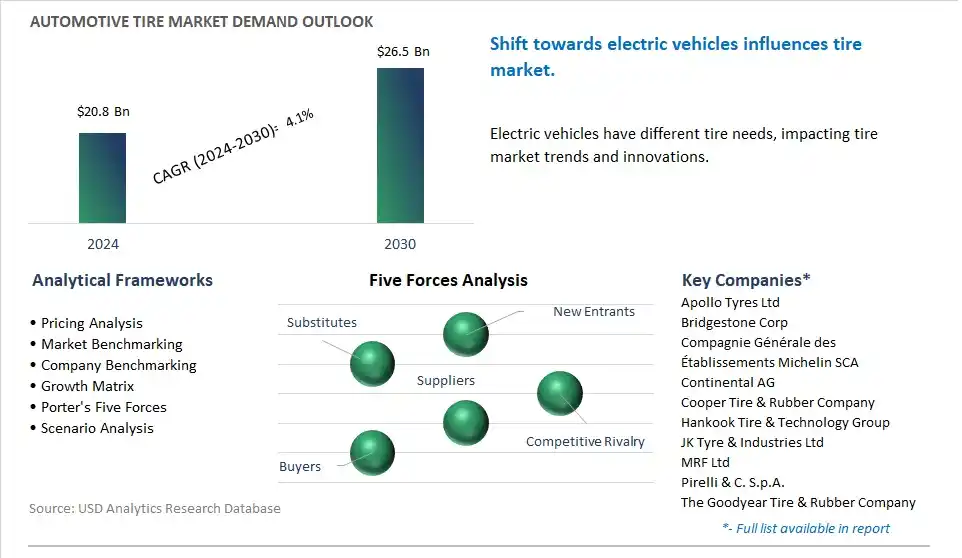
The global Automotive Tire Market is poised to register a 4.1% CAGR from $20.8 Billion in 2024 to $26.5 Billion in 2030.
The global Automotive Tire Market Study analyzes and forecasts the market size across 6 regions and 24 countries for diverse segments -By Type (Winter Tires, Summer Tires, Other Tire Types), By Application (On-the-Road, Off-the-Road), By Vehicle (Passenger Cars, Commercial Vehicles), By End-User (OEM, AfterMarket).
An Introduction to Global Automotive Tire Market in 2024
The automotive tire market is witnessing steady growth driven by increasing vehicle sales, rising demand for replacement tires, and advancements in tire technology. Key trends shaping the future of the industry include the growing adoption of run-flat tires, all-season tires, and low rolling resistance tires to improve vehicle handling, safety, and fuel efficiency. Moreover, there's a rising emphasis on tire labeling regulations and sustainability initiatives, leading to innovations in tire materials, tread designs, and manufacturing processes to reduce rolling resistance, noise emissions, and carbon footprint. Additionally, advancements in tire sensor technology, tire pressure monitoring systems (TPMS), and digital tire management solutions are driving innovation and market expansion, enabling tire manufacturers to offer innovative and intelligent tire solutions for automotive OEMs, fleet operators, and consumers in the global automotive tire market.
Automotive Tire Market Competitive Landscape
The market report analyses the leading companies in the industry including Apollo Tyres Ltd, Bridgestone Corp, Compagnie Générale des Établissements Michelin SCA, Continental AG, Cooper Tire & Rubber Company, Hankook Tire & Technology Group, JK Tyre & Industries Ltd, MRF Ltd, Pirelli & C. S.p.A., The Goodyear Tire & Rubber Company, The Yokohama Rubber Co. Ltd.
Automotive Tire Market Dynamics
Automotive Tire Market Trend: Adoption of Sustainable and Eco-Friendly Tire Materials
A prominent market trend for automotive tires is the increasing adoption of sustainable and eco-friendly tire materials. With growing environmental concerns and consumer demand for greener products, there's a rising trend towards the use of renewable and recycled materials in tire manufacturing. Tire manufacturers are exploring alternative materials such as natural rubber sourced from sustainable plantations, silica-based compounds for improved fuel efficiency, and recycled rubber from post-consumer tires. Additionally, advancements in tire design and production processes, such as energy-efficient curing methods and eco-friendly vulcanization agents, contribute to reducing the environmental impact of tire manufacturing. This trend reflects the industry's commitment to sustainability and environmental responsibility, driving the development and adoption of eco-friendly tire solutions.
Automotive Tire Market Driver: Increasing Vehicle Sales and Replacement Demand
A significant driver for the automotive tire market is the increasing sales of vehicles and replacement demand for tires. As the global automotive industry continues to grow, driven by factors such as urbanization, economic development, and increasing disposable income levels, there's a parallel increase in the demand for tires. Vehicle sales drive the original equipment (OE) tire market, with automakers specifying tires that meet performance, safety, and fuel efficiency requirements for new vehicles. Additionally, the aftermarket tire segment benefits from the growing vehicle parc and the need for tire replacement due to wear and tear, punctures, or aging. Furthermore, factors such as seasonal tire changes, tire rotations, and tire upgrades contribute to the ongoing replacement demand for tires. The expanding vehicle fleet and replacement market create opportunities for tire manufacturers and retailers to meet the growing demand for tires across various vehicle segments and regions.
Automotive Tire Market Opportunity: Integration of Smart Tire Technologies
An opportunity for the automotive tire market lies in the integration of smart tire technologies to enhance safety, performance, and connectivity. Smart tires equipped with sensors, embedded electronics, and connectivity capabilities offer a range of functionalities such as tire pressure monitoring, tread wear detection, temperature sensing, and real-time data transmission to vehicle systems or cloud platforms. These smart features enable proactive tire maintenance, early detection of tire issues, and optimization of tire performance for improved fuel efficiency, vehicle handling, and safety. Furthermore, smart tire data can be utilized for predictive maintenance, fleet management, and vehicle telematics applications, providing valuable insights for vehicle owners, fleet operators, and automotive manufacturers. By embracing smart tire technologies, tire manufacturers can differentiate their products, offer value-added solutions, and capitalize on the growing demand for connected and intelligent automotive components in the era of smart mobility.
Automotive Tire Market Share Analysis: Summer Tires segment generated the highest revenue in the industry
The Summer Tires segment is the largest in the Automotive Tire Market, primarily due to diverse key factors. Summer tires are designed to provide optimal performance in warm weather conditions, including dry and wet roads, making them suitable for use in most regions around the world. These tires are constructed with specialized rubber compounds that maintain flexibility and traction in higher temperatures, ensuring superior handling, cornering, and braking capabilities. In addition, summer tires feature tread patterns optimized for water evacuation, reducing the risk of hydroplaning and improving grip on wet surfaces. Additionally, summer tires offer a balance of performance characteristics, including responsiveness, comfort, and fuel efficiency, making them a popular choice for everyday driving. Further, the demand for summer tires is bolstered by their versatility, as they can be used on a wide range of vehicles, including passenger cars, SUVs, and light trucks. As a result of these factors, the Summer Tires segment dominates the Automotive Tire Market.
Automotive Tire Market Share Analysis: Off-the-Road (OTR) Tires Segment is poised to register the fastest growth rate (CAGR) over the forecast period to 2030
The Off-the-Road (OTR) Tires segment is the fastest-growing sector within the Automotive Tire Market, driven by diverse key factors. OTR tires are specifically designed for use in demanding environments such as construction sites, mining operations, agricultural fields, and forestry applications. As infrastructure development projects, mining activities, and agricultural operations expand globally, there is a growing demand for heavy-duty vehicles equipped with OTR tires to perform various tasks efficiently and safely. OTR tires are characterized by their robust construction, deep tread patterns, and puncture-resistant compounds, allowing them to withstand the rigors of off-road terrain, heavy loads, and harsh operating conditions. Additionally, advancements in tire technology, such as reinforced sidewalls, improved tread designs, and innovative rubber compounds, have enhanced the durability, traction, and load-carrying capacity of OTR tires, further driving their adoption. In addition, the trend towards larger and more powerful construction and mining equipment necessitates the use of specialized OTR tires capable of supporting heavy loads and operating in challenging environments. Further, increasing environmental regulations and sustainability concerns have prompted tire manufacturers to develop eco-friendly OTR tire solutions with reduced rolling resistance and improved fuel efficiency. As a result of these factors, the Off-the-Road (OTR) Tires segment is expected to experience rapid growth in the Automotive Tire Market.
Automotive Tire Market Share Analysis: Commercial Vehicles Segment is poised to register the fastest growth rate (CAGR) over the forecast period to 2030
The Commercial Vehicles segment is the fastest-growing sector within the Automotive Tire Market, driven by diverse key factors. Commercial vehicles, including trucks, buses, and vans, play a critical role in transportation, logistics, and commerce, carrying goods and passengers across various distances and terrains. As global trade, e-commerce, and urbanization continue to grow, there is an increasing demand for commercial vehicles to support the movement of goods and people. This heightened demand translates to a corresponding need for durable and reliable tires capable of withstanding heavy loads, long distances, and diverse operating conditions. Additionally, advancements in commercial vehicle technology, such as improvements in engine efficiency, aerodynamics, and vehicle connectivity, have raised performance expectations for tires, driving the adoption of innovative tire solutions. Further, regulatory requirements for fuel efficiency, emissions reductions, and safety standards incentivize commercial vehicle operators to invest in high-quality tires that contribute to Over the forecast period vehicle performance and compliance. In addition, the ongoing digitization and automation of commercial fleets have created opportunities for tire manufacturers to develop smart tire solutions with embedded sensors for real-time monitoring of tire pressure, temperature, and tread wear, further driving growth in this segment. As a result of these factors, the Commercial Vehicles segment is expected to experience rapid growth in the Automotive Tire Market.
Automotive Tire Market Report Segmentation
By Type
Winter Tires
Summer Tires
Other Tire Types
By Application
On-the-Road
Off-the-Road
By Vehicle
Passenger Cars
Commercial Vehicles
By End-User
OEM
AfterMarket
Regions Included
North America (US, Canada, Mexico)
Europe (Germany, UK, France, Spain, Italy, Russia, Rest of Europe)
Asia Pacific (China, India, Japan, South Korea, Australia, South East Asia, Rest of Asia)
South America (Brazil, Argentina, Rest of South America)
Middle East and Africa (Saudi Arabia, UAE, Rest of Middle East, South Africa, Egypt, Rest of Africa)
Automotive Tire Companies Profiled in the Market Study
Apollo Tyres Ltd
Bridgestone Corp
Compagnie Générale des Établissements Michelin SCA
Continental AG
Cooper Tire & Rubber Company
Hankook Tire & Technology Group
JK Tyre & Industries Ltd
MRF Ltd
Pirelli & C. S.p.A.
The Goodyear Tire & Rubber Company
The Yokohama Rubber Co. Ltd
*- List Not Exhaustive
TABLE OF CONTENTS
1 Introduction to 2024 Automotive Tire Market
1.1 Market Overview
1.2 Quick Facts
1.3 Scope/Objective of the Study
1.4 Market Definition
1.5 Countries and Regions Covered
1.6 Units, Currency, and Conversions
1.7 Industry Value Chain
2 Research Methodology
2.1 Market Size Estimation
2.2 Sources and Research Methodology
2.3 Data Triangulation
2.4 Assumptions and Limitations
3 Executive Summary
3.1 Global Automotive Tire Market Size Outlook, $ Million, 2021 to 2030
3.2 Automotive Tire Market Outlook by Type, $ Million, 2021 to 2030
3.3 Automotive Tire Market Outlook by Product, $ Million, 2021 to 2030
3.4 Automotive Tire Market Outlook by Application, $ Million, 2021 to 2030
3.5 Automotive Tire Market Outlook by Key Countries, $ Million, 2021 to 2030
4 Market Dynamics
4.1 Key Driving Forces of Automotive Tire Industry
4.2 Key Market Trends in Automotive Tire Industry
4.3 Potential Opportunities in Automotive Tire Industry
4.4 Key Challenges in Automotive Tire Industry
5 Market Factor Analysis
5.1 Value Chain Analysis
5.2 Competitive Landscape
5.2.1 Global Automotive Tire Market Share by Company (%), 2023
5.2.2 Product Offerings by Company
5.3 Porter’s Five Forces Analysis
5.4 Pricing Analysis and Outlook
6 Growth Outlook Across Scenarios
6.1 Growth Analysis-Case Scenario Definitions
6.2 Low Growth Scenario Forecasts
6.3 Reference Growth Scenario Forecasts
6.4 High Growth Scenario Forecasts
7 Global Automotive Tire Market Outlook by Segments
7.1 Automotive Tire Market Outlook by Segments, $ Million, 2021- 2030
By Type
Winter Tires
Summer Tires
Other Tire Types
By Application
On-the-Road
Off-the-Road
By Vehicle
Passenger Cars
Commercial Vehicles
By End-User
OEM
AfterMarket
8 North America Automotive Tire Market Analysis and Outlook To 2030
8.1 Introduction to North America Automotive Tire Markets in 2024
8.2 North America Automotive Tire Market Size Outlook by Country, 2021-2030
8.2.1 United States
8.2.2 Canada
8.2.3 Mexico
8.3 North America Automotive Tire Market size Outlook by Segments, 2021-2030
By Type
Winter Tires
Summer Tires
Other Tire Types
By Application
On-the-Road
Off-the-Road
By Vehicle
Passenger Cars
Commercial Vehicles
By End-User
OEM
AfterMarket
9 Europe Automotive Tire Market Analysis and Outlook To 2030
9.1 Introduction to Europe Automotive Tire Markets in 2024
9.2 Europe Automotive Tire Market Size Outlook by Country, 2021-2030
9.2.1 Germany
9.2.2 France
9.2.3 Spain
9.2.4 United Kingdom
9.2.4 Italy
9.2.5 Russia
9.2.6 Norway
9.2.7 Rest of Europe
9.3 Europe Automotive Tire Market Size Outlook by Segments, 2021-2030
By Type
Winter Tires
Summer Tires
Other Tire Types
By Application
On-the-Road
Off-the-Road
By Vehicle
Passenger Cars
Commercial Vehicles
By End-User
OEM
AfterMarket
10 Asia Pacific Automotive Tire Market Analysis and Outlook To 2030
10.1 Introduction to Asia Pacific Automotive Tire Markets in 2024
10.2 Asia Pacific Automotive Tire Market Size Outlook by Country, 2021-2030
10.2.1 China
10.2.2 India
10.2.3 Japan
10.2.4 South Korea
10.2.5 Indonesia
10.2.6 Malaysia
10.2.7 Australia
10.2.8 Rest of Asia Pacific
10.3 Asia Pacific Automotive Tire Market size Outlook by Segments, 2021-2030
By Type
Winter Tires
Summer Tires
Other Tire Types
By Application
On-the-Road
Off-the-Road
By Vehicle
Passenger Cars
Commercial Vehicles
By End-User
OEM
AfterMarket
11 South America Automotive Tire Market Analysis and Outlook To 2030
11.1 Introduction to South America Automotive Tire Markets in 2024
11.2 South America Automotive Tire Market Size Outlook by Country, 2021-2030
11.2.1 Brazil
11.2.2 Argentina
11.2.3 Rest of South America
11.3 South America Automotive Tire Market size Outlook by Segments, 2021-2030
By Type
Winter Tires
Summer Tires
Other Tire Types
By Application
On-the-Road
Off-the-Road
By Vehicle
Passenger Cars
Commercial Vehicles
By End-User
OEM
AfterMarket
12 Middle East and Africa Automotive Tire Market Analysis and Outlook To 2030
12.1 Introduction to Middle East and Africa Automotive Tire Markets in 2024
12.2 Middle East and Africa Automotive Tire Market Size Outlook by Country, 2021-2030
12.2.1 Saudi Arabia
12.2.2 UAE
12.2.3 Oman
12.2.4 Rest of Middle East
12.2.5 Egypt
12.2.6 Nigeria
12.2.7 South Africa
12.2.8 Rest of Africa
12.3 Middle East and Africa Automotive Tire Market size Outlook by Segments, 2021-2030
By Type
Winter Tires
Summer Tires
Other Tire Types
By Application
On-the-Road
Off-the-Road
By Vehicle
Passenger Cars
Commercial Vehicles
By End-User
OEM
AfterMarket
13 Company Profiles
13.1 Company Snapshot
13.2 SWOT Profiles
13.3 Products and Services
13.4 Recent Developments
13.5 Financial Profile
Apollo Tyres Ltd
Bridgestone Corp
Compagnie Générale des Établissements Michelin SCA
Continental AG
Cooper Tire & Rubber Company
Hankook Tire & Technology Group
JK Tyre & Industries Ltd
MRF Ltd
Pirelli & C. S.p.A.
The Goodyear Tire & Rubber Company
The Yokohama Rubber Co. Ltd
14 Appendix
14.1 Customization Offerings
14.2 Subscription Services
14.3 Related Reports
14.4 Publisher Expertise
By Type
Winter Tires
Summer Tires
Other Tire Types
By Application
On-the-Road
Off-the-Road
By Vehicle
Passenger Cars
Commercial Vehicles
By End-User
OEM
AfterMarket
Countries Analyzed
North America (US, Canada, Mexico)
Europe (Germany, UK, France, Spain, Italy, Russia, Rest of Europe)
Asia Pacific (China, India, Japan, South Korea, Australia, South East Asia, Rest of Asia)
South America (Brazil, Argentina, Rest of South America)
Middle East and Africa (Saudi Arabia, UAE, Rest of Middle East, South Africa, Egypt, Rest of Africa)
