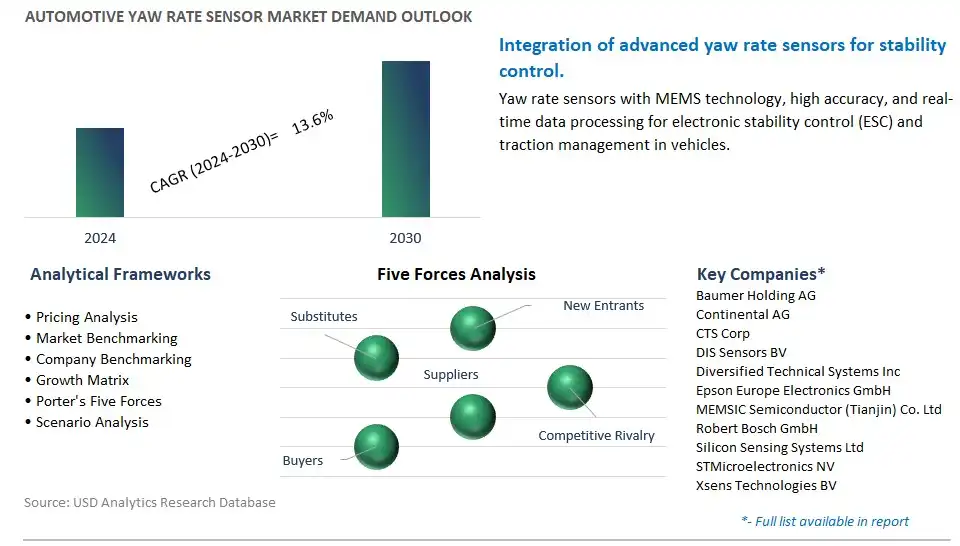
Automotive Yaw Rate Sensor Market is estimated to increase at a growth rate of 13.6% CAGR over the forecast period from 2024 to 2030.
The global Automotive Yaw Rate Sensor Market study analyzes and forecasts the market size across 6 regions and 24 countries for diverse segments including By Type (Piezoelectric Type, Micromechanical Type), By Application (Passenger Cars, Light Commercial Vehicles, Heavy Commercial Vehicles).
An Introduction to Global Automotive Yaw Rate Sensor Market, 2024
The Automotive Yaw Rate Sensor Market involves the production and distribution of sensors that measure a vehicle's rotational movement around its vertical axis, known as yaw, to provide stability control and prevent skidding during sudden maneuvers or slippery road conditions. Yaw rate sensors play a crucial role in electronic stability control (ESC) systems by detecting vehicle yaw rate and transmitting data to the vehicle's onboard computer to apply individual wheel braking and adjust engine torque, ensuring vehicle stability and safety. With the automotive industry's increasing focus on active safety systems and accident prevention, the demand for yaw rate sensors continues to grow. Manufacturers in this market focus on developing sensors with high accuracy, reliability, and responsiveness to meet the stringent requirements of ESC systems and vehicle stability control. Moreover, advancements in sensor technology, including MEMS (Micro-Electro-Mechanical Systems) technology, digital signal processing, and sensor fusion algorithms, drive innovation, enabling improved performance, responsiveness, and integration with other safety systems. Additionally, as vehicle designs evolve to incorporate more autonomous features and advanced driver assistance systems, the Automotive Yaw Rate Sensor Market presents opportunities for further innovation and customization to enhance vehicle stability, handling, and safety in various driving conditions.
Automotive Yaw Rate Sensor Competitive Landscape
The global Automotive Yaw Rate Sensor market is highly competitive with a large number of companies focusing on niche market segments. Amidst intense competitive conditions, Automotive Yaw Rate Sensor Companies are investing in new product launches and strengthening distribution channels. Key companies operating in the Automotive Yaw Rate Sensor Market Industry include- Baumer Holding AG, Continental AG, CTS Corp, DIS Sensors BV, Diversified Technical Systems Inc, Epson Europe Electronics GmbH, MEMSIC Semiconductor (Tianjin) Co. Ltd, Robert Bosch GmbH, Silicon Sensing Systems Ltd, STMicroelectronics NV, Xsens Technologies BV.
Automotive Yaw Rate Sensor Market Trend: Increasing Adoption of Advanced Driver Assistance Systems (ADAS)
A prominent trend in the automotive yaw rate sensor market is the increasing adoption of Advanced Driver Assistance Systems (ADAS). As vehicle safety regulations become more stringent and consumer demand for safety features grows, automakers are integrating ADAS technologies into their vehicles to enhance driver assistance, collision avoidance, and overall vehicle safety. Yaw rate sensors play a crucial role in ADAS by providing data on the vehicle's rotational movements, enabling systems like electronic stability control (ESC) and rollover prevention to operate effectively.
Automotive Yaw Rate Sensor Market Driver: Focus on Vehicle Stability and Safety
A key driver propelling the automotive yaw rate sensor market is the automotive industry's focus on vehicle stability and safety. Yaw rate sensors measure the angular velocity or rotation rate of a vehicle around its vertical axis, providing essential data for stability control systems to intervene in critical situations and prevent loss of control or rollover accidents. With safety being a top priority for consumers and regulatory bodies worldwide, the demand for yaw rate sensors is expected to continue growing as automakers strive to enhance vehicle stability and reduce the risk of accidents.
Automotive Yaw Rate Sensor Market Opportunity: Integration of Yaw Rate Sensors in Autonomous Vehicles
An opportunity for the automotive yaw rate sensor market lies in the integration of these sensors in autonomous vehicles. As autonomous driving technology advances and self-driving cars become more prevalent, the need for accurate and reliable sensor data becomes paramount. Yaw rate sensors, along with other sensors such as accelerometers and gyroscopes, contribute to the perception and decision-making capabilities of autonomous vehicles by providing real-time information about the vehicle's orientation and dynamics. By leveraging yaw rate sensors in autonomous driving systems, automotive manufacturers can improve the safety and performance of self-driving vehicles, paving the way for the widespread adoption of autonomous transportation in the future.
Automotive Yaw Rate Sensor Market Segmentation
By Type
Piezoelectric Type
Micromechanical Type
By Application
Passenger Cars
Light Commercial Vehicles
Heavy Commercial VehiclesGeographical Analysis
North America (United States, Canada, Mexico)
Europe (Germany, France, United Kingdom, Spain, Italy, Rest of Europe)
Asia Pacific (China, India, Japan, South Korea, Rest of Asia Pacific)
South America (Brazil, Argentina, Rest of South America)
Middle East and Africa (Saudi Arabia, UAE, Rest of Middle East, South Africa, Egypt, Rest of Africa
Automotive Yaw Rate Sensor Companies
Baumer Holding AG
Continental AG
CTS Corp
DIS Sensors BV
Diversified Technical Systems Inc
Epson Europe Electronics GmbH
MEMSIC Semiconductor (Tianjin) Co. Ltd
Robert Bosch GmbH
Silicon Sensing Systems Ltd
STMicroelectronics NV
Xsens Technologies BV
*- List not Exhaustive
TABLE OF CONTENTS
1 Introduction to 2024 Automotive Yaw Rate Sensor Market
1.1 Market Overview
1.2 Quick Facts
1.3 Scope/Objective of the Study
1.4 Market Definition
1.5 Countries and Regions Analyzed
1.6 Units, Currency, and Conversions
1.7 Industry Value Chain
2 Research Methodology
2.1 Market Size Estimation
2.2 Sources and Research Methodology
2.3 Data Triangulation
2.4 Assumptions and Limitations
3 Executive Summary
3.1 Global Automotive Yaw Rate Sensor Market Size Outlook, $ Million, 2021 to 2030
3.2 Automotive Yaw Rate Sensor Market Outlook by Type, $ Million, 2021 to 2030
3.3 Automotive Yaw Rate Sensor Market Outlook by Product, $ Million, 2021 to 2030
3.4 Automotive Yaw Rate Sensor Market Outlook by Application, $ Million, 2021 to 2030
3.5 Automotive Yaw Rate Sensor Market Outlook by Key Countries, $ Million, 2021 to 2030
4 Market Dynamics
4.1 Key Driving Forces of Automotive Yaw Rate Sensor Industry
4.2 Key Market Trends in Automotive Yaw Rate Sensor Industry
4.3 Potential Opportunities in Automotive Yaw Rate Sensor Industry
4.4 Key Challenges in Automotive Yaw Rate Sensor Industry
5 Market Factor Analysis
5.1 Value Chain Analysis
5.2 Competitive Landscape
5.2.1 Global Automotive Yaw Rate Sensor Market Share by Company (%), 2023
5.2.2 Product Offerings by Company
5.3 Porter’s Five Forces Analysis
5.4 Pricing Analysis and Outlook
6 Growth Outlook Across Scenarios
6.1 Growth Analysis-Case Scenario Definitions
6.2 Low Growth Scenario Forecasts
6.3 Reference Growth Scenario Forecasts
6.4 High Growth Scenario Forecasts
7 Global Automotive Yaw Rate Sensor Market Outlook by Segments
7.1 Automotive Yaw Rate Sensor Market Outlook by Segments, $ Million, 2021- 2030
By Type
Piezoelectric Type
Micromechanical Type
By Application
Passenger Cars
Light Commercial Vehicles
Heavy Commercial Vehicles
8 North America Automotive Yaw Rate Sensor Market Analysis and Outlook To 2030
8.1 Introduction to North America Automotive Yaw Rate Sensor Markets in 2024
8.2 North America Automotive Yaw Rate Sensor Market Size Outlook by Country, 2021-2030
8.2.1 United States
8.2.2 Canada
8.2.3 Mexico
8.3 North America Automotive Yaw Rate Sensor Market size Outlook by Segments, 2021-2030
By Type
Piezoelectric Type
Micromechanical Type
By Application
Passenger Cars
Light Commercial Vehicles
Heavy Commercial Vehicles
9 Europe Automotive Yaw Rate Sensor Market Analysis and Outlook To 2030
9.1 Introduction to Europe Automotive Yaw Rate Sensor Markets in 2024
9.2 Europe Automotive Yaw Rate Sensor Market Size Outlook by Country, 2021-2030
9.2.1 Germany
9.2.2 France
9.2.3 Spain
9.2.4 United Kingdom
9.2.4 Italy
9.2.5 Russia
9.2.6 Norway
9.2.7 Rest of Europe
9.3 Europe Automotive Yaw Rate Sensor Market Size Outlook by Segments, 2021-2030
By Type
Piezoelectric Type
Micromechanical Type
By Application
Passenger Cars
Light Commercial Vehicles
Heavy Commercial Vehicles
10 Asia Pacific Automotive Yaw Rate Sensor Market Analysis and Outlook To 2030
10.1 Introduction to Asia Pacific Automotive Yaw Rate Sensor Markets in 2024
10.2 Asia Pacific Automotive Yaw Rate Sensor Market Size Outlook by Country, 2021-2030
10.2.1 China
10.2.2 India
10.2.3 Japan
10.2.4 South Korea
10.2.5 Indonesia
10.2.6 Malaysia
10.2.7 Australia
10.2.8 Rest of Asia Pacific
10.3 Asia Pacific Automotive Yaw Rate Sensor Market size Outlook by Segments, 2021-2030
By Type
Piezoelectric Type
Micromechanical Type
By Application
Passenger Cars
Light Commercial Vehicles
Heavy Commercial Vehicles
11 South America Automotive Yaw Rate Sensor Market Analysis and Outlook To 2030
11.1 Introduction to South America Automotive Yaw Rate Sensor Markets in 2024
11.2 South America Automotive Yaw Rate Sensor Market Size Outlook by Country, 2021-2030
11.2.1 Brazil
11.2.2 Argentina
11.2.3 Rest of South America
11.3 South America Automotive Yaw Rate Sensor Market size Outlook by Segments, 2021-2030
By Type
Piezoelectric Type
Micromechanical Type
By Application
Passenger Cars
Light Commercial Vehicles
Heavy Commercial Vehicles
12 Middle East and Africa Automotive Yaw Rate Sensor Market Analysis and Outlook To 2030
12.1 Introduction to Middle East and Africa Automotive Yaw Rate Sensor Markets in 2024
12.2 Middle East and Africa Automotive Yaw Rate Sensor Market Size Outlook by Country, 2021-2030
12.2.1 Saudi Arabia
12.2.2 UAE
12.2.3 Oman
12.2.4 Rest of Middle East
12.2.5 Egypt
12.2.6 Nigeria
12.2.7 South Africa
12.2.8 Rest of Africa
12.3 Middle East and Africa Automotive Yaw Rate Sensor Market size Outlook by Segments, 2021-2030
By Type
Piezoelectric Type
Micromechanical Type
By Application
Passenger Cars
Light Commercial Vehicles
Heavy Commercial Vehicles
13 Company Profiles
13.1 Company Snapshot
13.2 SWOT Profiles
13.3 Products and Services
13.4 Recent Developments
13.5 Financial Profile
List of Companies
Baumer Holding AG
Continental AG
CTS Corp
DIS Sensors BV
Diversified Technical Systems Inc
Epson Europe Electronics GmbH
MEMSIC Semiconductor (Tianjin) Co. Ltd
Robert Bosch GmbH
Silicon Sensing Systems Ltd
STMicroelectronics NV
Xsens Technologies BV
14 Appendix
14.1 Customization Offerings
14.2 Subscription Services
14.3 Related Reports
14.4 Publisher Expertise
By Type
Piezoelectric Type
Micromechanical Type
By Application
Passenger Cars
Light Commercial Vehicles
Heavy Commercial Vehicles
