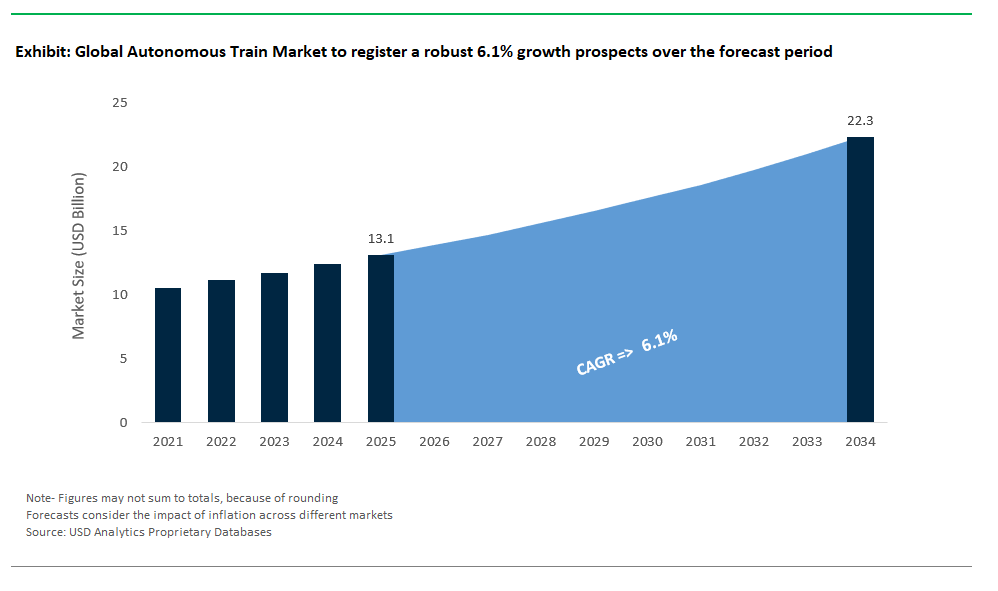
The Global Autonomous Train Market Size is estimated at $13.1 Billion in 2025 and is forecast to register an annual growth rate (CAGR) of 6.1% to reach $22.2 Billion by 2034.
The global Autonomous Train Market Study analyzes and forecasts the market size across 6 regions and 24 countries for diverse segments -By Automation Grade (GoA 1, GoA 2, GoA 3, GoA 4), By Train (Metro/Monorail, High-speed Rail, Light Rail), By Application (Passenger, Freight), By Technology (CBTC, ERTMS, PTC, ATC).
An Introduction to Autonomous Train Market in 2025
The Autonomous Train Market is at the forefront of revolutionizing transportation infrastructure with the integration of cutting-edge technologies. Autonomous trains, equipped with advanced sensors, artificial intelligence, and automated control systems, promise enhanced safety, efficiency, and operational flexibility. The drive towards autonomous rail systems is fueled by the need for increased capacity, reduced operational costs, and improved safety standards. Innovations in real-time monitoring, predictive maintenance, and remote control capabilities are paving the way for fully automated train operations. The market is supported by government initiatives and investments aimed at modernizing rail networks and reducing carbon emissions, positioning autonomous trains as a critical component of future transportation solutions.
Autonomous Train Competitive Landscape
The market report analyses the leading companies in the industry including Alstom SA, CRRC Corp Ltd, Green Automated Solutions Inc, Hitachi Rail STS, Ingeteam Corp SA, Kawasaki Heavy Industries, Mitsubishi Heavy Industries Ltd, Siemens AG, Thales Group, Wabtec Corp, and others.
Autonomous Train Market Dynamics
Market Trend: Increasing Adoption of Grade of Automation (GoA) in Rail Networks
In the autonomous train market, a key trend is the increasing adoption of Grade of Automation (GoA) systems, particularly GoA 3 (semi-automated) and GoA 4 (fully automated). Rail operators worldwide are embracing these advanced automation levels to improve operational efficiency, reduce human errors, and optimize service schedules. Autonomous trains equipped with sophisticated sensors, AI-driven control systems, and advanced signaling technologies are gaining traction, especially in urban metro networks and high-speed rail projects. As cities expand and transit systems become more congested, fully automated trains provide significant benefits, including higher frequency operations, better energy efficiency, and enhanced safety. Additionally, the rise of smart city initiatives and the demand for more reliable public transportation options are pushing governments and private operators to invest in autonomous rail technologies. This trend is poised to reshape the global rail landscape, driving innovations and collaborations between technology providers and rail operators.
Market Driver: Growing Investments in Rail Infrastructure and Modernization
The growing investments in rail infrastructure and modernization projects are a key driver for the autonomous train market. Governments and rail operators are heavily investing in upgrading existing rail networks and developing new ones to meet the increasing demand for efficient and reliable transportation systems. Autonomous trains, with their potential to optimize schedules, reduce operational costs, and enhance safety, are central to these modernization efforts. In densely populated regions, where rail is a critical mode of mass transit, the shift towards automated and autonomous systems is being prioritized to address challenges like overcrowding, traffic congestion, and environmental concerns. Infrastructure development programs, such as the expansion of high-speed rail networks and urban metro systems, are incorporating autonomous technologies to future-proof rail operations. Additionally, public-private partnerships and funding initiatives aimed at sustainable transport solutions are further accelerating the deployment of autonomous trains, positioning them as a cornerstone in the evolution of global transportation networks.
Market Opportunity: Integration of AI and IoT for Smart Rail Solutions
The integration of AI and IoT technologies offers a significant opportunity for growth in the autonomous train market. With the increasing focus on smart rail solutions, rail operators and manufacturers are exploring ways to leverage real-time data, predictive analytics, and machine learning algorithms to enhance train automation systems. AI-driven predictive maintenance, real-time monitoring, and data analytics can optimize performance, reduce downtime, and improve safety across rail networks. Additionally, IoT-enabled sensors and communication systems provide continuous feedback on rail conditions, passenger flow, and operational efficiency, enabling more responsive and adaptive train systems. These innovations not only enhance the reliability and efficiency of autonomous trains but also create opportunities for new revenue models and service offerings, such as intelligent transport systems (ITS) and connected rail ecosystems. As the rail industry continues to embrace digital transformation, companies that invest in integrating AI and IoT technologies stand to gain a competitive edge in the evolving autonomous train landscape.
Autonomous Train Market Share Analysis: Grade of Automation 4 generated the highest revenue in 2024
In the Autonomous Train market, GoA 4 (Grade of Automation 4) represents the largest segment due to its comprehensive level of automation, which offers significant operational efficiency and safety enhancements. GoA 4 trains are fully automated, with no onboard staff required for operations, relying entirely on advanced technologies such as automated train control systems, sensors, and communication networks to manage all aspects of train operations. This level of automation provides the highest degree of safety and operational efficiency, as it minimizes human error and maximizes system reliability. The increasing adoption of GoA 4 systems is driven by their ability to support high-frequency operations, reduce operational costs, and improve service quality, making them the preferred choice for modern transit systems and high-demand routes. As cities and transit authorities seek to optimize and expand their rail networks, the advanced capabilities of GoA 4 systems continue to make them the dominant segment in the market.
Autonomous Train Market Share Analysis: Metro/Monorail is poised to register the fastest CAGR over the forecast period
Within the Autonomous Train market, the Metro/Monorail segment is the fastest-growing due to the rising demand for efficient, high-capacity urban transportation solutions. Metro and monorail systems are increasingly being integrated with autonomous technologies to enhance service frequency, reliability, and safety in densely populated urban areas. The scalability and flexibility of these systems make them ideal candidates for automation, as they can be adapted to various urban environments and transit needs. Furthermore, the push for smart cities and sustainable public transport solutions has accelerated the adoption of autonomous metro and monorail systems. As urbanization continues to rise and cities seek to address transportation challenges, the growth in metro and monorail systems reflects a broader trend towards modernizing and expanding urban transit networks.
Autonomous Train Market Share Analysis: Passenger Application generated the highest revenue in 2024
In the Autonomous Train market, the passenger application segment is the largest due to its broad adoption in urban and suburban transit systems. Autonomous passenger trains, including metro, light rail, and regional services, benefit from automation by enhancing operational efficiency, safety, and passenger experience. The high demand for reliable and efficient public transportation solutions in urban areas drives the significant investment in autonomous passenger trains, which offer reduced operational costs, increased service frequency, and improved punctuality. The ability to integrate advanced automation technologies with passenger services ensures a better overall travel experience, making it the dominant application segment in the autonomous train market.
Autonomous Train Market Share Analysis: CBTC is poised to register the fastest CAGR over the forecast period
Among the various technologies in the Autonomous Train market, Communication-Based Train Control (CBTC) is the fastest-growing segment. CBTC technology allows for real-time communication between trains and control centers, enabling precise management of train movements and optimizing network capacity. The rapid adoption of CBTC is driven by its ability to enhance the efficiency, safety, and reliability of automated train systems, particularly in densely populated urban environments where high-frequency services are essential. CBTC’s advanced capabilities, including automated train separation and real-time data exchange, facilitate the implementation of higher levels of automation and integration with existing rail infrastructure. As cities and transit authorities increasingly prioritize the modernization of their rail systems, the growth of CBTC technology underscores its critical role in advancing autonomous train operations.
Autonomous Train Market Report Scope
|
Parameter
|
Details
|
|
Market Size (2025)
|
$ 13.1 Billion
|
|
Market Size (2034)
|
$ 22.2 Billion
|
|
Market Growth Rate
|
6.1%
|
|
Segments
|
By Automation Grade (GoA 1, GoA 2, GoA 3, GoA 4), By Train (Metro/Monorail, High-speed Rail, Light Rail), By Application (Passenger, Freight), By Technology (CBTC, ERTMS, PTC, ATC)
|
|
Study Period
|
2019- 2024 and 2025-2034
|
|
Units
|
Revenue (USD)
|
|
Qualitative Analysis
|
Porter’s Five Forces, SWOT Profile, Market Share, Scenario Forecasts, Market Ecosystem, Company Ranking, Market Dynamics, Industry Benchmarking
|
|
Companies
|
Alstom SA, CRRC Corp Ltd, Green Automated Solutions Inc, Hitachi Rail STS, Ingeteam Corp SA, Kawasaki Heavy Industries, Mitsubishi Heavy Industries Ltd, Siemens AG, Thales Group, Wabtec Corp
|
|
Countries
|
US, Canada, Mexico, Germany, France, Spain, Italy, UK, Russia, China, India, Japan, South Korea, Australia, South East Asia, Brazil, Argentina, Middle East, Africa
|
Autonomous Train Market Segmentation
By Automation Grade
GoA 1
GoA 2
GoA 3
GoA 4
By Train
Metro/Monorail
High-speed Rail
Light Rail
By Application
Passenger
Freight
By Technology
CBTC
ERTMS
PTC
ATC
Countries Analyzed
North America (US, Canada, Mexico)
Europe (Germany, UK, France, Spain, Italy, Russia, Rest of Europe)
Asia Pacific (China, India, Japan, South Korea, Australia, South East Asia, Rest of Asia)
South America (Brazil, Argentina, Rest of South America)
Middle East and Africa (Saudi Arabia, UAE, Rest of Middle East, South Africa, Egypt, Rest of Africa)
Autonomous Train Companies Profiled in the Study
Alstom SA
CRRC Corp Ltd
Green Automated Solutions Inc
Hitachi Rail STS
Ingeteam Corp SA
Kawasaki Heavy Industries
Mitsubishi Heavy Industries Ltd
Siemens AG
Thales Group
Wabtec Corp
*- List Not Exhaustive
About USD Analytics
Table of Contents
List of Charts and Exhibits
List of Tables
1. Executive Summary
What’s New in 2025?
Top 10 Takeaways from the industry
Potential Opportunities for Industry Stakeholders
Strategic Imperatives
Company Market Positioning
Industry Benchmarking Matrix
2. Research Scope and Methodology
Market Definition
Market Segments
Companies Profiled
Research Methodology
Bottom-Up Method
Top-Down Method
Data Triangulation
Forecast Methodology
Data Sources
USDA Proprietary Databases
External Sources
Primary Research and Interviews
Conversion Rates for USD
Abbreviations
3. Strategic Landscape: Key Insights and Implications
Spotlight: Key Strategies opted by Business Leaders
Competitive Landscape
Market Size ($ Million) and Share (%) by Company, 2024
SWOT Analysis
- Key Market Strengths
- Key Market Weaknesses
- Potential Opportunities
- Potential Threats
Porter’s Five Force Analysis
- Summary
- Bargaining Power of Buyers- Impact Analysis
- Bargaining Power of Suppliers- Impact Analysis
- Threat of new entrants- Impact Analysis
- Intensity of Competitive Rivalry- Impact Analysis
Macro-Environmental Analysis
- Economic forecasts by Country, 2010- 2035
- Population forecasts by Country, 2010- 2035
- Inflation Outlook by Country, 2010-2035
- Impact of Russia-Ukraine Conflict, Sluggish China Growth, US Developments
5. Growth Opportunity Analysis
Trends at a Glance
- What are the most noteworthy trends in the market
- Where should leaders pay attention?
- What industries are likely to be affected by the growth?
Market Dynamics
- Charting a path forward
- Growth Drivers
- Growth Barriers
Key Industry Stakeholders
- Suppliers
- Manufacturers and Service Providers
- Distribution Channels
- End-Users and Applications
- Regulators
- Investors, Traders, and R&D Institutes
Regulatory Landscape
6. Market Size Outlook to 2034
Global Nanocoatings Market Size Forecast, USD Million, 2018- 2034
- Historic Market Size, 2018- 2024
- Forecast Market Size, 2024- 2034
Scenario Analysis
- Low Growth Scenario: Definition and Outlook to 2034
- Reference Case: Definition and Outlook to 2034
- High Growth Scenario: Definition and Outlook to 2034
Pricing Analysis and Outlook
- Nanocoatings Average Price Forecast, 2021- 2034
- Key Factors Shaping the Pricing Patterns
7. Historical Nanocoatings Market Size by Segments, 2018- 2024
Key Statistics, 2024
Nanocoatings Market Size Outlook by Type, USD Million, 2018- 2024
Growth Comparison (y-o-y) across Nanocoatings Types, 2018- 2024
Nanocoatings Market Size Outlook by Application, USD Million, 2018- 2024
Growth Comparison (y-o-y) across Nanocoatings Applications, 2018- 2024
8. Nanocoatings Market Size Outlook by Segments, 2024- 2034
By Automation Grade
GoA 1
GoA 2
GoA 3
GoA 4
By Train
Metro/Monorail
High-speed Rail
Light Rail
By Application
Passenger
Freight
By Technology
CBTC
ERTMS
PTC
ATC
9. Nanocoatings Market Size Outlook by Region
North America
Key Market Dynamics
North America Nanocoatings Market Size Outlook by Type, USD Million, 2021-2034
North America Nanocoatings Market Size Outlook by Application, USD Million, 2021-2034
North America Nanocoatings Market Size Outlook by Sales Channel, USD Million, 2021-2034
North America Nanocoatings Market Size Outlook by Country, USD Million, 2021-2034
Europe
Key Market Dynamics
Europe Nanocoatings Market Size Outlook by Type, USD Million, 2021-2034
Europe Nanocoatings Market Size Outlook by Application, USD Million, 2021-2034
Europe Nanocoatings Market Size Outlook by Sales Channel, USD Million, 2021-2034
Europe Nanocoatings Market Size Outlook by Country, USD Million, 2021-2034
Asia Pacific
Key Market Dynamics
Asia Pacific Nanocoatings Market Size Outlook by Type, USD Million, 2021-2034
Asia Pacific Nanocoatings Market Size Outlook by Application, USD Million, 2021-2034
Asia Pacific Nanocoatings Market Size Outlook by Sales Channel, USD Million, 2021-2034
Asia Pacific Nanocoatings Market Size Outlook by Country, USD Million, 2021-2034
South America
Key Market Dynamics
South America Nanocoatings Market Size Outlook by Type, USD Million, 2021-2034
South America Nanocoatings Market Size Outlook by Application, USD Million, 2021-2034
South America Nanocoatings Market Size Outlook by Sales Channel, USD Million, 2021-2034
South America Nanocoatings Market Size Outlook by Country, USD Million, 2021-2034
Middle East and Africa
Key Market Dynamics
Middle East and Africa Nanocoatings Market Size Outlook by Type, USD Million, 2021-2034
Middle East and Africa Nanocoatings Market Size Outlook by Application, USD Million, 2021-2034
Middle East and Africa Nanocoatings Market Size Outlook by Sales Channel, USD Million, 2021-2034
Middle East and Africa Nanocoatings Market Size Outlook by Country, USD Million, 2021-2034
10. United States Nanocoatings Market Analysis and Outlook, 2021- 2034
Key Statistics
United States Nanocoatings Market Size Outlook by Type, 2021- 2034
United States Nanocoatings Market Size Outlook by Application, 2021- 2034
United States Nanocoatings Market Size Outlook by End-User, 2021- 2034
11. Canada Nanocoatings Market Analysis and Outlook, 2021- 2034
Key Statistics
Canada Nanocoatings Market Size Outlook by Type, 2021- 2034
Canada Nanocoatings Market Size Outlook by Application, 2021- 2034
Canada Nanocoatings Market Size Outlook by End-User, 2021- 2034
12. Mexico Nanocoatings Market Analysis and Outlook, 2021- 2034
Key Statistics
Mexico Nanocoatings Market Size Outlook by Type, 2021- 2034
Mexico Nanocoatings Market Size Outlook by Application, 2021- 2034
Mexico Nanocoatings Market Size Outlook by End-User, 2021- 2034
13. Germany Nanocoatings Market Analysis and Outlook, 2021- 2034
Key Statistics
Germany Nanocoatings Market Size Outlook by Type, 2021- 2034
Germany Nanocoatings Market Size Outlook by Application, 2021- 2034
Germany Nanocoatings Market Size Outlook by End-User, 2021- 2034
14. France Nanocoatings Market Analysis and Outlook, 2021- 2034
Key Statistics
France Nanocoatings Market Size Outlook by Type, 2021- 2034
France Nanocoatings Market Size Outlook by Application, 2021- 2034
France Nanocoatings Market Size Outlook by End-User, 2021- 2034
15. United Kingdom Nanocoatings Market Analysis and Outlook, 2021- 2034
Key Statistics
United Kingdom Nanocoatings Market Size Outlook by Type, 2021- 2034
United Kingdom Nanocoatings Market Size Outlook by Application, 2021- 2034
United Kingdom Nanocoatings Market Size Outlook by End-User, 2021- 2034
16. Spain Nanocoatings Market Analysis and Outlook, 2021- 2034
Key Statistics
Spain Nanocoatings Market Size Outlook by Type, 2021- 2034
Spain Nanocoatings Market Size Outlook by Application, 2021- 2034
Spain Nanocoatings Market Size Outlook by End-User, 2021- 2034
17. Italy Nanocoatings Market Analysis and Outlook, 2021- 2034
Key Statistics
Italy Nanocoatings Market Size Outlook by Type, 2021- 2034
Italy Nanocoatings Market Size Outlook by Application, 2021- 2034
Italy Nanocoatings Market Size Outlook by End-User, 2021- 2034
18. Benelux Nanocoatings Market Analysis and Outlook, 2021- 2034
Key Statistics
Benelux Nanocoatings Market Size Outlook by Type, 2021- 2034
Benelux Nanocoatings Market Size Outlook by Application, 2021- 2034
Benelux Nanocoatings Market Size Outlook by End-User, 2021- 2034
19. Nordic Nanocoatings Market Analysis and Outlook, 2021- 2034
Key Statistics
Nordic Nanocoatings Market Size Outlook by Type, 2021- 2034
Nordic Nanocoatings Market Size Outlook by Application, 2021- 2034
Nordic Nanocoatings Market Size Outlook by End-User, 2021- 2034
20. Rest of Europe Nanocoatings Market Analysis and Outlook, 2021- 2034
Key Statistics
Rest of Europe Nanocoatings Market Size Outlook by Type, 2021- 2034
Rest of Europe Nanocoatings Market Size Outlook by Application, 2021- 2034
Rest of Europe Nanocoatings Market Size Outlook by End-User, 2021- 2034
21. China Nanocoatings Market Analysis and Outlook, 2021- 2034
Key Statistics
China Nanocoatings Market Size Outlook by Type, 2021- 2034
China Nanocoatings Market Size Outlook by Application, 2021- 2034
China Nanocoatings Market Size Outlook by End-User, 2021- 2034
22. India Nanocoatings Market Analysis and Outlook, 2021- 2034
Key Statistics
India Nanocoatings Market Size Outlook by Type, 2021- 2034
India Nanocoatings Market Size Outlook by Application, 2021- 2034
India Nanocoatings Market Size Outlook by End-User, 2021- 2034
23. Japan Nanocoatings Market Analysis and Outlook, 2021- 2034
Key Statistics
Japan Nanocoatings Market Size Outlook by Type, 2021- 2034
Japan Nanocoatings Market Size Outlook by Application, 2021- 2034
Japan Nanocoatings Market Size Outlook by End-User, 2021- 2034
24. South Korea Nanocoatings Market Analysis and Outlook, 2021- 2034
Key Statistics
South Korea Nanocoatings Market Size Outlook by Type, 2021- 2034
South Korea Nanocoatings Market Size Outlook by Application, 2021- 2034
South Korea Nanocoatings Market Size Outlook by End-User, 2021- 2034
25. Australia Nanocoatings Market Analysis and Outlook, 2021- 2034
Key Statistics
Australia Nanocoatings Market Size Outlook by Type, 2021- 2034
Australia Nanocoatings Market Size Outlook by Application, 2021- 2034
Australia Nanocoatings Market Size Outlook by End-User, 2021- 2034
26. South East Asia Nanocoatings Market Analysis and Outlook, 2021- 2034
Key Statistics
South East Asia Nanocoatings Market Size Outlook by Type, 2021- 2034
South East Asia Nanocoatings Market Size Outlook by Application, 2021- 2034
South East Asia Nanocoatings Market Size Outlook by End-User, 2021- 2034
27. Rest of Asia Pacific Nanocoatings Market Analysis and Outlook, 2021- 2034
Key Statistics
Rest of Asia Pacific Nanocoatings Market Size Outlook by Type, 2021- 2034
Rest of Asia Pacific Nanocoatings Market Size Outlook by Application, 2021- 2034
Rest of Asia Pacific Nanocoatings Market Size Outlook by End-User, 2021- 2034
28. Brazil Nanocoatings Market Analysis and Outlook, 2021- 2034
Key Statistics
Brazil Nanocoatings Market Size Outlook by Type, 2021- 2034
Brazil Nanocoatings Market Size Outlook by Application, 2021- 2034
Brazil Nanocoatings Market Size Outlook by End-User, 2021- 2034
29. Argentina Nanocoatings Market Analysis and Outlook, 2021- 2034
Key Statistics
Argentina Nanocoatings Market Size Outlook by Type, 2021- 2034
Argentina Nanocoatings Market Size Outlook by Application, 2021- 2034
Argentina Nanocoatings Market Size Outlook by End-User, 2021- 2034
30. Rest of South America Nanocoatings Market Analysis and Outlook, 2021- 2034
Key Statistics
Rest of South America Nanocoatings Market Size Outlook by Type, 2021- 2034
Rest of South America Nanocoatings Market Size Outlook by Application, 2021- 2034
Rest of South America Nanocoatings Market Size Outlook by End-User, 2021- 2034
31. United Arab Emirates Nanocoatings Market Analysis and Outlook, 2021- 2034
Key Statistics
United Arab Emirates Nanocoatings Market Size Outlook by Type, 2021- 2034
United Arab Emirates Nanocoatings Market Size Outlook by Application, 2021- 2034
United Arab Emirates Nanocoatings Market Size Outlook by End-User, 2021- 2034
32. Saudi Arabia Nanocoatings Market Analysis and Outlook, 2021- 2034
Key Statistics
Saudi Arabia Nanocoatings Market Size Outlook by Type, 2021- 2034
Saudi Arabia Nanocoatings Market Size Outlook by Application, 2021- 2034
Saudi Arabia Nanocoatings Market Size Outlook by End-User, 2021- 2034
33. Rest of Middle East Nanocoatings Market Analysis and Outlook, 2021- 2034
Key Statistics
Rest of Middle East Nanocoatings Market Size Outlook by Type, 2021- 2034
Rest of Middle East Nanocoatings Market Size Outlook by Application, 2021- 2034
Rest of Middle East Nanocoatings Market Size Outlook by End-User, 2021- 2034
34. South Africa Nanocoatings Market Analysis and Outlook, 2021- 2034
Key Statistics
South Africa Nanocoatings Market Size Outlook by Type, 2021- 2034
South Africa Nanocoatings Market Size Outlook by Application, 2021- 2034
South Africa Nanocoatings Market Size Outlook by End-User, 2021- 2034
35. Rest of Africa Nanocoatings Market Analysis and Outlook, 2021- 2034
Key Statistics
Rest of Africa Nanocoatings Market Size Outlook by Type, 2021- 2034
Rest of Africa Nanocoatings Market Size Outlook by Application, 2021- 2034
Rest of Africa Nanocoatings Market Size Outlook by End-User, 2021- 2034
36. Key Companies
Market Share Analysis
Alstom SA
CRRC Corp Ltd
Green Automated Solutions Inc
Hitachi Rail STS
Ingeteam Corp SA
Kawasaki Heavy Industries
Mitsubishi Heavy Industries Ltd
Siemens AG
Thales Group
Wabtec Corp
Company Benchmarking
Financial Analysis
37. Recent Market Developments
38. Appendix
Looking Ahead
Research Methodology
Legal Disclaimer
