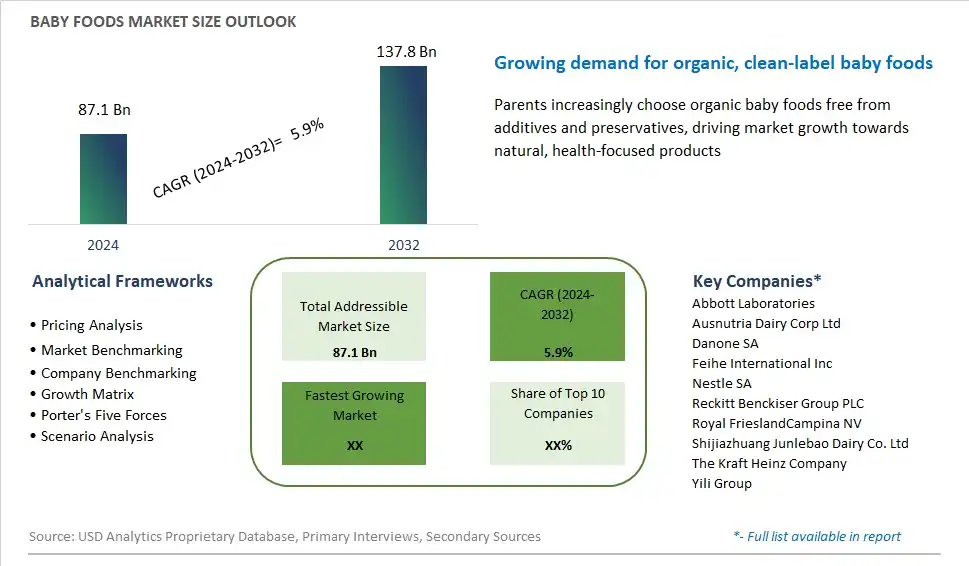
Global Baby Foods Market Size is valued at $87.1 Billion in 2024 and is forecast to register a growth rate (CAGR) of 5.9% to reach $137.8 Billion by 2032.
The global Baby Foods Market Comprehensive Study analyzes and forecasts the market size across 6 regions and 24 countries for diverse segments -By Category (Organic, Conventional), By Type (Milk Formula, Dried Baby Food, Ready to Feed Baby Food, Others), By Distribution Channel (Pharmacies, Supermarkets/ Hypermarkets, Convenience Stores, Online Channels, Others)
An Introduction to Baby Foods Market
The baby foods market in 2024 is expanding rapidly, driven by a growing emphasis on infant nutrition and the increasing availability of diverse, high-quality products. Parents are increasingly looking for baby foods that offer balanced nutrition, are made from organic ingredients, and are free from artificial additives and preservatives. This market includes a wide range of products, from purees and cereals to snacks and meals designed to meet the specific dietary needs of infants and toddlers. Innovations in packaging, such as convenient pouches and single-serve containers, are also contributing to market growth by catering to the busy lifestyles of modern families. Additionally, the trend towards plant-based and allergen-free options is gaining momentum, reflecting broader dietary trends in the general population.
Baby Foods Competitive Landscape
The market report analyses the leading companies in the industry including Abbott Laboratories, Ausnutria Dairy Corp Ltd, Danone SA, Feihe International Inc, Nestle SA, Reckitt Benckiser Group PLC, Royal FrieslandCampina NV, Shijiazhuang Junlebao Dairy Co. Ltd, The Kraft Heinz Company, Yili Group, and Others.
Baby Foods Market Dynamics
Baby Foods Market Trend: Increasing Demand for Organic and Natural Baby Foods
One of the most prominent trends in the baby food market is the increasing demand for organic and natural products. Parents are becoming more conscientious about the ingredients and nutritional content of the foods they provide to their infants and toddlers. This shift towards organic and natural baby foods is driven by concerns over pesticides, genetically modified organisms (GMOs), and synthetic additives commonly found in conventional baby foods. Brands are responding by offering a variety of organic, non-GMO, and minimally processed options that emphasize clean labels and transparency about ingredient sourcing. Additionally, there is a growing interest in plant-based baby foods, reflecting broader dietary trends in the adult population. This trend is supported by the increasing availability of organic baby food products in mainstream retail channels and the convenience of ready-to-eat organic options, making it easier for parents to make healthier choices for their children.
Market Driver: Rising Awareness of Infant Nutrition
The primary driver of the baby food market is the rising awareness of the importance of infant nutrition. Parents and caregivers are increasingly informed about the critical role that early childhood nutrition plays in growth, cognitive development, and long-term health outcomes. This awareness is fueled by healthcare professionals, pediatricians, and widespread educational campaigns highlighting the benefits of balanced, nutrient-rich diets for infants and toddlers. As a result, there is a growing demand for baby foods that are fortified with essential vitamins and minerals, such as iron, calcium, and DHA (docosahexaenoic acid), which are crucial for brain development. Furthermore, the proliferation of parenting blogs, social media, and online communities has made information about optimal infant nutrition more accessible, empowering parents to make informed decisions about the products they choose. This heightened focus on nutrition is driving innovation in the baby food market, leading to the development of products that cater to specific dietary needs and preferences.
Market Opportunity: Expansion into Emerging Markets
A significant opportunity for the baby food market lies in its expansion into emerging markets. Regions such as Asia-Pacific, Latin America, and Africa are experiencing rapid urbanization, rising incomes, and a growing middle class. These demographic shifts are contributing to an increased demand for convenient and nutritious baby food options among busy, health-conscious parents. Companies can capitalize on this opportunity by tailoring their products to meet the cultural and dietary preferences of these diverse markets. Strategic investments in local production facilities, distribution networks, and targeted marketing campaigns can enhance market penetration and brand recognition. Additionally, partnerships with local healthcare providers and retailers can facilitate trust and credibility, encouraging more parents to choose packaged baby foods over traditional homemade options. By leveraging these growth opportunities, baby food manufacturers can significantly expand their global footprint and drive long-term market growth.
Baby Foods Market Share Analysis: Conventional held the dominant market share in 2024
The conventional segment stands as the largest in the baby foods market due to its broader accessibility, affordability, and established market presence. Conventional baby foods are widely available in supermarkets, pharmacies, and convenience stores, making them easily accessible to a larger consumer base. Additionally, conventional baby foods often come at a lower price point compared to organic alternatives, appealing to budget-conscious parents or caregivers. While organic baby foods have gained popularity in recent years due to growing concerns about additives and pesticides, conventional options still dominate the market due to their longstanding presence and familiarity among consumers. Furthermore, stringent regulations and quality standards ensure the safety and nutritional adequacy of conventional baby foods, providing reassurance to parents regarding their suitability for infant consumption. As a result, the conventional category continues to maintain its lead in the baby foods market, catering to the diverse needs and preferences of families worldwide.
Baby Foods Market Share Analysis: Dried Baby Food market is poised to register the fastest growth rae over the forecast period to 2032
The dried baby food segment is the fastest-growing in the baby foods market, driven by its convenience, longer shelf life, and increasing demand for on-the-go feeding solutions. Dried baby food includes a variety of products such as cereals, snacks, and purees that are dehydrated or powdered for easy storage and preparation. With busy lifestyles becoming more prevalent among parents, dried baby food offers a convenient feeding option that can be easily packed for travel or consumed on the move. Additionally, advancements in food processing technology have led to innovations in flavor, texture, and nutritional content, making dried baby food increasingly appealing to parents seeking nutritious and flavorful options for their infants. Further, the COVID-19 pandemic has further accelerated the growth of this segment as parents prioritize pantry-stable items that offer convenience and minimize the need for frequent grocery trips. As consumer demand for convenient and nutritious baby food solutions continues to rise, the dried baby food segment is expected to sustain its rapid growth trajectory in the baby foods market.
Baby Foods Market Share Analysis: Supermarkets/Hypermarkets held the dominant market share in 2024
Supermarkets and hypermarkets emerge as the largest segment in the baby foods market's distribution channels due to their extensive reach, diverse product offerings, and consumer trust. These retail giants offer a comprehensive selection of baby foods, including milk formula, dried baby food, and ready-to-feed options, catering to the varying needs and preferences of parents. The convenience of one-stop shopping, coupled with the ability to browse and compare different brands and products, makes supermarkets and hypermarkets a preferred destination for parents seeking baby food supplies. Additionally, the stringent quality control measures implemented by these establishments ensure the safety and reliability of baby food products, instilling confidence in consumers regarding product authenticity and nutritional adequacy. The strategic placement of baby food products within easily accessible aisles and the availability of promotional offers further contribute to the dominance of supermarkets and hypermarkets in the baby foods market. As consumer demand for convenient and trustworthy baby food solutions continues to grow, this segment is expected to maintain its leadership position and witness steady growth in the coming years.
Baby Foods Market Segmentation
By Category
Organic
Conventional
By Type
Milk Formula
Dried Baby Food
Ready to Feed Baby Food
Others
By Distribution Channel
Pharmacies
Supermarkets/ Hypermarkets
Convenience Stores
Online Channels
Others
Countries Analyzed
North America (US, Canada, Mexico)
Europe (Germany, UK, France, Spain, Italy, Russia, Rest of Europe)
Asia Pacific (China, India, Japan, South Korea, Australia, South East Asia, Rest of Asia)
South America (Brazil, Argentina, Rest of South America)
Middle East and Africa (Saudi Arabia, UAE, Rest of Middle East, South Africa, Egypt, Rest of Africa)
Baby Foods Companies Profiled in the Study
Abbott Laboratories
Ausnutria Dairy Corp Ltd
Danone SA
Feihe International Inc
Nestle SA
Reckitt Benckiser Group PLC
Royal FrieslandCampina NV
Shijiazhuang Junlebao Dairy Co. Ltd
The Kraft Heinz Company
Yili Group
*- List Not Exhaustive
Chapter 1. TABLE OF CONTENTS
Chapter 2. Introduction to Baby Foods Market
2.1. Market Overview
2.2. Key Statistics and Report Highlights
2.3. Scope of the Comprehensive Study
2.3.1. Market Definition
2.3.2 Countries and Regions Covered
2.3.3 Research Objective
2.3.4 Units, Currency, and Conversions
2.3.5 Industry Value Chain
2.4. Key Market Segments
2.5. Key Companies
2.6. Study Period
Chapter 3. Strategic Analysis Review
3.1. Baby Foods Pricing Analysis and Forecast
3.2. Porter’s Five Forces
3.3. Market Ecosystem
3.4. SWOT Analysis
3.5. Regulatory Scenario
3.3. Effects of Inflation, Russia-Ukraine War, moderating economic growth, and other macroeconomic factors
Chapter 4. Competitive Landscape
4.1. Market Share Analysis
4.1.1. Global Baby Foods Market Share by Company, 2023
4.1.2. Product Offerings of Leading Baby Foods Companies
4.2. Market Entropy
4.2.1. New Product Launches in the Industry
4.2.2. Mergers, Acquisitions, Joint ventures, and Partnerships
4.3. Key Strategies and Best Practices
Chapter 5. Global Market Projections: Best, Reference, and Low Case Scenarios
5.1. Growth Analysis- Case Scenario Definitions
5.2. Low Growth Case Scenario Forecasts
5.3. Reference Growth Case Scenario Forecasts
5.4. High Growth Case Scenario Forecasts
Chapter 6. Market Dynamics
6.1. Baby Foods Market Drivers
6.2. Baby Foods Market Challenges
6.6. Baby Foods Market Opportunities
6.4. Baby Foods Market Trends
Chapter 7. Global Baby Foods Market Outlook Trends
7.1. Global Baby Foods Revenue (USD Million) and CAGR (%) by Type (2021-2032)
7.2. Global Baby Foods Revenue (USD Million) and CAGR (%) by Application (2021-2032)
7.3. Global Baby Foods Revenue (USD Million) and CAGR (%) by Product (2021-2032)
By Category
Organic
Conventional
By Type
Milk Formula
Dried Baby Food
Ready to Feed Baby Food
Others
By Distribution Channel
Pharmacies
Supermarkets/ Hypermarkets
Convenience Stores
Online Channels
Others
Chapter 8. Global Baby Foods Regional Analysis and Outlook
8.1. Global Baby Foods Revenue (USD Million) By Regions (2021- 2032)
8.2. North America Baby Foods Revenue (USD Million) by Country (2021-2032)
8.2.1. United States Baby Foods Regional Analysis and Outlook
8.2.2. Canada Baby Foods Regional Analysis and Outlook
8.2.3. Mexico Baby Foods Regional Analysis and Outlook
8.3. Europe Baby Foods Revenue (USD Million), by Country (2021-2032)
8.3.1. Germany Baby Foods Regional Analysis and Outlook
8.3.2. France Baby Foods Regional Analysis and Outlook
8.3.3. United Kingdom Baby Foods Regional Analysis and Outlook
8.3.4. Spain Baby Foods Regional Analysis and Outlook
8.3.5. Italy Baby Foods Regional Analysis and Outlook
8.3.6. Russia Baby Foods Regional Analysis and Outlook
8.3.7. Rest of Europe Baby Foods Regional Analysis and Outlook
8.4. Asia Pacific Baby Foods Revenue (USD Million) by Country (2021-2032)
8.4.1. China Baby Foods Regional Analysis and Outlook
8.4.2. Japan Baby Foods Regional Analysis and Outlook
8.4.3. India Baby Foods Regional Analysis and Outlook
8.4.4. South Korea Baby Foods Regional Analysis and Outlook
8.4.5. Australia Baby Foods Regional Analysis and Outlook
8.4.6. South East Asia Baby Foods Regional Analysis and Outlook
8.4.7. Rest of Asia Pacific Baby Foods Regional Analysis and Outlook
8.5. South America Baby Foods Revenue (USD Million), by Country (2021-2032)
8.5.1. Brazil Baby Foods Regional Analysis and Outlook
8.5.2. Argentina Baby Foods Regional Analysis and Outlook
8.5.3. Rest of South America Baby Foods Regional Analysis and Outlook
8.6. Middle East and Africa Baby Foods Revenue (USD Million) by Country (2021-2032)
8.6.1. Middle East Baby Foods Regional Analysis and Outlook
8.6.2. Africa Baby Foods Regional Analysis and Outlook
Chapter 9. North America Baby Foods Analysis and Outlook
9.1. North America Baby Foods Revenue (USD Million) by Segments (2021-2032)
9.1.1. North America Baby Foods Revenue (USD Million) by Type (2021-2032)
9.1.2. North America Baby Foods Revenue (USD Million) by Application (2021-2032)
9.1.3. North America Baby Foods Revenue (USD Million) by Product (2021-2032)
By Category
Organic
Conventional
By Type
Milk Formula
Dried Baby Food
Ready to Feed Baby Food
Others
By Distribution Channel
Pharmacies
Supermarkets/ Hypermarkets
Convenience Stores
Online Channels
Others
Chapter 10. Europe Baby Foods Analysis and Outlook
10.1. Europe Baby Foods Revenue (USD Million), by Segments (USD Million) (2021-2032)
10.1.1. Europe Baby Foods Revenue (USD Million) by Type (2021-2032)
10.1.2. Europe Baby Foods Revenue (USD Million) by Application (2021-2032)
10.1.3. Europe Baby Foods Revenue (USD Million) by Product (2021-2032)
By Category
Organic
Conventional
By Type
Milk Formula
Dried Baby Food
Ready to Feed Baby Food
Others
By Distribution Channel
Pharmacies
Supermarkets/ Hypermarkets
Convenience Stores
Online Channels
Others
Chapter 11. Asia Pacific Baby Foods Analysis and Outlook
11.1. Asia Pacific Baby Foods Revenue (USD Million), and Revenue (USD Million) by Segments (2021-2032)
11.1.1. Asia Pacific Baby Foods Revenue (USD Million) by Type (2021-2032)
11.1.2. Asia Pacific Baby Foods Revenue (USD Million) by Application (2021-2032)
11.1.3. Asia Pacific Baby Foods Revenue (USD Million) by Product (2021-2032)
By Category
Organic
Conventional
By Type
Milk Formula
Dried Baby Food
Ready to Feed Baby Food
Others
By Distribution Channel
Pharmacies
Supermarkets/ Hypermarkets
Convenience Stores
Online Channels
Others
Chapter 12. South America Baby Foods Analysis and Outlook
12.1. South America Baby Foods Revenue (USD Million), by Segments (2021-2032)
12.1.1. South America Baby Foods Revenue (USD Million) by Type (2021-2032)
12.1.2. South America Baby Foods Revenue (USD Million) by Application (2021-2032)
12.1.3. South America Baby Foods Revenue (USD Million) by Product (2021-2032)
By Category
Organic
Conventional
By Type
Milk Formula
Dried Baby Food
Ready to Feed Baby Food
Others
By Distribution Channel
Pharmacies
Supermarkets/ Hypermarkets
Convenience Stores
Online Channels
Others
Chapter 13. Middle East and Africa Baby Foods Analysis and Outlook
13.1. Middle East and Africa Baby Foods Revenue (USD Million), by Segments (2021-2032)
13.1.1. Middle East and Africa Baby Foods Revenue (USD Million) by Type (2021-2032)
13.1.2. Middle East and Africa Baby Foods Revenue (USD Million) by Application (2021-2032)
13.1.3. Middle East and Africa Baby Foods Revenue (USD Million) by Product (2021-2032)
By Category
Organic
Conventional
By Type
Milk Formula
Dried Baby Food
Ready to Feed Baby Food
Others
By Distribution Channel
Pharmacies
Supermarkets/ Hypermarkets
Convenience Stores
Online Channels
Others
Chapter 14. Baby Foods Company Profiles
14.1 Business Overview
14.2 Product Profiles
14.3 SWOT Profiles
14.5 Recent Developments
14.6 Financial Profile
List of Companies
Abbott Laboratories
Ausnutria Dairy Corp Ltd
Danone SA
Feihe International Inc
Nestle SA
Reckitt Benckiser Group PLC
Royal FrieslandCampina NV
Shijiazhuang Junlebao Dairy Co. Ltd
The Kraft Heinz Company
Yili Group
15. Methodology and Data Sources
15.1 Customization Offerings
15.2 Subscription Services
15.3 Related Reports
15.4 Publisher Expertise
LIST OF TABLES
Table 1 Market Segmentation Analysis
Table 2 Global Baby Foods Market Share of Leading Companies, 2023
Table 3 Product Offerings of Leading Companies
Table 4 Low Growth Scenario Forecasts
Table 5 Reference Case Growth Scenario
Table 6 High Growth Case Scenario
Table 7 Global Baby Foods Revenue (USD Million) And CAGR (%) By Type (2021-2032)
Table 8 Global Baby Foods Revenue (USD Million) And CAGR (%) By Application (2021-2032)
Table 9 Global Baby Foods Revenue (USD Million) And CAGR (%) By Product (2021-2032)
Table 10 Global Baby Foods Market Revenue (USD Million) By Regions (2021-2032)
Table 11 Global Baby Foods Market Share (%) By Regions (2021-2032)
Table 12 North America Baby Foods Revenue (USD Million) By Country (2021-2032)
Table 13 Europe Baby Foods Revenue (USD Million) By Country (2021-2032)
Table 14 Asia Pacific Baby Foods Revenue (USD Million) By Country (2021-2032)
Table 15 South America Baby Foods Revenue (USD Million) By Country (2021-2032)
Table 16 Middle East and Africa Baby Foods Revenue (USD Million) By Region (2021-2032)
Table 17 North America Baby Foods Revenue (USD Million) By Type (2021-2032)
Table 18 North America Baby Foods Revenue (USD Million) By Application (2021-2032)
Table 19 North America Baby Foods Revenue (USD Million) By Product (2021-2032)
Table 20 Europe Baby Foods Revenue (USD Million) By Type (2021-2032)
Table 21 Europe Baby Foods Revenue (USD Million) By Application (2021-2032)
Table 22 Europe Baby Foods Revenue (USD Million) By Product (2021-2032)
Table 23 Asia Pacific Baby Foods Revenue (USD Million) By Type (2021-2032)
Table 24 Asia Pacific Baby Foods Revenue (USD Million) By Application (2021-2032)
Table 25 Asia Pacific Baby Foods Revenue (USD Million) By Product (2021-2032)
Table 26 South America Baby Foods Revenue (USD Million) By Type (2021-2032)
Table 27 South America Baby Foods Revenue (USD Million) By Application (2021-2032)
Table 28 South America Baby Foods Revenue (USD Million) By Product (2021-2032)
Table 29 Middle East and Africa Baby Foods Revenue (USD Million) By Type (2021-2032)
Table 30 Middle East and Africa Baby Foods Revenue (USD Million) By Application (2021-2032)
Table 31 Middle East and Africa Baby Foods Revenue (USD Million) By Product (2021-2032)
LIST OF FIGURES
Figure 1. Market Scope
Figure 2. Pricing Forecasts Per Unit, 2023- 2032
Figure 3. Porter’s Five Forces
Figure 4. Global Baby Foods Market Revenue (USD Million) By Regions (2021-2032)
Figure 5. Global Baby Foods Market Share (%) By Regions (2023)
Figure 6. North America Baby Foods Revenue (USD Million) By Country (2021-2032)
Figure 7. United States Baby Foods Revenue (USD Million) By Country (2021-2032)
Figure 8. Canada Baby Foods Revenue (USD Million) By Country (2021-2032)
Figure 9. Mexico Baby Foods Revenue (USD Million) By Country (2021-2032)
Figure 10. Europe Baby Foods Revenue (USD Million) By Country (2021-2032)
Figure 11. Germany Baby Foods Revenue (USD Million) By Country (2021-2032)
Figure 12. France Baby Foods Revenue (USD Million) By Country (2021-2032)
Figure 13. United Kingdom Baby Foods Revenue (USD Million) By Country (2021-2032)
Figure 14. Spain Baby Foods Revenue (USD Million) By Country (2021-2032)
Figure 15. Italy Baby Foods Revenue (USD Million) By Country (2021-2032)
Figure 16. Russia Baby Foods Revenue (USD Million) By Country (2021-2032)
Figure 17. Rest of Europe Baby Foods Revenue (USD Million) By Country (2021-2032)
Figure 11. Asia Pacific Baby Foods Revenue (USD Million) By Country (2021-2032)
Figure 12. China Baby Foods Revenue (USD Million) By Country (2021-2032)
Figure 13. Japan Baby Foods Revenue (USD Million) By Country (2021-2032)
Figure 14. India Baby Foods Revenue (USD Million) By Country (2021-2032)
Figure 15. South Korea Baby Foods Revenue (USD Million) By Country (2021-2032)
Figure 16. Australia Baby Foods Revenue (USD Million) By Country (2021-2032)
Figure 17. South East Asia Baby Foods Revenue (USD Million) By Country (2021-2032)
Figure 18. South America Baby Foods Revenue (USD Million) By Country (2021-2032)
Figure 19. Brazil Baby Foods Revenue (USD Million) By Country (2021-2032)
Figure 20. Argentina Baby Foods Revenue (USD Million) By Country (2021-2032)
Figure 21. Rest of Asia Pacific Baby Foods Revenue (USD Million) By Country (2021-2032)
Figure 22. Middle East and Africa Baby Foods Revenue (USD Million) By Region (2021-2032)
Figure 23. Saudi Arabia Baby Foods Revenue (USD Million) By Region (2021-2032)
Figure 24. The UAE Baby Foods Revenue (USD Million) By Region (2021-2032)
Figure 25. Rest of Middle East Baby Foods Revenue (USD Million) By Region (2021-2032)
Figure 26. South Africa Baby Foods Revenue (USD Million) By Region (2021-2032)
Figure 27. Africa Baby Foods Revenue (USD Million) By Region (2021-2032)
Figure 28. North America Baby Foods Revenue (USD Million) By Type (2021-2032)
Figure 29. North America Baby Foods Revenue (USD Million) By Application (2021-2032)
Figure 30. North America Baby Foods Revenue (USD Million) By Product (2021-2032)
Figure 31. Europe Baby Foods Revenue (USD Million) By Type (2021-2032)
Figure 32. Europe Baby Foods Revenue (USD Million) By Application (2021-2032)
Figure 33. Europe Baby Foods Revenue (USD Million) By Product (2021-2032)
Figure 34. Asia Pacific Baby Foods Revenue (USD Million) By Type (2021-2032)
Figure 35. Asia Pacific Baby Foods Revenue (USD Million) By Application (2021-2032)
Figure 36. Asia Pacific Baby Foods Revenue (USD Million) By Product (2021-2032)
Figure 37. South America Baby Foods Revenue (USD Million) By Type (2021-2032)
Figure 38. South America Baby Foods Revenue (USD Million) By Application (2021-2032)
Figure 39. South America Baby Foods Revenue (USD Million) By Product (2021-2032)
Figure 40. Middle East and Africa Baby Foods Revenue (USD Million) By Type (2021-2032)
Figure 41. Middle East and Africa Baby Foods Revenue (USD Million) By Application (2021-2032)
Figure 42. Middle East and Africa Baby Foods Revenue (USD Million) By Product (2021-2032)
By Category
Organic
Conventional
By Type
Milk Formula
Dried Baby Food
Ready to Feed Baby Food
Others
By Distribution Channel
Pharmacies
Supermarkets/ Hypermarkets
Convenience Stores
Online Channels
Others
Countries Analyzed
North America (US, Canada, Mexico)
Europe (Germany, UK, France, Spain, Italy, Russia, Rest of Europe)
Asia Pacific (China, India, Japan, South Korea, Australia, South East Asia, Rest of Asia)
South America (Brazil, Argentina, Rest of South America)
Middle East and Africa (Saudi Arabia, UAE, Rest of Middle East, South Africa, Egypt, Rest of Africa)
