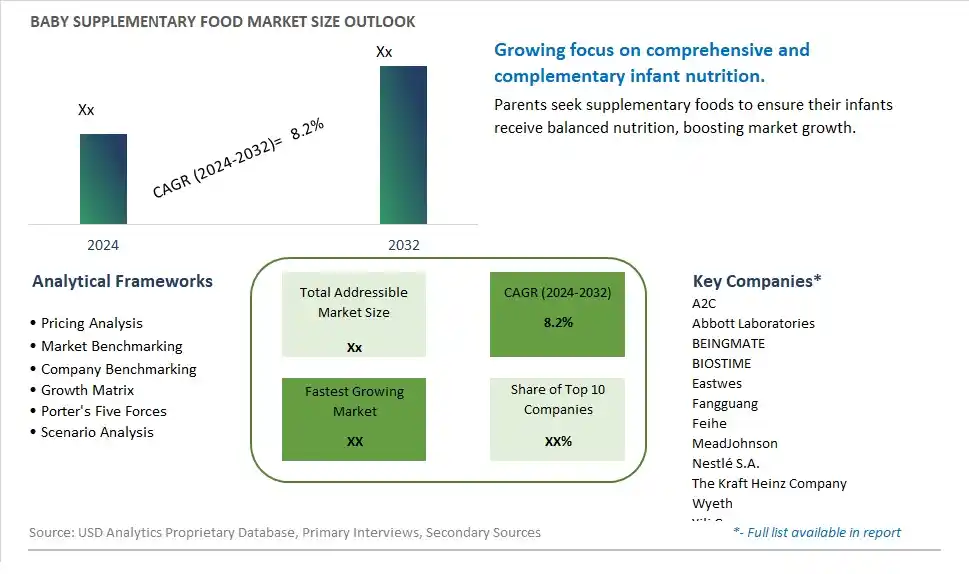
Global Baby Supplementary Food Market Size is valued at $XX Million in 2024 and is forecast to register a growth rate (CAGR) of 8.2% to reach $XX Million by 2032.
The global Baby Supplementary Food Market Comprehensive Study analyzes and forecasts the market size across 6 regions and 24 countries for diverse segments -By Type (Solid, Liquid, Others), By Application (Supermarkets/Hypermarkets, Convenience Stores, Baby Food Stores, Online Retail, Others)
An Introduction to Baby Supplementary Food Market
The Baby Supplementary Food market in 2024 is witnessing substantial growth, driven by the increasing awareness of the importance of complementary feeding in infant nutrition. Baby supplementary foods, which include a variety of products such as purees, cereals, and fortified snacks, are designed to provide essential nutrients that support growth and development. The market is supported by strong endorsement from healthcare professionals and the growing demand for high-quality, scientifically formulated nutrition solutions. Advances in food processing and fortification technologies are enhancing the safety, efficacy, and appeal of baby supplementary foods. The market is also benefiting from the trend towards organic and minimally processed products, catering to health-conscious parents seeking optimal nutrition for their infants.
Baby Supplementary Food Competitive Landscape
The market report analyses the leading companies in the industry including A2C, Abbott Laboratories, BEINGMATE, BIOSTIME, Eastwes, Fangguang, Feihe, MeadJohnson, Nestlé S.A., The Kraft Heinz Company, Wyeth, Yili Group, and Others.
Baby Supplementary Food Market Dynamics
Baby Supplementary Food Market Trend: Expansion of Organic and Natural Baby Supplementary Foods
The market trend for Baby Supplementary Food is characterized by the expanding availability and popularity of organic and natural options for infants and toddlers. Parents are increasingly seeking supplementary foods that are free from artificial additives, preservatives, pesticides, and genetically modified ingredients. They prefer products made with organic fruits, vegetables, grains, and proteins, as these are perceived as safer and healthier choices for their baby's diet. This trend reflects a broader shift towards clean label and transparent food options in the baby food industry, driven by growing consumer awareness about the importance of nutrition and food quality in early childhood development.
Baby Supplementary Food Market Driver: Focus on Nutritional Needs and Developmental Milestones
A key driver for the Baby Supplementary Food market is the focus on meeting the nutritional needs and supporting the developmental milestones of infants and toddlers. Parents, caregivers, and healthcare professionals prioritize supplementary foods that provide essential nutrients such as iron, calcium, vitamins, and healthy fats necessary for growth, immune system function, and brain development. The introduction of diverse food textures, flavors, and nutrient-rich ingredients in baby supplementary foods encourages sensory exploration, self-feeding skills, and promotes a varied and balanced diet during the weaning and toddler stages.
Baby Supplementary Food Market Opportunity: Innovation in Functional Ingredients and Customization
A potential opportunity within the Baby Supplementary Food market lies in innovation in functional ingredients and customization options to address specific nutritional needs and preferences of babies. Collaborating with nutritionists, pediatricians, and food scientists can lead to the development of supplementary foods fortified with targeted nutrients such as DHA, probiotics, prebiotics, and immune-boosting compounds that support optimal growth and health outcomes. Furthermore, offering customization options based on age-appropriate portions, flavor preferences, and dietary restrictions can enhance product appeal and meet the diverse needs of families with infants and toddlers. Exploring novel food formats, packaging designs, and convenient serving options can also improve convenience, convenience, and acceptance among parents and caregivers, creating opportunities to capture market share and drive growth in the competitive baby supplementary food segment.
Baby Supplementary Food Market Share Analysis: Solid segment generated the highest revenue share in the industry
The largest segment in the Baby Supplementary Food Market based on type is "Solid." This segment comprises a wide range of solid supplementary food options such as cereals, purees, snacks, and finger foods designed for infants and toddlers. The popularity of solid baby food can be attributed to several factors. Firstly, solid foods are often recommended by pediatricians and nutritionists as an essential part of an infant's diet as they transition from breastfeeding or formula feeding to solid foods. Solid foods provide crucial nutrients like iron, calcium, vitamins, and proteins necessary for healthy growth and development during early childhood. Additionally, parents often prefer solid baby food options due to their convenience, ease of storage, and longer shelf life compared to liquid alternatives. The variety of textures and flavors available in solid baby food also helps in introducing new tastes and promoting healthy eating habits from a young age. As a result, the "Solid" segment dominates the Baby Supplementary Food Market, catering to the nutritional needs and preferences of growing infants and toddlers.
Baby Supplementary Food Market Share Analysis: Online Retail is the fastest growing segment over the forecast period to 2032
The fastest-growing segment in the Baby Supplementary Food Market based on application is "Online Retail." This segment has witnessed remarkable growth due to several key factors driving the shift towards online purchasing of baby supplementary food products. One of the primary factors is the convenience and accessibility offered by online retail platforms, allowing parents and caregivers to browse and purchase a wide range of baby food products from the comfort of their homes. Online platforms also provide detailed product information, customer reviews, and comparison tools, aiding consumers in making informed purchasing decisions. Further, the increasing adoption of digital technologies and the proliferation of e-commerce platforms have expanded the reach of baby supplementary food products to a broader audience, including rural areas where access to physical stores may be limited. The convenience of doorstep delivery and the availability of subscription services further contribute to the growth of online retail in the baby food market. As digitalization continues to reshape consumer shopping behaviors, the Online Retail segment is expected to experience rapid growth and play a significant role in the overall expansion of the Baby Supplementary Food Market.
Baby Supplementary Food Market Segmentation
By Type
Solid
Liquid
Others
By Application
Supermarkets/Hypermarkets
Convenience Stores
Baby Food Stores
Online Retail
Others
Countries Analyzed
North America (US, Canada, Mexico)
Europe (Germany, UK, France, Spain, Italy, Russia, Rest of Europe)
Asia Pacific (China, India, Japan, South Korea, Australia, South East Asia, Rest of Asia)
South America (Brazil, Argentina, Rest of South America)
Middle East and Africa (Saudi Arabia, UAE, Rest of Middle East, South Africa, Egypt, Rest of Africa)
Baby Supplementary Food Companies Profiled in the Study
A2C
Abbott Laboratories
BEINGMATE
BIOSTIME
Eastwes
Fangguang
Feihe
MeadJohnson
Nestlé S.A.
The Kraft Heinz Company
Wyeth
Yili Group
*- List Not Exhaustive
Chapter 1. TABLE OF CONTENTS
Chapter 2. Introduction to Baby Supplementary Food Market
2.1. Market Overview
2.2. Key Statistics and Report Highlights
2.3. Scope of the Comprehensive Study
2.3.1. Market Definition
2.3.2 Countries and Regions Covered
2.3.3 Research Objective
2.3.4 Units, Currency, and Conversions
2.3.5 Industry Value Chain
2.4. Key Market Segments
2.5. Key Companies
2.6. Study Period
Chapter 3. Strategic Analysis Review
3.1. Baby Supplementary Food Pricing Analysis and Forecast
3.2. Porter’s Five Forces
3.3. Market Ecosystem
3.4. SWOT Analysis
3.5. Regulatory Scenario
3.3. Effects of Inflation, Russia-Ukraine War, moderating economic growth, and other macroeconomic factors
Chapter 4. Competitive Landscape
4.1. Market Share Analysis
4.1.1. Global Baby Supplementary Food Market Share by Company, 2023
4.1.2. Product Offerings of Leading Baby Supplementary Food Companies
4.2. Market Entropy
4.2.1. New Product Launches in the Industry
4.2.2. Mergers, Acquisitions, Joint ventures, and Partnerships
4.3. Key Strategies and Best Practices
Chapter 5. Global Market Projections: Best, Reference, and Low Case Scenarios
5.1. Growth Analysis- Case Scenario Definitions
5.2. Low Growth Case Scenario Forecasts
5.3. Reference Growth Case Scenario Forecasts
5.4. High Growth Case Scenario Forecasts
Chapter 6. Market Dynamics
6.1. Baby Supplementary Food Market Drivers
6.2. Baby Supplementary Food Market Challenges
6.6. Baby Supplementary Food Market Opportunities
6.4. Baby Supplementary Food Market Trends
Chapter 7. Global Baby Supplementary Food Market Outlook Trends
7.1. Global Baby Supplementary Food Revenue (USD Million) and CAGR (%) by Type (2021-2032)
7.2. Global Baby Supplementary Food Revenue (USD Million) and CAGR (%) by Application (2021-2032)
7.3. Global Baby Supplementary Food Revenue (USD Million) and CAGR (%) by Product (2021-2032)
By Type
Solid
Liquid
Others
By Application
Supermarkets/Hypermarkets
Convenience Stores
Baby Food Stores
Online Retail
Others
Chapter 8. Global Baby Supplementary Food Regional Analysis and Outlook
8.1. Global Baby Supplementary Food Revenue (USD Million) By Regions (2021- 2032)
8.2. North America Baby Supplementary Food Revenue (USD Million) by Country (2021-2032)
8.2.1. United States Baby Supplementary Food Regional Analysis and Outlook
8.2.2. Canada Baby Supplementary Food Regional Analysis and Outlook
8.2.3. Mexico Baby Supplementary Food Regional Analysis and Outlook
8.3. Europe Baby Supplementary Food Revenue (USD Million), by Country (2021-2032)
8.3.1. Germany Baby Supplementary Food Regional Analysis and Outlook
8.3.2. France Baby Supplementary Food Regional Analysis and Outlook
8.3.3. United Kingdom Baby Supplementary Food Regional Analysis and Outlook
8.3.4. Spain Baby Supplementary Food Regional Analysis and Outlook
8.3.5. Italy Baby Supplementary Food Regional Analysis and Outlook
8.3.6. Russia Baby Supplementary Food Regional Analysis and Outlook
8.3.7. Rest of Europe Baby Supplementary Food Regional Analysis and Outlook
8.4. Asia Pacific Baby Supplementary Food Revenue (USD Million) by Country (2021-2032)
8.4.1. China Baby Supplementary Food Regional Analysis and Outlook
8.4.2. Japan Baby Supplementary Food Regional Analysis and Outlook
8.4.3. India Baby Supplementary Food Regional Analysis and Outlook
8.4.4. South Korea Baby Supplementary Food Regional Analysis and Outlook
8.4.5. Australia Baby Supplementary Food Regional Analysis and Outlook
8.4.6. South East Asia Baby Supplementary Food Regional Analysis and Outlook
8.4.7. Rest of Asia Pacific Baby Supplementary Food Regional Analysis and Outlook
8.5. South America Baby Supplementary Food Revenue (USD Million), by Country (2021-2032)
8.5.1. Brazil Baby Supplementary Food Regional Analysis and Outlook
8.5.2. Argentina Baby Supplementary Food Regional Analysis and Outlook
8.5.3. Rest of South America Baby Supplementary Food Regional Analysis and Outlook
8.6. Middle East and Africa Baby Supplementary Food Revenue (USD Million) by Country (2021-2032)
8.6.1. Middle East Baby Supplementary Food Regional Analysis and Outlook
8.6.2. Africa Baby Supplementary Food Regional Analysis and Outlook
Chapter 9. North America Baby Supplementary Food Analysis and Outlook
9.1. North America Baby Supplementary Food Revenue (USD Million) by Segments (2021-2032)
9.1.1. North America Baby Supplementary Food Revenue (USD Million) by Type (2021-2032)
9.1.2. North America Baby Supplementary Food Revenue (USD Million) by Application (2021-2032)
9.1.3. North America Baby Supplementary Food Revenue (USD Million) by Product (2021-2032)
By Type
Solid
Liquid
Others
By Application
Supermarkets/Hypermarkets
Convenience Stores
Baby Food Stores
Online Retail
Others
Chapter 10. Europe Baby Supplementary Food Analysis and Outlook
10.1. Europe Baby Supplementary Food Revenue (USD Million), by Segments (USD Million) (2021-2032)
10.1.1. Europe Baby Supplementary Food Revenue (USD Million) by Type (2021-2032)
10.1.2. Europe Baby Supplementary Food Revenue (USD Million) by Application (2021-2032)
10.1.3. Europe Baby Supplementary Food Revenue (USD Million) by Product (2021-2032)
By Type
Solid
Liquid
Others
By Application
Supermarkets/Hypermarkets
Convenience Stores
Baby Food Stores
Online Retail
Others
Chapter 11. Asia Pacific Baby Supplementary Food Analysis and Outlook
11.1. Asia Pacific Baby Supplementary Food Revenue (USD Million), and Revenue (USD Million) by Segments (2021-2032)
11.1.1. Asia Pacific Baby Supplementary Food Revenue (USD Million) by Type (2021-2032)
11.1.2. Asia Pacific Baby Supplementary Food Revenue (USD Million) by Application (2021-2032)
11.1.3. Asia Pacific Baby Supplementary Food Revenue (USD Million) by Product (2021-2032)
By Type
Solid
Liquid
Others
By Application
Supermarkets/Hypermarkets
Convenience Stores
Baby Food Stores
Online Retail
Others
Chapter 12. South America Baby Supplementary Food Analysis and Outlook
12.1. South America Baby Supplementary Food Revenue (USD Million), by Segments (2021-2032)
12.1.1. South America Baby Supplementary Food Revenue (USD Million) by Type (2021-2032)
12.1.2. South America Baby Supplementary Food Revenue (USD Million) by Application (2021-2032)
12.1.3. South America Baby Supplementary Food Revenue (USD Million) by Product (2021-2032)
By Type
Solid
Liquid
Others
By Application
Supermarkets/Hypermarkets
Convenience Stores
Baby Food Stores
Online Retail
Others
Chapter 13. Middle East and Africa Baby Supplementary Food Analysis and Outlook
13.1. Middle East and Africa Baby Supplementary Food Revenue (USD Million), by Segments (2021-2032)
13.1.1. Middle East and Africa Baby Supplementary Food Revenue (USD Million) by Type (2021-2032)
13.1.2. Middle East and Africa Baby Supplementary Food Revenue (USD Million) by Application (2021-2032)
13.1.3. Middle East and Africa Baby Supplementary Food Revenue (USD Million) by Product (2021-2032)
By Type
Solid
Liquid
Others
By Application
Supermarkets/Hypermarkets
Convenience Stores
Baby Food Stores
Online Retail
Others
Chapter 14. Baby Supplementary Food Company Profiles
14.1 Business Overview
14.2 Product Profiles
14.3 SWOT Profiles
14.5 Recent Developments
14.6 Financial Profile
List of Companies
A2C
Abbott Laboratories
BEINGMATE
BIOSTIME
Eastwes
Fangguang
Feihe
MeadJohnson
Nestlé S.A.
The Kraft Heinz Company
Wyeth
Yili Group
15. Methodology and Data Sources
15.1 Customization Offerings
15.2 Subscription Services
15.3 Related Reports
15.4 Publisher Expertise
LIST OF TABLES
Table 1 Market Segmentation Analysis
Table 2 Global Baby Supplementary Food Market Share of Leading Companies, 2023
Table 3 Product Offerings of Leading Companies
Table 4 Low Growth Scenario Forecasts
Table 5 Reference Case Growth Scenario
Table 6 High Growth Case Scenario
Table 7 Global Baby Supplementary Food Revenue (USD Million) And CAGR (%) By Type (2021-2032)
Table 8 Global Baby Supplementary Food Revenue (USD Million) And CAGR (%) By Application (2021-2032)
Table 9 Global Baby Supplementary Food Revenue (USD Million) And CAGR (%) By Product (2021-2032)
Table 10 Global Baby Supplementary Food Market Revenue (USD Million) By Regions (2021-2032)
Table 11 Global Baby Supplementary Food Market Share (%) By Regions (2021-2032)
Table 12 North America Baby Supplementary Food Revenue (USD Million) By Country (2021-2032)
Table 13 Europe Baby Supplementary Food Revenue (USD Million) By Country (2021-2032)
Table 14 Asia Pacific Baby Supplementary Food Revenue (USD Million) By Country (2021-2032)
Table 15 South America Baby Supplementary Food Revenue (USD Million) By Country (2021-2032)
Table 16 Middle East and Africa Baby Supplementary Food Revenue (USD Million) By Region (2021-2032)
Table 17 North America Baby Supplementary Food Revenue (USD Million) By Type (2021-2032)
Table 18 North America Baby Supplementary Food Revenue (USD Million) By Application (2021-2032)
Table 19 North America Baby Supplementary Food Revenue (USD Million) By Product (2021-2032)
Table 20 Europe Baby Supplementary Food Revenue (USD Million) By Type (2021-2032)
Table 21 Europe Baby Supplementary Food Revenue (USD Million) By Application (2021-2032)
Table 22 Europe Baby Supplementary Food Revenue (USD Million) By Product (2021-2032)
Table 23 Asia Pacific Baby Supplementary Food Revenue (USD Million) By Type (2021-2032)
Table 24 Asia Pacific Baby Supplementary Food Revenue (USD Million) By Application (2021-2032)
Table 25 Asia Pacific Baby Supplementary Food Revenue (USD Million) By Product (2021-2032)
Table 26 South America Baby Supplementary Food Revenue (USD Million) By Type (2021-2032)
Table 27 South America Baby Supplementary Food Revenue (USD Million) By Application (2021-2032)
Table 28 South America Baby Supplementary Food Revenue (USD Million) By Product (2021-2032)
Table 29 Middle East and Africa Baby Supplementary Food Revenue (USD Million) By Type (2021-2032)
Table 30 Middle East and Africa Baby Supplementary Food Revenue (USD Million) By Application (2021-2032)
Table 31 Middle East and Africa Baby Supplementary Food Revenue (USD Million) By Product (2021-2032)
LIST OF FIGURES
Figure 1. Market Scope
Figure 2. Pricing Forecasts Per Unit, 2023- 2032
Figure 3. Porter’s Five Forces
Figure 4. Global Baby Supplementary Food Market Revenue (USD Million) By Regions (2021-2032)
Figure 5. Global Baby Supplementary Food Market Share (%) By Regions (2023)
Figure 6. North America Baby Supplementary Food Revenue (USD Million) By Country (2021-2032)
Figure 7. United States Baby Supplementary Food Revenue (USD Million) By Country (2021-2032)
Figure 8. Canada Baby Supplementary Food Revenue (USD Million) By Country (2021-2032)
Figure 9. Mexico Baby Supplementary Food Revenue (USD Million) By Country (2021-2032)
Figure 10. Europe Baby Supplementary Food Revenue (USD Million) By Country (2021-2032)
Figure 11. Germany Baby Supplementary Food Revenue (USD Million) By Country (2021-2032)
Figure 12. France Baby Supplementary Food Revenue (USD Million) By Country (2021-2032)
Figure 13. United Kingdom Baby Supplementary Food Revenue (USD Million) By Country (2021-2032)
Figure 14. Spain Baby Supplementary Food Revenue (USD Million) By Country (2021-2032)
Figure 15. Italy Baby Supplementary Food Revenue (USD Million) By Country (2021-2032)
Figure 16. Russia Baby Supplementary Food Revenue (USD Million) By Country (2021-2032)
Figure 17. Rest of Europe Baby Supplementary Food Revenue (USD Million) By Country (2021-2032)
Figure 11. Asia Pacific Baby Supplementary Food Revenue (USD Million) By Country (2021-2032)
Figure 12. China Baby Supplementary Food Revenue (USD Million) By Country (2021-2032)
Figure 13. Japan Baby Supplementary Food Revenue (USD Million) By Country (2021-2032)
Figure 14. India Baby Supplementary Food Revenue (USD Million) By Country (2021-2032)
Figure 15. South Korea Baby Supplementary Food Revenue (USD Million) By Country (2021-2032)
Figure 16. Australia Baby Supplementary Food Revenue (USD Million) By Country (2021-2032)
Figure 17. South East Asia Baby Supplementary Food Revenue (USD Million) By Country (2021-2032)
Figure 18. South America Baby Supplementary Food Revenue (USD Million) By Country (2021-2032)
Figure 19. Brazil Baby Supplementary Food Revenue (USD Million) By Country (2021-2032)
Figure 20. Argentina Baby Supplementary Food Revenue (USD Million) By Country (2021-2032)
Figure 21. Rest of Asia Pacific Baby Supplementary Food Revenue (USD Million) By Country (2021-2032)
Figure 22. Middle East and Africa Baby Supplementary Food Revenue (USD Million) By Region (2021-2032)
Figure 23. Saudi Arabia Baby Supplementary Food Revenue (USD Million) By Region (2021-2032)
Figure 24. The UAE Baby Supplementary Food Revenue (USD Million) By Region (2021-2032)
Figure 25. Rest of Middle East Baby Supplementary Food Revenue (USD Million) By Region (2021-2032)
Figure 26. South Africa Baby Supplementary Food Revenue (USD Million) By Region (2021-2032)
Figure 27. Africa Baby Supplementary Food Revenue (USD Million) By Region (2021-2032)
Figure 28. North America Baby Supplementary Food Revenue (USD Million) By Type (2021-2032)
Figure 29. North America Baby Supplementary Food Revenue (USD Million) By Application (2021-2032)
Figure 30. North America Baby Supplementary Food Revenue (USD Million) By Product (2021-2032)
Figure 31. Europe Baby Supplementary Food Revenue (USD Million) By Type (2021-2032)
Figure 32. Europe Baby Supplementary Food Revenue (USD Million) By Application (2021-2032)
Figure 33. Europe Baby Supplementary Food Revenue (USD Million) By Product (2021-2032)
Figure 34. Asia Pacific Baby Supplementary Food Revenue (USD Million) By Type (2021-2032)
Figure 35. Asia Pacific Baby Supplementary Food Revenue (USD Million) By Application (2021-2032)
Figure 36. Asia Pacific Baby Supplementary Food Revenue (USD Million) By Product (2021-2032)
Figure 37. South America Baby Supplementary Food Revenue (USD Million) By Type (2021-2032)
Figure 38. South America Baby Supplementary Food Revenue (USD Million) By Application (2021-2032)
Figure 39. South America Baby Supplementary Food Revenue (USD Million) By Product (2021-2032)
Figure 40. Middle East and Africa Baby Supplementary Food Revenue (USD Million) By Type (2021-2032)
Figure 41. Middle East and Africa Baby Supplementary Food Revenue (USD Million) By Application (2021-2032)
Figure 42. Middle East and Africa Baby Supplementary Food Revenue (USD Million) By Product (2021-2032)
By Type
Solid
Liquid
Others
By Application
Supermarkets/Hypermarkets
Convenience Stores
Baby Food Stores
Online Retail
Others
Countries Analyzed
North America (US, Canada, Mexico)
Europe (Germany, UK, France, Spain, Italy, Russia, Rest of Europe)
Asia Pacific (China, India, Japan, South Korea, Australia, South East Asia, Rest of Asia)
South America (Brazil, Argentina, Rest of South America)
Middle East and Africa (Saudi Arabia, UAE, Rest of Middle East, South Africa, Egypt, Rest of Africa)
