
The global Battery Metals Market Study analyzes and forecasts the market size across 6 regions and 24 countries for diverse segments -By Metal (Lithium, Cobalt, Nickel, Others), By Application (Consumer Electronics, Electric Mobility, Energy Storage Systems, Others).
The battery metals market is experiencing rapid growth driven by the increasing adoption of electric vehicles (EVs), renewable energy storage systems, and portable electronics. Key trends shaping the future of the industry include the growing demand for lithium, cobalt, nickel, and graphite as key components in lithium-ion batteries, which are essential for powering EVs and storing renewable energy. Moreover, there's a rising emphasis on supply chain resilience and responsible sourcing practices to ensure a stable and sustainable supply of battery metals, leading to investments in mining projects, recycling infrastructure, and raw material diversification. Additionally, advancements in battery technology, energy density, and cost reduction efforts are driving innovation and market expansion, enabling battery manufacturers to develop more efficient and affordable energy storage solutions for a wide range of applications in the global battery metals market.
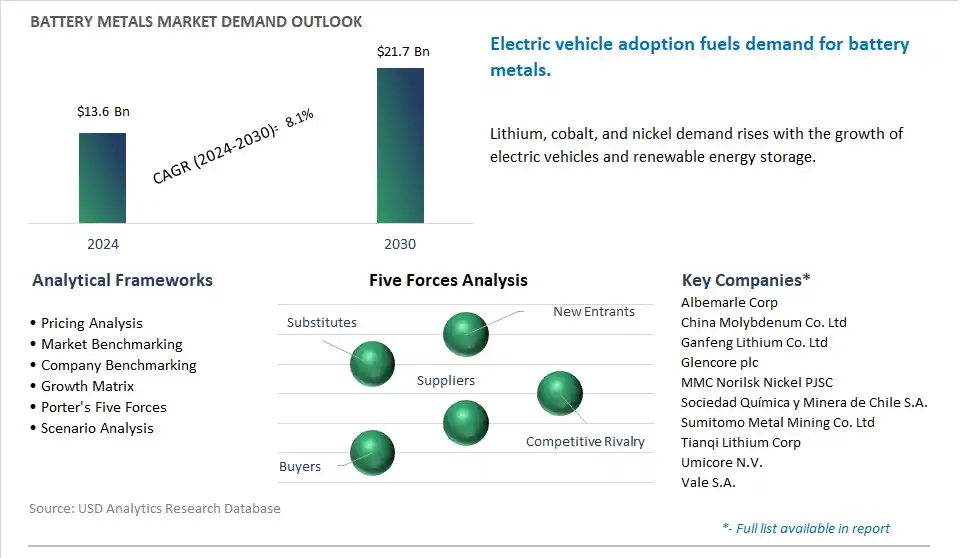
The market report analyses the leading companies in the industry including Albemarle Corp, China Molybdenum Co. Ltd, Ganfeng Lithium Co. Ltd, Glencore plc, MMC Norilsk Nickel PJSC, Sociedad Química y Minera de Chile S.A., Sumitomo Metal Mining Co. Ltd, Tianqi Lithium Corp, Umicore N.V., Vale S.A..
A prominent trend in the battery metals market is the surge in demand driven by electric vehicle (EV) batteries. Battery metals such as lithium, cobalt, nickel, and graphite are essential components in lithium-ion batteries used in electric vehicles. With the global shift towards electrification of transportation and the growing adoption of EVs to mitigate climate change and reduce reliance on fossil fuels, there is a significant increase in demand for battery metals. This trend is expected to continue as governments implement policies to phase out internal combustion engine vehicles and promote the uptake of EVs, leading to a substantial expansion of battery manufacturing capacity and a corresponding surge in demand for raw materials.
A primary driver fueling the battery metals market is the rapid expansion of energy storage systems (ESS). Battery metals such as lithium, cobalt, and nickel are critical for stationary energy storage applications, including grid-scale batteries, residential and commercial energy storage systems, and utility-scale renewable energy projects. As the integration of intermittent renewable energy sources such as solar and wind into the electricity grid increases, there is a growing need for energy storage solutions to stabilize grid operations, manage peak demand, and enhance grid resilience. Moreover, advancements in energy storage technologies and declining battery costs are driving the deployment of ESS for off-grid electrification, microgrids, and backup power applications, further driving demand for battery metals.
An opportunity within the battery metals market lies in the exploration and development of new deposits to meet growing demand and diversify supply sources. While existing mines and projects are expanding production to meet increased demand for battery metals, there is a need to identify and develop new sources of supply to ensure long-term sustainability and resilience of the supply chain. Companies can capitalize on this opportunity by investing in exploration activities to discover new mineral deposits rich in battery metals and advancing development projects to bring new mines into production. Moreover, there is potential to leverage technological advancements such as remote sensing, geophysical surveys, and machine learning algorithms to identify prospective exploration targets and optimize resource delineation and extraction processes. By securing access to new reserves of battery metals, companies can strengthen their market position, mitigate supply chain risks, and capitalize on the growing demand for clean energy technologies powered by lithium-ion batteries.
The lithium segment holds the distinction of being the largest segment in the Battery Metals Market, and this supremacy is underpinned by diverse crucial factors. The lithium-ion batteries are widely used in various applications, including electric vehicles (EVs), consumer electronics, and energy storage systems. With the global push towards sustainability and the transition to cleaner energy sources, the demand for lithium-ion batteries has surged exponentially. EV adoption, in particular, has witnessed remarkable growth, driven by government incentives, technological advancements, and environmental concerns, all of which rely heavily on lithium as a primary component. In addition, the burgeoning renewable energy sector, comprising solar and wind power, relies on lithium batteries for efficient energy storage solutions. Additionally, ongoing research and development efforts aimed at enhancing battery performance and reducing costs further bolster the demand for lithium, solidifying its position as the dominant segment in the Battery Metals Market.
Within the Battery Metals Market, the nickel segment stands out for its remarkable pace of growth. This rapid expansion is driven by the increasing adoption of electric vehicles (EVs) and the growing demand for energy storage solutions have propelled the need for high-energy-density batteries, where nickel plays a critical role. Nickel-rich lithium-ion batteries offer greater energy storage capacity and improved performance, making them highly sought after in the EV market. Additionally, advancements in battery technology, such as the development of nickel-rich cathode materials and the rise of solid-state batteries, further boost the demand for nickel in the battery industry. Further, concerns over the supply chain stability of cobalt, another commonly used metal in batteries, have led to a shift towards nickel-based chemistries, driving the rapid growth of the nickel segment within the Battery Metals Market. As the global focus on electrification and sustainable energy intensifies, the nickel segment is poised for continued expansion, making it a lucrative area for investment and market growth within the battery industry.
The electric mobility segment is the fastest-growing segment in the Battery Metals Market, driven by diverse compelling factors. The the global push towards decarbonization and the transition to electric vehicles (EVs) have fueled exponential growth in the demand for battery metals. Governments worldwide are implementing stringent emissions regulations and offering incentives to promote EV adoption, accelerating the shift away from traditional internal combustion engine vehicles. Additionally, technological advancements, coupled with decreasing battery costs, have made EVs increasingly affordable and appealing to consumers. As a result, major automotive manufacturers are ramping up production of electric vehicles and investing heavily in battery technologies, further driving demand for battery metals like lithium, cobalt, and nickel. In addition, the expansion of charging infrastructure and the development of longer-range batteries are addressing range anxiety concerns, bolstering consumer confidence in EVs and contributing to the rapid growth of the electric mobility segment within the Battery Metals Market. With the electrification of transportation gaining momentum globally, the electric mobility segment is poised for continued robust growth, making it a key focus area for investors and stakeholders in the battery industry.
By Metal
Lithium
Cobalt
Nickel
Others
By Application
Consumer Electronics
Electric Mobility
Energy Storage Systems
Others
Regions Included
North America (US, Canada, Mexico)
Europe (Germany, UK, France, Spain, Italy, Russia, Rest of Europe)
Asia Pacific (China, India, Japan, South Korea, Australia, South East Asia, Rest of Asia)
South America (Brazil, Argentina, Rest of South America)
Middle East and Africa (Saudi Arabia, UAE, Rest of Middle East, South Africa, Egypt, Rest of Africa)
Albemarle Corp
China Molybdenum Co. Ltd
Ganfeng Lithium Co. Ltd
Glencore plc
MMC Norilsk Nickel PJSC
Sociedad Química y Minera de Chile S.A.
Sumitomo Metal Mining Co. Ltd
Tianqi Lithium Corp
Umicore N.V.
Vale S.A.
*- List Not Exhaustive
TABLE OF CONTENTS
1 Introduction to 2024 Battery Metals Market
1.1 Market Overview
1.2 Quick Facts
1.3 Scope/Objective of the Study
1.4 Market Definition
1.5 Countries and Regions Covered
1.6 Units, Currency, and Conversions
1.7 Industry Value Chain
2 Research Methodology
2.1 Market Size Estimation
2.2 Sources and Research Methodology
2.3 Data Triangulation
2.4 Assumptions and Limitations
3 Executive Summary
3.1 Global Battery Metals Market Size Outlook, $ Million, 2021 to 2030
3.2 Battery Metals Market Outlook by Type, $ Million, 2021 to 2030
3.3 Battery Metals Market Outlook by Product, $ Million, 2021 to 2030
3.4 Battery Metals Market Outlook by Application, $ Million, 2021 to 2030
3.5 Battery Metals Market Outlook by Key Countries, $ Million, 2021 to 2030
4 Market Dynamics
4.1 Key Driving Forces of Battery Metals Industry
4.2 Key Market Trends in Battery Metals Industry
4.3 Potential Opportunities in Battery Metals Industry
4.4 Key Challenges in Battery Metals Industry
5 Market Factor Analysis
5.1 Value Chain Analysis
5.2 Competitive Landscape
5.2.1 Global Battery Metals Market Share by Company (%), 2023
5.2.2 Product Offerings by Company
5.3 Porter’s Five Forces Analysis
5.4 Pricing Analysis and Outlook
6 Growth Outlook Across Scenarios
6.1 Growth Analysis-Case Scenario Definitions
6.2 Low Growth Scenario Forecasts
6.3 Reference Growth Scenario Forecasts
6.4 High Growth Scenario Forecasts
7 Global Battery Metals Market Outlook by Segments
7.1 Battery Metals Market Outlook by Segments, $ Million, 2021- 2030
By Metal
Lithium
Cobalt
Nickel
Others
By Application
Consumer Electronics
Electric Mobility
Energy Storage Systems
Others
8 North America Battery Metals Market Analysis and Outlook To 2030
8.1 Introduction to North America Battery Metals Markets in 2024
8.2 North America Battery Metals Market Size Outlook by Country, 2021-2030
8.2.1 United States
8.2.2 Canada
8.2.3 Mexico
8.3 North America Battery Metals Market size Outlook by Segments, 2021-2030
By Metal
Lithium
Cobalt
Nickel
Others
By Application
Consumer Electronics
Electric Mobility
Energy Storage Systems
Others
9 Europe Battery Metals Market Analysis and Outlook To 2030
9.1 Introduction to Europe Battery Metals Markets in 2024
9.2 Europe Battery Metals Market Size Outlook by Country, 2021-2030
9.2.1 Germany
9.2.2 France
9.2.3 Spain
9.2.4 United Kingdom
9.2.4 Italy
9.2.5 Russia
9.2.6 Norway
9.2.7 Rest of Europe
9.3 Europe Battery Metals Market Size Outlook by Segments, 2021-2030
By Metal
Lithium
Cobalt
Nickel
Others
By Application
Consumer Electronics
Electric Mobility
Energy Storage Systems
Others
10 Asia Pacific Battery Metals Market Analysis and Outlook To 2030
10.1 Introduction to Asia Pacific Battery Metals Markets in 2024
10.2 Asia Pacific Battery Metals Market Size Outlook by Country, 2021-2030
10.2.1 China
10.2.2 India
10.2.3 Japan
10.2.4 South Korea
10.2.5 Indonesia
10.2.6 Malaysia
10.2.7 Australia
10.2.8 Rest of Asia Pacific
10.3 Asia Pacific Battery Metals Market size Outlook by Segments, 2021-2030
By Metal
Lithium
Cobalt
Nickel
Others
By Application
Consumer Electronics
Electric Mobility
Energy Storage Systems
Others
11 South America Battery Metals Market Analysis and Outlook To 2030
11.1 Introduction to South America Battery Metals Markets in 2024
11.2 South America Battery Metals Market Size Outlook by Country, 2021-2030
11.2.1 Brazil
11.2.2 Argentina
11.2.3 Rest of South America
11.3 South America Battery Metals Market size Outlook by Segments, 2021-2030
By Metal
Lithium
Cobalt
Nickel
Others
By Application
Consumer Electronics
Electric Mobility
Energy Storage Systems
Others
12 Middle East and Africa Battery Metals Market Analysis and Outlook To 2030
12.1 Introduction to Middle East and Africa Battery Metals Markets in 2024
12.2 Middle East and Africa Battery Metals Market Size Outlook by Country, 2021-2030
12.2.1 Saudi Arabia
12.2.2 UAE
12.2.3 Oman
12.2.4 Rest of Middle East
12.2.5 Egypt
12.2.6 Nigeria
12.2.7 South Africa
12.2.8 Rest of Africa
12.3 Middle East and Africa Battery Metals Market size Outlook by Segments, 2021-2030
By Metal
Lithium
Cobalt
Nickel
Others
By Application
Consumer Electronics
Electric Mobility
Energy Storage Systems
Others
13 Company Profiles
13.1 Company Snapshot
13.2 SWOT Profiles
13.3 Products and Services
13.4 Recent Developments
13.5 Financial Profile
Albemarle Corp
China Molybdenum Co. Ltd
Ganfeng Lithium Co. Ltd
Glencore plc
MMC Norilsk Nickel PJSC
Sociedad Química y Minera de Chile S.A.
Sumitomo Metal Mining Co. Ltd
Tianqi Lithium Corp
Umicore N.V.
Vale S.A.
14 Appendix
14.1 Customization Offerings
14.2 Subscription Services
14.3 Related Reports
14.4 Publisher Expertise
By Metal
Lithium
Cobalt
Nickel
Others
By Application
Consumer Electronics
Electric Mobility
Energy Storage Systems
Others
Countries Analyzed
North America (US, Canada, Mexico)
Europe (Germany, UK, France, Spain, Italy, Russia, Rest of Europe)
Asia Pacific (China, India, Japan, South Korea, Australia, South East Asia, Rest of Asia)
South America (Brazil, Argentina, Rest of South America)
Middle East and Africa (Saudi Arabia, UAE, Rest of Middle East, South Africa, Egypt, Rest of Africa)
Global Battery Metals is forecast to reach $21.7 Billion in 2030 from $13.6 Billion in 2024, registering a CAGR of 8.1%
Emerging Markets across Asia Pacific, Europe, and Americas present robust growth prospects.
Albemarle Corp, China Molybdenum Co. Ltd, Ganfeng Lithium Co. Ltd, Glencore plc, MMC Norilsk Nickel PJSC, Sociedad QuÃmica y Minera de Chile S.A., Sumitomo Metal Mining Co. Ltd, Tianqi Lithium Corp, Umicore N.V., Vale S.A.
Base Year- 2023; Estimated Year- 2024; Historic Period- 2018-2023; Forecast period- 2024 to 2030; Currency: Revenue (USD); Volume