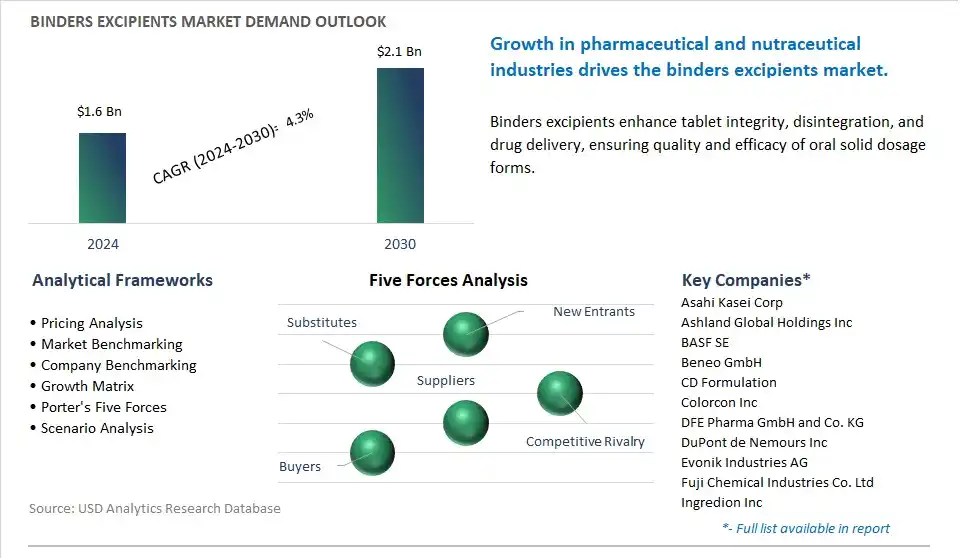
The global Binders Excipients Market is poised to register a 4.3% CAGR from $1.6 Billion in 2024 to $2.1 Billion in 2030.
The global Binders Excipients Market Study analyzes and forecasts the market size across 6 regions and 24 countries for diverse segments -By Type (Cellulosics Lactose, Polyols, Povidones, Starch and Polysaccharides, Others), By Application (Solution Binder, Dry Binder), By End-User (Pharmaceutical Companies, Nutraceutical Companies, Others).
An Introduction to Global Binders Excipients Market in 2024
The market for binders as excipients in pharmaceutical formulations is experiencing steady growth, driven by the demand for improved drug delivery systems and dosage forms. Key trends shaping the future of the industry include advancements in binder chemistry, formulation technologies, and regulatory compliance, enabling the development of excipients that provide enhanced drug stability, bioavailability, and patient compliance. Manufacturers are focusing on innovating binder formulations to meet the diverse requirements of various drug delivery systems such as tablets, capsules, and multiparticulate dosage forms. Additionally, there is a growing emphasis on functionality, performance, and safety in binder selection, driving the adoption of multifunctional excipients with controlled release, taste-masking, and compatibility with active pharmaceutical ingredients (APIs). Moreover, advancements in pharmaceutical processing equipment and techniques are driving market innovation, enabling the development of novel binder applications such as hot melt extrusion, spray drying, and coacervation for the production of sustained-release formulations, pediatric dosage forms, and personalized medicines. Overall, the future of binders as excipients in pharmaceuticals lies in continuous research and development efforts to address emerging formulation challenges, improve manufacturing efficiency, and enhance patient outcomes in the dynamic and highly regulated global pharmaceutical market.
Binders Excipients Market Competitive Landscape
The market report analyses the leading companies in the industry including Asahi Kasei Corp, Ashland Global Holdings Inc, BASF SE, Beneo GmbH, CD Formulation, Colorcon Inc, DFE Pharma GmbH and Co. KG, DuPont de Nemours Inc, Evonik Industries AG, Fuji Chemical Industries Co. Ltd, Ingredion Inc, JRS PHARMA GmbH and Co. KG, Kerry Group Plc, Merck KGaA, Roquette Freres SA, Scope Ingredients Pvt. Ltd, The Dow Chemical Co..
Binders Excipients Market Dynamics
Binders Excipients Market Trend: Increasing Demand for Pharmaceutical Formulations and Drug Delivery Systems
In the Binders Excipients market, a prominent trend is the increasing demand for pharmaceutical formulations and drug delivery systems. As the pharmaceutical industry continues to innovate and develop new medications, there's a growing need for excipients such as binders to ensure the stability, efficacy, and manufacturability of oral solid dosage forms. Binders play a crucial role in tablet and capsule formulations by providing cohesion and compressibility to the blend, facilitating uniform drug distribution, and controlling release kinetics. This trend is driven by factors such as the rising prevalence of chronic diseases, aging populations, and advancements in drug delivery technologies, all contributing to a steady growth in demand for binders and excipients in the pharmaceutical sector.
Binders Excipients Market Driver: Focus on Drug Bioavailability and Patient Compliance
A significant driver in the Binders Excipients market is the focus on drug bioavailability and patient compliance. With increasing emphasis on optimizing drug absorption and enhancing patient adherence to medication regimens, there's a growing demand for excipients that can improve drug solubility, dissolution, and release profiles. Binders help enhance the bioavailability of poorly soluble drugs and ensure consistent drug delivery to the target site within the body, leading to improved therapeutic outcomes and patient satisfaction. This driver is fueled by the need for innovative formulation approaches, personalized medicine strategies, and regulatory requirements for demonstrating bioequivalence and therapeutic equivalence, prompting pharmaceutical companies to invest in advanced binder excipients to meet the evolving needs of the healthcare market.
Binders Excipients Market Opportunity: Development of Functional Excipients for Advanced Formulations
A promising opportunity within the Binders Excipients market lies in the development of functional excipients for advanced formulations. Beyond traditional binder functionalities, there's a growing demand for excipients with additional functionalities such as controlled release, taste masking, and stability enhancement. Opportunities exist in developing multifunctional binder excipients based on novel polymers, lipid-based materials, or nanotechnology platforms that can address the formulation challenges associated with complex drug molecules and dosage forms. By leveraging advancements in materials science, formulation technology, and process engineering, excipient manufacturers can capitalize on this opportunity to expand their product portfolio, differentiate themselves in the market, and meet the evolving needs of pharmaceutical companies for innovative and high-performance excipients.
Binders Excipients Market Share Analysis: Cellulosics generated the highest revenue in 2024
The largest segment in the Binders Excipients Market is the Cellulosics segment. cellulosics are widely used as binders in pharmaceutical and nutraceutical formulations due to their versatile properties and suitability for various dosage forms, including tablets, capsules, and granules. Cellulosic binders, such as hydroxypropyl methylcellulose (HPMC), microcrystalline cellulose (MCC), and ethyl cellulose (EC), offer excellent binding, disintegration, and controlled-release properties, contributing to the formulation's stability, efficacy, and patient compliance. Additionally, cellulosic binders provide good flowability, compressibility, and compatibility with active pharmaceutical ingredients (APIs) and other excipients, facilitating the manufacturing process and ensuring uniformity and reproducibility of the final dosage form. Further, cellulosics are generally recognized as safe (GRAS) by regulatory authorities, making them suitable for use in pharmaceutical products intended for human consumption. Furthermore, the growing demand for oral solid dosage forms, including tablets and capsules, in the pharmaceutical industry drives the continuous growth of the cellulosics segment. Over the forecast period, the combination of versatile properties, regulatory acceptance, and the widespread use of cellulosics in pharmaceutical formulations positions the Cellulosics segment as the largest in the Binders Excipients Market.
Binders Excipients Market Share Analysis: Dry Binder application segment is poised to register the fastest growth rate (CAGR) over the forecast period to 2030
The fastest-growing segment in the Binders Excipients Market is the Dry Binder application segment. There is a growing demand for dry binders in the pharmaceutical and nutraceutical industries due to the increasing popularity of solid oral dosage forms, such as tablets and capsules. Dry binders play a crucial role in tablet and capsule formulations by providing cohesiveness, compressibility, and uniformity to the powder blend, enabling the production of high-quality and consistent dosage forms. Additionally, dry binders help improve tablet hardness, friability, and disintegration properties, ensuring optimal drug release and bioavailability. Further, the shift towards direct compression and dry granulation manufacturing processes, which offer advantages such as reduced production time, energy savings, and simplified formulation development, drives the demand for dry binders. Furthermore, technological advancements in dry binder formulations and manufacturing techniques, including the development of multifunctional excipients and specialized binder systems tailored for specific drug formulations, contribute to the growth of the Dry Binder application segment. Over the forecast period, the combination of increasing demand for solid oral dosage forms, process efficiency, and innovation in dry binder technology positions the Dry Binder application segment as the fastest-growing in the Binders Excipients Market.
Binders Excipients Market Share Analysis: Nutraceutical segment is poised to register the fastest growth rate (CAGR) over the forecast period to 2030
The fastest-growing segment in the Binders Excipients Market is the Nutraceutical Companies end-user segment. There is a growing consumer demand for nutraceutical products, including dietary supplements, functional foods, and health-related products, driven by increasing health awareness, aging populations, and lifestyle trends favoring wellness and preventive healthcare. Nutraceutical companies formulate a wide range of products that require excipients, including binders, to improve product stability, bioavailability, and sensory attributes. Additionally, nutraceutical formulations often require specialized excipients to meet specific formulation requirements, such as controlled release, masking of taste or odor, and compatibility with active ingredients. Further, the regulatory landscape for nutraceutical products is evolving, with increasing scrutiny and requirements for product safety, quality, and efficacy. Nutraceutical companies seek excipients that comply with regulatory standards and can support claims related to product quality and performance. Furthermore, the expanding distribution channels for nutraceutical products, including online retail platforms, specialty stores, and pharmacies, create opportunities for innovation and differentiation in product formulations, driving the demand for excipients. Over the forecast period, the combination of growing consumer demand for nutraceuticals, regulatory requirements, and market expansion positions the Nutraceutical Companies end-user segment as the fastest-growing in the Binders Excipients Market.
Binders Excipients Market Report Segmentation
By Type
Cellulosics Lactose
Polyols
Povidones
Starch and Polysaccharides
Others
By Application
Solution Binder
Dry Binder
By End-User
Pharmaceutical Companies
Nutraceutical Companies
Others
Regions Included
North America (US, Canada, Mexico)
Europe (Germany, UK, France, Spain, Italy, Russia, Rest of Europe)
Asia Pacific (China, India, Japan, South Korea, Australia, South East Asia, Rest of Asia)
South America (Brazil, Argentina, Rest of South America)
Middle East and Africa (Saudi Arabia, UAE, Rest of Middle East, South Africa, Egypt, Rest of Africa)
Binders Excipients Companies Profiled in the Market Study
Asahi Kasei Corp
Ashland Global Holdings Inc
BASF SE
Beneo GmbH
CD Formulation
Colorcon Inc
DFE Pharma GmbH and Co. KG
DuPont de Nemours Inc
Evonik Industries AG
Fuji Chemical Industries Co. Ltd
Ingredion Inc
JRS PHARMA GmbH and Co. KG
Kerry Group Plc
Merck KGaA
Roquette Freres SA
Scope Ingredients Pvt. Ltd
The Dow Chemical Co.
*- List Not Exhaustive
TABLE OF CONTENTS
1 Introduction to 2024 Binders Excipients Market
1.1 Market Overview
1.2 Quick Facts
1.3 Scope/Objective of the Study
1.4 Market Definition
1.5 Countries and Regions Covered
1.6 Units, Currency, and Conversions
1.7 Industry Value Chain
2 Research Methodology
2.1 Market Size Estimation
2.2 Sources and Research Methodology
2.3 Data Triangulation
2.4 Assumptions and Limitations
3 Executive Summary
3.1 Global Binders Excipients Market Size Outlook, $ Million, 2021 to 2030
3.2 Binders Excipients Market Outlook by Type, $ Million, 2021 to 2030
3.3 Binders Excipients Market Outlook by Product, $ Million, 2021 to 2030
3.4 Binders Excipients Market Outlook by Application, $ Million, 2021 to 2030
3.5 Binders Excipients Market Outlook by Key Countries, $ Million, 2021 to 2030
4 Market Dynamics
4.1 Key Driving Forces of Binders Excipients Industry
4.2 Key Market Trends in Binders Excipients Industry
4.3 Potential Opportunities in Binders Excipients Industry
4.4 Key Challenges in Binders Excipients Industry
5 Market Factor Analysis
5.1 Value Chain Analysis
5.2 Competitive Landscape
5.2.1 Global Binders Excipients Market Share by Company (%), 2023
5.2.2 Product Offerings by Company
5.3 Porter’s Five Forces Analysis
5.4 Pricing Analysis and Outlook
6 Growth Outlook Across Scenarios
6.1 Growth Analysis-Case Scenario Definitions
6.2 Low Growth Scenario Forecasts
6.3 Reference Growth Scenario Forecasts
6.4 High Growth Scenario Forecasts
7 Global Binders Excipients Market Outlook by Segments
7.1 Binders Excipients Market Outlook by Segments, $ Million, 2021- 2030
By Type
Cellulosics Lactose
Polyols
Povidones
Starch and Polysaccharides
Others
By Application
Solution Binder
Dry Binder
By End-User
Pharmaceutical Companies
Nutraceutical Companies
Others
8 North America Binders Excipients Market Analysis and Outlook To 2030
8.1 Introduction to North America Binders Excipients Markets in 2024
8.2 North America Binders Excipients Market Size Outlook by Country, 2021-2030
8.2.1 United States
8.2.2 Canada
8.2.3 Mexico
8.3 North America Binders Excipients Market size Outlook by Segments, 2021-2030
By Type
Cellulosics Lactose
Polyols
Povidones
Starch and Polysaccharides
Others
By Application
Solution Binder
Dry Binder
By End-User
Pharmaceutical Companies
Nutraceutical Companies
Others
9 Europe Binders Excipients Market Analysis and Outlook To 2030
9.1 Introduction to Europe Binders Excipients Markets in 2024
9.2 Europe Binders Excipients Market Size Outlook by Country, 2021-2030
9.2.1 Germany
9.2.2 France
9.2.3 Spain
9.2.4 United Kingdom
9.2.4 Italy
9.2.5 Russia
9.2.6 Norway
9.2.7 Rest of Europe
9.3 Europe Binders Excipients Market Size Outlook by Segments, 2021-2030
By Type
Cellulosics Lactose
Polyols
Povidones
Starch and Polysaccharides
Others
By Application
Solution Binder
Dry Binder
By End-User
Pharmaceutical Companies
Nutraceutical Companies
Others
10 Asia Pacific Binders Excipients Market Analysis and Outlook To 2030
10.1 Introduction to Asia Pacific Binders Excipients Markets in 2024
10.2 Asia Pacific Binders Excipients Market Size Outlook by Country, 2021-2030
10.2.1 China
10.2.2 India
10.2.3 Japan
10.2.4 South Korea
10.2.5 Indonesia
10.2.6 Malaysia
10.2.7 Australia
10.2.8 Rest of Asia Pacific
10.3 Asia Pacific Binders Excipients Market size Outlook by Segments, 2021-2030
By Type
Cellulosics Lactose
Polyols
Povidones
Starch and Polysaccharides
Others
By Application
Solution Binder
Dry Binder
By End-User
Pharmaceutical Companies
Nutraceutical Companies
Others
11 South America Binders Excipients Market Analysis and Outlook To 2030
11.1 Introduction to South America Binders Excipients Markets in 2024
11.2 South America Binders Excipients Market Size Outlook by Country, 2021-2030
11.2.1 Brazil
11.2.2 Argentina
11.2.3 Rest of South America
11.3 South America Binders Excipients Market size Outlook by Segments, 2021-2030
By Type
Cellulosics Lactose
Polyols
Povidones
Starch and Polysaccharides
Others
By Application
Solution Binder
Dry Binder
By End-User
Pharmaceutical Companies
Nutraceutical Companies
Others
12 Middle East and Africa Binders Excipients Market Analysis and Outlook To 2030
12.1 Introduction to Middle East and Africa Binders Excipients Markets in 2024
12.2 Middle East and Africa Binders Excipients Market Size Outlook by Country, 2021-2030
12.2.1 Saudi Arabia
12.2.2 UAE
12.2.3 Oman
12.2.4 Rest of Middle East
12.2.5 Egypt
12.2.6 Nigeria
12.2.7 South Africa
12.2.8 Rest of Africa
12.3 Middle East and Africa Binders Excipients Market size Outlook by Segments, 2021-2030
By Type
Cellulosics Lactose
Polyols
Povidones
Starch and Polysaccharides
Others
By Application
Solution Binder
Dry Binder
By End-User
Pharmaceutical Companies
Nutraceutical Companies
Others
13 Company Profiles
13.1 Company Snapshot
13.2 SWOT Profiles
13.3 Products and Services
13.4 Recent Developments
13.5 Financial Profile
Asahi Kasei Corp
Ashland Global Holdings Inc
BASF SE
Beneo GmbH
CD Formulation
Colorcon Inc
DFE Pharma GmbH and Co. KG
DuPont de Nemours Inc
Evonik Industries AG
Fuji Chemical Industries Co. Ltd
Ingredion Inc
JRS PHARMA GmbH and Co. KG
Kerry Group Plc
Merck KGaA
Roquette Freres SA
Scope Ingredients Pvt. Ltd
The Dow Chemical Co.
14 Appendix
14.1 Customization Offerings
14.2 Subscription Services
14.3 Related Reports
14.4 Publisher Expertise
By Type
Cellulosics Lactose
Polyols
Povidones
Starch and Polysaccharides
Others
By Application
Solution Binder
Dry Binder
By End-User
Pharmaceutical Companies
Nutraceutical Companies
Others
Countries Analyzed
North America (US, Canada, Mexico)
Europe (Germany, UK, France, Spain, Italy, Russia, Rest of Europe)
Asia Pacific (China, India, Japan, South Korea, Australia, South East Asia, Rest of Asia)
South America (Brazil, Argentina, Rest of South America)
Middle East and Africa (Saudi Arabia, UAE, Rest of Middle East, South Africa, Egypt, Rest of Africa)
