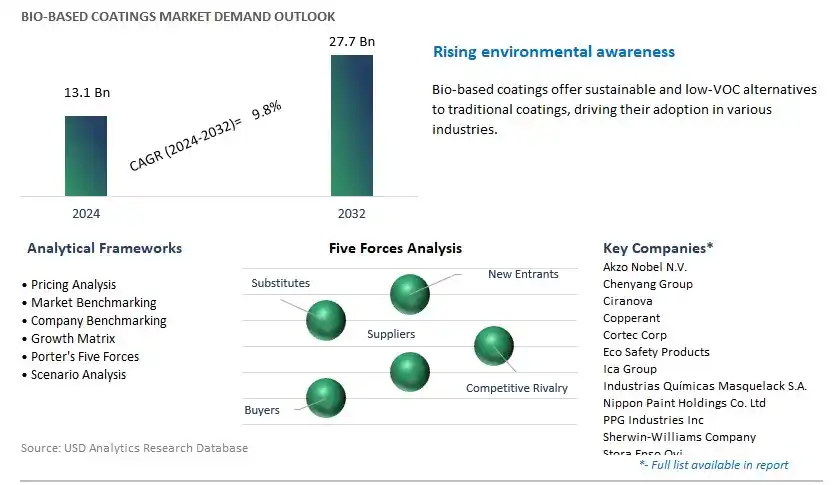
Global Bio-based Coatings Market Size is valued at $13.1 Billion in 2024 and is forecast to register a growth rate (CAGR) of 9.8% to reach $27.7 Billion by 2032.
The global Bio-based Coatings Market Study analyzes and forecasts the market size across 6 regions and 24 countries for diverse segments -By Resin (Alkyd, Polyurethane, Acrylic, Others), By Application (Architectural, Transportation, Woodworking, Packaging, Others).
An Introduction to Bio-based Coatings Market in 2024
Bio-based coatings are coatings formulated with renewable and sustainable ingredients derived from biomass sources such as plants, algae, or microorganisms. These coatings offer environmental benefits such as reduced greenhouse gas emissions, decreased dependency on fossil fuels, and improved end-of-life options compared to conventional petroleum-based coatings. The market for bio-based coatings is driven by the growing demand for environmentally friendly and non-toxic alternatives in various industries, including construction, automotive, packaging, and furniture. Bio-based coatings can be formulated as paints, varnishes, sealants, or adhesives, offering properties such as durability, weather resistance, and UV protection. Additionally, bio-based coatings are compatible with existing application methods and equipment, making them suitable for commercial and industrial use. Further, advancements in bio-based raw materials, formulation technologies, and performance additives are driving innovation and market growth. As sustainability becomes increasingly important to consumers and businesses, bio-based coatings offer a viable solution to reduce environmental impact and promote a circular economy.
Bio-based Coatings Market Competitive Landscape
The market report analyses the leading companies in the industry including Akzo Nobel N.V., Chenyang Group, Ciranova, Copperant, Cortec Corp, Eco Safety Products, Ica Group, Industrias Químicas Masquelack S.A., Nippon Paint Holdings Co. Ltd, PPG Industries Inc, Sherwin-Williams Company, Stora Enso Oyj, Tremco Roofing & Building Maintenance, and others.
Bio-based Coatings Market Dynamics
Market Trend: Increasing Demand for Sustainable Coating Solutions
A significant market trend for Bio-based Coatings is the increasing demand for sustainable coating solutions driven by environmental concerns, regulatory requirements, and consumer preferences for eco-friendly products. Bio-based coatings, derived from renewable biomass sources such as plant oils, starches, and natural resins, offer a more environmentally friendly alternative to conventional coatings made from fossil fuel-derived chemicals. With growing awareness of climate change, pollution, and resource depletion, there is a rising demand for coatings that minimize environmental impact, reduce carbon footprint, and support circular economy principles. This trend reflects a broader industry shift towards sustainable manufacturing practices, green chemistry, and corporate sustainability initiatives, influencing the adoption of bio-based coatings across various sectors including construction, automotive, packaging, and furniture.
Market Driver: Stringent Environmental Regulations and Sustainability Goals
A significant market driver for Bio-based Coatings is the implementation of stringent environmental regulations and sustainability goals by governments, industry associations, and corporate entities to reduce emissions, promote resource conservation, and mitigate climate change impacts. Regulatory frameworks such as VOC (volatile organic compound) limits, REACH (Registration, Evaluation, Authorization and Restriction of Chemicals) regulations, and LEED (Leadership in Energy and Environmental Design) certification requirements drive the adoption of bio-based coatings as they offer lower VOC emissions, reduced toxicity, and improved indoor air quality compared to traditional solvent-based coatings. Additionally, corporate sustainability commitments, supply chain transparency initiatives, and consumer demand for greener products incentivize coatings manufacturers to invest in bio-based technologies, research, and product development to meet regulatory compliance and market expectations for sustainable coatings solutions.
Market Opportunity: Innovation in Bio-based Coating Formulations and Applications
An attractive opportunity in the Bio-based Coatings market lies in the innovation of bio-based coating formulations and applications to address evolving customer needs, performance requirements, and market trends. Manufacturers can capitalize on the opportunity to develop bio-based coatings with enhanced properties such as durability, weather resistance, adhesion, and color stability to compete with conventional coatings on performance metrics. Opportunities exist to explore novel bio-based raw materials, functional additives, and formulation techniques that improve coating performance while maintaining environmental sustainability and cost-effectiveness. Additionally, there is potential to expand the application of bio-based coatings into new market segments such as marine coatings, aerospace coatings, and industrial maintenance coatings where environmental regulations, corrosion protection, and sustainability considerations are paramount. By investing in research and development, collaborating with raw material suppliers, and partnering with end-users to validate performance, coatings manufacturers can unlock opportunities for growth, differentiation, and market leadership in the rapidly evolving bio-based coatings industry.
Bio-based Coatings Market Share Analysis: Acrylic segment generated the highest revenue in 2024
Acrylic is the largest segment in the bio-based coatings market due to its wide range of applications and desirable properties. Acrylic resins offer excellent durability, weatherability, UV resistance, and color retention, making them ideal for various coating applications across industries such as construction, automotive, and furniture. Additionally, acrylic coatings provide high gloss finishes and can be easily formulated to meet specific performance requirements, including adhesion, flexibility, and scratch resistance. Moreover, the growing emphasis on sustainable and eco-friendly coatings solutions has propelled the demand for bio-based acrylic resins derived from renewable sources such as plant-based feedstocks. With its versatility, superior performance characteristics, and increasing adoption in diverse end-use sectors, acrylic resins stand out as the largest segment within the bio-based coatings market.
Bio-based Coatings Market Share Analysis: Packaging is poised to register the fastest CAGR over the forecast period
Packaging is the fastest-growing segment in the bio-based coatings market. With the increasing awareness of environmental concerns and the push towards sustainable packaging solutions, there is a growing demand for bio-based coatings derived from renewable sources. Bio-based coatings offer advantages such as biodegradability, reduced carbon footprint, and non-toxicity, making them suitable for various packaging applications, including food, beverage, cosmetics, and pharmaceuticals. Additionally, stringent regulations aimed at reducing plastic waste and promoting eco-friendly packaging alternatives further accelerate the adoption of bio-based coatings in the packaging industry. Moreover, advancements in bio-based coating technologies, coupled with innovative formulations tailored to meet specific packaging requirements such as barrier properties and printability, contribute to the rapid growth of this segment. With the increasing consumer preference for sustainable packaging options and the ongoing shift towards circular economy principles, the packaging sector is the fastest-growing segment within the bio-based coatings market.
Bio-based Coatings Market
By Resin
Alkyd
Polyurethane
Acrylic
Others
By Application
Architectural
Transportation
Woodworking
Packaging
Others
Countries Analyzed
North America (US, Canada, Mexico)
Europe (Germany, UK, France, Spain, Italy, Russia, Rest of Europe)
Asia Pacific (China, India, Japan, South Korea, Australia, South East Asia, Rest of Asia)
South America (Brazil, Argentina, Rest of South America)
Middle East and Africa (Saudi Arabia, UAE, Rest of Middle East, South Africa, Egypt, Rest of Africa)
Bio based Coatings Companies Profiled in the Study
Akzo Nobel N.V.
Chenyang Group
Ciranova
Copperant
Cortec Corp
Eco Safety Products
Ica Group
Industrias Químicas Masquelack S.A.
Nippon Paint Holdings Co. Ltd
PPG Industries Inc
Sherwin-Williams Company
Stora Enso Oyj
Tremco Roofing & Building Maintenance
*- List Not Exhaustive
TABLE OF CONTENTS
1 Introduction to 2024 Bio based Coatings Market
1.1 Market Overview
1.2 Quick Facts
1.3 Scope/Objective of the Study
1.4 Market Definition
1.5 Countries and Regions Covered
1.6 Units, Currency, and Conversions
1.7 Industry Value Chain
2 Research Methodology
2.1 Market Size Estimation
2.2 Sources and Research Methodology
2.3 Data Triangulation
2.4 Assumptions and Limitations
3 Executive Summary
3.1 Global Bio based Coatings Market Size Outlook, $ Million, 2021 to 2032
3.2 Bio based Coatings Market Outlook by Type, $ Million, 2021 to 2032
3.3 Bio based Coatings Market Outlook by Product, $ Million, 2021 to 2032
3.4 Bio based Coatings Market Outlook by Application, $ Million, 2021 to 2032
3.5 Bio based Coatings Market Outlook by Key Countries, $ Million, 2021 to 2032
4 Market Dynamics
4.1 Key Driving Forces of Bio based Coatings Industry
4.2 Key Market Trends in Bio based Coatings Industry
4.3 Potential Opportunities in Bio based Coatings Industry
4.4 Key Challenges in Bio based Coatings Industry
5 Market Factor Analysis
5.1 Value Chain Analysis
5.2 Competitive Landscape
5.2.1 Global Bio based Coatings Market Share by Company (%), 2023
5.2.2 Product Offerings by Company
5.3 Porter’s Five Forces Analysis
5.4 Pricing Analysis and Outlook
6 Growth Outlook Across Scenarios
6.1 Growth Analysis-Case Scenario Definitions
6.2 Low Growth Scenario Forecasts
6.3 Reference Growth Scenario Forecasts
6.4 High Growth Scenario Forecasts
7 Global Bio based Coatings Market Outlook by Segments
7.1 Bio based Coatings Market Outlook by Segments, $ Million, 2021- 2032
By Resin
Alkyd
Polyurethane
Acrylic
Others
By Application
Architectural
Transportation
Woodworking
Packaging
Others
8 North America Bio based Coatings Market Analysis and Outlook To 2032
8.1 Introduction to North America Bio based Coatings Markets in 2024
8.2 North America Bio based Coatings Market Size Outlook by Country, 2021-2032
8.2.1 United States
8.2.2 Canada
8.2.3 Mexico
8.3 North America Bio based Coatings Market size Outlook by Segments, 2021-2032
By Resin
Alkyd
Polyurethane
Acrylic
Others
By Application
Architectural
Transportation
Woodworking
Packaging
Others
9 Europe Bio based Coatings Market Analysis and Outlook To 2032
9.1 Introduction to Europe Bio based Coatings Markets in 2024
9.2 Europe Bio based Coatings Market Size Outlook by Country, 2021-2032
9.2.1 Germany
9.2.2 France
9.2.3 Spain
9.2.4 United Kingdom
9.2.4 Italy
9.2.5 Russia
9.2.6 Norway
9.2.7 Rest of Europe
9.3 Europe Bio based Coatings Market Size Outlook by Segments, 2021-2032
By Resin
Alkyd
Polyurethane
Acrylic
Others
By Application
Architectural
Transportation
Woodworking
Packaging
Others
10 Asia Pacific Bio based Coatings Market Analysis and Outlook To 2032
10.1 Introduction to Asia Pacific Bio based Coatings Markets in 2024
10.2 Asia Pacific Bio based Coatings Market Size Outlook by Country, 2021-2032
10.2.1 China
10.2.2 India
10.2.3 Japan
10.2.4 South Korea
10.2.5 Indonesia
10.2.6 Malaysia
10.2.7 Australia
10.2.8 Rest of Asia Pacific
10.3 Asia Pacific Bio based Coatings Market size Outlook by Segments, 2021-2032
By Resin
Alkyd
Polyurethane
Acrylic
Others
By Application
Architectural
Transportation
Woodworking
Packaging
Others
11 South America Bio based Coatings Market Analysis and Outlook To 2032
11.1 Introduction to South America Bio based Coatings Markets in 2024
11.2 South America Bio based Coatings Market Size Outlook by Country, 2021-2032
11.2.1 Brazil
11.2.2 Argentina
11.2.3 Rest of South America
11.3 South America Bio based Coatings Market size Outlook by Segments, 2021-2032
By Resin
Alkyd
Polyurethane
Acrylic
Others
By Application
Architectural
Transportation
Woodworking
Packaging
Others
12 Middle East and Africa Bio based Coatings Market Analysis and Outlook To 2032
12.1 Introduction to Middle East and Africa Bio based Coatings Markets in 2024
12.2 Middle East and Africa Bio based Coatings Market Size Outlook by Country, 2021-2032
12.2.1 Saudi Arabia
12.2.2 UAE
12.2.3 Oman
12.2.4 Rest of Middle East
12.2.5 Egypt
12.2.6 Nigeria
12.2.7 South Africa
12.2.8 Rest of Africa
12.3 Middle East and Africa Bio based Coatings Market size Outlook by Segments, 2021-2032
By Resin
Alkyd
Polyurethane
Acrylic
Others
By Application
Architectural
Transportation
Woodworking
Packaging
Others
13 Company Profiles
13.1 Company Snapshot
13.2 SWOT Profiles
13.3 Products and Services
13.4 Recent Developments
13.5 Financial Profile
Akzo Nobel N.V.
Chenyang Group
Ciranova
Copperant
Cortec Corp
Eco Safety Products
Ica Group
Industrias Químicas Masquelack S.A.
Nippon Paint Holdings Co. Ltd
PPG Industries Inc
Sherwin-Williams Company
Stora Enso Oyj
Tremco Roofing & Building Maintenance
14 Appendix
14.1 Customization Offerings
14.2 Subscription Services
14.3 Related Reports
14.4 Publisher Expertise
By Resin
Alkyd
Polyurethane
Acrylic
Others
By Application
Architectural
Transportation
Woodworking
Packaging
Others
Countries Analyzed
North America (US, Canada, Mexico)
Europe (Germany, UK, France, Spain, Italy, Russia, Rest of Europe)
Asia Pacific (China, India, Japan, South Korea, Australia, South East Asia, Rest of Asia)
South America (Brazil, Argentina, Rest of South America)
Middle East and Africa (Saudi Arabia, UAE, Rest of Middle East, South Africa, Egypt, Rest of Africa)
