The global Bio-based Elastomers Market is poised to register a 12.7% CAGR from $894 Million in 2024 to $1831.8 Million in 2030.
The global Bio-based Elastomers Market Study analyzes and forecasts the market size across 6 regions and 24 countries for diverse segments -By Product (Thermoplastic, Thermoset), By Application (Footwear, Automotive, Sports, Electrical & Electronics, Others).
An Introduction to Global Bio based Elastomers Market in 2024
The market for bio-based elastomers is advancing sustainability in the rubber industry as manufacturers seek renewable alternatives to petroleum-based rubber materials. Key trends shaping the future of this industry include the development of elastomers derived from bio-based feedstocks such as natural rubber latex, plant oils, and biomass-derived monomers, offering advantages in terms of carbon neutrality, biodegradability, and reduced environmental impact. Additionally, advancements in elastomer synthesis, compounding, and processing technologies enable the production of bio-based elastomers with comparable mechanical properties and performance to conventional rubber materials, meeting the diverse needs of industries such as automotive, construction, and consumer goods. Moreover, the adoption of sustainable sourcing practices, eco-labeling initiatives, and circular economy strategies drives market demand for bio-based elastomers, fostering innovation and market expansion in this sector. As industries transition towards renewable and eco-friendly materials, the demand for bio-based elastomers is expected to increase, driving further innovation and market development in sustainable rubber products.
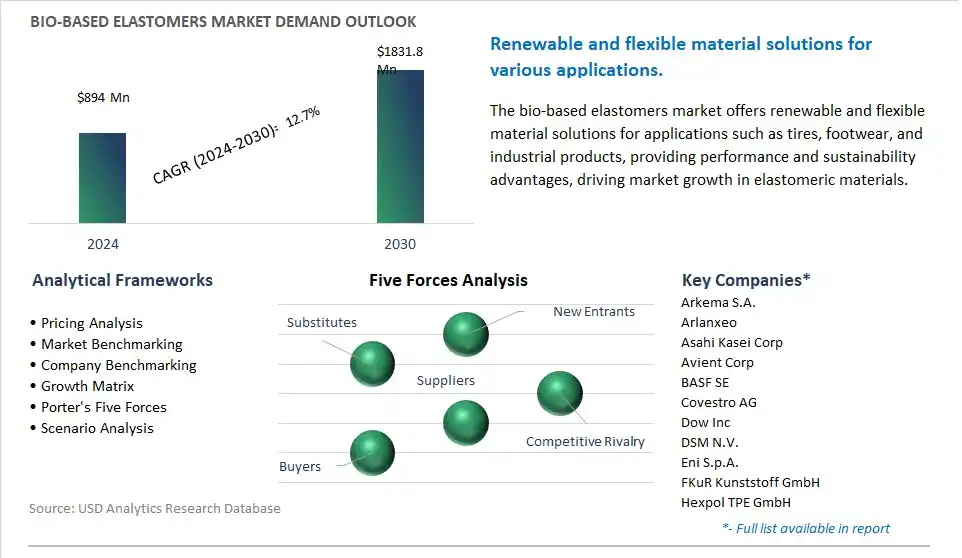
Bio-based Elastomers Market Competitive Landscape
The market report analyses the leading companies in the industry including Arkema S.A., Arlanxeo, Asahi Kasei Corp, Avient Corp, BASF SE, Covestro AG, Dow Inc, DSM N.V., Eni S.p.A., FKuR Kunststoff GmbH, Hexpol TPE GmbH, Huntsman International LLC, Kuraray Co. Ltd, Mitsubishi Chemical Europe GmbH, The Goodyear Tire & Rubber Company, The Lubrizol Corp, Trinseo LLC, Wacker Chemie AG.
Bio-based Elastomers Market Dynamics
Bio-based Elastomers Market Trend: Increasing Demand for Sustainable and Renewable Materials in Various Industries
A prominent trend in the market for bio-based elastomers is the increasing demand for sustainable and renewable materials across various industries. Bio-based elastomers, derived from renewable biomass sources such as plant oils, biomass sugars, or natural rubber, offer a sustainable alternative to petroleum-based elastomers. With growing concerns about environmental sustainability, climate change, and resource depletion, industries such as automotive, construction, footwear, and consumer goods are seeking eco-friendly materials to reduce their carbon footprint and environmental impact. Bio-based elastomers are gaining traction as they provide similar performance characteristics to conventional elastomers while offering the benefits of biodegradability, lower greenhouse gas emissions, and reduced dependency on finite resources.
Bio-based Elastomers Market Driver: Regulatory Pressure and Consumer Preferences for Eco-Friendly Products
A key driver behind the demand for bio-based elastomers is regulatory pressure and consumer preferences for eco-friendly products. Governments worldwide are implementing regulations and policies to promote the use of renewable and sustainable materials, incentivize bio-based innovation, and reduce the environmental impact of industrial processes. Additionally, consumers are becoming more conscious of the environmental and social implications of their purchasing decisions and are actively seeking products that align with their values. Accordingly, manufacturers and brand owners are under pressure to adopt sustainable practices and offer environmentally friendly products to meet regulatory requirements and consumer expectations. Bio-based elastomers provide an opportunity for companies to differentiate their products in the market, comply with sustainability standards, and enhance their corporate social responsibility (CSR) initiatives.
Bio-based Elastomers Market Opportunity: Collaboration and Innovation in Material Science and Process Engineering
An emerging opportunity in the market for bio-based elastomers lies in collaboration and innovation in material science and process engineering. While bio-based elastomers offer several environmental benefits, challenges remain in terms of performance, cost-effectiveness, and scalability compared to conventional elastomers. Opportunities exist for collaboration between academia, research institutions, industry players, and government agencies to advance research and development efforts in bio-based materials technology. By leveraging interdisciplinary expertise and cutting-edge technologies, such as biotechnology, nanotechnology, and green chemistry, stakeholders can overcome technical barriers and optimize the properties and processing of bio-based elastomers. Additionally, investments in process optimization, scale-up capabilities, and supply chain integration can drive down production costs and improve the competitiveness of bio-based elastomers in the market. By embracing collaboration and innovation, companies can unlock the full potential of bio-based elastomers and capitalize on the growing demand for sustainable materials across industries.
Bio-based Elastomers Market Ecosystem
The bio-based elastomers market involves a series of stages beginning with feedstock production, where companies including sugarcane and beet growers, corn and cassava farmers, and castor oil and vegetable oil producers supply renewable materials. Pre-treatment, though optional, is facilitated by specialized companies including LIG Renewable Fuels and Quadrise Fuels International, or integrated facilities within bio-based elastomer producers. Bio-based monomer production follows, with companies specializing in bio-monomer production or integrated bio-based elastomer producers.
Polymerization or bioconversion is characterized by the presence of established bio-based elastomer producers with expertise in the field, alongside biotechnology companies developing fermentation technologies for bio-elastomers. Compounding and modification enhance the properties of bio-based elastomers, with companies possessing compounding capabilities or specialty compounding firms working with bio-based polymers.
Further, these elastomers find applications in automotive, footwear, sports and leisure, medical devices, electronics, adhesives, and other industries, with manufacturers incorporating bio-based solutions into their products.
Bio-based Elastomers Market Share Analysis: Thermoplastic held the dominant revenue share in 2024
Among the segments in the Bio-based Elastomers Market, Thermoplastic elastomers (TPEs) emerge as the largest, driven by diverse significant factors contributing to their dominance. Thermoplastic elastomers offer a unique combination of elasticity and processability, making them highly versatile and suitable for a wide range of applications across industries such as automotive, consumer goods, and medical devices. Bio-based thermoplastic elastomers, derived from renewable sources such as plant-based oils and biomass, provide an environmentally friendly alternative to conventional elastomers derived from fossil fuels. In addition, advancements in bio-based polymer technology have led to the development of high-performance TPEs with properties comparable to traditional elastomers, further driving their adoption in various applications. Additionally, the growing emphasis on sustainability and circular economy principles in manufacturing industries propels the demand for bio-based thermoplastic elastomers, as they offer a renewable and biodegradable solution to meet environmental goals. As industries continue to prioritize sustainability and seek alternatives to conventional materials, the dominance of Thermoplastic elastomers in the Bio-based Elastomers Market is expected to persist, offering manufacturers and suppliers significant opportunities for growth and market expansion.
Bio-based Elastomers Market Share Analysis: Automotive is the fastest growing market segment over the forecast period to 2030
The Automotive segment is the fastest-growing segment in the Bio-based Elastomers Market, driven by diverse key factors contributing to its rapid expansion. Automotive manufacturers are increasingly turning to bio-based elastomers to meet stringent environmental regulations, reduce carbon footprint, and address consumer demands for sustainable materials in vehicle production. Bio-based elastomers offer excellent performance characteristics such as durability, flexibility, and resistance to temperature extremes, making them suitable for a wide range of automotive applications, including seals, gaskets, hoses, and vibration-dampening components. In addition, the automotive industry's shift toward electric and hybrid vehicles further accelerates the demand for bio-based elastomers, as these vehicles require lightweight materials with superior electrical insulation properties. Additionally, collaborations between automotive OEMs and bio-based polymer manufacturers drive innovation and product development in the bio-based elastomers sector, further fueling its growth. As automotive manufacturers increasingly embrace sustainability and eco-friendly solutions, the Automotive segment in the Bio-based Elastomers Market is expected to experience sustained growth, presenting significant opportunities for manufacturers and suppliers alike.
Bio-based Elastomers Market Report Scope-
By Product
Thermoplastic
Thermoset
By Application
Footwear
Automotive
Sports
Electrical & Electronics
Others
Bio-based Elastomers Market Companies Profiled
Arkema S.A.
Arlanxeo
Asahi Kasei Corp
Avient Corp
BASF SE
Covestro AG
Dow Inc
DSM N.V.
Eni S.p.A.
FKuR Kunststoff GmbH
Hexpol TPE GmbH
Huntsman International LLC
Kuraray Co. Ltd
Mitsubishi Chemical Europe GmbH
The Goodyear Tire & Rubber Company
The Lubrizol Corp
Trinseo LLC
Wacker Chemie AG
*- List Not Exhaustive
TABLE OF CONTENTS
1 Introduction to 2024 Bio-based Elastomers Market
1.1 Market Overview
1.2 Quick Facts
1.3 Scope/Objective of the Study
1.4 Market Definition
1.5 Countries and Regions Covered
1.6 Units, Currency, and Conversions
1.7 Industry Value Chain
2 Research Methodology
2.1 Market Size Estimation
2.2 Sources and Research Methodology
2.3 Data Triangulation
2.4 Assumptions and Limitations
3 Executive Summary
3.1 Global Bio-based Elastomers Market Size Outlook, $ Million, 2021 to 2030
3.2 Bio-based Elastomers Market Outlook by Type, $ Million, 2021 to 2030
3.3 Bio-based Elastomers Market Outlook by Product, $ Million, 2021 to 2030
3.4 Bio-based Elastomers Market Outlook by Application, $ Million, 2021 to 2030
3.5 Bio-based Elastomers Market Outlook by Key Countries, $ Million, 2021 to 2030
4 Market Dynamics
4.1 Key Driving Forces of Bio-based Elastomers Industry
4.2 Key Market Trends in Bio-based Elastomers Industry
4.3 Potential Opportunities in Bio-based Elastomers Industry
4.4 Key Challenges in Bio-based Elastomers Industry
5 Market Factor Analysis
5.1 Value Chain Analysis
5.2 Competitive Landscape
5.2.1 Global Bio-based Elastomers Market Share by Company (%), 2023
5.2.2 Product Offerings by Company
5.3 Porter’s Five Forces Analysis
5.4 Pricing Analysis and Outlook
6 Growth Outlook Across Scenarios
6.1 Growth Analysis-Case Scenario Definitions
6.2 Low Growth Scenario Forecasts
6.3 Reference Growth Scenario Forecasts
6.4 High Growth Scenario Forecasts
7 Global Bio-based Elastomers Market Outlook by Segments
7.1 Bio-based Elastomers Market Outlook by Segments, $ Million, 2021- 2030
By Product
Thermoplastic
Thermoset
By Application
Footwear
Automotive
Sports
Electrical & Electronics
Others
8 North America Bio-based Elastomers Market Analysis and Outlook To 2030
8.1 Introduction to North America Bio-based Elastomers Markets in 2024
8.2 North America Bio-based Elastomers Market Size Outlook by Country, 2021-2030
8.2.1 United States
8.2.2 Canada
8.2.3 Mexico
8.3 North America Bio-based Elastomers Market size Outlook by Segments, 2021-2030
By Product
Thermoplastic
Thermoset
By Application
Footwear
Automotive
Sports
Electrical & Electronics
Others
9 Europe Bio-based Elastomers Market Analysis and Outlook To 2030
9.1 Introduction to Europe Bio-based Elastomers Markets in 2024
9.2 Europe Bio-based Elastomers Market Size Outlook by Country, 2021-2030
9.2.1 Germany
9.2.2 France
9.2.3 Spain
9.2.4 United Kingdom
9.2.4 Italy
9.2.5 Russia
9.2.6 Norway
9.2.7 Rest of Europe
9.3 Europe Bio-based Elastomers Market Size Outlook by Segments, 2021-2030
By Product
Thermoplastic
Thermoset
By Application
Footwear
Automotive
Sports
Electrical & Electronics
Others
10 Asia Pacific Bio-based Elastomers Market Analysis and Outlook To 2030
10.1 Introduction to Asia Pacific Bio-based Elastomers Markets in 2024
10.2 Asia Pacific Bio-based Elastomers Market Size Outlook by Country, 2021-2030
10.2.1 China
10.2.2 India
10.2.3 Japan
10.2.4 South Korea
10.2.5 Indonesia
10.2.6 Malaysia
10.2.7 Australia
10.2.8 Rest of Asia Pacific
10.3 Asia Pacific Bio-based Elastomers Market size Outlook by Segments, 2021-2030
By Product
Thermoplastic
Thermoset
By Application
Footwear
Automotive
Sports
Electrical & Electronics
Others
11 South America Bio-based Elastomers Market Analysis and Outlook To 2030
11.1 Introduction to South America Bio-based Elastomers Markets in 2024
11.2 South America Bio-based Elastomers Market Size Outlook by Country, 2021-2030
11.2.1 Brazil
11.2.2 Argentina
11.2.3 Rest of South America
11.3 South America Bio-based Elastomers Market size Outlook by Segments, 2021-2030
By Product
Thermoplastic
Thermoset
By Application
Footwear
Automotive
Sports
Electrical & Electronics
Others
12 Middle East and Africa Bio-based Elastomers Market Analysis and Outlook To 2030
12.1 Introduction to Middle East and Africa Bio-based Elastomers Markets in 2024
12.2 Middle East and Africa Bio-based Elastomers Market Size Outlook by Country, 2021-2030
12.2.1 Saudi Arabia
12.2.2 UAE
12.2.3 Oman
12.2.4 Rest of Middle East
12.2.5 Egypt
12.2.6 Nigeria
12.2.7 South Africa
12.2.8 Rest of Africa
12.3 Middle East and Africa Bio-based Elastomers Market size Outlook by Segments, 2021-2030
By Product
Thermoplastic
Thermoset
By Application
Footwear
Automotive
Sports
Electrical & Electronics
Others
13 Company Profiles
13.1 Company Snapshot
13.2 SWOT Profiles
13.3 Products and Services
13.4 Recent Developments
13.5 Financial Profile
Arkema S.A.
Arlanxeo
Asahi Kasei Corp
Avient Corp
BASF SE
Covestro AG
Dow Inc
DSM N.V.
Eni S.p.A.
FKuR Kunststoff GmbH
Hexpol TPE GmbH
Huntsman International LLC
Kuraray Co. Ltd
Mitsubishi Chemical Europe GmbH
The Goodyear Tire & Rubber Company
The Lubrizol Corp
Trinseo LLC
Wacker Chemie AG
14 Appendix
14.1 Customization Offerings
14.2 Subscription Services
14.3 Related Reports
14.4 Publisher Expertise
By Product
Thermoplastic
Thermoset
By Application
Footwear
Automotive
Sports
Electrical & Electronics
Others
Countries Analyzed
North America (US, Canada, Mexico)
Europe (Germany, UK, France, Spain, Italy, Russia, Rest of Europe)
Asia Pacific (China, India, Japan, South Korea, Australia, South East Asia, Rest of Asia)
South America (Brazil, Argentina, Rest of South America)
Middle East and Africa (Saudi Arabia, UAE, Rest of Middle East, South Africa, Egypt, Rest of Africa)
