
The global Bio-based Itaconic Acid Market Study analyzes and forecasts the market size across 6 regions and 24 countries for diverse segments -By Derivative (Styrene Butadiene Itaconic Acid, Methyl Methacrylate, Polyitaconic Acid, Others), By Application (SBR Latex, Synthetic Latex, Chillant Dispersant Agent, Superabsorbent Polymer, Unsaturated Polyester Resins, Methyl Methacrylate, Detergent Builder, Others).
The market for bio-based itaconic acid is expanding as industries seek sustainable alternatives to petroleum-based chemicals for various applications, including polymers, resins, coatings, and adhesives. Key trends shaping the future of this industry include the development of biotechnological processes for the microbial fermentation of renewable feedstocks such as sugars, starches, and agricultural residues to produce itaconic acid through environmentally friendly and economically viable methods. Additionally, advancements in fermentation technology, strain optimization, and downstream processing enable the production of bio-based itaconic acid with high yields, purity, and process efficiency, meeting the performance requirements of diverse industrial applications. Moreover, the adoption of sustainability certifications, eco-labeling initiatives, and circular economy principles drives market demand for bio-based itaconic acid, fostering innovation and market expansion in this sector. As industries transition towards renewable and eco-friendly chemicals, the demand for bio-based itaconic acid is expected to increase, driving further innovation and market development in sustainable chemical production.
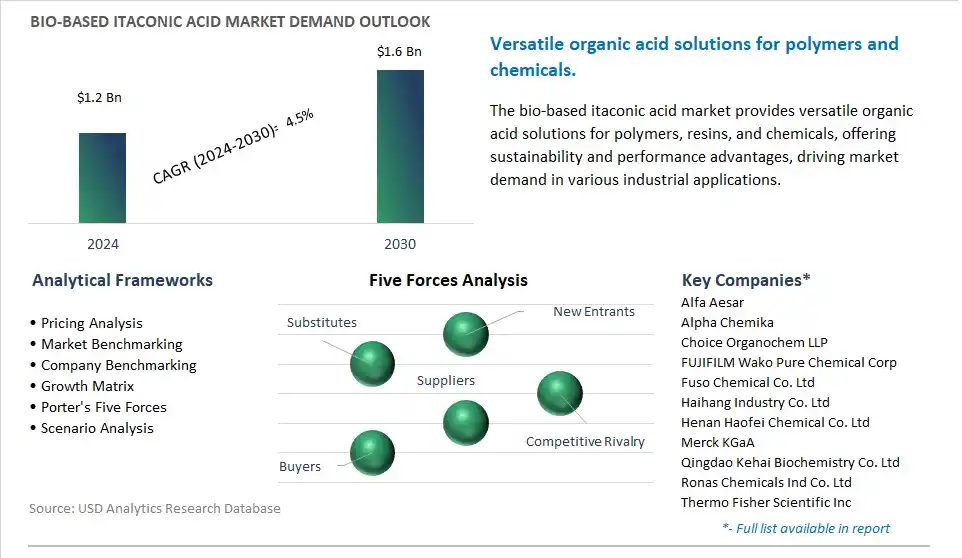
The market report analyses the leading companies in the industry including Alfa Aesar, Alpha Chemika, Choice Organochem LLP, FUJIFILM Wako Pure Chemical Corp, Fuso Chemical Co. Ltd, Haihang Industry Co. Ltd, Henan Haofei Chemical Co. Ltd, Merck KGaA, Qingdao Kehai Biochemistry Co. Ltd, Ronas Chemicals Ind Co. Ltd, Thermo Fisher Scientific Inc, Ultimate Chem India Pvt. Ltd.
A prominent trend in the market for bio-based itaconic acid is the growing demand for sustainable chemical feedstocks. Itaconic acid is a versatile compound used in various applications, including polymers, resins, textiles, pharmaceuticals, and personal care products. With increasing concerns about environmental sustainability and the depletion of fossil fuel resources, industries are seeking renewable alternatives to petrochemical-based itaconic acid. Bio-based itaconic acid, produced through fermentation of renewable biomass sources such as corn, sugarcane, or lignocellulosic materials, offers a sustainable solution with reduced carbon footprint and lower environmental impact. As sustainability becomes a key driver in product development and purchasing decisions, the demand for bio-based itaconic acid is expected to continue rising in the global market.
A key driver behind the demand for bio-based itaconic acid is regulatory incentives and corporate sustainability goals aimed at reducing carbon emissions and promoting the use of renewable resources. Governments worldwide are implementing regulations and policies to encourage the adoption of bio-based chemicals, including itaconic acid, in various industries. Additionally, companies are setting ambitious sustainability targets and commitments to reduce their environmental footprint and enhance their corporate social responsibility (CSR) efforts. Bio-based itaconic acid aligns with these regulatory requirements and sustainability objectives by offering a renewable and low-carbon alternative to conventional itaconic acid derived from fossil fuels. As regulatory pressure increases and consumer preferences shift towards sustainable products, the demand for bio-based itaconic acid is expected to rise, driving market growth and investment in the industry.
An emerging opportunity in the market for bio-based itaconic acid lies in diversification into high-value applications and specialty markets. While itaconic acid is commonly used in traditional applications such as polymers and resins, there is potential for growth in new sectors and niche markets. Opportunities exist to develop bio-based itaconic acid derivatives with unique properties and functionalities to meet the needs of specialized industries such as bioplastics, pharmaceuticals, food additives, and agricultural chemicals. Additionally, bio-based itaconic acid can capture market share in emerging applications such as biodegradable polymers, specialty coatings, and renewable chemicals where sustainability and performance are critical factors. By investing in research and development of novel formulations, partnerships with end-users, and market expansion strategies, manufacturers of bio-based itaconic acid can capitalize on new opportunities and drive the adoption of sustainable chemicals in diverse industries.
In the bio-based itaconic acid market, various stages involve different companies working towards sustainable production and distribution. Feedstock production relies on sugarcane and beet growers, as well as corn and cassava farmers, while pre-treatment processes are managed by specialized companies including LIG Renewable Fuels and Quadrise Fuels International. Fermentation is executed by bio-based itaconic acid producers including Myriant Corporation and Metabolic Institute, alongside industrial biotechnology firms advancing fermentation technology. Downstream processing for purification involves both bio-based itaconic acid producers and chemical engineering companies.
Distribution and sales networks are facilitated by logistics companies skilled in chemical transportation, bio-based itaconic acid producers with established networks, and chemical distributors focusing on sustainable materials. In end-use applications, bio-based itaconic acid finds usage in superabsorbent polymers, unsaturated polyester resins, styrene butadiene itaconic acid, and various other sectors, with key players including SAP manufacturers, UPR producers, tire and rubber companies, and manufacturers in diverse industries adopting bio-based itaconic acid solutions.
Among the derivatives in the Bio-based Itaconic Acid Market, Polyitaconic Acid is the largest segment, driven by diverse significant factors contributing to its dominance. Polyitaconic Acid, a polymer derived from itaconic acid, finds extensive use in various industries due to its exceptional properties and versatility. It is widely utilized in applications such as water treatment, detergent builders, and scale inhibitors. The increasing demand for environmentally friendly and sustainable alternatives to conventional chemicals drives the adoption of polyitaconic acid in diverse applications. In addition, the growing emphasis on water conservation and environmental regulations regarding wastewater treatment propel the demand for polyitaconic acid-based products. Additionally, technological advancements and research in polymer chemistry continue to enhance the performance and cost-effectiveness of polyitaconic acid, further consolidating its position as the largest segment in the Bio-based Itaconic Acid Market. As industries continue to prioritize sustainability and seek innovative solutions, the dominance of Polyitaconic Acid is expected to persist, offering manufacturers and suppliers significant opportunities for growth and market expansion.
Among the applications in the Bio-based Itaconic Acid Market, the Superabsorbent Polymer (SAP) segment is the fastest-growing, driven by diverse key factors contributing to its rapid expansion. Superabsorbent polymers, derived from itaconic acid, are utilized in various industries for their exceptional water absorption capacity, making them ideal for applications such as hygiene products, agriculture, and medical devices. The increasing demand for eco-friendly and biodegradable alternatives to conventional superabsorbent materials drives the adoption of bio-based SAPs. In addition, the growing awareness of environmental sustainability and regulatory restrictions on single-use plastics further propel the demand for bio-based SAPs. Additionally, advancements in polymer chemistry and manufacturing processes have led to the development of bio-based SAPs with improved performance and cost-effectiveness, further fueling their market growth. As industries across sectors continue to prioritize sustainability and seek innovative solutions, the Superabsorbent Polymer segment in the Bio-based Itaconic Acid Market is expected to experience sustained growth, offering manufacturers and suppliers significant opportunities for market expansion and differentiation.
By Derivative
Styrene Butadiene Itaconic Acid
Methyl Methacrylate
Polyitaconic Acid
Others
By Application
SBR Latex
Synthetic Latex
Chillant Dispersant Agent
Superabsorbent Polymer
Unsaturated Polyester Resins
Methyl Methacrylate
Detergent Builder
Others
Alfa Aesar
Alpha Chemika
Choice Organochem LLP
FUJIFILM Wako Pure Chemical Corp
Fuso Chemical Co. Ltd
Haihang Industry Co. Ltd
Henan Haofei Chemical Co. Ltd
Merck KGaA
Qingdao Kehai Biochemistry Co. Ltd
Ronas Chemicals Ind Co. Ltd
Thermo Fisher Scientific Inc
Ultimate Chem India Pvt. Ltd
*- List Not Exhaustive
TABLE OF CONTENTS
1 Introduction to 2024 Bio-based Itaconic Acid Market
1.1 Market Overview
1.2 Quick Facts
1.3 Scope/Objective of the Study
1.4 Market Definition
1.5 Countries and Regions Covered
1.6 Units, Currency, and Conversions
1.7 Industry Value Chain
2 Research Methodology
2.1 Market Size Estimation
2.2 Sources and Research Methodology
2.3 Data Triangulation
2.4 Assumptions and Limitations
3 Executive Summary
3.1 Global Bio-based Itaconic Acid Market Size Outlook, $ Million, 2021 to 2030
3.2 Bio-based Itaconic Acid Market Outlook by Type, $ Million, 2021 to 2030
3.3 Bio-based Itaconic Acid Market Outlook by Product, $ Million, 2021 to 2030
3.4 Bio-based Itaconic Acid Market Outlook by Application, $ Million, 2021 to 2030
3.5 Bio-based Itaconic Acid Market Outlook by Key Countries, $ Million, 2021 to 2030
4 Market Dynamics
4.1 Key Driving Forces of Bio-based Itaconic Acid Industry
4.2 Key Market Trends in Bio-based Itaconic Acid Industry
4.3 Potential Opportunities in Bio-based Itaconic Acid Industry
4.4 Key Challenges in Bio-based Itaconic Acid Industry
5 Market Factor Analysis
5.1 Value Chain Analysis
5.2 Competitive Landscape
5.2.1 Global Bio-based Itaconic Acid Market Share by Company (%), 2023
5.2.2 Product Offerings by Company
5.3 Porter’s Five Forces Analysis
5.4 Pricing Analysis and Outlook
6 Growth Outlook Across Scenarios
6.1 Growth Analysis-Case Scenario Definitions
6.2 Low Growth Scenario Forecasts
6.3 Reference Growth Scenario Forecasts
6.4 High Growth Scenario Forecasts
7 Global Bio-based Itaconic Acid Market Outlook by Segments
7.1 Bio-based Itaconic Acid Market Outlook by Segments, $ Million, 2021- 2030
By Derivative
Styrene Butadiene Itaconic Acid
Methyl Methacrylate
Polyitaconic Acid
Others
By Application
SBR Latex
Synthetic Latex
Chillant Dispersant Agent
Superabsorbent Polymer
Unsaturated Polyester Resins
Methyl Methacrylate
Detergent Builder
Others
8 North America Bio-based Itaconic Acid Market Analysis and Outlook To 2030
8.1 Introduction to North America Bio-based Itaconic Acid Markets in 2024
8.2 North America Bio-based Itaconic Acid Market Size Outlook by Country, 2021-2030
8.2.1 United States
8.2.2 Canada
8.2.3 Mexico
8.3 North America Bio-based Itaconic Acid Market size Outlook by Segments, 2021-2030
By Derivative
Styrene Butadiene Itaconic Acid
Methyl Methacrylate
Polyitaconic Acid
Others
By Application
SBR Latex
Synthetic Latex
Chillant Dispersant Agent
Superabsorbent Polymer
Unsaturated Polyester Resins
Methyl Methacrylate
Detergent Builder
Others
9 Europe Bio-based Itaconic Acid Market Analysis and Outlook To 2030
9.1 Introduction to Europe Bio-based Itaconic Acid Markets in 2024
9.2 Europe Bio-based Itaconic Acid Market Size Outlook by Country, 2021-2030
9.2.1 Germany
9.2.2 France
9.2.3 Spain
9.2.4 United Kingdom
9.2.4 Italy
9.2.5 Russia
9.2.6 Norway
9.2.7 Rest of Europe
9.3 Europe Bio-based Itaconic Acid Market Size Outlook by Segments, 2021-2030
By Derivative
Styrene Butadiene Itaconic Acid
Methyl Methacrylate
Polyitaconic Acid
Others
By Application
SBR Latex
Synthetic Latex
Chillant Dispersant Agent
Superabsorbent Polymer
Unsaturated Polyester Resins
Methyl Methacrylate
Detergent Builder
Others
10 Asia Pacific Bio-based Itaconic Acid Market Analysis and Outlook To 2030
10.1 Introduction to Asia Pacific Bio-based Itaconic Acid Markets in 2024
10.2 Asia Pacific Bio-based Itaconic Acid Market Size Outlook by Country, 2021-2030
10.2.1 China
10.2.2 India
10.2.3 Japan
10.2.4 South Korea
10.2.5 Indonesia
10.2.6 Malaysia
10.2.7 Australia
10.2.8 Rest of Asia Pacific
10.3 Asia Pacific Bio-based Itaconic Acid Market size Outlook by Segments, 2021-2030
By Derivative
Styrene Butadiene Itaconic Acid
Methyl Methacrylate
Polyitaconic Acid
Others
By Application
SBR Latex
Synthetic Latex
Chillant Dispersant Agent
Superabsorbent Polymer
Unsaturated Polyester Resins
Methyl Methacrylate
Detergent Builder
Others
11 South America Bio-based Itaconic Acid Market Analysis and Outlook To 2030
11.1 Introduction to South America Bio-based Itaconic Acid Markets in 2024
11.2 South America Bio-based Itaconic Acid Market Size Outlook by Country, 2021-2030
11.2.1 Brazil
11.2.2 Argentina
11.2.3 Rest of South America
11.3 South America Bio-based Itaconic Acid Market size Outlook by Segments, 2021-2030
By Derivative
Styrene Butadiene Itaconic Acid
Methyl Methacrylate
Polyitaconic Acid
Others
By Application
SBR Latex
Synthetic Latex
Chillant Dispersant Agent
Superabsorbent Polymer
Unsaturated Polyester Resins
Methyl Methacrylate
Detergent Builder
Others
12 Middle East and Africa Bio-based Itaconic Acid Market Analysis and Outlook To 2030
12.1 Introduction to Middle East and Africa Bio-based Itaconic Acid Markets in 2024
12.2 Middle East and Africa Bio-based Itaconic Acid Market Size Outlook by Country, 2021-2030
12.2.1 Saudi Arabia
12.2.2 UAE
12.2.3 Oman
12.2.4 Rest of Middle East
12.2.5 Egypt
12.2.6 Nigeria
12.2.7 South Africa
12.2.8 Rest of Africa
12.3 Middle East and Africa Bio-based Itaconic Acid Market size Outlook by Segments, 2021-2030
By Derivative
Styrene Butadiene Itaconic Acid
Methyl Methacrylate
Polyitaconic Acid
Others
By Application
SBR Latex
Synthetic Latex
Chillant Dispersant Agent
Superabsorbent Polymer
Unsaturated Polyester Resins
Methyl Methacrylate
Detergent Builder
Others
13 Company Profiles
13.1 Company Snapshot
13.2 SWOT Profiles
13.3 Products and Services
13.4 Recent Developments
13.5 Financial Profile
Alfa Aesar
Alpha Chemika
Choice Organochem LLP
FUJIFILM Wako Pure Chemical Corp
Fuso Chemical Co. Ltd
Haihang Industry Co. Ltd
Henan Haofei Chemical Co. Ltd
Merck KGaA
Qingdao Kehai Biochemistry Co. Ltd
Ronas Chemicals Ind Co. Ltd
Thermo Fisher Scientific Inc
Ultimate Chem India Pvt. Ltd
14 Appendix
14.1 Customization Offerings
14.2 Subscription Services
14.3 Related Reports
14.4 Publisher Expertise
By Derivative
Styrene Butadiene Itaconic Acid
Methyl Methacrylate
Polyitaconic Acid
Others
By Application
SBR Latex
Synthetic Latex
Chillant Dispersant Agent
Superabsorbent Polymer
Unsaturated Polyester Resins
Methyl Methacrylate
Detergent Builder
Others
Countries Analyzed
North America (US, Canada, Mexico)
Europe (Germany, UK, France, Spain, Italy, Russia, Rest of Europe)
Asia Pacific (China, India, Japan, South Korea, Australia, South East Asia, Rest of Asia)
South America (Brazil, Argentina, Rest of South America)
Middle East and Africa (Saudi Arabia, UAE, Rest of Middle East, South Africa, Egypt, Rest of Africa)
Global Bio-based Itaconic Acid is forecast to reach $1.6 Billion in 2030 from $1.2 Billion in 2024, registering a CAGR of 4.5% over the outlook period
Emerging Markets across Asia Pacific, Europe, and Americas present robust growth prospects.
Alfa Aesar, Alpha Chemika, Choice Organochem LLP, FUJIFILM Wako Pure Chemical Corp, Fuso Chemical Co. Ltd, Haihang Industry Co. Ltd, Henan Haofei Chemical Co. Ltd, Merck KGaA, Qingdao Kehai Biochemistry Co. Ltd, Ronas Chemicals Ind Co. Ltd, Thermo Fisher Scientific Inc, Ultimate Chem India Pvt. Ltd
Base Year- 2023; Estimated Year- 2024; Historic Period- 2018-2023; Forecast period- 2024 to 2030; Currency: Revenue (USD); Volume