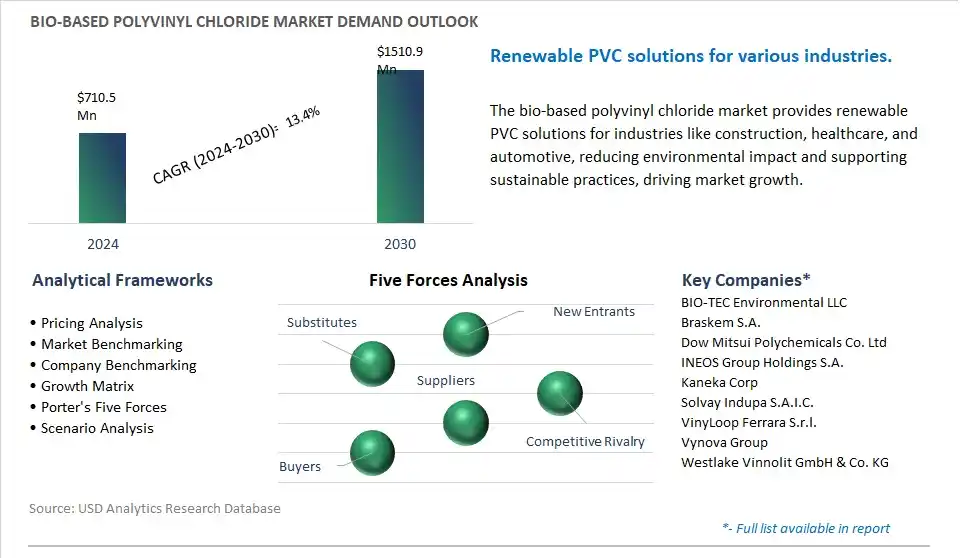
The global Bio-based Polyvinyl Chloride Market is poised to register a 13.4% CAGR from $710.5 Million in 2024 to $1510.9 Million in 2030.
The global Bio-based Polyvinyl Chloride Market Study analyzes and forecasts the market size across 6 regions and 24 countries for diverse segments -By Product (Rigid, Flexible), By Application (Films and Sheets, Wires and Cables, Pipes and Fittings, Hoses, Edge Band, Others).
An Introduction to Global Bio based Polyvinyl Chloride Market in 2024
The market for bio-based polyvinyl chloride (PVC) is experiencing growth as industries seek sustainable alternatives to conventional PVC derived from fossil fuels. Key trends shaping the future of this industry include the development of PVC polymers derived from renewable feedstocks such as plant-based sugars, biomass, and recycled materials, offering advantages in terms of biodegradability, carbon neutrality, and reduced environmental impact compared to petroleum-based PVC. Additionally, advancements in polymerization techniques, compounding, and material engineering enable the production of bio-based PVC with properties and performance comparable to traditional PVC, meeting the diverse needs of end-users and brand owners. Moreover, the adoption of sustainability certifications, eco-labeling initiatives, and circular economy strategies drives market demand for bio-based PVC, fostering innovation and market expansion in this sector. As industries strive to reduce dependence on fossil fuels and address environmental concerns, the demand for bio-based PVC is expected to continue growing, driving further innovation and market development in sustainable plastic materials.
Bio-based Polyvinyl Chloride Market Competitive Landscape
The market report analyses the leading companies in the industry including BIO-TEC Environmental LLC, Braskem S.A., Dow Mitsui Polychemicals Co. Ltd, INEOS Group Holdings S.A., Kaneka Corp, Solvay Indupa S.A.I.C., VinyLoop Ferrara S.r.l., Vynova Group, Westlake Vinnolit GmbH & Co. KG.
Bio-based Polyvinyl Chloride Market Dynamics
Bio-based Polyvinyl Chloride Market Trend: Increasing Focus on Sustainable Plastic Alternatives
A prominent trend in the market for bio-based polyvinyl chloride (PVC) is the increasing focus on sustainable plastic alternatives. PVC is a widely used thermoplastic known for its versatility and durability in various applications such as construction materials, pipes, packaging, and healthcare products. With growing concerns about plastic pollution and environmental sustainability, there is a notable shift towards replacing conventional petroleum-based PVC with bio-based alternatives. Bio-based PVC, derived from renewable biomass sources such as plant oils or biomass-derived intermediates, offers a sustainable solution with reduced carbon footprint and lower environmental impact. As consumers, governments, and industries prioritize sustainability, the demand for bio-based PVC is expected to rise, driving market growth and innovation in the industry.
Bio-based Polyvinyl Chloride Market Driver: Regulatory Pressure and Corporate Sustainability Initiatives
A key driver behind the demand for bio-based PVC is regulatory pressure and corporate sustainability initiatives aimed at reducing plastic waste and promoting the use of renewable resources. Governments worldwide are implementing regulations and policies to encourage the adoption of bio-based materials, including PVC, in various industries. Additionally, companies are setting ambitious sustainability goals and commitments to reduce their environmental footprint and enhance their corporate social responsibility (CSR) efforts. Bio-based PVC aligns with these regulatory requirements and sustainability objectives by offering a renewable and eco-friendly alternative to conventional PVC derived from fossil fuels. As regulatory pressure increases and consumer preferences shift towards sustainable products, the demand for bio-based PVC is expected to grow, driving market expansion and investment in the industry.
Bio-based Polyvinyl Chloride Market Opportunity: Collaboration for Technology Development and Market Adoption
An emerging opportunity in the market for bio-based PVC lies in collaboration for technology development and market adoption. While bio-based PVC offers environmental benefits, challenges remain in terms of technological scalability, cost competitiveness, and market acceptance. Opportunities exist for collaboration between technology developers, chemical manufacturers, and end-users to advance research and development efforts in bio-based PVC production. By leveraging innovations in biotechnology, catalysis, and process engineering, stakeholders can optimize biomass conversion pathways, improve PVC yield and purity, and reduce production costs. Additionally, partnerships with end-users, retailers, and value chain partners can drive market adoption strategies, enabling manufacturers of bio-based PVC to capitalize on new opportunities and accelerate the transition towards sustainable plastics.
Bio-based Polyvinyl Chloride Market Ecosystem
The bio-based Polyvinyl Chloride (Bio-PVC) market involves a multi-stage Market Ecosystem, beginning with feedstock production sourced from sugarcane, corn starch, or microbial fermentation. Pre-treatment processes, handled by companies including LIG Renewable Fuels, prepare the biomass for conversion. Bio-monomer production, potentially involving chemical or biological conversion, is led by companies including Myriant Corporation and Metabolic Institute.
Emerging technologies explore alternative routes for chlorine, a key PVC component, with companies focusing on bio-based alternatives. Established chemical companies including Dow and Olin Corporation are exploring adapting VCM production for bio-based feedstocks. Polymerization processes, managed by PVC producers including Solvay and Shin-Etsu Chemical, convert VCM into bio-PVC, potentially requiring modifications to existing facilities. End-use applications span building materials, medical devices, consumer goods, and packaging, driving innovation and adoption of sustainable alternatives across industries.
Bio-based Polyvinyl Chloride Market Share Analysis: Rigid PVC held the dominant revenue share in 2024
Among the products in the Bio-based Polyvinyl Chloride (PVC) Market, the Rigid PVC segment is the largest, driven by diverse significant factors contributing to its dominance. Rigid PVC, also known as uPVC (unplasticized PVC), is widely used in construction, piping, window frames, and automotive applications due to its excellent durability, chemical resistance, and mechanical strength. The dominance of the Rigid PVC segment can be attributed to the extensive use of bio-based rigid PVC in various industries for manufacturing structural components and building materials. Additionally, the increasing demand for eco-friendly and sustainable materials in the construction and automotive sectors, coupled with regulatory initiatives promoting the use of renewable materials, further drives the adoption of bio-based rigid PVC. In addition, advancements in bio-based PVC technology and manufacturing processes have improved the performance and cost-effectiveness of rigid PVC, making it a preferred choice for applications requiring robust and long-lasting materials. As industries continue to prioritize sustainability and seek alternatives to conventional plastics, the dominance of the Rigid PVC segment in the Bio-based PVC Market is expected to persist, offering manufacturers and suppliers significant opportunities for growth and market expansion.
Bio-based Polyvinyl Chloride Market Share Analysis: Pipes and Fittings is the fastest growing market segment over the forecast period to 2030
Among the applications in the Bio-based Polyvinyl Chloride (PVC) Market, the Pipes and Fittings segment is the fastest-growing, driven by diverse key factors contributing to its rapid expansion. Bio-based PVC pipes and fittings are increasingly being utilized in various industries, including construction, agriculture, and infrastructure development, due to their durability, corrosion resistance, and eco-friendly properties. The rapid growth of the Pipes and Fittings segment can be attributed to the increasing demand for sustainable and long-lasting piping solutions, driven by urbanization, population growth, and infrastructure development projects worldwide. Additionally, bio-based PVC pipes and fittings offer advantages such as reduced environmental impact, lower carbon footprint, and compliance with green building standards and regulations, making them an attractive choice for modern construction projects. In addition, advancements in bio-based PVC formulation and manufacturing technologies have improved the performance and cost-effectiveness of pipes and fittings, further fueling their adoption in various applications. As industries continue to prioritize sustainability and seek alternatives to conventional materials, the Pipes and Fittings segment in the Bio-based PVC Market is expected to experience sustained growth, offering manufacturers and suppliers significant opportunities for market expansion and innovation.
Bio-based Polyvinyl Chloride Market Report Scope-
By Product
Rigid
Flexible
By Application
Films and Sheets
Wires and Cables
Pipes and Fittings
Hoses
Edge Band
Others
Bio-based Polyvinyl Chloride Market Companies Profiled
BIO-TEC Environmental LLC
Braskem S.A.
Dow Mitsui Polychemicals Co. Ltd
INEOS Group Holdings S.A.
Kaneka Corp
Solvay Indupa S.A.I.C.
VinyLoop Ferrara S.r.l.
Vynova Group
Westlake Vinnolit GmbH & Co. KG
*- List Not Exhaustive
TABLE OF CONTENTS
1 Introduction to 2024 Bio-based Polyvinyl Chloride Market
1.1 Market Overview
1.2 Quick Facts
1.3 Scope/Objective of the Study
1.4 Market Definition
1.5 Countries and Regions Covered
1.6 Units, Currency, and Conversions
1.7 Industry Value Chain
2 Research Methodology
2.1 Market Size Estimation
2.2 Sources and Research Methodology
2.3 Data Triangulation
2.4 Assumptions and Limitations
3 Executive Summary
3.1 Global Bio-based Polyvinyl Chloride Market Size Outlook, $ Million, 2021 to 2030
3.2 Bio-based Polyvinyl Chloride Market Outlook by Type, $ Million, 2021 to 2030
3.3 Bio-based Polyvinyl Chloride Market Outlook by Product, $ Million, 2021 to 2030
3.4 Bio-based Polyvinyl Chloride Market Outlook by Application, $ Million, 2021 to 2030
3.5 Bio-based Polyvinyl Chloride Market Outlook by Key Countries, $ Million, 2021 to 2030
4 Market Dynamics
4.1 Key Driving Forces of Bio-based Polyvinyl Chloride Industry
4.2 Key Market Trends in Bio-based Polyvinyl Chloride Industry
4.3 Potential Opportunities in Bio-based Polyvinyl Chloride Industry
4.4 Key Challenges in Bio-based Polyvinyl Chloride Industry
5 Market Factor Analysis
5.1 Value Chain Analysis
5.2 Competitive Landscape
5.2.1 Global Bio-based Polyvinyl Chloride Market Share by Company (%), 2023
5.2.2 Product Offerings by Company
5.3 Porter’s Five Forces Analysis
5.4 Pricing Analysis and Outlook
6 Growth Outlook Across Scenarios
6.1 Growth Analysis-Case Scenario Definitions
6.2 Low Growth Scenario Forecasts
6.3 Reference Growth Scenario Forecasts
6.4 High Growth Scenario Forecasts
7 Global Bio-based Polyvinyl Chloride Market Outlook by Segments
7.1 Bio-based Polyvinyl Chloride Market Outlook by Segments, $ Million, 2021- 2030
By Product
Rigid
Flexible
By Application
Films and Sheets
Wires and Cables
Pipes and Fittings
Hoses
Edge Band
Others
8 North America Bio-based Polyvinyl Chloride Market Analysis and Outlook To 2030
8.1 Introduction to North America Bio-based Polyvinyl Chloride Markets in 2024
8.2 North America Bio-based Polyvinyl Chloride Market Size Outlook by Country, 2021-2030
8.2.1 United States
8.2.2 Canada
8.2.3 Mexico
8.3 North America Bio-based Polyvinyl Chloride Market size Outlook by Segments, 2021-2030
By Product
Rigid
Flexible
By Application
Films and Sheets
Wires and Cables
Pipes and Fittings
Hoses
Edge Band
Others
9 Europe Bio-based Polyvinyl Chloride Market Analysis and Outlook To 2030
9.1 Introduction to Europe Bio-based Polyvinyl Chloride Markets in 2024
9.2 Europe Bio-based Polyvinyl Chloride Market Size Outlook by Country, 2021-2030
9.2.1 Germany
9.2.2 France
9.2.3 Spain
9.2.4 United Kingdom
9.2.4 Italy
9.2.5 Russia
9.2.6 Norway
9.2.7 Rest of Europe
9.3 Europe Bio-based Polyvinyl Chloride Market Size Outlook by Segments, 2021-2030
By Product
Rigid
Flexible
By Application
Films and Sheets
Wires and Cables
Pipes and Fittings
Hoses
Edge Band
Others
10 Asia Pacific Bio-based Polyvinyl Chloride Market Analysis and Outlook To 2030
10.1 Introduction to Asia Pacific Bio-based Polyvinyl Chloride Markets in 2024
10.2 Asia Pacific Bio-based Polyvinyl Chloride Market Size Outlook by Country, 2021-2030
10.2.1 China
10.2.2 India
10.2.3 Japan
10.2.4 South Korea
10.2.5 Indonesia
10.2.6 Malaysia
10.2.7 Australia
10.2.8 Rest of Asia Pacific
10.3 Asia Pacific Bio-based Polyvinyl Chloride Market size Outlook by Segments, 2021-2030
By Product
Rigid
Flexible
By Application
Films and Sheets
Wires and Cables
Pipes and Fittings
Hoses
Edge Band
Others
11 South America Bio-based Polyvinyl Chloride Market Analysis and Outlook To 2030
11.1 Introduction to South America Bio-based Polyvinyl Chloride Markets in 2024
11.2 South America Bio-based Polyvinyl Chloride Market Size Outlook by Country, 2021-2030
11.2.1 Brazil
11.2.2 Argentina
11.2.3 Rest of South America
11.3 South America Bio-based Polyvinyl Chloride Market size Outlook by Segments, 2021-2030
By Product
Rigid
Flexible
By Application
Films and Sheets
Wires and Cables
Pipes and Fittings
Hoses
Edge Band
Others
12 Middle East and Africa Bio-based Polyvinyl Chloride Market Analysis and Outlook To 2030
12.1 Introduction to Middle East and Africa Bio-based Polyvinyl Chloride Markets in 2024
12.2 Middle East and Africa Bio-based Polyvinyl Chloride Market Size Outlook by Country, 2021-2030
12.2.1 Saudi Arabia
12.2.2 UAE
12.2.3 Oman
12.2.4 Rest of Middle East
12.2.5 Egypt
12.2.6 Nigeria
12.2.7 South Africa
12.2.8 Rest of Africa
12.3 Middle East and Africa Bio-based Polyvinyl Chloride Market size Outlook by Segments, 2021-2030
By Product
Rigid
Flexible
By Application
Films and Sheets
Wires and Cables
Pipes and Fittings
Hoses
Edge Band
Others
13 Company Profiles
13.1 Company Snapshot
13.2 SWOT Profiles
13.3 Products and Services
13.4 Recent Developments
13.5 Financial Profile
BIO-TEC Environmental LLC
Braskem S.A.
Dow Mitsui Polychemicals Co. Ltd
INEOS Group Holdings S.A.
Kaneka Corp
Solvay Indupa S.A.I.C.
VinyLoop Ferrara S.r.l.
Vynova Group
Westlake Vinnolit GmbH & Co. KG
14 Appendix
14.1 Customization Offerings
14.2 Subscription Services
14.3 Related Reports
14.4 Publisher Expertise
By Product
Rigid
Flexible
By Application
Films and Sheets
Wires and Cables
Pipes and Fittings
Hoses
Edge Band
Others
Countries Analyzed
North America (US, Canada, Mexico)
Europe (Germany, UK, France, Spain, Italy, Russia, Rest of Europe)
Asia Pacific (China, India, Japan, South Korea, Australia, South East Asia, Rest of Asia)
South America (Brazil, Argentina, Rest of South America)
Middle East and Africa (Saudi Arabia, UAE, Rest of Middle East, South Africa, Egypt, Rest of Africa)
