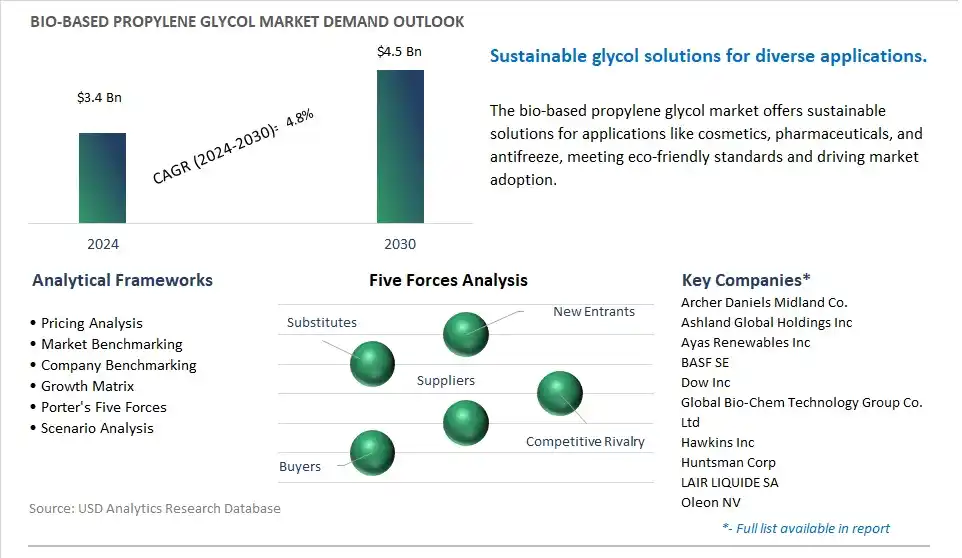
The global Bio-based Propylene Glycol Market is poised to register a 4.8% CAGR from $3.4 Billion in 2024 to $4.5 Billion in 2030.
The global Bio-based Propylene Glycol Market Study analyzes and forecasts the market size across 6 regions and 24 countries for diverse segments -By Application (Unsaturated Polyester Resins, Fluids and Coolants, Detergents, Food, Pharmaceuticals, Others), By End-User (Automotive, Food Processing, Cosmetics, Pharmaceuticals, Construction, Marine, Transportation, Others).
An Introduction to Global Bio based Propylene Glycol Market in 2024
The market for bio-based propylene glycol is expanding as industries seek sustainable alternatives to conventional propylene glycol derived from fossil fuels for use in cosmetics, pharmaceuticals, food processing, and other applications. Key trends shaping the future of this industry include the development of propylene glycol derived from renewable feedstocks such as plant-based oils, sugars, and biomass, offering advantages in terms of biodegradability, purity, and reduced environmental impact compared to petroleum-based propylene glycol. Additionally, advancements in bioconversion processes, enzyme engineering, and fermentation technology enable the production of bio-based propylene glycol with high yields, purity, and process efficiency, meeting the performance requirements of diverse applications. Moreover, the adoption of sustainability certifications, green procurement policies, and regulatory mandates drives market demand for bio-based propylene glycol, fostering innovation and market expansion in this sector. As industries prioritize sustainability and seek to minimize environmental footprint, the demand for bio-based propylene glycol is expected to continue growing, driving further innovation and market development in sustainable solvent and humectant solutions.
Bio-based Propylene Glycol Market Competitive Landscape
The market report analyses the leading companies in the industry including Archer Daniels Midland Co., Ashland Global Holdings Inc, Ayas Renewables Inc, BASF SE, Dow Inc, Global Bio-Chem Technology Group Co. Ltd, Hawkins Inc, Huntsman Corp, LAIR LIQUIDE SA, Oleon NV.
Bio-based Propylene Glycol Market Dynamics
Bio based Propylene Glycol Market Trend: Growing Demand for Sustainable Personal Care Products
A prominent trend in the market for bio-based propylene glycol is the growing demand for sustainable personal care products. Propylene glycol is a versatile compound used in various applications, including cosmetics, pharmaceuticals, food additives, and antifreeze. With increasing consumer awareness of environmental issues and the need for eco-friendly alternatives, there is a notable shift towards replacing petroleum-based propylene glycol with bio-based options. Bio-based propylene glycol, derived from renewable biomass sources such as plant sugars or glycerol, offers a sustainable solution with reduced carbon footprint and lower environmental impact. As consumers prioritize sustainability and natural ingredients in their personal care products, the demand for bio-based propylene glycol is expected to rise, driving market growth and innovation in the industry.
Bio based Propylene Glycol Market Driver: Consumer Preference for Natural and Eco-Friendly Ingredients
A key driver behind the demand for bio-based propylene glycol is consumer preference for natural and eco-friendly ingredients in personal care products. Consumers are increasingly seeking products that are free from synthetic chemicals, additives, and harsh preservatives, opting for formulations that are safe, gentle, and environmentally sustainable. Bio-based propylene glycol aligns with these consumer preferences by offering a renewable and biodegradable alternative to conventional propylene glycol derived from fossil fuels. Additionally, as regulatory agencies impose stricter regulations on chemical ingredients in cosmetics and personal care products, manufacturers are incentivized to switch to bio-based alternatives to meet consumer demands and comply with regulatory standards. Accordingly, the demand for bio-based propylene glycol is expected to continue growing, driven by consumer preference for natural and eco-friendly ingredients.
Bio based Propylene Glycol Market Opportunity: Expansion into Novel Applications and Market Segments
An emerging opportunity in the market for bio-based propylene glycol lies in expansion into novel applications and market segments. While bio-based propylene glycol is commonly used in cosmetics and personal care products, there is potential for growth in new sectors and niche markets. Opportunities exist to develop bio-based propylene glycol derivatives with unique properties and functionalities to meet the needs of specialized industries such as pharmaceuticals, food and beverage, and industrial applications. Additionally, bio-based propylene glycol can be explored for use in emerging applications such as bioplastics, lubricants, solvents, and antifreeze, where sustainability and performance are critical factors. By investing in research and development of novel formulations, partnerships with end-users, and market expansion strategies, manufacturers of bio-based propylene glycol can capitalize on new opportunities and drive the adoption of sustainable ingredients in diverse industries.
Bio-based Propylene Glycol Market Ecosystem
The bio-based Propylene Glycol (Bio-PG) market boasts a well-established value chain comprising diverse key stages, beginning with feedstock production sourced from sugarcane, corn starch, or potential waste streams including vegetable oils or food waste. Companies across the globe, from feedstock producers to bio-PG manufacturers and end-users, contribute to each stage, aiming to offer a renewable and sustainable alternative to petroleum-derived PG. Pre-treatment processes, managed by specialized companies including LIG Renewable Fuels, prepare the feedstocks for efficient fermentation, a crucial step conducted by established biotechnology firms including DuPont Tate & Lyle Bio Products, and emerging companies dedicated to bio-PG fermentation.
Following fermentation, purification, and downstream processing are essential to isolate and refine bio-PG to meet specific product standards, with bio-based PG producers leading these efforts and potentially partnering with established chemical companies for expertise in purification. Distribution and sales ensure the delivery of bio-PG to manufacturers and distributors, facilitated by logistics companies and bio-PG producers with established distribution networks, along with chemical distributors focusing on sustainable materials. Further, bio-PG finds applications across pharmaceuticals, cosmetics, food and beverage, and industrial sectors, utilized by various manufacturers in the production of a wide array of end-products.
Bio-based Propylene Glycol Market Share Analysis: Unsaturated Polyester Resins held the dominant revenue share in 2024
Among the applications in the Bio-based Propylene Glycol Market, the Unsaturated Polyester resin segment is the largest, driven by diverse significant factors contributing to its dominance. Unsaturated polyester resins are widely used in various industries, including construction, automotive, marine, and aerospace, for manufacturing composite materials such as fiberglass reinforced plastics (FRP) and fiber-reinforced polymers (FRP). The dominance of the Unsaturated Polyester Resins segment can be attributed to the extensive use of bio-based propylene glycol as a key ingredient in the production of polyester resins. Additionally, bio-based propylene glycol offers advantages such as improved sustainability, reduced environmental impact, and compliance with regulatory standards, making it an attractive choice for manufacturers seeking eco-friendly alternatives to conventional petrochemical-based propylene glycol. In addition, the growing demand for lightweight and durable materials in various end-use industries drives the adoption of unsaturated polyester resins, further fueling the growth of the segment. As industries continue to prioritize sustainability and seek greener solutions, the Unsaturated Polyester Resins segment in the Bio-based Propylene Glycol Market is expected to maintain its leading position, offering manufacturers and suppliers significant opportunities for growth and market expansion.
Bio-based Propylene Glycol Market Share Analysis: Cosmetics is the fastest growing market segment over the forecast period to 2030
Among the end-users in the Bio-based Propylene Glycol Market, the Cosmetics segment is the fastest-growing, driven by diverse key factors contributing to its rapid expansion. Propylene glycol is commonly used in cosmetics and personal care products such as moisturizers, creams, lotions, and hair care products due to its humectant properties, which help to retain moisture and improve product texture. The rapid growth of the Cosmetics segment can be attributed to the increasing consumer demand for natural and sustainable ingredients in cosmetic formulations. Bio-based propylene glycol offers a renewable and eco-friendly alternative to petroleum-based propylene glycol, aligning with the growing trend toward green and clean beauty products. Additionally, bio-based propylene glycol is perceived as safer and less irritating to the skin compared to its synthetic counterparts, further driving its adoption in cosmetic formulations. In addition, regulatory restrictions and consumer preferences for clean label and environmentally friendly products contribute to the increasing use of bio-based propylene glycol in cosmetics. As the cosmetics industry continues to innovate and prioritize sustainability, the Cosmetics segment in the Bio-based Propylene Glycol Market is expected to experience sustained growth, presenting significant opportunities for manufacturers and suppliers to cater to this growing demand.
Bio-based Propylene Glycol Market Report Scope-
By Application
Unsaturated Polyester Resins
Fluids and Coolants
Detergents
Food
Pharmaceuticals
Others
By End-User
Automotive
Food Processing
Cosmetics
Pharmaceuticals
Construction
Marine
Transportation
Others
Bio-based Propylene Glycol Market Companies Profiled
Archer Daniels Midland Co.
Ashland Global Holdings Inc
Ayas Renewables Inc
BASF SE
Dow Inc
Global Bio-Chem Technology Group Co. Ltd
Hawkins Inc
Huntsman Corp
LAIR LIQUIDE SA
Oleon NV
*- List Not Exhaustive
TABLE OF CONTENTS
1 Introduction to 2024 Bio-based Propylene Glycol Market
1.1 Market Overview
1.2 Quick Facts
1.3 Scope/Objective of the Study
1.4 Market Definition
1.5 Countries and Regions Covered
1.6 Units, Currency, and Conversions
1.7 Industry Value Chain
2 Research Methodology
2.1 Market Size Estimation
2.2 Sources and Research Methodology
2.3 Data Triangulation
2.4 Assumptions and Limitations
3 Executive Summary
3.1 Global Bio-based Propylene Glycol Market Size Outlook, $ Million, 2021 to 2030
3.2 Bio-based Propylene Glycol Market Outlook by Type, $ Million, 2021 to 2030
3.3 Bio-based Propylene Glycol Market Outlook by Product, $ Million, 2021 to 2030
3.4 Bio-based Propylene Glycol Market Outlook by Application, $ Million, 2021 to 2030
3.5 Bio-based Propylene Glycol Market Outlook by Key Countries, $ Million, 2021 to 2030
4 Market Dynamics
4.1 Key Driving Forces of Bio-based Propylene Glycol Industry
4.2 Key Market Trends in Bio-based Propylene Glycol Industry
4.3 Potential Opportunities in Bio-based Propylene Glycol Industry
4.4 Key Challenges in Bio-based Propylene Glycol Industry
5 Market Factor Analysis
5.1 Value Chain Analysis
5.2 Competitive Landscape
5.2.1 Global Bio-based Propylene Glycol Market Share by Company (%), 2023
5.2.2 Product Offerings by Company
5.3 Porter’s Five Forces Analysis
5.4 Pricing Analysis and Outlook
6 Growth Outlook Across Scenarios
6.1 Growth Analysis-Case Scenario Definitions
6.2 Low Growth Scenario Forecasts
6.3 Reference Growth Scenario Forecasts
6.4 High Growth Scenario Forecasts
7 Global Bio-based Propylene Glycol Market Outlook by Segments
7.1 Bio-based Propylene Glycol Market Outlook by Segments, $ Million, 2021- 2030
By Application
Unsaturated Polyester Resins
Fluids and Coolants
Detergents
Food
Pharmaceuticals
Others
By End-User
Automotive
Food Processing
Cosmetics
Pharmaceuticals
Construction
Marine
Transportation
Others
8 North America Bio-based Propylene Glycol Market Analysis and Outlook To 2030
8.1 Introduction to North America Bio-based Propylene Glycol Markets in 2024
8.2 North America Bio-based Propylene Glycol Market Size Outlook by Country, 2021-2030
8.2.1 United States
8.2.2 Canada
8.2.3 Mexico
8.3 North America Bio-based Propylene Glycol Market size Outlook by Segments, 2021-2030
By Application
Unsaturated Polyester Resins
Fluids and Coolants
Detergents
Food
Pharmaceuticals
Others
By End-User
Automotive
Food Processing
Cosmetics
Pharmaceuticals
Construction
Marine
Transportation
Others
9 Europe Bio-based Propylene Glycol Market Analysis and Outlook To 2030
9.1 Introduction to Europe Bio-based Propylene Glycol Markets in 2024
9.2 Europe Bio-based Propylene Glycol Market Size Outlook by Country, 2021-2030
9.2.1 Germany
9.2.2 France
9.2.3 Spain
9.2.4 United Kingdom
9.2.4 Italy
9.2.5 Russia
9.2.6 Norway
9.2.7 Rest of Europe
9.3 Europe Bio-based Propylene Glycol Market Size Outlook by Segments, 2021-2030
By Application
Unsaturated Polyester Resins
Fluids and Coolants
Detergents
Food
Pharmaceuticals
Others
By End-User
Automotive
Food Processing
Cosmetics
Pharmaceuticals
Construction
Marine
Transportation
Others
10 Asia Pacific Bio-based Propylene Glycol Market Analysis and Outlook To 2030
10.1 Introduction to Asia Pacific Bio-based Propylene Glycol Markets in 2024
10.2 Asia Pacific Bio-based Propylene Glycol Market Size Outlook by Country, 2021-2030
10.2.1 China
10.2.2 India
10.2.3 Japan
10.2.4 South Korea
10.2.5 Indonesia
10.2.6 Malaysia
10.2.7 Australia
10.2.8 Rest of Asia Pacific
10.3 Asia Pacific Bio-based Propylene Glycol Market size Outlook by Segments, 2021-2030
By Application
Unsaturated Polyester Resins
Fluids and Coolants
Detergents
Food
Pharmaceuticals
Others
By End-User
Automotive
Food Processing
Cosmetics
Pharmaceuticals
Construction
Marine
Transportation
Others
11 South America Bio-based Propylene Glycol Market Analysis and Outlook To 2030
11.1 Introduction to South America Bio-based Propylene Glycol Markets in 2024
11.2 South America Bio-based Propylene Glycol Market Size Outlook by Country, 2021-2030
11.2.1 Brazil
11.2.2 Argentina
11.2.3 Rest of South America
11.3 South America Bio-based Propylene Glycol Market size Outlook by Segments, 2021-2030
By Application
Unsaturated Polyester Resins
Fluids and Coolants
Detergents
Food
Pharmaceuticals
Others
By End-User
Automotive
Food Processing
Cosmetics
Pharmaceuticals
Construction
Marine
Transportation
Others
12 Middle East and Africa Bio-based Propylene Glycol Market Analysis and Outlook To 2030
12.1 Introduction to Middle East and Africa Bio-based Propylene Glycol Markets in 2024
12.2 Middle East and Africa Bio-based Propylene Glycol Market Size Outlook by Country, 2021-2030
12.2.1 Saudi Arabia
12.2.2 UAE
12.2.3 Oman
12.2.4 Rest of Middle East
12.2.5 Egypt
12.2.6 Nigeria
12.2.7 South Africa
12.2.8 Rest of Africa
12.3 Middle East and Africa Bio-based Propylene Glycol Market size Outlook by Segments, 2021-2030
By Application
Unsaturated Polyester Resins
Fluids and Coolants
Detergents
Food
Pharmaceuticals
Others
By End-User
Automotive
Food Processing
Cosmetics
Pharmaceuticals
Construction
Marine
Transportation
Others
13 Company Profiles
13.1 Company Snapshot
13.2 SWOT Profiles
13.3 Products and Services
13.4 Recent Developments
13.5 Financial Profile
Archer Daniels Midland Co.
Ashland Global Holdings Inc
Ayas Renewables Inc
BASF SE
Dow Inc
Global Bio-Chem Technology Group Co. Ltd
Hawkins Inc
Huntsman Corp
LAIR LIQUIDE SA
Oleon NV
14 Appendix
14.1 Customization Offerings
14.2 Subscription Services
14.3 Related Reports
14.4 Publisher Expertise
By Application
Unsaturated Polyester Resins
Fluids and Coolants
Detergents
Food
Pharmaceuticals
Others
By End-User
Automotive
Food Processing
Cosmetics
Pharmaceuticals
Construction
Marine
Transportation
Others
Countries Analyzed
North America (US, Canada, Mexico)
Europe (Germany, UK, France, Spain, Italy, Russia, Rest of Europe)
Asia Pacific (China, India, Japan, South Korea, Australia, South East Asia, Rest of Asia)
South America (Brazil, Argentina, Rest of South America)
Middle East and Africa (Saudi Arabia, UAE, Rest of Middle East, South Africa, Egypt, Rest of Africa)
