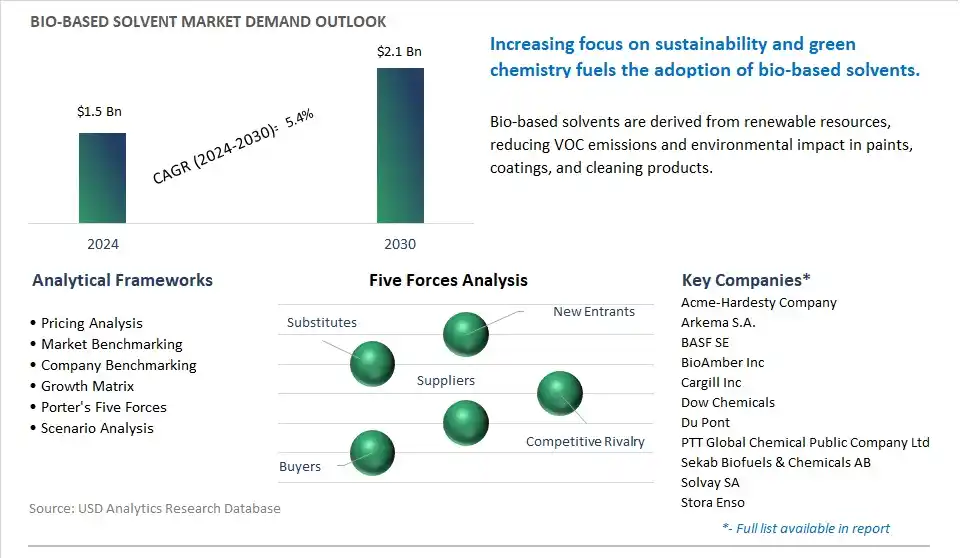
The global Bio-based Solvent Market is poised to register a 5.4% CAGR from $1.5 Billion in 2024 to $2.1 Billion in 2030.
The global Bio-based Solvent Market Study analyzes and forecasts the market size across 6 regions and 24 countries for diverse segments -By Type (Bio-alcohols, Bio-glycols, Bio-diols, Others), By End-User (Painting & Coatings, Cosmetics, Agriculture, Pharmaceutical, Chemical, Others).
An Introduction to Global Bio based Solvent Market in 2024
The market for bio-based solvents is experiencing rapid growth, driven by the demand for sustainable and environmentally friendly alternatives to petrochemical-derived solvents in various industries such as paints and coatings, cosmetics, and pharmaceuticals. Key trends shaping the future of the industry include advancements in biorefinery technologies, green chemistry, and renewable feedstock utilization, enabling the production of solvents from biomass, agricultural residues, and waste streams. Manufacturers are focusing on innovating solvent formulations to meet the stringent performance requirements, regulatory standards, and sustainability goals of end-users and brand owners. Additionally, there is a growing emphasis on biodegradability, low toxicity, and VOC (volatile organic compound) emissions reduction, driving the adoption of bio-based solvents as green alternatives that offer improved health and environmental benefits compared to conventional solvents derived from fossil fuels. Moreover, advancements in solvent recovery, purification techniques, and process optimization are driving market innovation, enabling the development of cost-effective and scalable bio-based solvent production processes that minimize energy consumption and waste generation. Overall, the future of bio-based solvents lies in continuous research and development efforts to expand product portfolios, improve performance attributes, and drive market penetration in a wide range of applications, contributing to the transition towards a more sustainable and circular economy.
Bio-based Solvent Market Competitive Landscape
The market report analyses the leading companies in the industry including Acme-Hardesty Company, Arkema S.A., BASF SE, BioAmber Inc, Cargill Inc, Dow Chemicals, Du Pont, PTT Global Chemical Public Company Ltd, Sekab Biofuels & Chemicals AB, Solvay SA, Stora Enso, Vertec BioSolvents.
Bio-based Solvent Market Dynamics
Bio based Solvent Market Trend: Growing Demand for Sustainable and Environmentally Friendly Solutions
In the Bio-based Solvent market, a prominent trend is the growing demand for sustainable and environmentally friendly solutions. With increasing awareness about the environmental impact of traditional solvent chemicals, there's a shift towards bio-based alternatives derived from renewable biomass sources such as plant oils, sugars, or lignocellulosic feedstocks. Bio-based solvents offer a more sustainable option compared to petrochemical-based solvents, as they have lower carbon footprints, reduced toxicity, and improved biodegradability. This trend is driven by factors such as regulatory pressures to reduce emissions and hazardous waste, corporate sustainability initiatives, and consumer preferences for eco-friendly products, all contributing to a rising market demand for bio-based solvents across various industries.
Bio based Solvent Market Driver: Regulatory Compliance and Sustainability Goals
A significant driver in the Bio-based Solvent market is the need for regulatory compliance and sustainability goals. As governments around the world implement stricter environmental regulations and policies to address climate change and pollution, industries are facing increasing pressure to reduce their environmental footprint and adopt sustainable practices. Bio-based solvents offer an opportunity for companies to meet regulatory requirements and achieve their sustainability goals by replacing hazardous or volatile organic compound (VOC) solvents with greener alternatives. This driver is fueled by the need for safer working environments, reduced emissions, and improved corporate image and reputation, prompting industries to invest in bio-based solvent technologies and transition towards more sustainable manufacturing processes.
Bio based Solvent Market Opportunity: Expansion into Specialty Applications and High-Value Markets
A promising opportunity within the Bio-based Solvent market lies in the expansion into specialty applications and high-value markets. Beyond traditional solvent applications such as paints, coatings, and cleaning products, there's a growing demand for bio-based solvents in niche sectors and high-value markets where sustainability, performance, and safety are paramount. Opportunities exist in sectors such as pharmaceuticals, cosmetics, flavors, and fragrances, where bio-based solvents can offer unique benefits such as biocompatibility, purity, and low odor profiles. By targeting these specialty applications and developing tailored bio-based solvent formulations to meet specific industry requirements, manufacturers can capitalize on this opportunity to differentiate themselves in the market, command premium prices, and unlock new revenue streams in emerging segments of the bio-based solvent market.
Bio-based Solvent Market Share Analysis: Bio-alcohols generated the highest revenue in 2024
The largest segment in the Bio-based Solvent Market is the Bio-alcohols segment. bio-alcohols, such as ethanol and isopropanol, are among the most widely produced and consumed bio-based solvents due to their versatility, compatibility, and renewable nature. Bio-alcohols serve as key ingredients in various industrial and consumer applications, including cleaning agents, disinfectants, paints, coatings, adhesives, and personal care products. Additionally, bio-alcohols offer potential advantages over petroleum-derived solvents, including lower toxicity, biodegradability, and reduced environmental impact, making them preferred choices for eco-conscious consumers and industries. Further, bio-alcohols can be produced from renewable feedstocks such as corn, sugarcane, biomass, and agricultural residues through fermentation, enzymatic hydrolysis, or chemical synthesis processes, ensuring a sustainable and secure supply chain. Furthermore, the growing awareness of environmental and health concerns associated with conventional solvents, such as volatile organic compounds (VOCs) and hazardous air pollutants (HAPs), drives the adoption of bio-based solvents like bio-alcohols as safer and more sustainable alternatives. Over the forecast period, the combination of versatility, environmental benefits, and renewable sourcing positions the Bio-alcohols segment as the largest in the Bio-based Solvent Market.
Bio-based Solvent Market Share Analysis: Painting & Coatings segment is poised to register the fastest growth rate (CAGR) over the forecast period to 2030
The fastest-growing segment in the Bio-based Solvent Market is the Painting & Coatings end-user segment. There is a growing demand for environmentally friendly and sustainable alternatives to traditional solvent-based paints and coatings in response to increasing environmental regulations, consumer preferences, and corporate sustainability initiatives. Bio-based solvents offer potential advantages for the painting and coatings industry, including lower VOC emissions, reduced toxicity, and improved indoor air quality, making them attractive options for architectural, industrial, and automotive coatings applications. Additionally, bio-based solvents can enhance the performance and durability of paints and coatings by improving flow, leveling, and adhesion properties while reducing drying times and odor. Further, the shift towards waterborne and high-solid content coatings formulations, which require lower VOC content and higher levels of renewable content, drives the demand for bio-based solvents as key ingredients. Furthermore, the painting and coatings industry is experiencing growth in emerging markets, driven by urbanization, infrastructure development, and increased construction activities, further boosting the demand for bio-based solvents. Over the forecast period, the combination of regulatory requirements, technological advancements, and market expansion positions the Painting & Coatings end-user segment as the fastest-growing in the Bio-based Solvent Market.
Bio-based Solvent Market Report Segmentation
By Type
Bio-alcohols
Bio-glycols
Bio-diols
Others
By End-User
Painting & Coatings
Cosmetics
Agriculture
Pharmaceutical
Chemical
Others
Regions Included
North America (US, Canada, Mexico)
Europe (Germany, UK, France, Spain, Italy, Russia, Rest of Europe)
Asia Pacific (China, India, Japan, South Korea, Australia, South East Asia, Rest of Asia)
South America (Brazil, Argentina, Rest of South America)
Middle East and Africa (Saudi Arabia, UAE, Rest of Middle East, South Africa, Egypt, Rest of Africa)
Bio-based Solvent Companies Profiled in the Market Study
Acme-Hardesty Company
Arkema S.A.
BASF SE
BioAmber Inc
Cargill Inc
Dow Chemicals
Du Pont
PTT Global Chemical Public Company Ltd
Sekab Biofuels & Chemicals AB
Solvay SA
Stora Enso
Vertec BioSolvents
*- List Not Exhaustive
TABLE OF CONTENTS
1 Introduction to 2024 Bio-based Solvent Market
1.1 Market Overview
1.2 Quick Facts
1.3 Scope/Objective of the Study
1.4 Market Definition
1.5 Countries and Regions Covered
1.6 Units, Currency, and Conversions
1.7 Industry Value Chain
2 Research Methodology
2.1 Market Size Estimation
2.2 Sources and Research Methodology
2.3 Data Triangulation
2.4 Assumptions and Limitations
3 Executive Summary
3.1 Global Bio-based Solvent Market Size Outlook, $ Million, 2021 to 2030
3.2 Bio-based Solvent Market Outlook by Type, $ Million, 2021 to 2030
3.3 Bio-based Solvent Market Outlook by Product, $ Million, 2021 to 2030
3.4 Bio-based Solvent Market Outlook by Application, $ Million, 2021 to 2030
3.5 Bio-based Solvent Market Outlook by Key Countries, $ Million, 2021 to 2030
4 Market Dynamics
4.1 Key Driving Forces of Bio-based Solvent Industry
4.2 Key Market Trends in Bio-based Solvent Industry
4.3 Potential Opportunities in Bio-based Solvent Industry
4.4 Key Challenges in Bio-based Solvent Industry
5 Market Factor Analysis
5.1 Value Chain Analysis
5.2 Competitive Landscape
5.2.1 Global Bio-based Solvent Market Share by Company (%), 2023
5.2.2 Product Offerings by Company
5.3 Porter’s Five Forces Analysis
5.4 Pricing Analysis and Outlook
6 Growth Outlook Across Scenarios
6.1 Growth Analysis-Case Scenario Definitions
6.2 Low Growth Scenario Forecasts
6.3 Reference Growth Scenario Forecasts
6.4 High Growth Scenario Forecasts
7 Global Bio-based Solvent Market Outlook by Segments
7.1 Bio-based Solvent Market Outlook by Segments, $ Million, 2021- 2030
By Type
Bio-alcohols
Bio-glycols
Bio-diols
Others
By End-User
Painting & Coatings
Cosmetics
Agriculture
Pharmaceutical
Chemical
Others
8 North America Bio-based Solvent Market Analysis and Outlook To 2030
8.1 Introduction to North America Bio-based Solvent Markets in 2024
8.2 North America Bio-based Solvent Market Size Outlook by Country, 2021-2030
8.2.1 United States
8.2.2 Canada
8.2.3 Mexico
8.3 North America Bio-based Solvent Market size Outlook by Segments, 2021-2030
By Type
Bio-alcohols
Bio-glycols
Bio-diols
Others
By End-User
Painting & Coatings
Cosmetics
Agriculture
Pharmaceutical
Chemical
Others
9 Europe Bio-based Solvent Market Analysis and Outlook To 2030
9.1 Introduction to Europe Bio-based Solvent Markets in 2024
9.2 Europe Bio-based Solvent Market Size Outlook by Country, 2021-2030
9.2.1 Germany
9.2.2 France
9.2.3 Spain
9.2.4 United Kingdom
9.2.4 Italy
9.2.5 Russia
9.2.6 Norway
9.2.7 Rest of Europe
9.3 Europe Bio-based Solvent Market Size Outlook by Segments, 2021-2030
By Type
Bio-alcohols
Bio-glycols
Bio-diols
Others
By End-User
Painting & Coatings
Cosmetics
Agriculture
Pharmaceutical
Chemical
Others
10 Asia Pacific Bio-based Solvent Market Analysis and Outlook To 2030
10.1 Introduction to Asia Pacific Bio-based Solvent Markets in 2024
10.2 Asia Pacific Bio-based Solvent Market Size Outlook by Country, 2021-2030
10.2.1 China
10.2.2 India
10.2.3 Japan
10.2.4 South Korea
10.2.5 Indonesia
10.2.6 Malaysia
10.2.7 Australia
10.2.8 Rest of Asia Pacific
10.3 Asia Pacific Bio-based Solvent Market size Outlook by Segments, 2021-2030
By Type
Bio-alcohols
Bio-glycols
Bio-diols
Others
By End-User
Painting & Coatings
Cosmetics
Agriculture
Pharmaceutical
Chemical
Others
11 South America Bio-based Solvent Market Analysis and Outlook To 2030
11.1 Introduction to South America Bio-based Solvent Markets in 2024
11.2 South America Bio-based Solvent Market Size Outlook by Country, 2021-2030
11.2.1 Brazil
11.2.2 Argentina
11.2.3 Rest of South America
11.3 South America Bio-based Solvent Market size Outlook by Segments, 2021-2030
By Type
Bio-alcohols
Bio-glycols
Bio-diols
Others
By End-User
Painting & Coatings
Cosmetics
Agriculture
Pharmaceutical
Chemical
Others
12 Middle East and Africa Bio-based Solvent Market Analysis and Outlook To 2030
12.1 Introduction to Middle East and Africa Bio-based Solvent Markets in 2024
12.2 Middle East and Africa Bio-based Solvent Market Size Outlook by Country, 2021-2030
12.2.1 Saudi Arabia
12.2.2 UAE
12.2.3 Oman
12.2.4 Rest of Middle East
12.2.5 Egypt
12.2.6 Nigeria
12.2.7 South Africa
12.2.8 Rest of Africa
12.3 Middle East and Africa Bio-based Solvent Market size Outlook by Segments, 2021-2030
By Type
Bio-alcohols
Bio-glycols
Bio-diols
Others
By End-User
Painting & Coatings
Cosmetics
Agriculture
Pharmaceutical
Chemical
Others
13 Company Profiles
13.1 Company Snapshot
13.2 SWOT Profiles
13.3 Products and Services
13.4 Recent Developments
13.5 Financial Profile
Acme-Hardesty Company
Arkema S.A.
BASF SE
BioAmber Inc
Cargill Inc
Dow Chemicals
Du Pont
PTT Global Chemical Public Company Ltd
Sekab Biofuels & Chemicals AB
Solvay SA
Stora Enso
Vertec BioSolvents
14 Appendix
14.1 Customization Offerings
14.2 Subscription Services
14.3 Related Reports
14.4 Publisher Expertise
By Type
Bio-alcohols
Bio-glycols
Bio-diols
Others
By End-User
Painting & Coatings
Cosmetics
Agriculture
Pharmaceutical
Chemical
Others
Countries Analyzed
North America (US, Canada, Mexico)
Europe (Germany, UK, France, Spain, Italy, Russia, Rest of Europe)
Asia Pacific (China, India, Japan, South Korea, Australia, South East Asia, Rest of Asia)
South America (Brazil, Argentina, Rest of South America)
Middle East and Africa (Saudi Arabia, UAE, Rest of Middle East, South Africa, Egypt, Rest of Africa)
