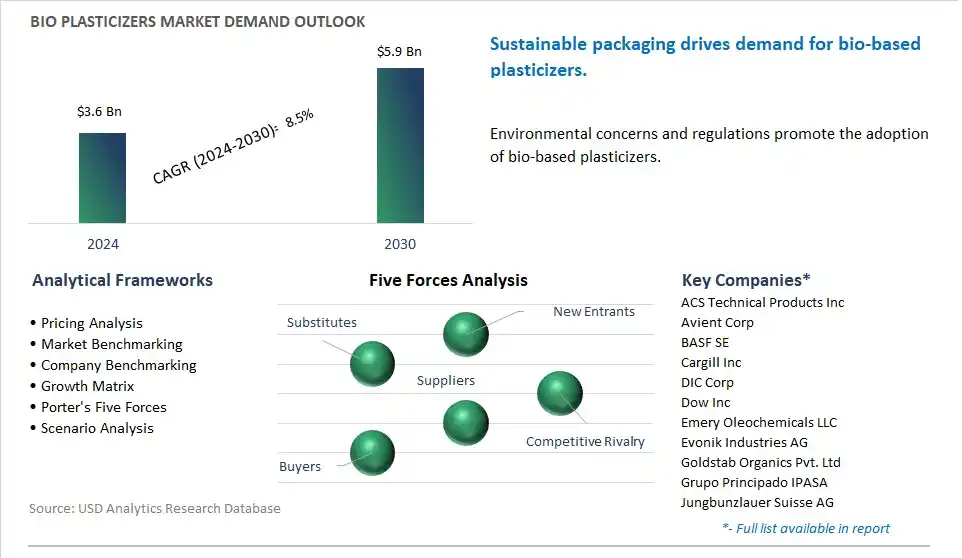
The global Bio Plasticizers Market is poised to register a 8.5% CAGR from $3.6 Billion in 2024 to $5.9 Billion in 2030.
The global Bio Plasticizers Market Study analyzes and forecasts the market size across 6 regions and 24 countries for diverse segments -By Product (Epoxidized Soyabean Oil (ESBO), Castor Oil-Based Plasticizer, Citrates, Succinic Acid, Others), By Application (Packaging Materials, Consumer Goods, Automotive, Building & Construction, Textile, Agriculture, Others).
An Introduction to Global Bio Plasticizers Market in 2024
The bio plasticizers market is experiencing significant growth driven by increasing awareness of health and environmental issues associated with traditional phthalate-based plasticizers. Key trends shaping the future of the industry include the growing demand for bio-based plasticizers derived from renewable feedstocks such as vegetable oils, citrates, and succinic acid, offering non-toxic, biodegradable, and sustainable alternatives for polymer compounding and PVC applications. Moreover, there's a rising emphasis on regulatory compliance, green labeling, and product certifications to ensure the safety, quality, and eco-friendliness of bio-based plasticizers in various end-use sectors such as construction, automotive, and medical devices. Additionally, advancements in bio-based plasticizer formulation, performance testing, and compatibility with polymers are driving innovation and market competitiveness, enabling manufacturers to develop a wide range of bio-based plasticizer products that meet industry standards and customer requirements in the global bio plasticizers market.
Bio Plasticizers Market Competitive Landscape
The market report analyses the leading companies in the industry including ACS Technical Products Inc, Avient Corp, BASF SE, Cargill Inc, DIC Corp, Dow Inc, Emery Oleochemicals LLC, Evonik Industries AG, Goldstab Organics Pvt. Ltd, Grupo Principado IPASA, Jungbunzlauer Suisse AG, LANXESS AG, Matrìca S.p.A., Roquette Frères, Solvay SA, Valtris Specialty Chemicals, Zhejiangjiaao Enprotech Stock Co. Ltd.
Bio Plasticizers Market Dynamics
Bio Plasticizers Market Trend: Increasing Demand for Environmentally Friendly Plasticizers
A prominent trend in the bio plasticizers market is the increasing demand for environmentally friendly alternatives to traditional petroleum-based plasticizers. With growing concerns about the environmental impact of conventional plasticizers such as phthalates, there is a shift towards bio-based and biodegradable plasticizers derived from renewable feedstocks such as plant oils, starches, and sugars. These bio plasticizers offer comparable performance to conventional plasticizers while providing the advantage of being derived from sustainable sources and having lower environmental footprint. As regulatory restrictions on phthalates and other harmful chemicals become stricter, the demand for bio plasticizers is expected to continue rising across various industries, including packaging, construction, automotive, and consumer goods.
Bio Plasticizers Market Driver: Regulatory Restrictions and Environmental Concerns
A primary driver fueling the bio plasticizers market is regulatory restrictions on conventional plasticizers and growing environmental concerns. Phthalates, a commonly used class of plasticizers, have been linked to adverse health effects and environmental pollution, leading to regulatory measures restricting their use in various applications. Additionally, increasing awareness of plastic pollution and the need for sustainable solutions are driving industries to seek alternatives to petroleum-based plasticizers. Governments and regulatory agencies are implementing policies and standards to promote the use of bio-based and non-toxic plasticizers, creating opportunities for manufacturers to innovate and develop eco-friendly alternatives to meet market demand.
Bio Plasticizers Market Opportunity: Expansion into Novel Applications and Formulations
An opportunity within the bio plasticizers market lies in the expansion into novel applications and formulations. While bio plasticizers have been primarily used as alternatives to phthalates in flexible PVC applications, there is potential to explore new markets and applications where eco-friendly plasticizers can offer unique advantages. Industries such as medical devices, toys, textiles, and coatings present opportunities for bio plasticizers to replace conventional additives and contribute to improved product safety and sustainability. Moreover, there is potential to develop custom formulations of bio plasticizers with tailored properties such as compatibility, flexibility, and thermal stability to meet the specific requirements of different applications and end-users. By diversifying into new applications and formulations, companies can expand their market reach, differentiate their products, and capitalize on the growing demand for sustainable plasticizer solutions in the evolving regulatory and consumer landscape.
Bio Plasticizers Market Share Analysis: Epoxidized Soybean Oil (ESBO) Segment generated the highest revenue in the industry
The Epoxidized Soybean Oil (ESBO) segment holds the position of the largest segment in the Bio Plasticizers Market for diverse compelling reasons. The ESBO is one of the most widely used bio-based plasticizers due to its excellent compatibility with a variety of polymers, including polyvinyl chloride (PVC), polyethylene, and polystyrene. Its high efficiency as a plasticizer, combined with its low cost and availability, makes it a preferred choice for numerous applications in industries such as construction, automotive, packaging, and medical devices. In addition, ESBO is derived from renewable soybean oil, making it a sustainable and environmentally friendly alternative to conventional petroleum-based plasticizers. The increasing focus on sustainability and the growing demand for eco-friendly products drive the adoption of bio-based plasticizers like ESBO in various end-use industries. Additionally, stringent regulations and standards regarding the use of toxic chemicals in consumer products further propel the demand for safer and greener alternatives such as ESBO. As a result, the ESBO segment remains the largest in the Bio Plasticizers Market, reflecting its widespread usage and numerous benefits across diverse industries.
Bio Plasticizers Market Share Analysis: Packaging Materials Segment is poised to register the fastest growth rate (CAGR) over the forecast period to 2030
The packaging materials segment is the fastest-growing segment in the Bio Plasticizers Market for diverse significant reasons. The there is a growing global demand for sustainable packaging solutions driven by increasing awareness of environmental issues, regulations banning single-use plastics, and consumer preferences for eco-friendly products. Bio-based plasticizers offer a more sustainable alternative to traditional petroleum-based plasticizers, aligning with the sustainability goals of packaging manufacturers and brand owners. Additionally, the rise of e-commerce and online shopping has led to a surge in demand for packaging materials, including films, bottles, pouches, and trays, to accommodate the shipping and handling of products. Bio-based plasticizers play a crucial role in enhancing the flexibility, durability, and performance of biodegradable and compostable packaging materials, meeting the stringent requirements of the packaging industry. In addition, the packaging sector's continuous innovation and development of bio-based packaging solutions, coupled with advancements in bio-plastics technology, further drive the adoption of bio-based plasticizers in packaging applications. As consumers and regulatory bodies increasingly prioritize sustainability and circular economy principles, the demand for bio-based plasticizers in the packaging materials segment is expected to experience rapid and sustained growth, making it a key focus area in the Bio Plasticizers Market.
Bio Plasticizers Market Report Segmentation
By Product
Epoxidized Soyabean Oil (ESBO)
Castor Oil-Based Plasticizer
Citrates
Succinic Acid
Others
By Application
Packaging Materials
Consumer Goods
Automotive
Building & Construction
Textile
Agriculture
Others
Regions Included
North America (US, Canada, Mexico)
Europe (Germany, UK, France, Spain, Italy, Russia, Rest of Europe)
Asia Pacific (China, India, Japan, South Korea, Australia, South East Asia, Rest of Asia)
South America (Brazil, Argentina, Rest of South America)
Middle East and Africa (Saudi Arabia, UAE, Rest of Middle East, South Africa, Egypt, Rest of Africa)
Bio Plasticizers Companies Profiled in the Market Study
ACS Technical Products Inc
Avient Corp
BASF SE
Cargill Inc
DIC Corp
Dow Inc
Emery Oleochemicals LLC
Evonik Industries AG
Goldstab Organics Pvt. Ltd
Grupo Principado IPASA
Jungbunzlauer Suisse AG
LANXESS AG
Matrìca S.p.A.
Roquette Frères
Solvay SA
Valtris Specialty Chemicals
Zhejiangjiaao Enprotech Stock Co. Ltd
*- List Not Exhaustive
TABLE OF CONTENTS
1 Introduction to 2024 Bio Plasticizers Market
1.1 Market Overview
1.2 Quick Facts
1.3 Scope/Objective of the Study
1.4 Market Definition
1.5 Countries and Regions Covered
1.6 Units, Currency, and Conversions
1.7 Industry Value Chain
2 Research Methodology
2.1 Market Size Estimation
2.2 Sources and Research Methodology
2.3 Data Triangulation
2.4 Assumptions and Limitations
3 Executive Summary
3.1 Global Bio Plasticizers Market Size Outlook, $ Million, 2021 to 2030
3.2 Bio Plasticizers Market Outlook by Type, $ Million, 2021 to 2030
3.3 Bio Plasticizers Market Outlook by Product, $ Million, 2021 to 2030
3.4 Bio Plasticizers Market Outlook by Application, $ Million, 2021 to 2030
3.5 Bio Plasticizers Market Outlook by Key Countries, $ Million, 2021 to 2030
4 Market Dynamics
4.1 Key Driving Forces of Bio Plasticizers Industry
4.2 Key Market Trends in Bio Plasticizers Industry
4.3 Potential Opportunities in Bio Plasticizers Industry
4.4 Key Challenges in Bio Plasticizers Industry
5 Market Factor Analysis
5.1 Value Chain Analysis
5.2 Competitive Landscape
5.2.1 Global Bio Plasticizers Market Share by Company (%), 2023
5.2.2 Product Offerings by Company
5.3 Porter’s Five Forces Analysis
5.4 Pricing Analysis and Outlook
6 Growth Outlook Across Scenarios
6.1 Growth Analysis-Case Scenario Definitions
6.2 Low Growth Scenario Forecasts
6.3 Reference Growth Scenario Forecasts
6.4 High Growth Scenario Forecasts
7 Global Bio Plasticizers Market Outlook by Segments
7.1 Bio Plasticizers Market Outlook by Segments, $ Million, 2021- 2030
By Product
Epoxidized Soyabean Oil (ESBO)
Castor Oil-Based Plasticizer
Citrates
Succinic Acid
Others
By Application
Packaging Materials
Consumer Goods
Automotive
Building & Construction
Textile
Agriculture
Others
8 North America Bio Plasticizers Market Analysis and Outlook To 2030
8.1 Introduction to North America Bio Plasticizers Markets in 2024
8.2 North America Bio Plasticizers Market Size Outlook by Country, 2021-2030
8.2.1 United States
8.2.2 Canada
8.2.3 Mexico
8.3 North America Bio Plasticizers Market size Outlook by Segments, 2021-2030
By Product
Epoxidized Soyabean Oil (ESBO)
Castor Oil-Based Plasticizer
Citrates
Succinic Acid
Others
By Application
Packaging Materials
Consumer Goods
Automotive
Building & Construction
Textile
Agriculture
Others
9 Europe Bio Plasticizers Market Analysis and Outlook To 2030
9.1 Introduction to Europe Bio Plasticizers Markets in 2024
9.2 Europe Bio Plasticizers Market Size Outlook by Country, 2021-2030
9.2.1 Germany
9.2.2 France
9.2.3 Spain
9.2.4 United Kingdom
9.2.4 Italy
9.2.5 Russia
9.2.6 Norway
9.2.7 Rest of Europe
9.3 Europe Bio Plasticizers Market Size Outlook by Segments, 2021-2030
By Product
Epoxidized Soyabean Oil (ESBO)
Castor Oil-Based Plasticizer
Citrates
Succinic Acid
Others
By Application
Packaging Materials
Consumer Goods
Automotive
Building & Construction
Textile
Agriculture
Others
10 Asia Pacific Bio Plasticizers Market Analysis and Outlook To 2030
10.1 Introduction to Asia Pacific Bio Plasticizers Markets in 2024
10.2 Asia Pacific Bio Plasticizers Market Size Outlook by Country, 2021-2030
10.2.1 China
10.2.2 India
10.2.3 Japan
10.2.4 South Korea
10.2.5 Indonesia
10.2.6 Malaysia
10.2.7 Australia
10.2.8 Rest of Asia Pacific
10.3 Asia Pacific Bio Plasticizers Market size Outlook by Segments, 2021-2030
By Product
Epoxidized Soyabean Oil (ESBO)
Castor Oil-Based Plasticizer
Citrates
Succinic Acid
Others
By Application
Packaging Materials
Consumer Goods
Automotive
Building & Construction
Textile
Agriculture
Others
11 South America Bio Plasticizers Market Analysis and Outlook To 2030
11.1 Introduction to South America Bio Plasticizers Markets in 2024
11.2 South America Bio Plasticizers Market Size Outlook by Country, 2021-2030
11.2.1 Brazil
11.2.2 Argentina
11.2.3 Rest of South America
11.3 South America Bio Plasticizers Market size Outlook by Segments, 2021-2030
By Product
Epoxidized Soyabean Oil (ESBO)
Castor Oil-Based Plasticizer
Citrates
Succinic Acid
Others
By Application
Packaging Materials
Consumer Goods
Automotive
Building & Construction
Textile
Agriculture
Others
12 Middle East and Africa Bio Plasticizers Market Analysis and Outlook To 2030
12.1 Introduction to Middle East and Africa Bio Plasticizers Markets in 2024
12.2 Middle East and Africa Bio Plasticizers Market Size Outlook by Country, 2021-2030
12.2.1 Saudi Arabia
12.2.2 UAE
12.2.3 Oman
12.2.4 Rest of Middle East
12.2.5 Egypt
12.2.6 Nigeria
12.2.7 South Africa
12.2.8 Rest of Africa
12.3 Middle East and Africa Bio Plasticizers Market size Outlook by Segments, 2021-2030
By Product
Epoxidized Soyabean Oil (ESBO)
Castor Oil-Based Plasticizer
Citrates
Succinic Acid
Others
By Application
Packaging Materials
Consumer Goods
Automotive
Building & Construction
Textile
Agriculture
Others
13 Company Profiles
13.1 Company Snapshot
13.2 SWOT Profiles
13.3 Products and Services
13.4 Recent Developments
13.5 Financial Profile
ACS Technical Products Inc
Avient Corp
BASF SE
Cargill Inc
DIC Corp
Dow Inc
Emery Oleochemicals LLC
Evonik Industries AG
Goldstab Organics Pvt. Ltd
Grupo Principado IPASA
Jungbunzlauer Suisse AG
LANXESS AG
Matrìca S.p.A.
Roquette Frères
Solvay SA
Valtris Specialty Chemicals
Zhejiangjiaao Enprotech Stock Co. Ltd
14 Appendix
14.1 Customization Offerings
14.2 Subscription Services
14.3 Related Reports
14.4 Publisher Expertise
By Product
Epoxidized Soyabean Oil (ESBO)
Castor Oil-Based Plasticizer
Citrates
Succinic Acid
Others
By Application
Packaging Materials
Consumer Goods
Automotive
Building & Construction
Textile
Agriculture
Others
Countries Analyzed
North America (US, Canada, Mexico)
Europe (Germany, UK, France, Spain, Italy, Russia, Rest of Europe)
Asia Pacific (China, India, Japan, South Korea, Australia, South East Asia, Rest of Asia)
South America (Brazil, Argentina, Rest of South America)
Middle East and Africa (Saudi Arabia, UAE, Rest of Middle East, South Africa, Egypt, Rest of Africa)
